3 Key Takeaways
- Syndication works by publishing a structured feed of your listings that portals pull on their own schedule, which means changes you make are never instant and failures are often silent.
- The most common breakages are validation rejections, stale listings that stay live after a property leases, and duplicate listings created by posting manually alongside a feed.
- Syndication only determines how many inquiries arrive, and what happens in the minutes after one arrives determines whether it converts, with Showdigs reaching a 39.7 percent inquiry to scheduled tour rate in April 2026. (Source: Showdigs platform data, 2026) Syndication is presented as a single button and behaves like a supply chain. When it works, a vacancy appears everywhere within a day and inquiries start arriving. When it breaks, it usually breaks quietly, and the first sign is a property that has been live for two weeks with almost no activity.
Understanding the mechanics underneath makes the failures diagnosable instead of mysterious.
What Syndication Actually Is
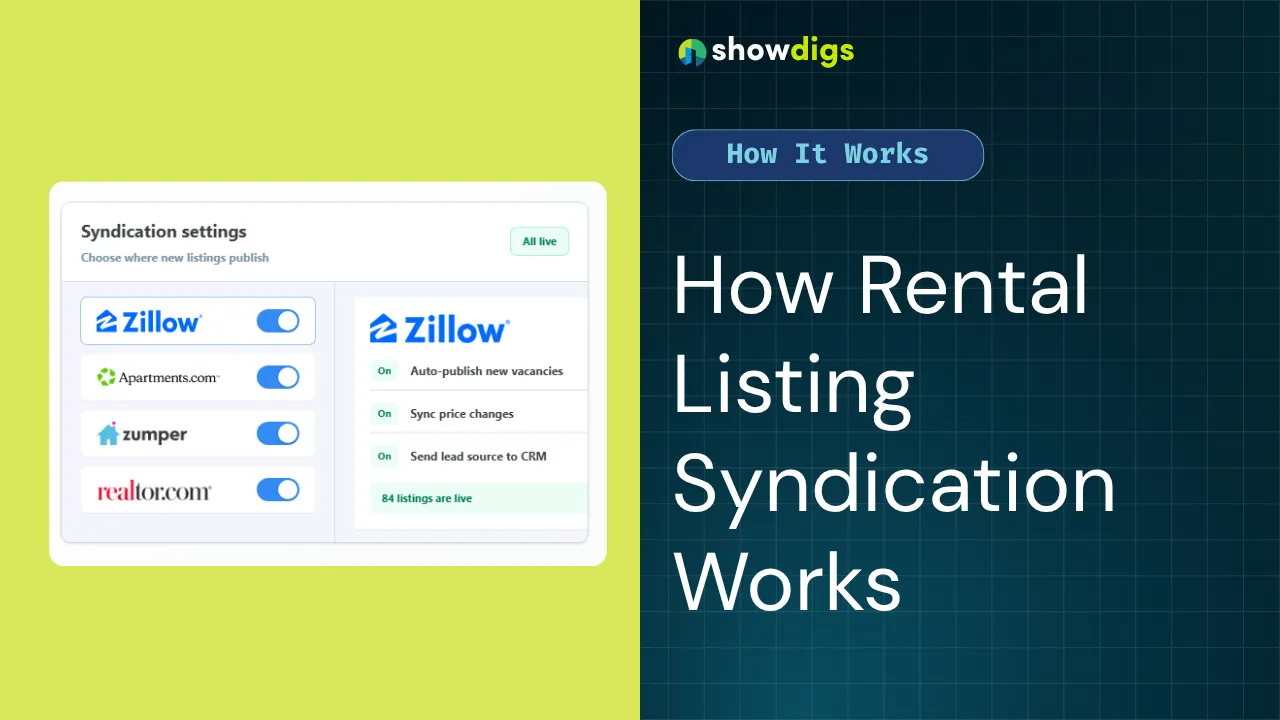
Your system generates a structured file, typically a feed, listing every active property with its address, rent, bedrooms, bathrooms, square footage, availability date, photos, description, and contact details.
Portals such as Zillow, Apartments.com, and Zumper pull that feed on their own schedule. Each portal validates it against its own rules, accepts what passes, rejects what does not, and publishes on its own timeline.
Three consequences follow from that design, and they explain nearly every syndication complaint.
Nothing is instant. A portal that pulls every twelve hours publishes on its clock, not yours.
Each portal has different rules. A listing that passes on one can fail on another for a reason as small as a missing square footage value.
Rejections are often silent. Many portals do not report a failure back in a way anyone sees, so the listing simply never appears.
Where Syndication Breaks
Validation rejections. Missing required fields are the usual cause. Square footage, availability date, and a minimum photo count are the frequent offenders. The listing looks complete in your system and fails at the portal.
Stale listings. The property leases, your system marks it unavailable, and the listing stays live on a portal for another day or two while the feed catches up. Inquiries keep arriving for a home that is gone, which wastes your time and irritates the prospect.
Duplicates. Someone posts manually to a portal that also receives your feed. Now two listings compete, split the inquiry volume, and often show different rents.
Address mismatches. Portals geocode addresses. A unit designation formatted differently than the portal expects can place your property on the wrong block or suppress it from map results entirely.
Photo compression. Portals resize and compress images. Photos that looked fine in your system can render badly, and listing photos drive click through more than any other field.
A Diagnostic Sequence
When a listing is underperforming, work through it in this order.
Confirm the listing is actually live on each portal by searching for the address directly rather than trusting your dashboard.
Check the required fields for each portal that rejected it.
Search the address for duplicates, including manual posts from a previous vacancy.
Check the map placement.
Check the photos as the prospect sees them.
Only after all five should you conclude the listing is a pricing problem. Median asking rent was 1,672 dollars nationally and down 1.5 percent year over year as of January 2026, while single family rents averaged 2,183 dollars and rose in 49 of 50 metros. (Source: Realtor.com January 2026 and Zillow March 2026) Market direction varies enough by property type that pricing conclusions need local comps, not national averages.
What Syndication Does Not Solve
Syndication controls how many inquiries you get. It has no effect on what happens next.
That distinction matters because inquiry volume is the easier half of the problem. A property syndicated to six portals that generates forty inquiries and converts three of them into tours has a response problem, not a marketing problem.
Half of all rental inquiries arrive outside business hours. (Source: 2026 NARPM Benchmark Study) Those are the inquiries your syndication worked hardest to produce, and they are the ones most likely to sit unanswered until morning.
Connecting Distribution to Response
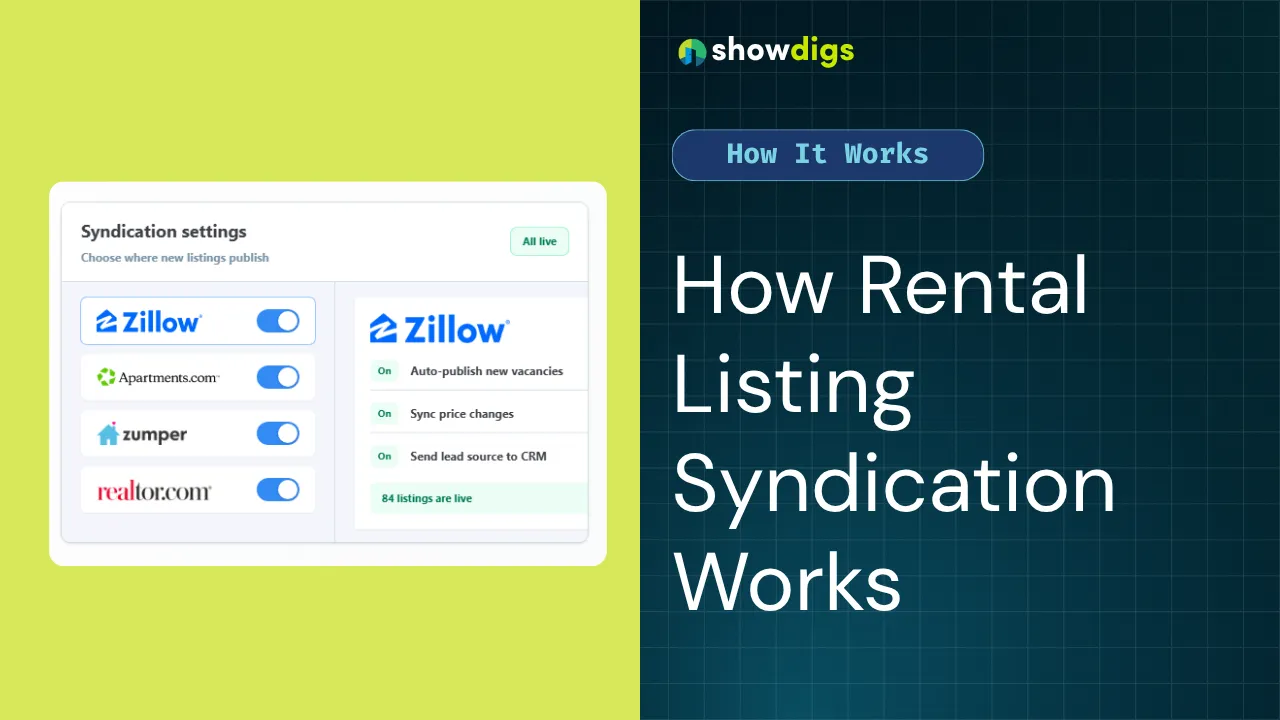
Showdigs syndicates listings to Zillow, Apartments.com, Zumper, and other portals, and then covers the part that syndication cannot.
The AI Leasing Agent responds by SMS immediately at any hour, answers property questions, qualifies the prospect, and books the tour inside the same conversation. Average SMS conversation duration on the platform is 32 hours end to end, compared to more than five days when handled manually. (Source: Showdigs platform data, 2026)
Coverage is then assigned automatically, either self showing with AI verification for vacant properties or a licensed vetted agent at approximately 49 dollars per showing in most markets. Confirmations, reminders, and the post tour application push run on their own.
Inquiry to scheduled tour conversion on the platform rose from 33.4 percent in January 2026 to 39.7 percent in April, breaking a three year seasonal trend. (Source: Showdigs platform data, 2026) That gain came from what happens after the inquiry arrives rather than from where it came from.
Get the inquiries, then answer every one of them within minutes. /pro
Frequently Asked Questions
How does rental listing syndication work?
Your system publishes a structured feed of active listings, and portals such as Zillow, Apartments.com, and Zumper pull and validate that feed on their own schedule. Showdigs handles syndication to the major portals and then automates the inquiry response that determines whether the traffic converts.
Why is my rental listing not showing up on Zillow?
The most common causes are a validation rejection from a missing required field, a duplicate listing splitting visibility, or an address mismatch affecting map placement. Search the address directly on the portal to confirm, then check required fields before assuming a pricing problem.
How long does syndication take to publish a listing?
Portals pull feeds on their own schedules, so publication typically takes hours rather than minutes and varies by portal. Showdigs pushes listings to the major portals automatically so the process starts as soon as the listing is ready.
Can I syndicate listings automatically instead of posting manually?
Yes, and you should, because manual posting alongside a feed creates duplicate listings that split inquiry volume. Showdigs syndicates to Zillow, Apartments.com, Zumper, and other portals from one action.
Does syndication help fill vacancies faster?
It increases inquiry volume, but speed to lease depends on what happens after the inquiry arrives. Showdigs pairs syndication with an AI Leasing Agent that responds by SMS around the clock and books tours immediately, which raised inquiry to scheduled tour conversion to 39.7 percent in April 2026.
What happens to listings after a property leases?
Feeds update on the portal’s next pull, so a leased property can stay visible briefly. Showdigs manages listing status through the same platform that handles inquiries, so prospects who reach out on a stale listing still get an immediate response and can be redirected to available homes.
Which rental listing sites should I syndicate to?
Zillow, Apartments.com, and Zumper cover the majority of single family rental search traffic, with additional portals adding reach in specific markets. Showdigs syndicates to these and others automatically as part of the platform at 1.20 dollars per door per month.