3 Key Takeaways
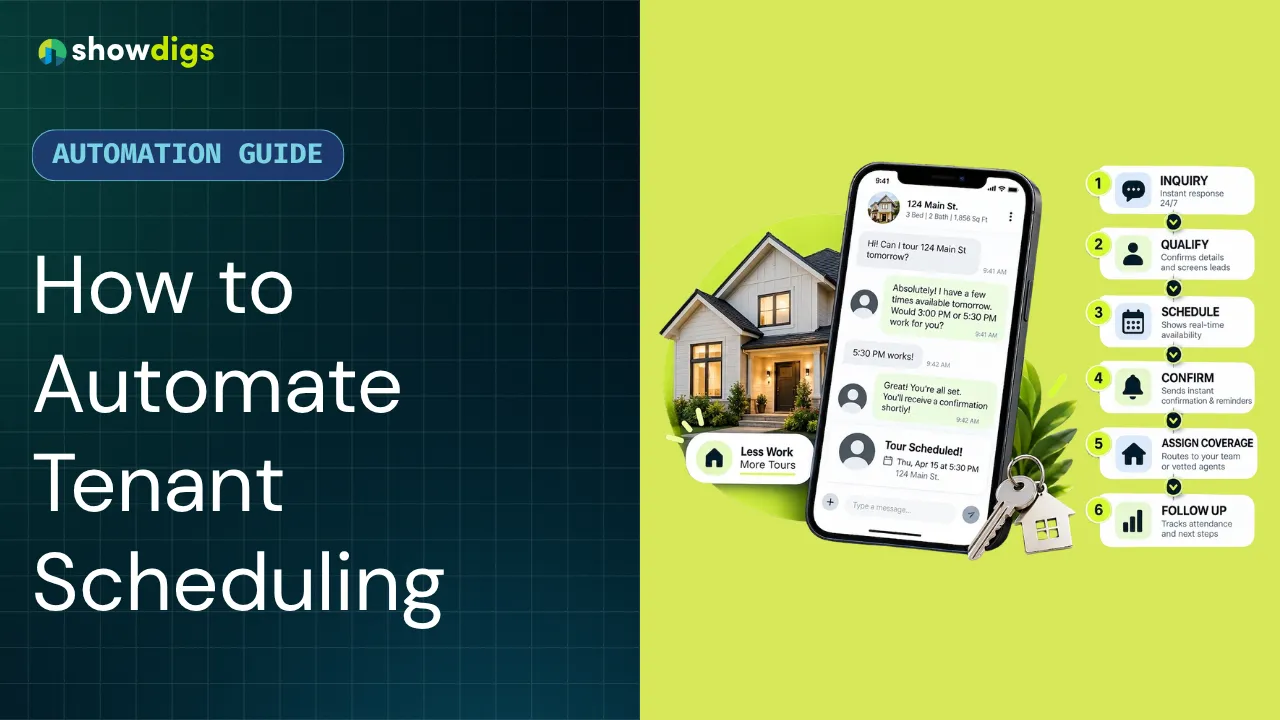
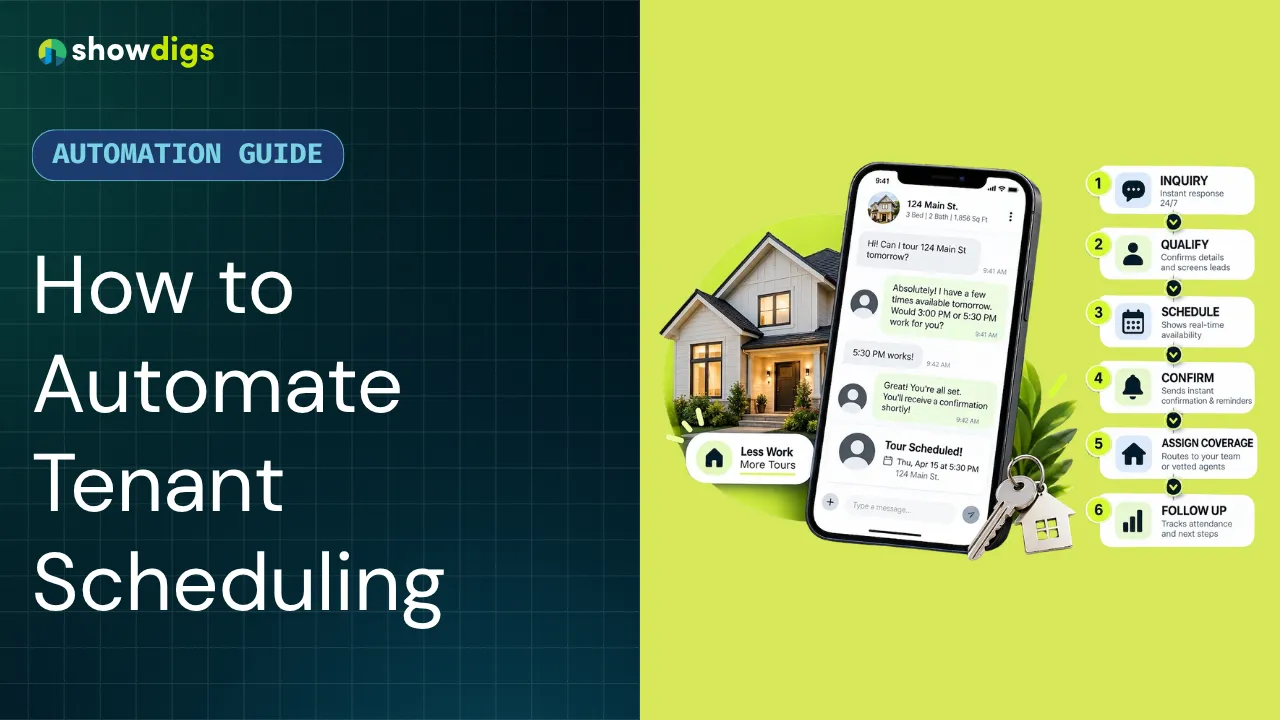
- Automating tenant scheduling means automating the whole path from first inquiry to confirmed tour, not just handing the prospect a calendar link.
- Response speed drives scheduling outcomes more than calendar convenience, because half of rental inquiries arrive outside business hours and a prospect who waits until morning has already contacted three other listings.
- Property managers using automated response and scheduling reached a 39.7 percent inquiry to scheduled tour rate in April 2026, breaking a three year seasonal trend. (Source: Showdigs platform data, 2026) Ask a leasing coordinator where their day goes and the answer is rarely the showings themselves. It is the coordination. The call back, the three text exchanges to find a time, the confirmation, the reminder, the reschedule, the no show, and the whole sequence starting again with the next lead.
Scheduling automation is supposed to remove that. Often it removes only the last step, the calendar itself, and leaves everything before it exactly where it was. This guide walks the full workflow so you can see which stages your current setup actually covers.
Stage 1: Inquiry Response
Every scheduling problem starts here. A prospect submits an inquiry on Zillow at 8:40pm. If nobody replies until 9am, that lead has already messaged several other listings.
Half of all rental inquiries arrive after business hours. (Source: 2026 NARPM Benchmark Study)
Automating this stage means an immediate response by SMS that engages the prospect rather than acknowledging them. An autoresponder that says we will get back to you soon is not automation, it is a delay notice. The response has to move the conversation forward on its own.
The Showdigs AI Leasing Agent responds by text around the clock, answers property questions, qualifies the lead, and books the tour inside the same conversation. It is not a chatbot working from a script. It handles the back and forth the way a coordinator would, and it escalates to your team when a question needs a human.
Average SMS conversation duration on the platform is 32 hours, compared to more than five days when the same exchange is handled manually. (Source: Showdigs platform data, 2026)
Stage 2: Qualification
Booking every inquiry is not the goal. Booking the right ones is.
Automated qualification asks the questions your team asks anyway. Move in timing, occupants, pets, income range, and whether the prospect has actually seen the listing details. It happens inside the text conversation rather than in a separate form the prospect has to be talked into completing.
The payoff is downstream. Tours that are booked after qualification complete at a higher rate, because the prospect who answered five questions has already invested something in the process.
Stage 3: Availability and Booking
This is the part most tools handle well, and it is worth being clear about what good looks like.
Availability should reflect real coverage, which includes your staff calendar, your vetted agent coverage, and self showing windows if the property supports them. A prospect should see times that can actually be honored rather than times that trigger an internal scramble.
The booking itself should complete in the same channel where the conversation started. Every handoff to a new link, login, or app loses prospects.
Scheduling control matters here too. Property managers need to book directly without placing hard blocks on the calendar, assign a showing to a specific team member, and confirm instantly when an owner or resident sets a constraint.
Stage 4: Confirmation and Reminders
Booked is not the same as attended. Between 55 and 60 percent of scheduled tours are completed, and the confirmation sequence is one of the few levers that moves that number. (Source: Showdigs platform data, 2026)
Automate a confirmation at booking, a reminder the day before, and a short reminder on the day with the address, access instructions, and a one tap way to cancel or reschedule. Making cancellation easy sounds counterproductive. It is not. A cancellation you receive an hour ahead lets you fill the slot. A silent no show costs you the slot and the agent fee.
Stage 5: Coverage Assignment
Once a time is confirmed, someone has to be there, or the property has to be accessible without anyone.
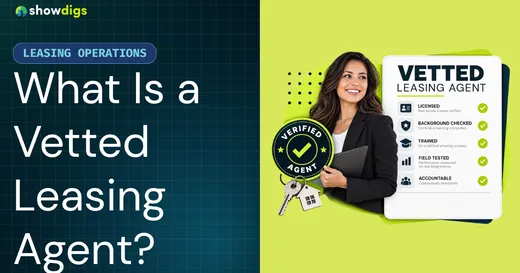
Automated coverage assignment routes the showing to whichever option fits. Your own staff, a licensed vetted showing agent in that market, or self showing with identity verification and time limited smart lock access.
This is the stage that decides whether scheduling automation actually scales. A system that books tours faster than you can staff them creates a new problem instead of solving the old one.
Stage 6: Follow Up After the Tour
The gap between completed tour and submitted application is where a lot of leasing revenue quietly disappears.
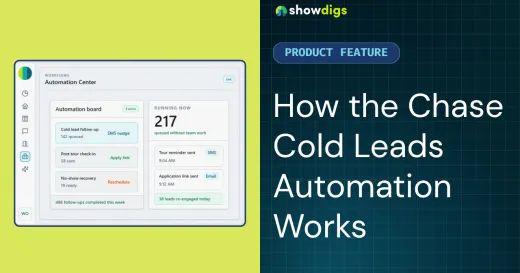
Automate the post tour push. A prompt with the application link while the property is still fresh, and a re engagement sequence for cold leads that went quiet.
On the Showdigs platform, 17.5 percent of cold leads respond to automated outreach, 21.5 percent go on to schedule a tour, and 3 percent book within one hour of the message. (Source: Showdigs platform data, 2026)
What to Look for in a Scheduling Tool
Run your current setup against the six stages. Most tools cover stages three and four well and leave one, two, five, and six to your staff. That is why coordinator hours often do not drop after a scheduling tool goes in.
It is also where the differences between platforms show up. ShowMojo and TenantTurner are built around scheduling coordination with call center or self showing support behind it rather than genuine AI at the response stage. RentEngine markets AI capability with limited field validation, no vetted agent network, and no live ops support. Showdigs runs the full sequence, from AI response through coverage assignment and post tour follow up, starting at 1.20 dollars per door per month.
Automation adoption in property management climbed from 20 percent to 58 percent in a single year, and 85 percent of adopters report improved lead to lease rates. (Source: 2026 Buildium/NARPM Report and 2026 NARPM Benchmark Study) The advantage is no longer in having automation. It is in how much of the workflow you actually automated.
See what full leasing workflow automation covers, stage by stage. /pro
Frequently Asked Questions
What does it mean to automate tenant scheduling?
Automating tenant scheduling means every step from first inquiry to confirmed tour happens without staff intervention, including the response, qualification, booking, confirmation, reminders, and coverage assignment. Showdigs automates all of these in one workflow rather than only the calendar step.
Can tenant scheduling be automated outside business hours?
Yes, and that is where most of the value is, since half of rental inquiries arrive after hours. The Showdigs AI Leasing Agent responds by SMS around the clock, qualifies the lead, and books the tour without anyone on your team being awake.
How much time does automated scheduling save a property manager?
Showdigs data shows SMS conversations resolving in 32 hours on average compared to more than five days handled manually, which removes the majority of coordinator follow up work. Property managers using AI report 20 to 30 percent operational efficiency gains overall. (Source: 2026 Buildium/NARPM Report)
Does scheduling automation reduce no shows?
Yes. Automated confirmations and reminders with easy rescheduling keep the completed tour rate in the 55 to 60 percent range on the Showdigs platform, and no show re engagement automatically brings prospects back into the funnel instead of losing them.
What happens if nobody is available to run the showing?
Showdigs routes the confirmed showing to a licensed vetted agent from its nationwide network, or enables self showing with identity verification and time limited smart lock access. Coverage is assigned automatically, so booking capacity is never limited by staff availability.
Does automated scheduling work with my property management software?
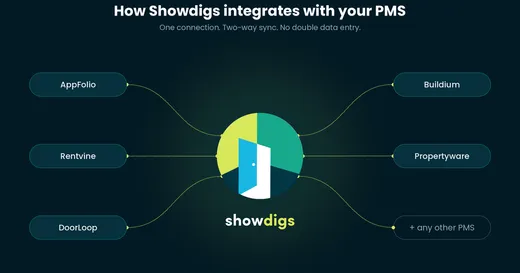
Yes. Showdigs integrates with AppFolio, Buildium, Rentvine, Propertyware, and Yardi, with 91 active AppFolio integrations on the platform today. Scheduling activity flows back into the system your team already works in.
What is the difference between a scheduling link and scheduling automation?
A scheduling link waits for the prospect to act and does nothing before or after the booking. Showdigs automates the response that earns the booking, the qualification behind it, the coverage that fulfills it, and the follow up that converts it into an application.