


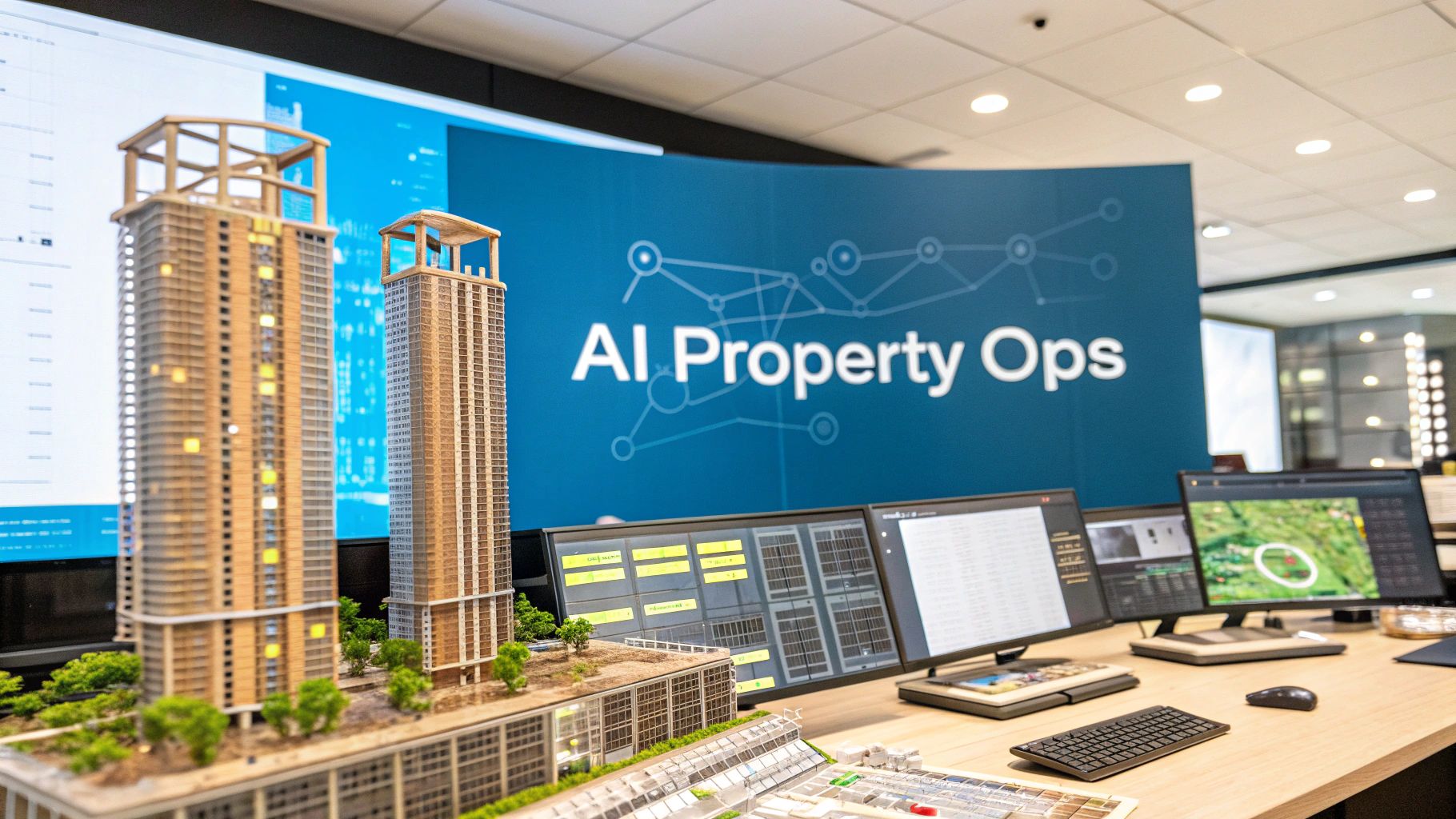
When managing hundreds or thousands of rental units, every vacant day is a direct hit to your Net Operating Income (NOI). For large-scale property management companies, the conversation around AI isn't a futuristic concept—it's a critical operational tool for slashing vacancy rates, controlling cost-per-door, and driving revenue. AI-powered software now automates the entire leasing funnel, from initial lead inquiry to lease signing, making it an essential component for achieving operational scalability.
The New Standard for Scaling Property Management Operations
If you're overseeing a distributed portfolio of 1,000+ units, the core challenge is clear: how do you scale efficiently without operational costs spiraling out of control? Every manual task, from answering a lead inquiry to coordinating a showing, is a bottleneck that erodes margins and slows down leasing velocity. This is precisely where AI for property management fundamentally changes the operational equation for enterprise-level operators.
Let's be clear: AI doesn't replace skilled property managers. It empowers them by offloading the high-volume, repetitive work that consumes their day, directly impacting key performance indicators like Days on Market (DOM) and lead-to-tour conversion rates. This allows your team to shift from a reactive, fire-fighting mode to a proactive, data-driven strategy focused on high-value activities that accelerate leasing and improve resident retention.
Transforming Daily Operations at Scale
Imagine every rental inquiry receiving an immediate, intelligent response, 24/7, converting hot leads before they move on to a competitor. No lead falls through the cracks due to a busy leasing agent. This is one of the most immediate and tangible impacts of implementing AI, and it goes far beyond a simple auto-responder.
Here’s where you’ll see the biggest operational shifts:
- Instant Lead Qualification: AI sifts through incoming leads in seconds, qualifying high-intent prospects based on your specific criteria and filtering out unqualified inquiries.
- Automated Tour Scheduling: It eliminates the endless phone tag that plagues leasing teams. Qualified leads can book showings instantly, dramatically improving the lead-to-tour conversion rate.
- 24/7 Tenant Communication: AI handles routine inquiries about rent, maintenance, and policies, enhancing the tenant experience without adding to your team's workload.
For companies managing distributed portfolios, implementing an AI-powered property management answering service is a strategic move to ensure consistent, high-quality service across thousands of units without scaling headcount.
From Cost Center to Profit Driver
By integrating AI, enterprise property management companies can manage vast portfolios with a level of precision that was previously unattainable. The result is a direct, measurable improvement in the metrics that matter most: DOM, conversion rates, and ultimately, NOI.
The core message is clear: AI enables property managers to dramatically reduce Days on Market (DOM), enhance lead-to-tour conversion rates, and directly boost Net Operating Income (NOI) across their entire portfolio.
This isn't about saving a few hours. It's about turning operational efficiency into measurable financial performance. When your leasing team focuses on closing qualified leads instead of scheduling appointments, the entire leasing funnel accelerates. That’s how you convert vacant units into revenue-generating assets with unprecedented speed. This is the new standard for property management at scale.
How AI Transforms Your Leasing Funnel
For property managers handling large, geographically dispersed portfolios, the leasing funnel is a race against vacancy. Every missed lead and scheduling delay directly impacts revenue. This is where AI for property management moves from a buzzword to a bottom-line driver, revolutionizing each stage of the leasing journey to maximize speed-to-lease.

Your traditional leasing process is a manual assembly line—slow and prone to error. AI re-engineers it into a smart, automated system that operates 24/7 with precision, ensuring no revenue is left on the table.
Instant Lead Response and Qualification
In today’s hyper-competitive rental market, speed-to-lead is everything. The first property manager to engage a prospect is the one who secures the tour. AI-powered leasing automation ensures you are always first, providing instant, 24/7 responses to every inquiry from every source.
These systems go beyond canned responses. They actively engage prospects with intelligent questions, provide property details, and pre-qualify them against your criteria (e.g., income-to-rent ratio, move-in date) in real-time. To see how this works in practice, explore the impact of real estate chatbots. It's like having a top-performing leasing agent on duty around the clock, converting interest into action.
Intelligent Tour Scheduling
Coordinating showings across a portfolio of hundreds of scattered-site properties is a logistical nightmare. It's a swamp of phone tag, email chains, and calendar conflicts that kills conversion rates. AI completely eradicates this friction.
Once a lead is qualified, an intelligent scheduling system can:
- Offer self-service booking: Prospects view real-time availability and book a tour that fits their schedule, dramatically boosting your lead-to-tour conversion rate.
- Optimize agent routes: For agent-led showings, the system can group tours geographically, reducing travel time and maximizing the number of showings an agent can conduct daily.
- Manage all tour types: It seamlessly coordinates scheduling for self-guided tours, agent-led showings, and virtual tours without a single manual entry.
Automating this critical step shrinks the time from initial inquiry to property visit from days to mere minutes. That velocity is a powerful competitive advantage that directly reduces DOM.
AI-Powered Tenant Screening
Traditional screening often over-relies on credit scores, which provide an incomplete picture of an applicant's reliability. AI introduces a more holistic, data-driven approach to risk assessment.
Modern screening platforms leverage AI to analyze a broader set of data points—such as rental history, income verification, and public records—to generate a more accurate risk profile. This not only reduces the likelihood of costly evictions but also helps you place stable, long-term tenants, which is crucial for predictable revenue across a large portfolio.
Dynamic Rental Pricing
Setting the optimal rent is a critical balancing act. Price too high, and the unit languishes on the market, increasing Days on Market (DOM) and vacancy loss. Price too low, and you leave revenue on the table every month.
AI-powered dynamic pricing tools eliminate the guesswork. They continuously analyze real-time market data, including competitor pricing, local demand trends, and property amenities, to provide data-backed rental rate recommendations. This ensures your portfolio is priced to maximize revenue while minimizing vacancy. For a 5,000-unit portfolio, a 2% increase in rental income translates to millions in additional NOI.
Predictive Maintenance and IoT Integration
The leasing funnel extends beyond lease signing into the tenant lifecycle. Pairing AI with IoT (Internet of Things) devices in your units enables a shift from reactive to proactive maintenance. Smart sensors can detect a minor HVAC issue or a small leak before it becomes a catastrophic failure requiring an emergency dispatch.
This predictive capability not only slashes emergency repair costs but also significantly enhances tenant satisfaction and retention—a critical metric for long-term portfolio performance. A satisfied resident is more likely to renew, reducing turnover costs and vacancy loss.
According to research from Morgan Stanley, which analyzed real estate firms with a collective $92 billion in labor costs, AI could automate 37% of tasks, unlocking $34 billion in efficiency gains. The data is clear: adopting these tools has a profound financial impact.
AI Impact on Key Property Management Metrics
The transition from manual processes to AI-driven workflows creates clear, measurable improvements in the KPIs that matter most to enterprise-level operators. The table below illustrates how AI directly impacts performance across large-scale property management operations.
Operational AreaTraditional MethodAI-Powered SolutionPotential KPI ImprovementLeasing & MarketingManual lead follow-up, static pricing, manual ad posting.24/7 AI chatbot, dynamic pricing algorithms, automated ad syndication.20-30% reduction in vacancy loss; 5-10% increase in rental revenue.Screening & PlacementCredit scores, manual reference checks, lengthy processing times.AI-driven risk models, automated income/identity verification.15-25% reduction in eviction rates; 50% faster application processing.Maintenance & RepairsReactive tenant-reported issues, manual work order assignments.IoT sensors for predictive maintenance, AI-based work order triage.20-40% decrease in emergency repair costs; 10-15% improvement in tenant retention.Resident CommunicationPhone calls and emails during business hours, slow response times.AI chatbots for instant answers, automated rent reminders and announcements.30-50% reduction in inbound calls; 24/7 resident support availability.
This data shows a clear pattern: AI doesn't just accelerate workflows; it optimizes them for superior financial outcomes and a better experience for both your team and your residents.
Proving the ROI of Your AI Investment
For enterprise-level operators, every technology investment must be justified with a clear return. When implementing AI into your property management stack, the ROI isn't just about cutting costs—it's about fundamentally boosting your Net Operating Income (NOI). The financial impact can be broken down into three core pillars: direct revenue gains, operational cost savings, and strategic risk mitigation.
This framework shifts the conversation from abstract benefits to hard numbers, demonstrating how AI pays for itself and fuels portfolio growth.
Revenue Gains from Slashed Vacancy
Vacancy is the single largest drain on a portfolio's profitability. Every day a unit sits empty is a direct financial loss. AI attacks this problem head-on by accelerating the entire leasing funnel, from initial lead to signed lease.
The vacancy cost calculation is simple but powerful. Consider a 1,000-unit portfolio with an average monthly rent of $2,000.
- Daily Rent Per Unit: $2,000 / 30 days = $66.67
- Daily Portfolio Vacancy Cost (at 5% vacancy): 50 units x $66.67 = $3,333.50 per day
- Annual Vacancy Loss: $3,333.50 x 365 days = Over $1.2 million
Think about that. Shaving just five days off the average Days on Market (DOM) for each vacancy could put over $166,000 back into your pocket annually. AI-powered leasing automation, like the tools Showdigs offers, makes this happen by making sure no lead falls through the cracks and tours are booked instantly. You're literally turning empty days into income.
Cost Savings from Supercharged Operations
Beyond filling units faster, AI drives significant operational cost savings. It automates the repetitive, time-consuming tasks that bog down your team, allowing them to manage more doors per person without sacrificing quality. This directly improves your cost-per-door—a critical KPI for any large-scale operator.
Quantifying these savings is straightforward:
- Reduced Manual Labor: Automating just 30% of leasing coordination tasks—like lead follow-up, scheduling, and answering routine questions—can free up hundreds of team hours per month to focus on high-value activities.
- Lower Advertising Spend: Faster lease-ups mean you stop wasting marketing dollars on units that have been vacant for too long.
- Optimized Maintenance: Predictive maintenance AI identifies potential issues before they become emergencies, saving you a fortune on expensive after-hours repairs and premature replacements.
The AI real estate market, valued at $2.9 billion in 2024, is projected to reach $41.5 billion by 2033, driven by these proven efficiencies. While 67% of firms use standard property management software, a forward-thinking 48% have already adopted automated leasing tools. You can discover more about these AI real estate trends to see how quickly the industry is evolving.
Risk Mitigation and Making Wiser Moves
Finally, AI delivers a substantial return by helping you avoid costly mistakes. While harder to quantify, this is an incredibly valuable benefit. Better data leads to better decisions, resulting in fewer evictions, reduced legal exposure, and lower tenant turnover.
AI helps you sidestep risk by:
- Improving Tenant Screening: AI algorithms analyze a much broader set of data points to provide a clearer applicant risk profile, helping you avoid problem tenants and the associated eviction costs.
- Ensuring Compliance: Automated systems are a powerful tool for Fair Housing compliance. They apply your screening criteria consistently to every applicant, every time, without bias.
- Preventing Major Capital Expenditures: As mentioned, predictive maintenance can alert you to a failing HVAC system before it dies completely, saving you from a catastrophic and budget-breaking replacement.
When you combine these three financial drivers—increased revenue, reduced operating costs, and smarter risk management—the business case for AI becomes undeniable. It's a clear and compelling path to scalable growth for any ambitious property management company.
Your Phased Rollout Plan for Adopting AI
Integrating AI for property management across a large-scale portfolio requires a strategic, phased approach to ensure a smooth transition, secure team buy-in, and maximize return on investment. This four-phase roadmap is designed for operators managing distributed portfolios, guiding you from initial concept to full implementation without disrupting daily operations.
This process demonstrates how a well-planned AI rollout directly contributes to ROI through increased revenue, cost savings, and risk reduction.

Each step in this framework builds upon the last, transforming a technology investment into a measurable engine for portfolio growth.
Phase 1: Assessment and Goal Setting
Before evaluating any software, pinpoint your single greatest operational bottleneck. Is it slow lead response times? The logistical nightmare of scheduling showings across multiple markets? Or an unacceptably high cost-per-door for your leasing process?
Once you've identified the core problem, establish clear, quantifiable goals. Vague targets like "improve efficiency" are insufficient. You need concrete metrics to guide your strategy:
- Reduce average Days on Market (DOM) by 15% within the first six months.
- Increase lead-to-tour conversion rate from 25% to 40% within 90 days.
- Decrease leasing-related operational costs per door by 20% annually.
These specific KPIs become your North Star, ensuring alignment and providing a clear definition of success.
Phase 2: Vendor Selection and Pilot Program
With your goals defined, it's time to select the right technology partner. For any large portfolio, seamless integration is paramount. The AI property management software you choose must offer a robust API that connects directly with your existing Property Management System (PMS), such as AppFolio or Rentvine.
Instead of a portfolio-wide rollout, launch a pilot program with a manageable subset of your properties—for example, 50-100 units in a single market. This allows you to validate the technology, resolve any process kinks, and gather performance data without causing widespread disruption. During the pilot, rigorously track your pre-defined KPIs to confirm the solution is delivering the expected results.
Phase 3: System Integration and Team Training
Once the pilot proves successful, focus on technical integration and team enablement. Work with your vendor to establish a deep, two-way data synchronization between the AI platform and your core systems. This ensures property information, lead data, and applicant statuses flow automatically, creating a single source of truth for your leasing operations.
Simultaneously, implement a comprehensive training program for your leasing agents and property managers. Frame the new tool as a way to eliminate tedious administrative work so they can focus on high-impact activities like building relationships and closing leases. Gaining team buy-in is essential—powerful technology is ineffective if not used correctly.
"AI is a tool, not a strategy—it requires strategic alignment and oversight." This insight underscores the necessity of human expertise guiding the technology to ensure it meets specific business goals rather than becoming an inefficient, standalone solution.
Phase 4: Full Rollout and Performance Monitoring
With a successful pilot, seamless integration, and a well-trained team, you are ready for a full portfolio rollout. Execute this in stages, expanding market-by-market or region-by-region to maintain control and address any local challenges that arise.
The work doesn't end at launch. Continuously monitor performance against the KPIs established in Phase 1. Use dashboards to track metrics like DOM, lead-to-tour conversion rates, and cost-per-showing in real time. Regular performance reviews will help you identify optimization opportunities and ensure the AI solution continues to deliver a strong, measurable ROI as your portfolio scales.
Making AI Part of Your Existing Proptech Stack
For an enterprise-level operator, a new technology is only as valuable as its ability to integrate with the systems you already depend on. A standalone tool creates data silos and operational friction. That's why a successful AI for property management strategy is defined by its seamless integration with your existing proptech stack.
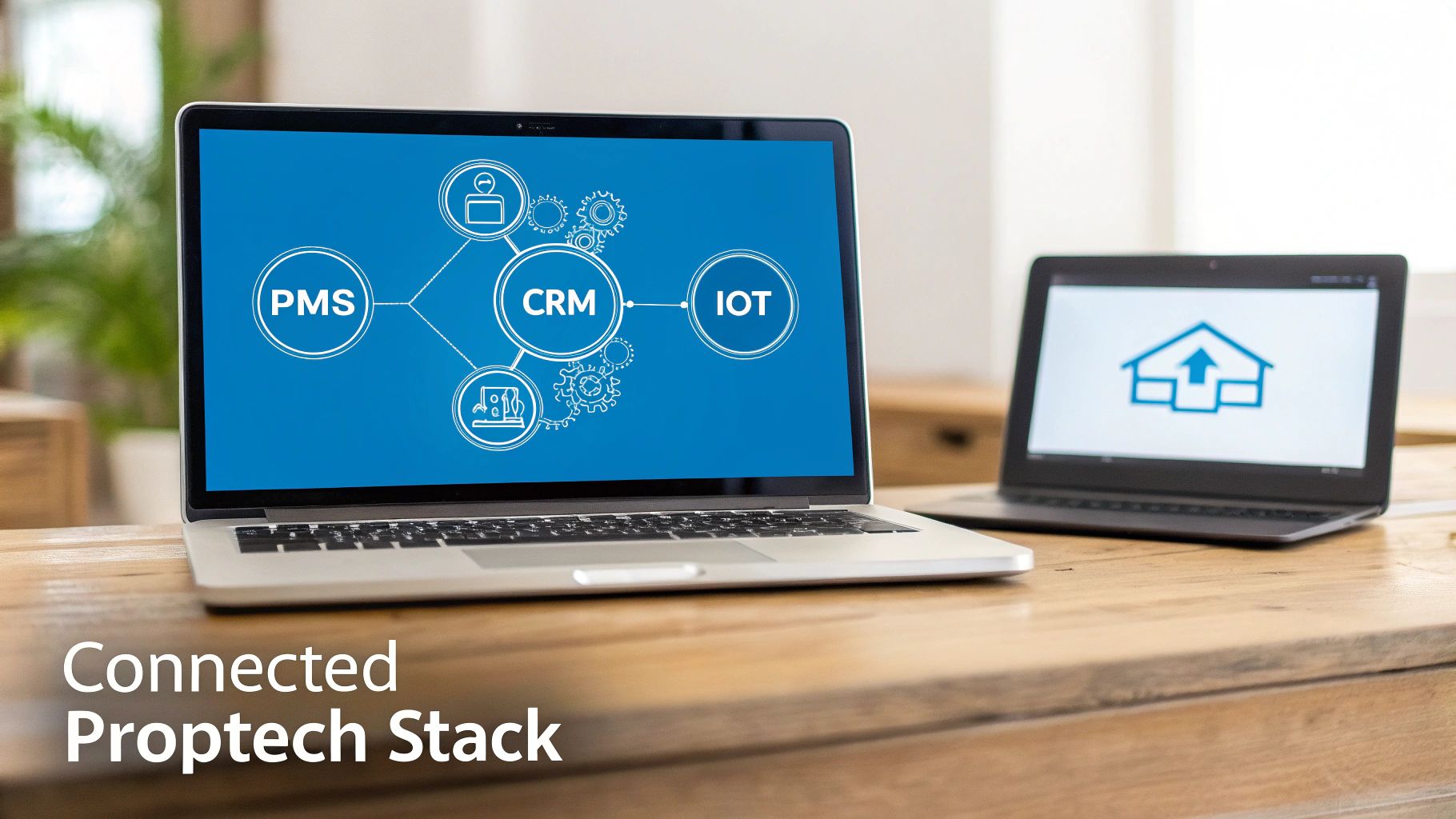
Modern AI platforms are built with robust APIs (Application Programming Interfaces) that act as an intelligent layer, synchronizing data across your entire operation. The objective is to create a single source of truth that powers smarter automation and eliminates manual data entry.
Core Integration Points for Enterprise Scale
For any large-scale portfolio, several integrations are non-negotiable. Your AI leasing platform must exchange data with these key systems in real-time.
- Property Management Systems (PMS): This is the central hub. The AI tool must sync with your PMS—like AppFolio or Rentvine—to access live data on unit availability, pricing, and amenities. When a lead is captured or an application is submitted, that information must flow back into the PMS automatically.
- Customer Relationship Management (CRM): Integrating with your CRM provides a comprehensive view of the prospect journey. It enables you to track every touchpoint, from the initial AI-powered chat to the final lease execution, within a single, consolidated record.
- Smart Home and IoT Devices: If you utilize smart home technology, your AI platform can leverage data from these devices to enable predictive maintenance. An alert from a smart water sensor, for instance, can automatically trigger a work order before a minor leak becomes a major flood.
This interoperability is what distinguishes a useful gadget from a transformative operational asset. When your systems communicate, data flows freely, ensuring your team always works with accurate information and enabling intelligent automation across your entire workflow. Explore a range of powerful Showdigs integrations that connect your leasing operations to your core management systems.
Building a Unified Data Ecosystem
Ultimately, AI's power is unlocked when it has access to clean, comprehensive data. A well-integrated stack ensures your AI leasing assistant knows which units are available, your screening tool has accurate applicant data, and your maintenance system is flagging issues proactively.
Consider AI-powered tenant screening. By leveraging data to minimize risk, some platforms have helped property managers reduce evictions by as much as 30%—a significant financial win. Today, 65% of property management companies use AI-driven screening to generate a more complete risk score, boosting their net operating income by 3-7%.
This level of connectivity is no longer a luxury; it's a requirement for scaling efficiently. It ensures every decision is data-driven, every process is optimized, and your portfolio is positioned for intelligent, sustainable growth.
Navigating Risks and Ensuring Ethical AI Use
While AI for property management unlocks significant operational efficiencies, it's crucial for large-scale operators to understand and mitigate the associated risks. Proper governance is not just about technology—it's about protecting your brand, maintaining compliance, and preserving trust with property owners and residents.
A proactive approach involves careful management of three critical areas to ensure your technology adoption fuels growth without introducing new liabilities.
Data Privacy and Security Protocols
Your AI systems will process a vast amount of sensitive information, from tenant financial data to owner portfolio details. A data breach is more than a technical failure; it's a catastrophic breakdown of trust that can cause irreparable reputational damage.
Therefore, vetting a vendor's security credentials is non-negotiable. Look for partners with robust security protocols, evidenced by certifications like SOC 2 compliance. This demonstrates a serious commitment to secure data management, protecting your business, clients, and residents from significant financial and legal exposure.
Algorithmic Bias and Fair Housing Compliance
A primary risk associated with AI in leasing is algorithmic bias, particularly in tenant screening. If an AI tool is trained on historical data containing implicit biases, it can unintentionally perpetuate discriminatory patterns, leading to a Fair Housing Act (FHA) violation.
To maintain fair and compliant operations, you must:
- Audit Your Tools: Regularly review the decisions made by your AI screening software to ensure equitable and legally sound outcomes.
- Demand Transparency: Your technology partners must be able to clearly explain how their algorithms function and what safeguards are in place to prevent bias.
- Maintain Human Oversight: Use AI as a decision-support tool, not the sole decision-maker. The final approval on an application should always involve human review to ensure fairness remains the top priority.
Tools that standardize your processes, like an AI-powered listing shield, are invaluable for risk mitigation. They ensure your advertising is consistent and compliant across every property in your portfolio.
The goal is simple: AI should apply your exact rental criteria consistently to every single applicant, every single time. That consistency is your best defense against discrimination claims and a true hallmark of using AI ethically.
Over-Reliance on Automation
While automation is key to scalability, over-reliance on it can weaken tenant relationships. Critical moments like handling a major maintenance crisis or negotiating a complex lease renewal require human empathy and judgment that cannot be automated.
The optimal strategy is a balanced one. Delegate high-volume, repetitive tasks to AI. This frees your property managers to focus on high-value interactions and complex problem-solving that build strong tenant loyalty and owner satisfaction. It's about leveraging technology to enhance human capabilities, not replace them.
Common Questions About AI in Property Management
When you're running a large-scale property management company, you learn to be skeptical of new tech. Grand promises are common, but real-world results are what matter. As leaders start looking at AI, the same practical questions always come up.
Let's cut through the noise and address the things enterprise operators really want to know.
How Quickly Can We See a Return on Investment?
Forget waiting a year for results. The ROI from AI isn’t some far-off goal; you’ll see it hit your leasing metrics almost immediately. Most large portfolios see a measurable impact within the first 90 days of a pilot program.
Where does it show up first? A massive drop in Days on Market (DOM). By automating the grunt work of lead response and tour scheduling, you shrink the time from a prospect's first click to their first visit from days down to minutes. That directly speeds up lease signings, which means revenue in the door, faster.
Will AI Replace Our Leasing Agents?
Not a chance. Think of AI as the ultimate assistant for your leasing team, not a replacement. It takes over the high-volume, repetitive tasks that eat up to 50% of an agent's day—things like answering the same five questions a dozen times, pre-qualifying leads, and playing calendar Tetris to book tours.
This frees up your best people to do what they do best: build relationships with truly qualified prospects, give amazing property tours, and close deals. You end up with a more focused, more productive team that can comfortably manage more doors per person.
Does AI Work for Both SFR and Multifamily Portfolios?
Absolutely. The headaches of leasing—the need for speed, efficiency, and converting leads before they go cold—are the same whether you’re managing scattered single-family rentals (SFR) or multifamily buildings without dedicated onsite staff. Good AI platforms are built to be flexible. They can be dialed in to manage leasing for a portfolio of suburban homes just as effectively as a centralized apartment community.
The real magic is that AI standardizes your leasing process. It doesn't matter if a prospect is looking at a house across town or a unit in a low-rise. The automated qualification, scheduling, and follow-up are consistently excellent, giving every lead a top-tier experience at scale.
How Much Training Is Required for Our Team?
This isn't like rolling out a clunky old software system. Modern AI tools are designed with clean, intuitive interfaces that your team will pick up fast. The training isn't about learning complex software; it’s about tweaking your existing workflows to take full advantage of the automation.
Most property management companies find their teams are completely up and running after just a few hours of focused training. The best vendors also provide great onboarding and ongoing support to make the switch painless, helping your staff see from day one how this new tool makes their jobs easier, not harder.
Ready to see how AI-powered leasing automation can slash your vacancy days and give your team its time back? Showdigs offers the fastest path from lead to lease for distributed portfolios, proven to cut down DOM and optimize your entire lead-to-tour pipeline. Schedule a demo today and discover a smarter way to scale.
.png)