


When you're managing a portfolio of hundreds or thousands of units, choosing the right software isn't an operational tweak—it's a high-stakes financial decision that directly impacts revenue. Here’s the fundamental difference you need to grasp: standard Property Management Systems (PMS) are masters of accounting and tenant management, but specialized leasing automation tools are purpose-built for one thing: aggressively cutting down your Days on Market (DOM).
For large-scale operators managing distributed portfolios, this is the single biggest revenue challenge, and it's where the real money is lost or made. Every day a unit sits vacant is a direct hit to your NOI, and inefficient leasing operations are the primary culprit.
Choosing Property Management Software That Scales
As you scale from 500 units to 5,000 and beyond, the cracks in all-in-one software start to show. Your core PMS is absolutely essential for financial administration and coordinating maintenance. But its leasing features often can't keep up with the speed, automation, and deep analytics required to run a high-volume, geographically scattered portfolio. This is where operational bottlenecks kill your speed-to-lease.
This is exactly where specialized leasing platforms come in. Their entire reason for existing is to optimize the top of your leasing funnel—from the second a lead comes in to the moment a tour is finished. For enterprise-level operators, this is where you'll find the most significant gains in operational efficiency and revenue.
Every single day a unit sits empty, it's a direct hit to your bottom line. Inefficient showing coordination is one of the biggest culprits behind long vacancies, directly inflating your Days on Market.
The Financial Imperative For Specialized Tools
The global property management software market is exploding, projected to reach $27.95 billion by 2025. This isn't just hype; it's a clear signal that the industry is moving toward specialized tools to automate leasing and boost efficiency at scale.
For large portfolios, the decision to add a specialized tool comes down to a simple ROI calculation. Just think about the financial impact of shaving a few DOM off across 1,000 units. For a portfolio with an average rent of $1,800/month, reducing DOM by just 5 days across 1,000 units translates to $300,000 in recovered annual revenue. The revenue you claw back will dwarf the cost of a dedicated leasing platform. This guide offers a detailed comparison of property management software to help you make that data-driven choice.
The real challenge for scaled portfolios isn't just managing properties; it's managing the velocity of the leasing cycle. Standard PMS platforms manage the asset. Specialized leasing software manages the revenue stream by compressing the time from lead to lease.
Key Evaluation Criteria For Enterprise Software
When you're looking at solutions, large-scale operators have to think beyond basic feature lists. You need to assess platforms on their ability to support complex, remote operations. The right software should feel like an extension of your central team, not just another dashboard to log into.
Our analysis will zero in on the criteria that truly matter at scale:
- Leasing Automation: How well does the software handle lead nurturing, pre-qualification, and follow-up without needing a human to step in? This is critical for improving your lead-to-tour conversion rate.
- Showing Logistics: Can it handle a mix of showing options, like self-guided and agent-led tours, that you can deploy across a scattered portfolio to enable same-day showings?
- System Integration: How deep and seamless are the integrations with your core PMS, like AppFolio or Rentvine, to keep data flowing smoothly?
- Performance Analytics: Can you actually track the KPIs that matter, like lead-to-tour conversion rates, cost-per-lease, and agent performance, in real-time?
Understanding these distinctions is how you build a PropTech stack that doesn't just support your portfolio today but is engineered to handle your future growth. You can also check out our detailed guide on the best property management software for a deeper dive into some of the top-tier solutions out there.
Core PMS Platforms Versus Specialized Leasing Solutions
When you’re managing hundreds or even thousands of single-family rentals, the difference between a core Property Management System (PMS) and a specialized leasing solution isn't just a technical detail—it’s fundamental to your operational scalability and bottom line.
A core PMS like AppFolio or RentManager is the central nervous system of your portfolio. It’s the system of record, built to expertly handle accounting, coordinate maintenance, and keep tenant records straight. It’s designed for stability and comprehensive financial administration.
But when you get into the fast-paced, high-stakes game of leasing, these all-in-one platforms start to show their limits. Their built-in leasing features are often basic, designed for smaller portfolios where a few extra days on market don’t cause a major financial drag. For a multi-market operator managing a distributed portfolio, that functionality gap translates directly into lost revenue.
Where Core PMS Functionality Ends
A core PMS is built to manage the asset, not to optimize the velocity of your leasing funnel. Its leasing tools can handle the basics—posting a listing, accepting an online application—but they simply lack the sophisticated automation and deep analytics needed to convert leads at the speed and scale that large, distributed portfolios demand.
This is where the comparison of property management software becomes so critical. Trying to run a high-volume leasing operation solely on a PMS creates serious operational bottlenecks:
- Manual Lead Follow-Up: Leasing agents end up spending their days chasing down leads instead of focusing on showing homes and closing qualified prospects, cratering your lead-to-tour conversion rate.
- Clunky Tour Scheduling: The endless back-and-forth trying to coordinate showings across a wide geographic area slows the entire process to a crawl and prevents same-day showings.
- Lack of Actionable Data: You get basic reports, but not the deep insights needed to track lead-to-tour conversion rates or pinpoint exactly where friction is killing your funnel.
For a portfolio with 1,000 units, a single extra day of vacancy per unit per year can represent over $500,000 in lost revenue, assuming an average rent of $1,500/month. That's the real cost of an unspecialized leasing process.
The Rise Of Specialized Leasing Automation
This is exactly why today’s best-in-class PropTech stacks almost always include a dedicated leasing automation platform. Tools like Tenant Turner, ShowMojo, and Showdigs are purpose-built to solve one problem: aggressively reducing vacancy by optimizing the top of your leasing funnel.
These platforms aren't meant to replace your PMS. Instead, they integrate with it, supercharging your leasing process with advanced capabilities that core systems just don't offer. For a more detailed breakdown, you can explore this analysis of Showdigs vs. other leasing software.
Key Differentiators In Functionality
Let’s get into the nitty-gritty of how these two types of systems differ. The table below breaks down the core functional distinctions and, more importantly, what they mean for a growing enterprise.
Core PMS Vs Specialized Leasing Automation Capabilities
Ultimately, the goal isn't to pick one over the other. The modern, efficient enterprise property management company understands that these systems serve two distinct but complementary roles.
Your PMS is the foundation for stable, long-term asset management. Your specialized leasing platform is the high-performance engine that drives revenue and growth by making sure your properties are leased faster than the competition.
Feature Comparison Of Leading Leasing Automation Software
When you're running a scattered portfolio, picking a leasing automation platform isn't about flashy features. It's about what directly impacts your bottom line—how quickly you can slash Days on Market (DOM) and what it costs you per door to get a lease signed. The real magic happens when software can untangle the operational knots of managing rentals across different locations without requiring onsite staff.
This means we need to get granular. A true comparison of property management software in the leasing space boils down to three critical areas for enterprise operators: how it handles leads, the flexibility and quality control of its tour scheduling, and how deeply it integrates with your core systems. Let's see how the big players—Tenant Turner, ShowMojo, and Showdigs—stack up.
This graphic really nails the difference between what a PMS does and what a specialized leasing tool is built for.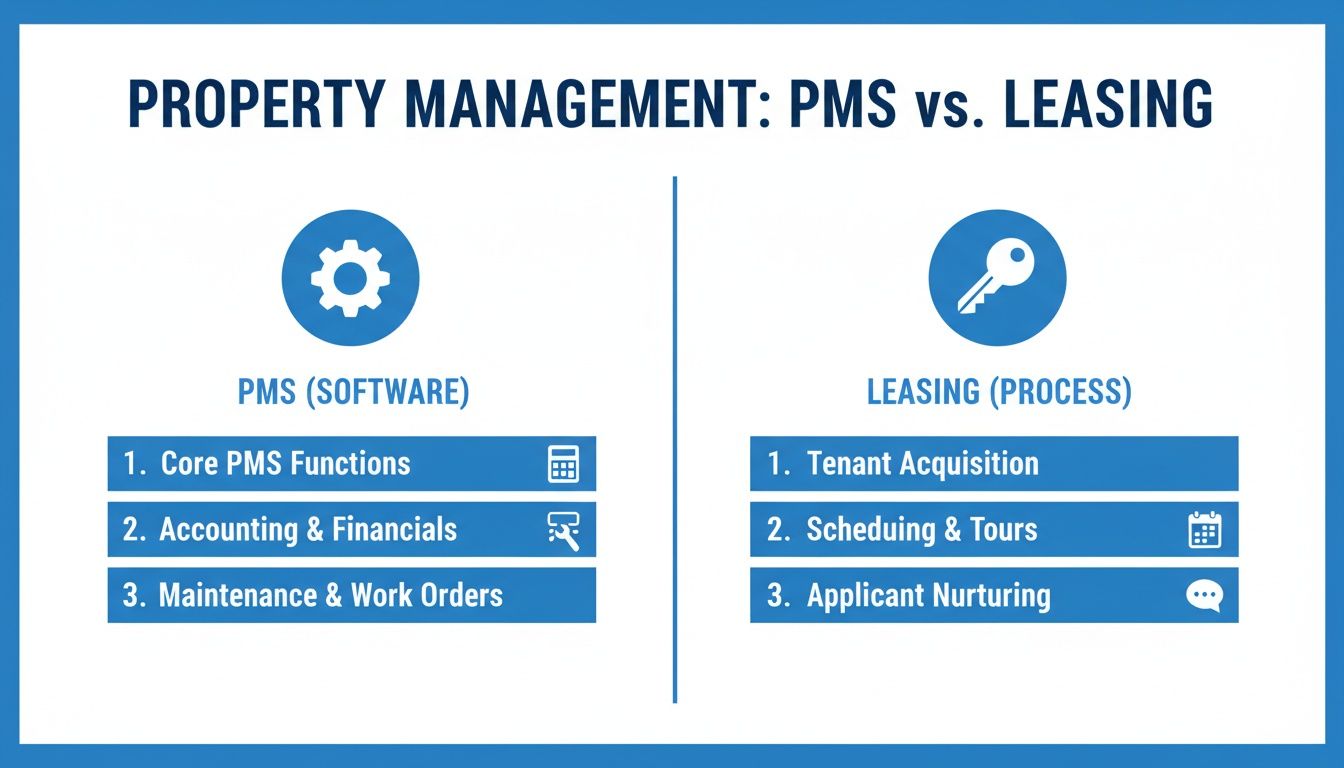
Essentially, your PMS manages the property itself, while these tools are laser-focused on filling it faster to maximize revenue.
Lead Management And Pre-Qualification Protocols
For a large portfolio, speed-to-lead and qualification accuracy are everything. Every minute a qualified prospect has to wait for a reply, your chance of getting them to a tour drops dramatically. This is where automation isn't just a nice-to-have; it's essential for optimizing your lead-to-tour conversion rate.
- Tenant Turner is a powerhouse here, with a centralized call center and automated messaging that makes sure no lead gets lost. Their system is fantastic at filtering prospects against your specific criteria, so your team only deals with qualified renters.
- ShowMojo also offers strong automated communication tools, using email and text to keep prospects warm. It gives property managers a solid way to set pre-qualification rules that renters have to meet before they can even book a showing.
Showdigs approaches this differently by blending AI-powered instant responses with an on-demand human element. This hybrid model gets leads pre-qualified in seconds but also provides a real person to answer those tricky questions—delivering a top-tier experience for the prospect without bogging down your staff.
Tour Scheduling Agility And Quality Control
For anyone managing properties in multiple markets without onsite staff, scheduling tours is hands-down the biggest operational headache. The ability to offer same-day showings is a massive competitive edge that directly contributes to DOM reduction.
Both Tenant Turner and ShowMojo are big believers in self-showing tech. They integrate with secure lockboxes and automate the scheduling, letting prospects tour homes on their own time. It’s a game-changer for increasing tour volume and a huge step up from the old way of doing things.
But here’s the rub with a purely self-guided model: quality control and security. Who makes sure the lights are on and the place looks presentable after the last person left a mess? Who checks that the lockbox is even working? These are critical challenges when scaling remote operations.
This is where Showdigs really carves out its niche. We pair the efficiency of automated scheduling with the accountability of a real person on the ground. Our network of on-demand, licensed real estate agents preps the property, handles the showing, and secures it afterward.
This hybrid approach solves the biggest problem for distributed single-family and multifamily portfolios: maintaining a secure, high-quality showing experience without hiring full-time leasing agents in every market. You get the speed of self-showings with the peace of mind and quality control of an in-person tour. For an example of how a detailed evaluation can be conducted, consider a guide on comparing drone software platforms.
Depth Of PMS Integrations
If your leasing platform doesn't talk to your PMS, you're creating data silos and manual work, which completely defeats the purpose of automation. When doing a comparison of property management software, the depth of that integration is a deal-breaker for any enterprise.
All three platforms connect with the major PMS players like AppFolio and RentManager. They’ll sync property info and create guest cards automatically, which is a massive time-saver.
The real test, though, is how much data flows both ways and whether it can trigger actions in your PMS. A truly deep integration doesn't just pull listing information; it pushes back detailed showing feedback and updates a prospect’s status in real-time.
At Showdigs, we focus on deep API connections that keep your PMS as the single source of truth. This gets rid of manual data entry and gives you one consolidated view of your leasing funnel, from the first lead to the final lease, all inside the system you already use. That kind of seamless connection is what you need to make smart, data-backed decisions that actually improve your lead-to-tour conversion and boost your portfolio's performance.
Analyzing Pricing Models and Total Cost of Ownership

When you're running a comparison of property management software, the sticker price is just the tip of the iceberg. For enterprise operators, the only number that really matters is the Total Cost of Ownership (TCO), which is directly tied to your cost-per-door efficiency. This figure digs deeper, revealing the true financial footprint of a platform on your portfolio. It’s not just about subscription fees; it’s about the hidden costs of inefficiency and the massive opportunity cost of a unit sitting empty.
The stakes are especially high in the United States, which absolutely dominates the North American property management software market. This competitive environment makes finding cost-effective, scalable solutions a make-or-break task. You can get a clearer picture of the global market distribution on grandviewresearch.com.
Deconstructing Common Pricing Models
Leasing automation platforms generally stick to a few pricing structures, and each one impacts a large portfolio differently. Getting a handle on these is the first step to calculating your real TCO.
- Per-Unit-Per-Month (PUPM): This is as straightforward as it gets. You pay a flat fee for each unit you manage. It’s predictable, but it can get pricey as you grow if the value you’re getting doesn’t scale with the cost.
- Tiered Pricing: Here, you buy into different feature sets based on your portfolio size. This can work well, but watch out for tiers that force you to pay for a bunch of flashy features you'll never use just to get the one or two you actually need for your leasing process.
- Usage-Based Costs: Some tools, especially those that offer on-the-ground services, charge per action—think a per-showing fee. This model is incredibly transparent and scalable because your costs are directly tied to leasing activity, improving your cost-per-door economics.
Calculating true ROI means looking way beyond the software subscription. A platform that costs more but cuts your average Days on Market (DOM) by 15% is going to put far more money back in your pocket than a cheaper tool that lets units sit vacant.
The Real Cost of Inefficiency
In any TCO analysis, the biggest line item is often the one you won't find on an invoice: the opportunity cost of feature gaps. If the software you choose adds even a few days to your vacancy period, the lost rent can easily dwarf what you pay for the subscription.
Let’s run the numbers. On a 1,000-unit portfolio with an average rent of $1,800, a single extra day of vacancy across the board adds up to $60,000 in lost revenue. If you can shave just five days off each vacancy cycle, you could claw back $300,000 annually. Suddenly, investing in a platform built for speed-to-lease doesn't just make sense—it's a financial no-brainer.
A Framework for Comparative ROI
To do a true apples-to-apples comparison, operations directors need to model the financial outcome, not just the initial price tag. It's about calculating the total impact on your bottom line.
Comparative ROI Framework:
- Calculate Baseline Vacancy Cost: Figure out your current average DOM and what a vacant unit costs your portfolio per day.
- Model DOM Reduction: Project how many days each platform could realistically cut from your vacancy time. A tool that enables same-day showings, for example, has a direct, measurable impact here.
- Quantify Recovered Revenue: Multiply the days saved by your daily vacancy cost. That’s your recovered revenue.
- Subtract Total Platform Cost: From that recovered revenue, deduct the annual subscription and any usage fees.
This simple framework changes the conversation from "Which software is cheaper?" to "Which software generates the highest net return?" For large-scale portfolios, the answer almost always points to the platform that most aggressively shrinks the leasing timeline.
Evaluating Integration And PropTech Stack Synergy

In a modern enterprise, software has to enhance your ecosystem, not complicate it. A leasing platform that doesn’t genuinely connect with your core Property Management System (PMS) isn't just an inconvenience anymore—it’s an operational liability. For any large-scale operator, the real value in a comparison of property management software comes down to its ability to create a seamless PropTech stack.
Fragmented systems create data silos, forcing your team into the soul-crushing work of manual data entry. This doesn't just waste time; it introduces a high risk of errors that can poison your leasing analytics. The goal is to build a setup where data flows freely, automating workflows and giving you a single source of truth for every KPI, from lead source to a signed lease.
A tightly integrated system is what gets rid of the friction that slows your leasing cycle and drives up your Days on Market (DOM).
Assessing The Depth Of API Integrations
Let's be clear: not all integrations are created equal. A "surface-level" connection might sync basic property details but completely fail at the dynamic, two-way data flow you need for high-velocity leasing. When you're looking at a platform's integration capabilities, you have to dig deeper than a simple logo on a partner page.
The key is finding solutions with robust, reliable API connections to major PMS platforms like AppFolio, RentManager, and Rentvine. A deep integration should automatically handle critical tasks without a human ever touching it.
For example, when a prospect shows interest, the leasing platform should instantly create a guest card in your PMS. After a showing, detailed feedback and status updates should flow right back into the system, keeping your records perfectly in sync. This is the kind of automation that allows you to scale your remote property management operations effectively.
A well-integrated PropTech stack turns your leasing process into an automated, data-rich assembly line. It ensures that your core PMS remains the undisputed system of record while specialized tools handle the heavy lifting at the top of the funnel.
Vetting Software For Operational Harmony
Before you commit to a new platform, operations directors have to rigorously vet its ability to support—not fragment—their existing workflows. A powerful leasing tool that forces your team to constantly switch between dashboards or manually reconcile data is, frankly, a step backward. A great place to start is by exploring a platform's dedicated resources on system connections, like this detailed overview of Showdigs’ property management software integrations.
Here's a practical checklist to guide your evaluation and make sure any new software will actually strengthen your operational foundation.
Integration Checklist For Enterprise PM Software
When you're vetting a new leasing platform, it's not just about the features—it's about how it plays with your existing tools. This checklist helps you ask the right questions to ensure any new software will be a team player, not a source of friction.
Ultimately, the best leasing software for an enterprise portfolio is one that acts as a natural extension of your central operations. It should amplify the power of your PMS, giving you the specialized tools you need to optimize leasing without creating a technological mess.
A Decision Framework For Your Portfolio
Picking the right software isn't about finding a magic bullet; it's about matching a platform's strengths to your portfolio's most pressing financial and operational needs. Let's move past the feature lists and build a practical framework for making a confident, data-backed decision that actually drives growth.
Making the right choice means getting methodical. It’s about aligning the tech with your specific business goals for DOM reduction and lead conversion.
Define Your Primary Business Objectives
First things first, what does success actually look like? Vague goals like "improving efficiency" won't cut it. You need specific, measurable targets tied directly to your bottom line.
- DOM Reduction Target: Are you aiming to reduce average Days on Market by 20% in the next six months?
- Conversion Rate Goal: How about boosting your lead-to-tour conversion rate from 25% to 40%?
- Operational Cost Savings: Maybe the goal is to lower your cost-per-showing by leaning on an on-demand network.
These KPIs become the yardstick you'll use to measure the true ROI of any platform you consider.
Audit Your Portfolio's Unique Needs
Next, take a hard look at your portfolio's DNA. A company managing 1,000 single-family rentals scattered across three states has wildly different problems than one with 1,000 doors in a single metro area.
The real question to ask is whether your portfolio’s complexity has outgrown a pure self-showing model. For multi-market operators, keeping brand standards and quality control consistent is a huge challenge. This often makes a hybrid solution with on-demand agents a necessity for both speed and security.
As you explore different solutions, it’s always a good idea to dig into what various providers offer. For instance, you could check out Samskit's official website to see how they position themselves.
Structure a Pilot Program for Validation
Before you sign a massive contract and flip the switch on your entire portfolio, design a limited pilot program. Pick a representative sample of properties—say, 50-100 units in one of your tougher markets—and implement the new software there. This is your chance to see how it performs in the wild, measured against the KPIs you just defined.
A successful pilot gives you the hard data you need to justify a full-scale investment. It’s the ultimate proof of concept, showing tangible improvements in DOM and conversion rates before you commit serious resources. This step turns a software purchase from a leap of faith into a calculated business decision.
Answering Your Key Questions
When you're looking to bring a new platform into a large-scale operation, asking the right questions is critical. It’s not just about features—it's about how a new tool fits into your workflow, integrates with your existing tech, and ultimately, impacts your bottom line.
How Does Implementation Work For A Large Portfolio?
The biggest fear for any large operator is disruption. A clunky software transition can throw your entire leasing operation into chaos. That's why the best platforms avoid a "flip the switch" approach and instead use a structured, phased rollout.
It usually starts with a pilot program. We’re talking about testing the software on a small, controlled group of 50-100 units. This isn't just about kicking the tires; it's about validating performance against your specific goals, like a measurable DOM reduction or a higher lead-to-tour conversion rate. Once the pilot proves its worth, the rollout continues with a carefully mapped-out data migration and team training schedule, ensuring your business keeps humming without missing a beat.
What Is The Best Way To Measure ROI?
For large portfolios, ROI isn't some fuzzy metric. It's cold, hard cash recovered from cutting down vacancy loss. The most direct way to measure this is to first calculate your current average cost per vacant day. Then, you track how the new software directly shrinks your Days on Market (DOM).
Let's put some real numbers to it. Imagine a platform helps you shave just five days off your average DOM across a 1,000-unit portfolio. Depending on your market, that reclaimed revenue can easily climb into the hundreds of thousands of dollars each year. That’s a business case that gets attention.
Can New Leasing Software Integrate With Our Existing PMS?
Absolutely. In fact, this should be a deal-breaker. Any enterprise-level leasing tool worth its salt must offer deep, two-way API integrations with the major players like AppFolio and RentManager. This is non-negotiable.
A true integration means that guest cards, showing feedback, application statuses, and prospect notes all sync automatically and in real-time. This completely eliminates double data entry, kills off dangerous data silos, and keeps your core PMS as the undisputed single source of truth for everything leasing-related.
Ready to see how a hybrid leasing solution can slash your Days on Market and fine-tune your cost per door? Showdigs blends smart automation with a nationwide network of on-demand agents to get your properties signed, sealed, and delivered faster.
Schedule a demo today and find a smarter way to handle leasing at scale.
.png)