



Effective home rental management is far more than collecting rent; it’s about architecting a high-performance operational machine that maximizes portfolio revenue while minimizing operational drag. For property managers overseeing 100 to 10,000+ units, this means abandoning manual processes and embracing a system that leverages technology at every stage of the leasing lifecycle to drive down Days on Market (DOM) and boost net operating income.
Building Your Operational Framework for Growth
When you're managing a distributed portfolio, a scattered, inconsistent leasing process is a direct path to revenue leakage and operational chaos. To achieve scalable growth, a standardized operational framework is non-negotiable—a repeatable, tech-powered system that ensures every prospect receives the same quality experience, regardless of the property's location.
This isn’t about increasing headcount proportionally with unit count. It’s about building a scalable engine that absorbs growth efficiently. The strategic goal is to transition from a fragmented set of manual tasks to an integrated PropTech stack that eliminates bottlenecks and drives measurable improvement in your most critical KPIs: DOM and lead-to-tour conversion rates.
Pillars of a Scalable Management System
A modern framework built for enterprise-scale property management rests on four core pillars, each designed to optimize a specific stage of the leasing funnel.
- Centralized Lead Management: Every inquiry, whether from Zillow, Apartments.com, or your direct website, must flow into a single, unified dashboard. This provides portfolio-level visibility and prevents lead slippage—a critical failure point for multi-market operators.
- Automated Tour Scheduling: Eliminate the operational drag of manual scheduling. An automated system empowers prospects to book tours 24/7, satisfying modern renter expectations for instant engagement and significantly boosting lead-to-tour conversion rates.
- Standardized Property Workflows: From make-ready processes to move-out inspections, every operational task must be documented and systemized. This includes standardized safety and security protocols for every unit. For instance, knowing how to enhance the security of sliding glass doors should be part of a repeatable checklist, not an afterthought.
- Frictionless Lease Execution: The final stage—from application screening to digital lease signing and security deposit collection—must be completely seamless. Any delay in this phase provides qualified applicants with an opportunity to lease from a competitor, nullifying your marketing efforts.
The guiding principle for scale is simple: If a task can be automated or systemized, it must be. This strategic allocation of resources frees up your team to focus on high-value activities like nurturing owner relationships and driving portfolio expansion.
The Financial Imperative for an Operational Framework
The U.S. property management market is projected to reach $31.87 billion by 2029, a testament to its robust growth. However, this expansion intensifies competition among the more than 304,000 property management businesses operating today. In this environment, operational efficiency is the primary differentiator between market leaders and laggards.
Data indicates that roughly 35% of property managers oversee portfolios of 101 to 500 units—a critical growth stage where manual processes begin to break down. For companies managing portfolios of this size and larger, an ad-hoc approach is unsustainable.
A scalable operational framework directly impacts your bottom line by aggressively reducing vacancy. Every day a unit sits empty represents a tangible revenue loss. By systemizing your leasing pipeline, you can dramatically reduce Days on Market (DOM) and lower your overall cost-per-door. These are not vanity metrics; they are the fundamental drivers of portfolio profitability. To explore this further, our guide to property management growth strategies outlines how a structured approach is essential for sustainable expansion.
Optimizing Listings for Maximum Lead Velocity
In a competitive rental market, simply publishing listings online is insufficient to minimize vacancy across a large portfolio. The objective is to generate a high volume of qualified, high-intent leads and convert them before they are lost to competitors. This requires moving beyond basic marketing tactics and adopting a large-scale operator's mindset focused on standardization, data analytics, and speed-to-lease.
The foundation of a high-velocity leasing operation is a consistent, premium brand experience across every listing. When a prospective renter views one of your properties, they should immediately recognize a standard of quality, whether the unit is in Dallas or Denver. This begins with your visual assets, which are non-negotiable.
Standardize Your Visuals to Build a Trusted Brand
For portfolios with hundreds or thousands of units, inconsistent photo quality is a brand liability. A standardized visual package is essential for building trust and setting accurate expectations from the first interaction.
- Mandate Professional Photography: Every property must be photographed by a professional following a strict, standardized shot list. This list should include high-resolution images of all rooms, key amenities, and exterior views, all edited with a consistent color and brightness profile. There can be no exceptions.
- Implement Virtual Tours as a Standard: Modern renters expect more than static photos. A 3D virtual tour is now a fundamental tool for pre-qualifying leads. It allows serious prospects to self-qualify based on the layout, reducing wasted in-person tours and attracting applicants who are already confident in their decision.
This commitment to visual consistency does more than improve individual listing performance. It builds a recognizable brand that signals professionalism and quality, positioning your portfolio as the preferred choice for discerning renters.
Takeaway: Your listings are your digital curb appeal. Standardizing photography and virtual tours across your entire portfolio is the most direct way to build brand equity and attract higher-quality tenants at scale.
Leverage AI for Descriptions and Implement Smart Syndication
Manually writing compelling descriptions for a large portfolio is a significant time and resource drain, and it introduces compliance risks. AI-powered tools can generate unique, engaging, and SEO-optimized descriptions that highlight key features and local amenities in seconds.
Crucially, these tools can be programmed with Fair Housing guidelines to scrub language for compliance, providing a level of risk mitigation that is unattainable with manual processes.
Once your listings are optimized, they must be syndicated strategically. Smart syndication involves more than just pushing listings to Zillow; it requires broad distribution and, most importantly, performance tracking. Your property management software should integrate with a wide network of rental platforms, enabling instant publishing and updates across all channels.
The critical component is tracking which sources deliver not just leads, but qualified applicants who convert to signed leases. By monitoring source effectiveness, you can allocate marketing spend in real-time to the platforms delivering the highest ROI, systematically driving down your cost-per-acquisition. For a deeper dive into these strategies, explore our guide on effectively marketing your listing.
This methodical approach transforms your listing process from a series of disjointed tasks into a scalable, data-driven marketing engine that maintains a full lead pipeline, optimizes marketing spend, and positions your portfolio for rapid, profitable leasing.
Automating The Leasing Funnel To Reduce Vacancy Costs
The single greatest threat to your portfolio's financial performance isn't a problematic tenant—it's a vacant unit. Every minute that passes between a prospect's initial inquiry and a scheduled tour represents lost revenue.
For property managers juggling hundreds or thousands of units, manual lead follow-up is operationally untenable. It is not merely inefficient; it is a direct contributor to higher Days on Market (DOM) and competitive losses to faster-moving operators.
The only way to win at scale is to automate this critical top-of-funnel stage. This requires a system that delivers instant, 24/7 engagement, converting a casual online inquiry into a booked tour before the prospect has a chance to consider another listing.
Implementing An AI-Powered Response System
The first step is to deploy an AI-powered system for initial lead response. This digital leasing agent works around the clock to ensure no lead goes cold, focusing on two key objectives: speed and qualification.
- Instant Engagement: The system responds immediately to an inquiry, regardless of its source or the time of day. This immediate feedback aligns with the expectations of today’s high-intent renters.
- Automated Pre-Qualification: Before human intervention is required, the AI asks critical qualifying questions, such as "What is your desired move-in date?" or "Does your household income meet our 3x rent requirement?" This filters out unqualified leads, preserving your team's resources for serious prospects.
- Seamless Tour Scheduling: Once a prospect is qualified, the system guides them to book a showing through a direct integration with your calendar, displaying real-time availability for self-guided, virtual, or agent-led tours. This eliminates email back-and-forth and scheduling conflicts.
By reducing lead response time from hours to seconds, property managers can achieve a significant increase in their lead-to-tour conversion rate. The strategy is to meet renters where they are: online and ready to take immediate action.
This automated engine is fueled by high-quality listings. The process below illustrates how optimized listings are the essential starting point for a successful automated funnel.
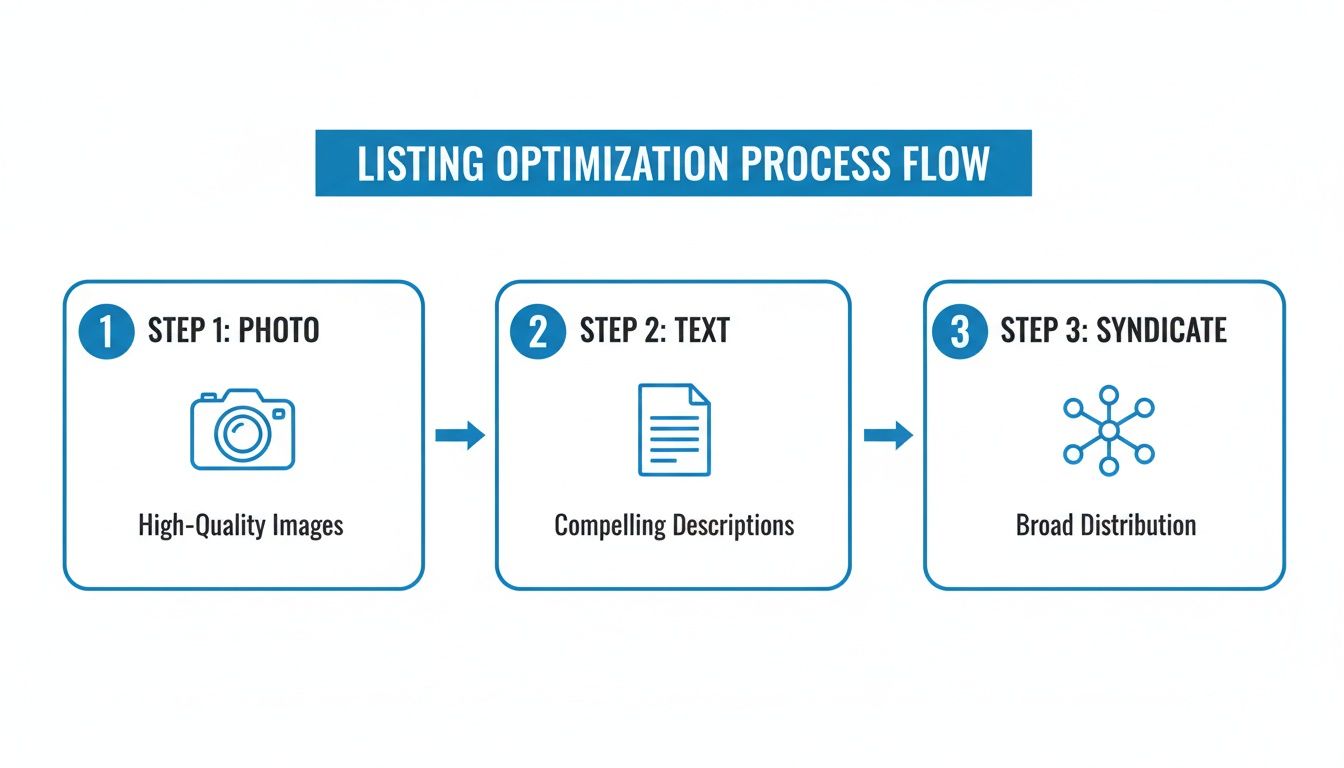
It all begins with professional photography and compelling descriptions syndicated widely to attract qualified prospects.
Manual vs. Automated Lead-to-Tour Workflow Impact
The operational difference between a traditional, manual leasing process and a modern, automated workflow is stark, especially for large portfolios. The table below quantifies this contrast, highlighting the real-world impact on efficiency, conversion rates, and revenue.
Automation transforms a high-friction, time-consuming process into a streamlined, efficient machine that fills vacancies faster and drives revenue growth.
Calculating The ROI Of An Automated Funnel
For any large-scale operator, the return on investment from leasing automation is clear and quantifiable, driven primarily by DOM reduction.
Let’s calculate the revenue impact for a 1,000-unit portfolio:
- Average Rent: $1,800/month
- Daily Cost of Vacancy Per Unit: $60/day ($1,800 / 30 days)
- Assume automation reduces average DOM by 7 days.
The calculation is straightforward: 7 days x $60/day x 1,000 units = $420,000 in recovered annual revenue, assuming just one turnover per unit.
This is not a trend; it is a fundamental market shift. Data shows 67% of companies already use property management software, and 48% have adopted automated lease management. Renter preferences reinforce this, with 80% preferring to pay rent online. You can explore more data on how technology is shaping the industry to understand the scale of this transformation.
Beyond direct revenue recovery, ROI is also realized through enhanced team productivity. By automating top-of-funnel administrative tasks, leasing agents can focus on building relationships with qualified applicants and closing leases. This enables portfolio growth and reduces the cost per door without a linear increase in headcount, resulting in a more profitable, scalable, and competitive operation.
From Application to Lease: Closing the Deal with Speed and Precision
Once a qualified prospect completes a tour and expresses intent to apply, the final and most critical phase of the leasing process begins. Any operational friction at this stage—from application submission to lease execution—can result in losing a top-tier resident and incurring additional, costly vacancy days.
For portfolios managing hundreds or thousands of units, a manual, paper-based application process is operationally and legally untenable. It is slow, inconsistent, and creates significant compliance risks that are difficult to audit.
The only viable solution for modern property management is a secure, compliant, and high-velocity digital workflow. The objective is to guide an approved applicant through screening, lease signing, and payment collection so efficiently that they become a resident before a competitor can capture their attention.
Standardize and Automate Your Screening Process
Inconsistent screening practices are not just inefficient; they represent one of the largest legal exposures for property managers. A standardized, automated process is the most effective defense, ensuring that identical criteria are applied fairly and equitably to every applicant, thereby mitigating Fair Housing risks.
The first step is to integrate a robust, automated screening solution directly into your property management software. This allows applicants to consent and pay for screening online, initiating background checks instantly without manual intervention from your team.
A best-in-class screening workflow should automate the following:
- Comprehensive Background Checks: Instant retrieval of credit history, nationwide criminal records, and eviction data.
- Customizable Criteria: The ability to set specific portfolio-wide income requirements (e.g., 3x the monthly rent) and credit score thresholds, with automatic flagging of applicants who meet or fail to meet the criteria.
- Fair Housing Compliance: Creation of a clear, defensible audit trail by processing every applicant against the same objective standards, removing human bias from the decision-making process.
This level of automation transforms a multi-day manual verification process into a decision that can be made in minutes, allowing you to extend an offer to a qualified applicant while their interest is at its peak.
Eliminate Paper with Digital Leases and E-Signatures
The era of printing, mailing, and chasing wet signatures on lease agreements is over. Digital lease agreements and e-signature platforms like DocuSign are now the industry standard for their efficiency and security. This technology enables tenants to review and sign their lease from any device, anywhere in the world.
The goal is to make signing the lease as easy as booking the tour. A frictionless digital workflow removes the final barrier between you and a new resident, often slashing the time from approval to execution from days to mere hours.
For any large-scale operation, using templated digital leases is an operational necessity. After legal review and approval of a master lease agreement, your system can automatically populate it with specific tenant and property details directly from your PMS. This ensures consistency and compliance across the entire portfolio.
Upon approval, the system automatically sends the pre-filled lease for e-signature. Once signed, all parties receive a legally binding copy, and the property's status is updated to "leased" in your system, eliminating manual follow-up and lost paperwork.
Automate Final Move-In Payments
The final component of this workflow is the collection of initial funds: the security deposit and first month's rent. This step should be seamlessly integrated into your digital leasing process.
Immediately following lease execution, the system should automatically direct the new resident to a secure online portal to submit payment. This obviates the need to wait for paper checks or coordinate wire transfers.
This automated collection process secures the move-in without administrative burden. It provides instant payment confirmation, generates a digital receipt for the tenant, and logs the transaction directly in your accounting software. By integrating screening, leasing, and payments into a single, cohesive digital journey, you create a robust system that secures qualified residents faster, protecting your revenue stream and maintaining your portfolio's performance.
Integrating Your PropTech Stack for Seamless Data Flow
The effectiveness of your rental management system is determined by its most fragmented component. For large-scale portfolio operators, a disconnected technology stack is not a minor inconvenience—it is a direct threat to profitability. When platforms operate in isolation, they create data silos, forcing your team into a cycle of manual data entry that is inefficient and prone to error.
A high-performing, modern property management operation is built on the seamless flow of information between every tool in its stack. This is where API integrations cease to be a "nice-to-have" and become a strategic imperative.
By connecting your leasing automation software with your core property management system (PMS)—such as AppFolio or RentManager—you establish a single source of truth for all property, prospect, and tenant data. This eliminates redundant data entry, guesswork, and ensures access to accurate, real-time information.
The Real-World Cost of Disconnected Systems
A fragmented tech stack directly impacts profitability. Every hour your team spends manually transcribing lead data from a showing platform into your PMS is an hour not spent on high-value activities, such as nurturing owner relationships or sourcing new management contracts.
The consequences extend beyond lost productivity. Data inaccuracies lead to flawed strategic decisions. If leasing data does not sync instantly with accounting software, your vacancy loss reports will be unreliable, potentially masking significant financial drains until they become critical.
A well-integrated system is about more than just time savings; it's about establishing operational integrity. When data flows automatically, you drastically reduce human error, enforce standardized processes, and provide leadership with the accurate, up-to-the-minute reporting required for effective strategic management.
How to Vet PropTech for Enterprise-Grade Integrations
Not all integrations are created equal. When evaluating new software for your tech stack, its ability to deeply integrate with existing systems should be a primary consideration. A superficial, one-way data push is of limited value compared to a deep, two-way integration that facilitates constant, dynamic communication between platforms.
Use this checklist to assess a potential PropTech partner’s integration capabilities:
- Clear API Documentation: Is their API well-documented and accessible to developers? This indicates a tech-forward company committed to open connectivity.
- Proven Native Integrations: Do they offer pre-built, native integrations with major property management systems? This demonstrates real-world experience and simplifies implementation. You can explore our list of native property management software integrations to see what a mature, connected ecosystem looks like.
- True Two-Way Sync: Can the software both pull data from and push data back to your core PMS? This is critical for real-time updates on applicant status, property availability, and agent notes.
- Built to Scale: Can their system handle the data volume of a 5,000+ unit portfolio without performance degradation? Request case studies and references from companies of a similar scale.
The Strategic Payoff of Integrated Data
The global property management market is projected to expand significantly, driven by advancements in data analytics, remote management capabilities, and smart home technology. Companies with fully integrated tech stacks are best positioned to capitalize on this growth.
For a portfolio manager, an integrated system unlocks a new level of operational intelligence. Imagine a dashboard where lead-to-tour conversion rates from your showing platform are automatically cross-referenced with final lease data from your PMS.
This enables you to calculate your true cost-per-lease by marketing source, optimize advertising spend for maximum impact, and identify top-performing leasing agents—all without manual spreadsheet analysis.
Ultimately, integrating your PropTech stack transforms your operation from a collection of disparate tools into a single, powerful management platform. This unified data flow is the key to reducing operational drag, eliminating revenue leaks, and building a home rental business that is truly engineered for scale.
Common Questions on Scaling Rental Management
As property management companies scale their portfolios, particularly across multiple markets, a consistent set of operational challenges emerges. Operations directors and portfolio managers are continually focused on solving these key issues. Here are direct answers to the most common hurdles faced when managing a large, geographically dispersed portfolio.
How Can We Standardize Our Leasing Process Across Multiple Markets?
Standardization is unattainable without a central technology platform serving as your single source of truth. Disparate processes for different markets—one for Austin, another for Atlanta—inevitably lead to inconsistency and inefficiency.
The first step is to collaboratively map out a "master" leasing workflow, detailing every touchpoint from initial lead inquiry to e-signed lease. Once this blueprint is finalized, it must be embedded directly into your leasing automation software. This involves implementing standardized email templates, uniform pre-screening questions, and identical showing protocols for every property across the portfolio.
An integrated platform is the only way to guarantee every prospect gets the same high-quality, on-brand experience, no matter where they are. It also gives you the bird's-eye view you need to make sure everyone's sticking to the playbook.
This approach prevents process deviation and provides the visibility needed to identify and resolve operational issues before they impact revenue.
What Are the Most Important KPIs to Track for Rental Management at Scale?
When managing thousands of units, it is critical to focus on the metrics that directly impact revenue. Avoid vanity metrics and concentrate on these five essential KPIs:
- Days on Market (DOM): This is your primary performance indicator. Every day a unit is vacant represents a direct, quantifiable revenue loss.
- Lead-to-Tour Conversion Rate: This metric assesses the effectiveness of your top-of-funnel marketing and initial response system. A low conversion rate signals a critical leak that requires immediate attention.
- Tour-to-Application Rate: This KPI measures the quality of your tours and the intent of your leads. A high volume of tours with few applications may indicate issues with property condition, pricing, or agent follow-up.
- Cost Per Lease: This is your all-in efficiency metric. It is calculated by dividing total marketing and leasing staff costs by the number of signed leases, revealing the true cost to acquire a tenant.
- Vacancy Loss: Calculated as a percentage of Gross Potential Rent (GPR), this is the high-level financial metric that matters most to owners, investors, and executive leadership. It is the ultimate report card on portfolio performance.
Tracking these KPIs on a centralized, automated dashboard is essential for identifying trends, benchmarking performance across markets, and making data-driven decisions that drive profitability.
What Is the ROI on Implementing a Leasing Automation Platform?
The return on investment from a leasing automation platform is multifaceted, delivering three distinct financial benefits.
First is direct revenue recovery from DOM reduction. The calculation is simple: multiply your portfolio's average daily rent by the number of vacancy days eliminated. For a 1,000-unit portfolio, reducing DOM by just 5 days can recover over $100,000 in annual revenue.
Second are significant operational cost savings. Quantify the hours your team spends on repetitive administrative tasks, such as answering lead inquiries and scheduling tours. Automation reclaims these hours, allowing your team to focus on high-value, growth-oriented activities.
Finally, the platform provides inherent scalability. With automation handling administrative workloads, you can add hundreds of new units to your portfolio without a proportional increase in headcount. This fundamentally lowers your cost-per-door and makes growth more profitable.
How Do We Manage In-Person Showings for a Geographically Dispersed Portfolio?
Managing in-person tours across a wide geographic area is a classic operational bottleneck that consumes time, fuel, and resources. The most effective solution is a hybrid model that combines smart technology with a flexible, on-demand network of field agents.
A specialized platform handles the scheduling chaos, while a network of licensed, vetted showing agents is dispatched to run professional, in-person tours for you.
This model eliminates the "windshield time" that undermines the productivity of in-house leasing teams. The key strategic advantage, however, is the ability to offer same-day showings. This allows you to engage high-intent renters at the peak of their interest, before they move on to other listings.
It is a scalable solution that provides the flexibility required to manage a distributed portfolio without the fixed overhead of hiring full-time leasing agents in every market.
Ready to slash your Days on Market and automate your leasing funnel? Showdigs is the first AI-backed leasing automation platform built for scale. Book a demo today to see how you can convert more leads into leases, faster.
.png)