



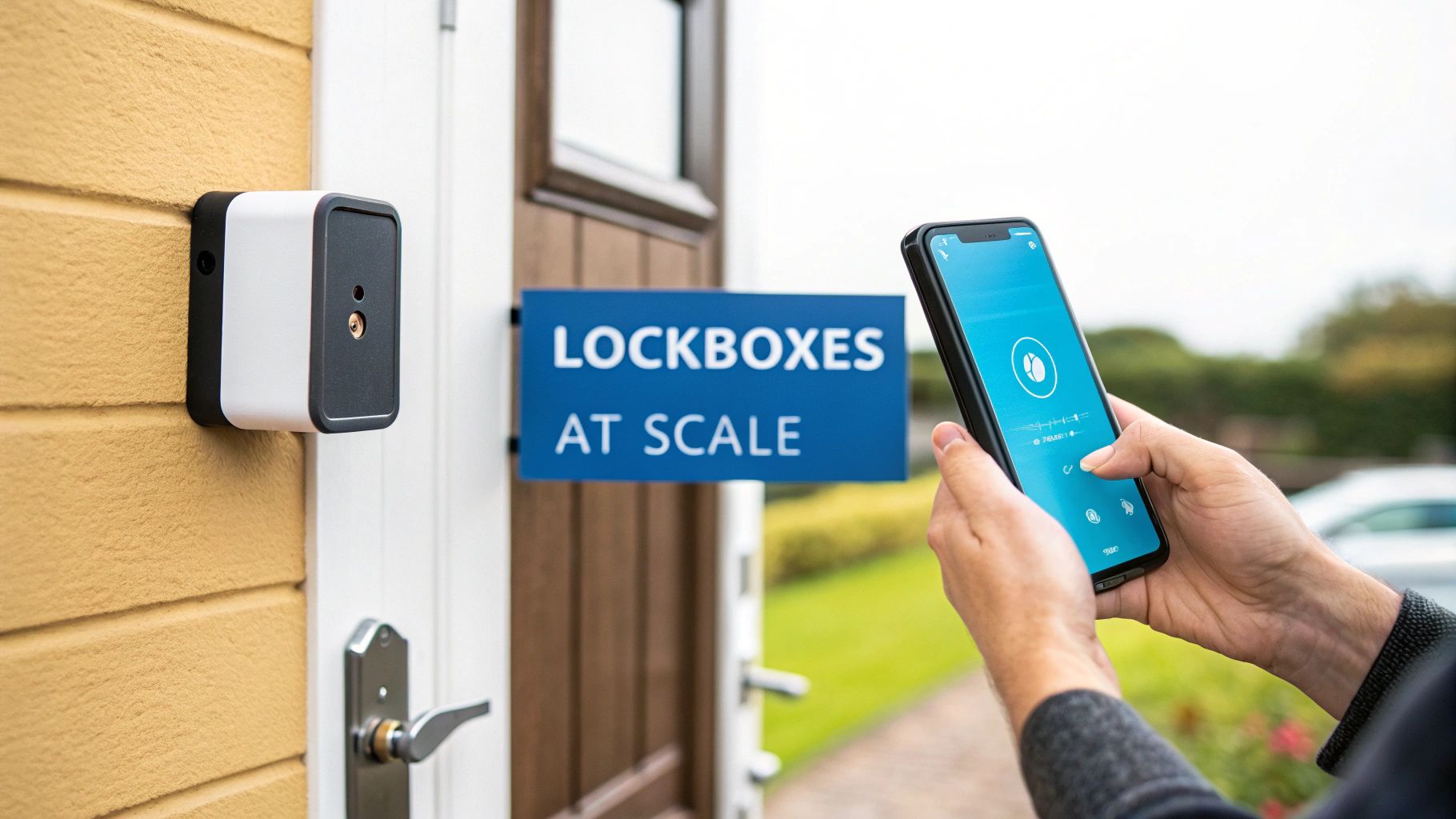
At their core, real estate lockboxes are secure containers for holding property keys. But for property management companies juggling hundreds—or thousands—of units, they're critical operational tools that directly impact revenue.
The technology has evolved far beyond simple combination boxes. Today's smart systems are designed to accelerate the leasing process, slash vacancy costs, and provide the data-driven control required to manage a distributed portfolio efficiently.
Why Lockboxes Are Critical for Scaling Property Management Operations
For any large-scale property management company, the primary bottleneck is almost always coordinating access across a dispersed portfolio. Every manual key handoff, every delayed showing, every minute an agent spends driving across town—it's a direct hit to your operational efficiency and your cost per door.
This is where a strategic lockbox system stops being a "tool" and becomes the engine for scalable growth.
A well-implemented smart lockbox system transforms the logistical nightmare of showings into an automated, revenue-generating machine. Instead of your team playing keychain traffic controller, they can focus on high-value tasks: nurturing qualified leads and executing leases. When evaluating management solutions, it's essential to ask specific questions to ask a property management company about how they leverage technology like lockboxes to streamline operations.
The market has already embraced this shift. The global key lock box market is projected to reach USD 1.9 billion by 2033. More telling, in 2024, over 60% of real estate professionals reported using digital lockboxes, a significant jump from just 35% in 2020, signaling a clear industry trend toward automation. You can learn more about these key lock box market trends.
By automating property access, large-scale property managers can reduce administrative workload by an estimated 25%. This isn't just about convenience; it’s about building a scalable system that drives down your Days on Market (DOM), directly boosting your bottom line and enabling faster portfolio expansion.
Comparing Lockbox Types for Your Portfolio
Selecting the right lockbox is a critical decision that directly shapes your operational efficiency, security, and cost per door. When managing a large, distributed portfolio, this is about deploying an entire access system that can scale across thousands of properties without creating logistical chaos.
The choice comes down to balancing upfront investment with long-term operational savings and risk mitigation.
A traditional combination lockbox is the operational equivalent of leaving a key under the doormat. It’s cheap, but it offers zero visibility, control, or data. For a multi-market portfolio, this approach introduces significant security risks and operational friction.
In contrast, a smart lockbox acts as a modern security and access management system for your vacant units. It provides real-time logs of who enters and when, allows remote generation of time-sensitive access codes for prospects and vendors, and integrates directly with your property management software (PMS). It transforms property access from a manual, high-touch chore into a streamlined, automated workflow that directly impacts revenue.
Traditional Combination Lockboxes
These are the mechanical lockboxes real estate professionals have used for decades, operating with a manually set code on a dial or push-buttons.
- Pros: The primary advantage is the low cost, typically $20 to $50 per unit. They require no batteries or connectivity, making them simple to deploy.
- Cons: For property managers focused on scale, the drawbacks are substantial. A single, static code shared among agents, vendors, and prospects creates a massive security vulnerability. Every code change requires a physical trip to the property, resulting in wasted time and increased labor costs.
The most critical vulnerability is the complete lack of an audit trail. If a security incident occurs, there is no way to definitively prove who was on-site and when. This exposes your portfolio and your clients to significant liability.
The decision-making process becomes clear when visualized.
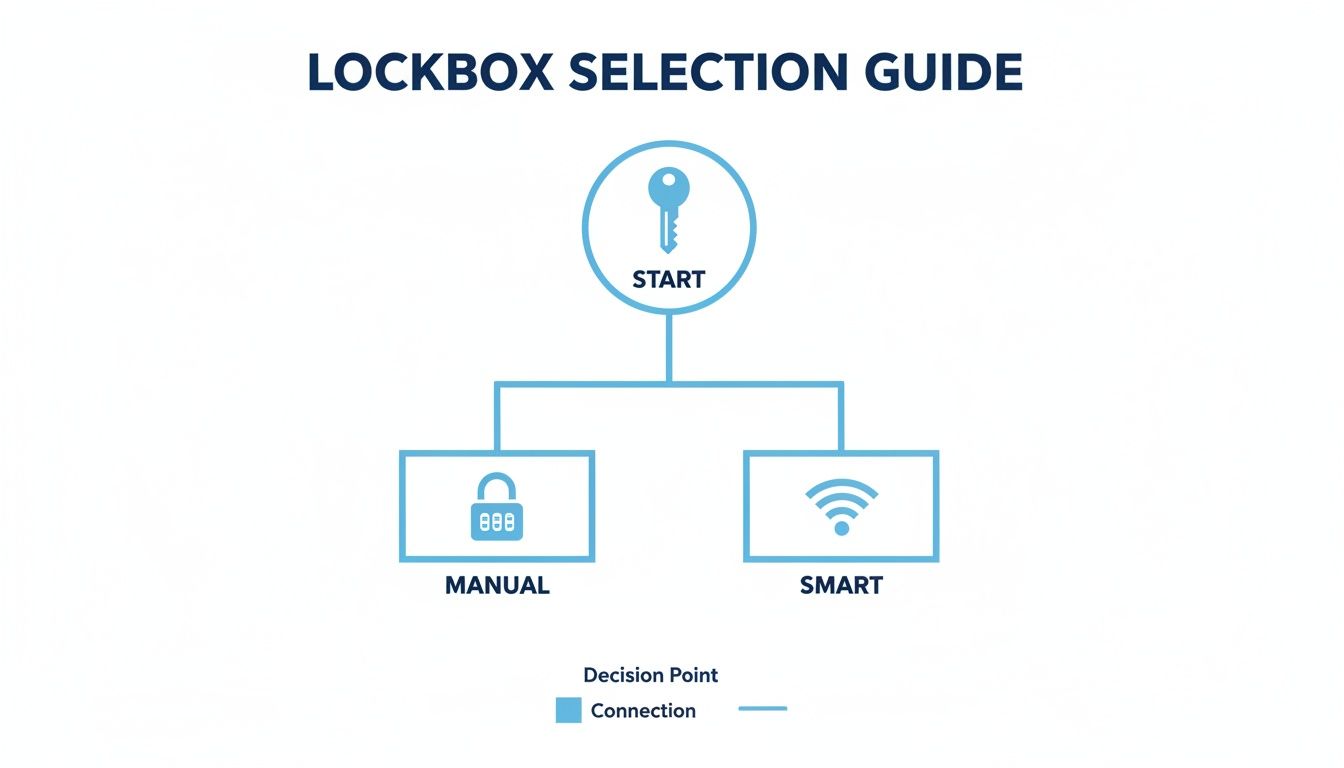
As the flowchart illustrates, there is a clear divergence. Manual lockboxes offer only basic access and hit an operational dead end. Smart lockboxes, however, unlock a path toward enhanced security, data-driven insights, and the automation required for profitable growth.
Electronic and Smart Lockboxes
Electronic and smart lockboxes represent a massive technological leap, designed specifically to solve the operational and security challenges of mechanical lockboxes.
- Electronic Lockboxes: These often use a digital keypad or a Bluetooth connection to a smartphone app. They can generate unique, time-sensitive access codes, which is a game-changer for security.
- Smart Lockboxes: This is the enterprise-grade solution. These lockboxes connect to the internet (typically via a dedicated cellular connection) and integrate directly with your property management software and leasing platforms. For large portfolios, this API integration is where the true ROI is realized.
If your core mandate is to slash Days on Market and improve lead-to-tour conversion rates, the choice is clear. With an integrated system, you can enable self-showings with a smart lockbox, automating the entire top of your leasing funnel. A prospective tenant can find a listing, schedule a tour, complete ID verification, and receive a one-time access code—all without any manual intervention from your team.
That speed-to-lease has a direct and measurable impact on your revenue.
Here is a side-by-side comparison of how these technologies meet the demands of a growing property management enterprise.
Lockbox Technology Comparison for Property Portfolios
This table compares key features, security, scalability, and costs to help large-scale property managers select the optimal access solution for their operational needs.
Ultimately, while the initial capital expenditure for a smart lockbox is higher, the long-term ROI from reduced labor costs, minimized vacancy loss, and enhanced security makes it the clear choice for any property manager focused on scaling their portfolio efficiently.
Key Security and Durability Features to Look For
When deploying an access system across hundreds or thousands of properties, security and reliability are paramount. Choosing the right lockboxes real estate technology is about implementing a system that minimizes liability and protects your assets 24/7, especially in a remote management context.
The difference between a consumer-grade device and an enterprise solution lies in data and control. When a dispute arises over property access, a precise, timestamped log is infinitely more valuable than a verbal account. That is the operational certainty that modern lockboxes deliver.
Digital Security and Access Control
For remote property management, digital safeguards are your first line of defense, enabling you to grant access with confidence from anywhere.
Key requirements for enterprise-grade security include:
- End-to-End Encryption: Data transmitted between the lockbox, mobile app, and cloud servers must be encrypted to prevent interception and unauthorized access.
- Immutable Audit Trails: A non-negotiable feature for managing large portfolios. You need a complete, unalterable record of every access event—who, when, and for how long. This is critical for security, dispute resolution, and operational oversight.
- Remote Access Revocation: If an agent leaves your company or a prospect cancels a tour, you must be able to revoke their access instantly from your central dashboard.
The ability to generate unique, time-sensitive access codes is the single greatest security advancement over mechanical lockboxes. It ensures every entry is tied to a specific individual and a defined time window, drastically reducing the risk of unauthorized access across your entire portfolio.
Physical Durability and Reliability
A lockbox’s digital security is meaningless if it can be physically compromised or fails in adverse weather. For a distributed portfolio, a single device failure can derail a day of showings, resulting in lost leads and costly emergency site visits.
A lockbox must be built to withstand real-world conditions.
Key durability markers to look for:
- Weather Resistance: The device must function reliably in extreme heat, cold, rain, and snow. Look for official IP ratings (e.g., IP65) that certify its resistance to dust and water ingress.
- Tamper-Proof Construction: The best lockboxes are constructed from reinforced steel or zinc alloys to resist drilling, prying, and brute-force attacks.
- Long Battery Life: For smart lockboxes, a battery life of 12+ months is essential to minimize maintenance. The system must also provide proactive low-battery alerts, allowing for scheduled replacements without disrupting leasing operations.
How to Integrate Lockboxes with Leasing Automation
A smart lockbox is a powerful tool, but its true value is unlocked when integrated with your leasing automation software. This synergy transforms a piece of hardware into the engine that drives your entire leasing operation, delivering measurable ROI.
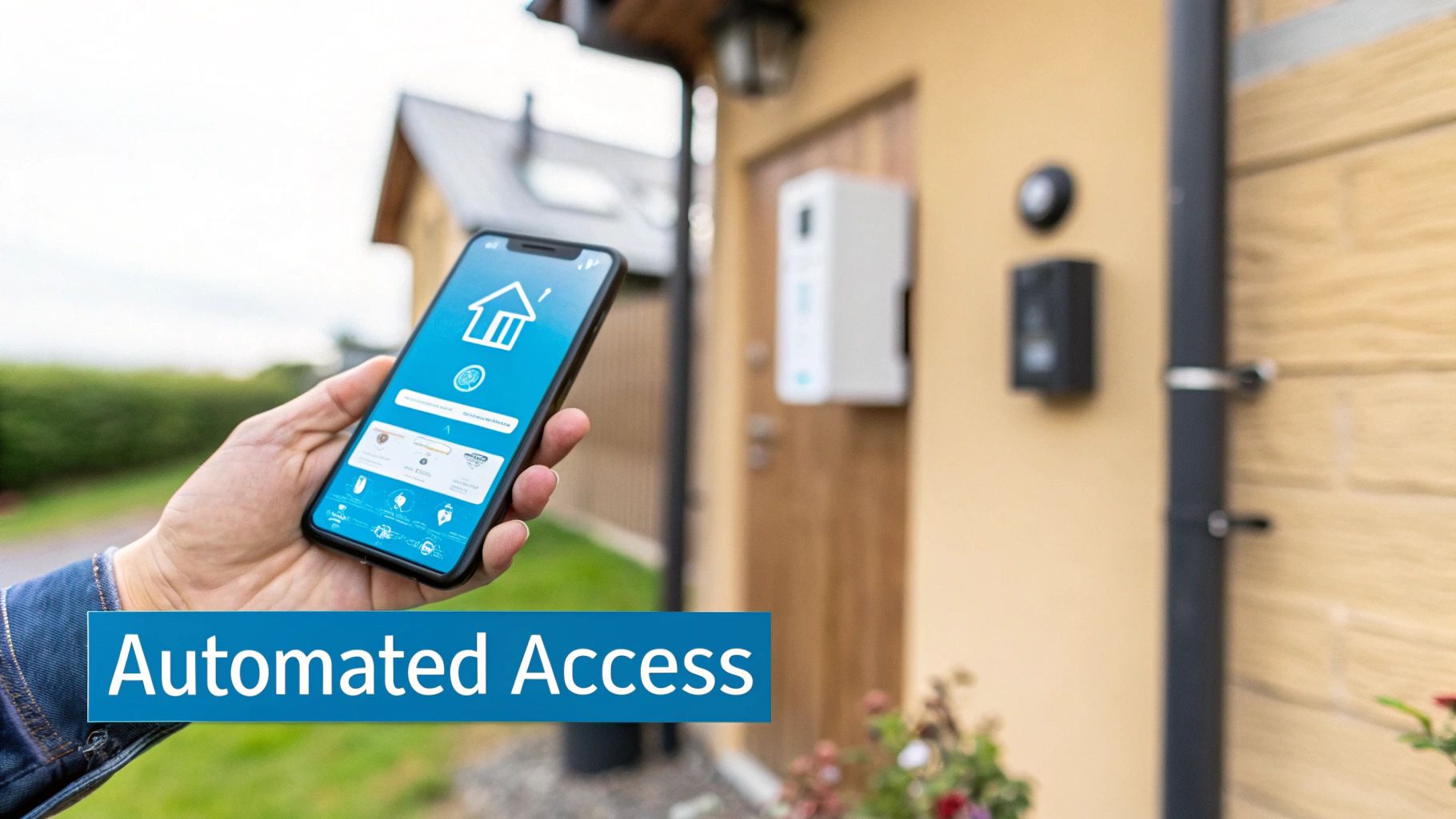
Consider the streamlined, automated workflow this enables. A prospective renter finds your listing online and schedules a tour instantly. Your system automatically verifies their identity and, upon approval, generates a unique, one-time access code for the smart lockbox. The code is sent directly to their phone, granting secure, temporary access to the property.
This hands-off process eliminates the need for your team to manage code spreadsheets, coordinate key handoffs, or field calls for simple tour scheduling. You are systemically removing the most common bottlenecks in the leasing cycle.
Driving Revenue Through Integrated Access
The financial impact of this integration is significant. By offering on-demand, self-guided tours, you dramatically reduce the time from lead to tour. A qualified renter can go from discovering your listing to physically viewing the property in minutes, not days. This speed is critical for converting high-intent prospects before they are captured by competitors.
This automated workflow frees up your leasing agents from low-value administrative tasks, allowing them to focus entirely on nurturing qualified leads and closing deals. Instead of managing keys, they're managing relationships and driving revenue.
Industry data supports this model. The global smart lock market, closely linked to lockboxes real estate technology, was valued at USD 4.92 billion in 2024 and is projected to hit USD 21.31 billion by 2032. This growth is driven by tangible results. Property managers offering self-tour options report reducing showing no-shows by 35%, boosting lead-to-tour conversion rates by 15-20%, and cutting average vacancy periods significantly.
The Broader Automation Ecosystem
To maximize ROI, view lockboxes as a key component of a larger automation ecosystem. Integrating them with your other proptech tools creates a powerful flywheel effect. For a deeper dive, it's worth understanding the broader world of real estate marketing automation software to streamline the entire leasing funnel.
This level of integration is fundamental to building a property management operation that can scale, especially for remote or multi-market portfolios. It provides the technological backbone to manage thousands of doors without requiring on-site staff for every leasing activity, standardizing your processes across your entire portfolio.
To see the full potential, explore these new tools for leasing automation that are reshaping the industry. Ultimately, connecting your hardware to your core software transforms a key-holding device into a strategic asset that reduces your Days on Market and increases net operating income.
Best Practices for Managing Lockboxes at Scale
Deploying hundreds or thousands of lockboxes requires a robust operational playbook. Without standardized processes, you risk security gaps, lost productivity, and a poor prospect experience that hurts your lead-to-tour conversion rates.
Success at scale is built on consistency. Every member of your team, from leasing agents to maintenance technicians, must follow the exact same procedures for every device. This ensures a reliable, predictable system across your entire portfolio, regardless of geographic location.
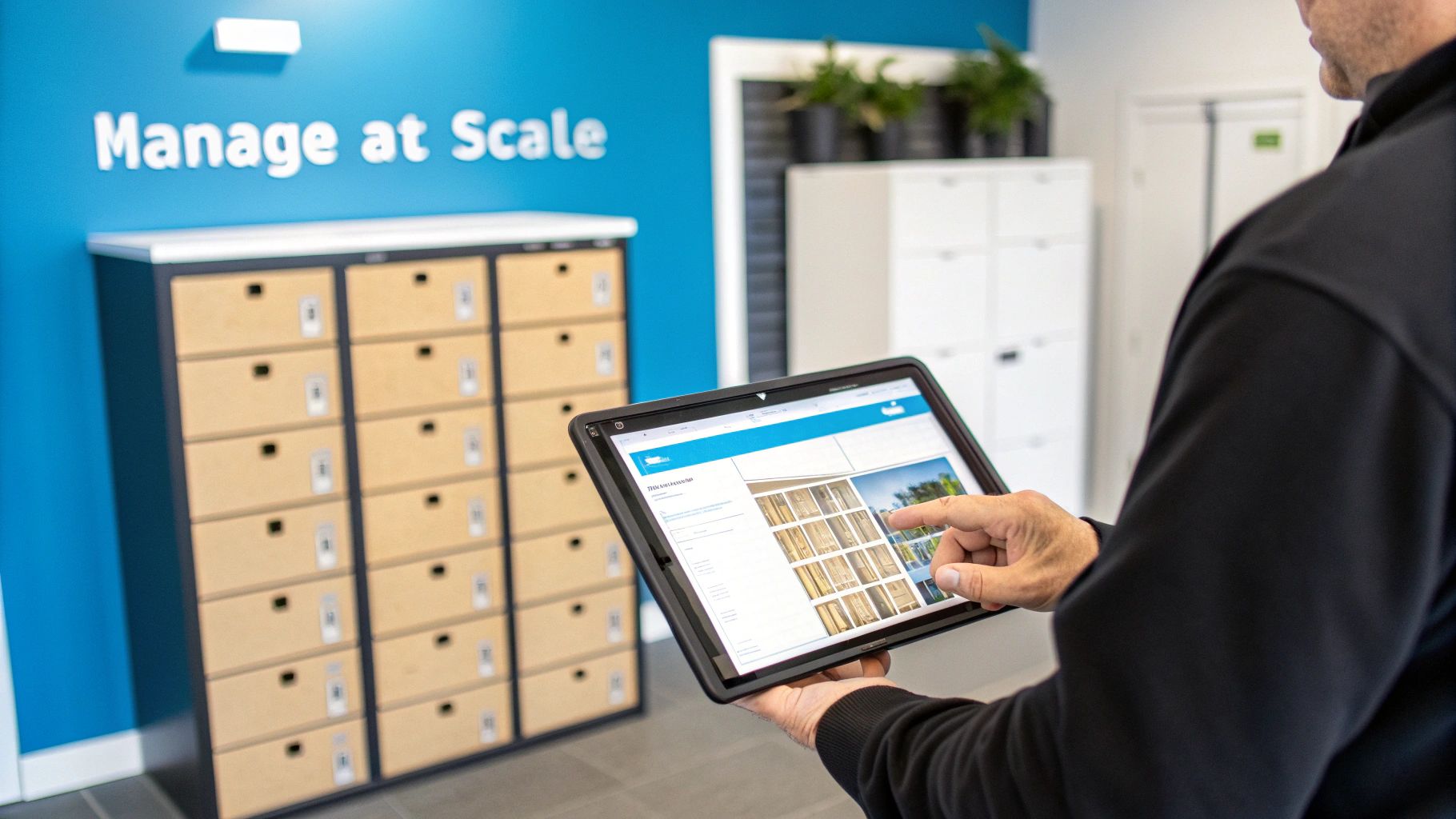
Establish a Centralized Inventory System
You must maintain a single source of truth for your entire lockbox fleet, ideally within your Property Management Software (PMS).
Your inventory system must track:
- Device Serial Number: The unique identifier for each lockbox.
- Assigned Property Address: Linking the device to a specific unit.
- Installation Date: For lifecycle management and warranty tracking.
- Last Battery Change: Critical for proactive maintenance scheduling to prevent device failure.
This data allows you to run reports, identify devices needing service, plan deployments for new acquisitions, and maintain a complete audit trail. Centralized visibility prevents lockbox loss during property turnover and reduces unnecessary replacement costs.
Implement Strict Access Protocols
Standardizing how access codes are generated, shared, and revoked is non-negotiable for large portfolios. You must move beyond the security risks of static, shared codes.
The gold standard for large-scale operations is an integrated platform that automates code management. A system that generates a unique, time-sensitive code for every verified prospect or vendor is the most effective way to minimize liability and maintain a complete access log.
Your access protocol checklist should include:
- Automated Code Generation: Codes are created automatically upon showing confirmation, eliminating manual entry.
- Time-Limited Access: Each code expires shortly after the scheduled tour ends, preventing unauthorized re-entry.
- Instant Revocation: Your team must have the ability to remotely and instantly revoke access for any user at any time.
Standardize the Turnover Workflow
A clear, repeatable process for lockbox management during tenant turnover is essential for maintaining security and readiness. Old keys or codes must not compromise the safety of a new resident.
This turnover workflow should be a mandatory part of your make-ready checklist. It ensures every unit is secure and prepared for showings the moment it becomes available, which directly contributes to Days on Market (DOM) reduction. By embedding these practices into your standard operating procedures, you transform your lockboxes from simple hardware into a strategic tool for scaling your operations efficiently.
Calculating the ROI of Your Smart Lockbox Investment
When evaluating an upgrade to smart lockboxes, focusing solely on the upfront hardware cost is a mistake. This is not an expense; it is a strategic investment in operational efficiency that directly increases your portfolio's net operating income (NOI).
For property managers overseeing large portfolios, the ROI is realized through improvements in key performance indicators like Days on Market (DOM), labor efficiency, and direct operational costs. The true value is found in the operational savings and accelerated revenue generation.
Every day you shave off your average vacancy period translates directly into captured revenue.
Breaking Down the ROI Formula
A practical ROI calculation quantifies the financial impact, creating a powerful business case for the investment.
Your formula must account for:
- Reduced Vacancy Costs: Calculate the revenue gained for every day your DOM is reduced across the portfolio.
- Labor Savings: Quantify the hours your team saves by eliminating manual key management, travel for showings, and scheduling coordination.
- Material Cost Reduction: Sum the savings from no longer needing to re-key properties between tenants. At scale, this is a significant expense.
Let’s model a scenario for a 1,000-unit portfolio with an average rent of $1,800/month (approx. $60/day). If implementing smart lockboxes and automated showings reduces your average DOM by just seven days, the financial impact is substantial.
Calculation Example: 7 days x $60/day = $420 in recovered revenue per vacancy. Assuming a 50% annual turnover rate (500 units), this operational improvement generates $210,000 in additional annual revenue.
This analysis demonstrates that the initial investment is quickly recouped, turning the technology into a significant profit center. For more strategies on improving your bottom line, explore our guide on 8 ways to boost ROI for property managers.
Your Top Questions About Real Estate Lockboxes, Answered
Implementing a portfolio-wide lockbox system naturally raises operational questions. Here are answers to common concerns from large-scale property managers.
Are Smart Lockboxes Secure Enough for Unoccupied Properties?
Yes, they are significantly more secure than mechanical lockboxes. A traditional lockbox uses a single, static code, creating a major vulnerability. An enterprise-grade smart lockbox system provides layered, dynamic security for each property.
Key security advantages include:
- Unique, Time-Sensitive Codes: Access is granted to a specific individual for a predefined time, eliminating the risk of shared codes.
- Detailed Audit Trails: You have an immutable digital record of every entry—who, when, and for how long.
- Instant Access Revocation: Access can be revoked remotely and instantly from your central dashboard, neutralizing threats immediately.
How Do I Manage Battery Life Across Hundreds of Units?
This is a critical operational consideration at scale. Leading smart lockbox providers have engineered solutions specifically for this challenge.
Look for models with a battery life of 12 months or longer.
The crucial element is the software. Your management platform must provide proactive, automated low-battery alerts. This allows your maintenance team to perform battery swaps during routine property visits, preventing device failures that can disrupt showings and negatively impact your lead-to-tour conversion rate.
What Happens If a Smart Lockbox Loses Its Internet Connection?
Enterprise-quality smart lockboxes are designed for high reliability. The best models do not depend on a property's local Wi-Fi, instead using their own dedicated cellular connections for superior uptime.
Furthermore, top-tier systems cache access credentials directly on the device. This means that even if the lockbox temporarily loses its connection to the cloud, any pre-authorized access codes will continue to function seamlessly. Showings proceed without interruption, ensuring a consistently positive prospect experience and maintaining the velocity of your leasing funnel.
Ready to slash your Days on Market and automate your entire showing process? Showdigs integrates best-in-class lockbox technology with a full suite of leasing automation tools designed for property managers at scale. Learn how Showdigs can transform your operations.
.png)

.png)