



When you're managing hundreds, or even thousands, of doors, AppFolio tenant screening stops being a simple checklist item. It becomes a critical lever for portfolio performance, directly impacting revenue, operational efficiency, and your Days on Market (DOM). It’s your command center for vetting applicants at scale, pulling background checks, and making data-backed decisions that minimize risk without slowing down your leasing velocity.
Building a Scalable Tenant Screening Framework in AppFolio

This guide is for property management companies focused on scaling operations. We’re moving beyond the basics to build a strategic framework for using AppFolio screening across a large, distributed portfolio. The goal is to shift from a reactive, unit-by-unit task to a standardized, automated system that cuts vacancy costs, improves lead-to-lease conversion rates, and elevates tenant quality across your entire portfolio.
It’s about creating a repeatable process that removes guesswork and drastically shortens the time from lead to a signed lease. A properly configured AppFolio workflow is your first line of defense against costly vacancies, ensuring every decision is consistent and compliant.
The Financial Impact of an Optimized Screening Process
For large portfolios, every single day a unit sits vacant is a direct revenue leak. A slow, manual screening process can easily add 5-7 days to your DOM, which, across thousands of units, translates into significant lost income.
Conversely, a systematized approach delivers measurable ROI:
- DOM Reduction: Faster, more decisive screening means quicker approvals and signed leases. Reducing your average DOM by just a few days can add tens of thousands of dollars back to your net operating income annually.
- Higher Tenant Quality: Applying consistent, data-driven criteria helps you select more reliable residents, which reduces turnover, delinquencies, and costly evictions.
- Mitigated Compliance Risk: Automation is your best tool for minimizing human error and avoiding Fair Housing violations, which can lead to costly litigation.
- Improved Operational Scalability: A standardized framework allows your team to manage a growing number of units without a proportional increase in headcount, directly improving your cost-per-door efficiency.
At scale, your tenant screening process is a financial lever. Optimizing it isn't just about finding good tenants; it’s about protecting asset value and maximizing portfolio-wide returns. For a 1,000-unit portfolio with an average rent of $1,500, cutting just one day off your average DOM translates to recapturing $50,000 in annual revenue.
Ultimately, this is about building a system that fuels growth, not one that restrains it. For a deeper dive into the fundamentals, this ultimate guide to property management tenant screening is a great resource.
How to Configure Screening Criteria for Consistency and Speed
For large portfolios, "gut feeling" is a liability. It's inconsistent, legally perilous, and, most importantly, slow. Every minute your team spends debating an application is another minute a unit sits vacant, eroding your revenue.
The solution is to build a clear, consistent, and automated set of screening criteria directly within AppFolio. This is about creating a repeatable system that eliminates guesswork and empowers your team to make fast, defensible decisions aligned with your portfolio's risk profile.
AppFolio transforms complex screening data into a simple, actionable "Approve" or "Deny" recommendation, enabling rapid decision-making.
By defining these rules upfront, you build an automated gatekeeper that flags applicants, minimizes human error, and helps you convert qualified leads into leases faster.
Defining Your Core Screening Pillars
A robust screening framework in AppFolio rests on a few key pillars. By defining these parameters ahead of time, you guarantee every applicant is measured against the same objective standards—a non-negotiable for Fair Housing compliance at scale.
- Credit Score Thresholds: Establish clear minimum credit scores. Best practice is to create different profiles for different property classes. A Class A property in a competitive urban market might require a 700 minimum, while a Class C asset could be set at 620. This aligns risk tolerance with asset strategy.
- Income-to-Rent Ratios: The industry standard is typically 3x the monthly rent, but this should be market-specific. AppFolio allows you to set this as a firm rule, automatically flagging any applicant who falls short.
- Criminal Background Parameters: Precision is critical for compliance. Avoid blanket bans. Instead, define specific look-back periods and categories of offenses relevant to resident safety and property. For instance, you might flag certain felonies within the last seven years while disregarding older, unrelated misdemeanors, adhering to local and federal guidance.
- Rental and Eviction History: Clearly define what constitutes a clean rental history. This could mean no evictions within the last five years or no outstanding debts owed to previous landlords.
Building Tiered Screening Profiles for Portfolio Management
If you manage a diverse portfolio, a one-size-fits-all screening policy is inefficient and increases risk. A key strength of AppFolio is the ability to create multiple "Screening Configurations," letting you design tiered profiles for different properties, markets, or asset classes.
Think of a well-defined screening profile as an automated gatekeeper. It ensures that only applicants who meet your baseline criteria advance, freeing up your leasing agents to focus on converting qualified prospects, not sifting through unqualified leads.
For example, your configurations for a multi-market portfolio could be broken down like this:
This structured approach transforms your AppFolio tenant screening into a strategic operational tool. It standardizes decisions across your entire team, whether they oversee 100 units or 1,000. That level of consistency is crucial for reducing your Days on Market (DOM) and is a core part of effective prospect screening to find your ideal tenants. By automating these rules, you empower your team to approve qualified applicants in minutes, not days.
Reading Screening Reports to Make Defensible Decisions

Once an AppFolio screening report is generated, the real work begins. For enterprise-scale property managers, this isn't about a simple pass/fail. It’s about making data-backed leasing decisions that are both profitable and legally defensible. Knowing how to interpret these comprehensive reports is a non-negotiable skill for any high-performing leasing team.
It means looking beyond a single number like a credit score and digging into the applicant's complete financial and rental history. This holistic approach is your best defense against delinquencies and costly evictions that can destroy a property's ROI.
Beyond the Credit Score: A Holistic Review
A credit score is a snapshot, not the full story. An AppFolio report provides the context needed to understand an applicant's true financial stability.
Here’s what your team should focus on:
- Payment Histories: Look for patterns of late payments, especially on rent or utilities. A consistent track record of on-time payments is one of the strongest predictors of a reliable resident.
- Debt-to-Income Ratio: How leveraged is the applicant? High levels of revolving debt or personal loans could signal financial distress, even with a satisfactory credit score.
- Eviction Records: This is a major red flag. AppFolio's integration with Experian RentBureau provides a detailed rental history, making it easy to identify prior evictions or judgments owed to previous landlords.
This detailed review is more critical than ever. The global tenant screening market is projected to reach USD 3.66 billion by 2032, driven in part by rising application fraud. Recent data from NMHC reveals that 93.3% of property managers encountered fraudulent applications in the last year, with 70.7% reporting an increase. This underscores why a superficial review is no longer sufficient. You can learn more about the tenant screening services market growth and its drivers.
A defensible leasing decision is one backed by a clear, consistent, and documented process. When every approval, denial, or conditional offer is tied directly to your pre-set criteria and noted in AppFolio, you create an audit trail that protects your business from compliance challenges.
Decoding the AppFolio Tenant Screening Report
An AppFolio report is dense with information. Knowing where to look and what it means is key to making a quick, accurate assessment.
Here's a framework for your team to review key sections:
By systematically reviewing each of these components, your team moves from subjective assessment to a data-driven decision. This not only helps you select better tenants but also creates a consistent, defensible process for every applicant across your portfolio.
Handling Conditional Approvals and Denials
Not every application is a clear "yes" or "no." For applicants in the gray area—perhaps due to a borderline credit score or limited rental history—conditional approvals are a valuable tool. You might require a larger security deposit or a qualified co-signer to mitigate the perceived risk.
When denying an applicant, process and documentation are paramount. AppFolio helps automate the creation of adverse action notices, which is critical for FCRA compliance. Every decision, especially a denial, must be logged with a clear reason that links directly back to your written screening criteria.
For a large portfolio, this isn't just best practice—it's a critical risk management strategy. It ensures every leasing choice is uniform, defensible, and protects your entire operation.
Navigating Compliance to Mitigate Portfolio-Wide Risk
For any property management company operating at scale, compliance isn't a department—it's a core business function. A single misstep in your tenant screening process can expose your entire portfolio to legal and financial jeopardy. Navigating the complex web of regulations like the Fair Credit Reporting Act (FCRA) and the Fair Housing Act (FHA) demands an ironclad, standardized process.
This is where a platform like AppFolio becomes your operational backbone. By embedding key compliance steps directly into your workflow, you dramatically reduce the risk of human error and ensure every applicant is evaluated against the same objective, non-discriminatory criteria. Consistency is your best defense against a bias claim.
An Actionable Compliance Checklist for Scaled Operations
To protect your portfolio, every leasing decision must be defensible. AppFolio’s built-in tools are designed to create a clear, automated audit trail for every application.
Here’s a practical framework for keeping your team on the right side of the law:
Obtain Explicit Consent: Before running any background or credit check, you must have documented consent from the applicant. AppFolio’s online application process handles this automatically, capturing a digital record that’s stored with the applicant's file.
Apply Criteria Uniformly: This is non-negotiable. Your pre-defined screening criteria must be applied to every single applicant, every time, without exception. Automation removes subjective judgment from the process, ensuring decisions are based on data, not unconscious bias.
Automate Adverse Action Notices: If you deny an applicant or approve them with conditions based on information in their screening report, you are legally required to send an adverse action notice. AppFolio automates this process, generating standardized, FCRA-compliant letters with all required disclosures.
When you're managing hundreds or thousands of doors, manual compliance is a massive liability. The goal is to set up a system where the compliant path is also the easiest one for your team to follow. AppFolio's workflows make consistency the default, not an afterthought.
Using Technology for Bulletproof Compliance
The right technology doesn't just improve efficiency; it serves as a critical safeguard. A 2023 AppFolio survey highlighted that 89% of renters preferred its FolioScreen™ Trusted Renter experience, signaling the value of a process that is fast, transparent, and compliant.
For PMCs with properties distributed across different markets and regulatory environments, this level of standardization is invaluable. You can learn more about how AppFolio enhances the tenant screening experience on their website.
By embedding compliance directly into your AppFolio tenant screening workflow, you transform a high-risk manual task into a scalable, automated, and defensible business process. This is how you protect your portfolio from expensive litigation and build a foundation for sustainable growth.
Integrating Screening into Your Automated Leasing Funnel
Effective screening doesn't happen in a vacuum. For large-scale property managers, it must be a seamless, integrated component of a larger automated leasing funnel designed to minimize Days on Market (DOM) and maximize team efficiency.
The strategic goal is to stop wasting your leasing agents' valuable time on leads that will never qualify. Instead, they should focus their efforts on high-intent, pre-vetted prospects ready to sign a lease.
This is where integrating your AppFolio tenant screening process with leasing automation tools creates a powerful competitive advantage. Imagine a lead comes in, is instantly pre-qualified against your basic criteria, and self-schedules a showing. Immediately after the tour, they are automatically prompted to complete the formal AppFolio application. This integrated workflow can shave days, or even weeks, off your lead-to-lease cycle.
From First Contact to Signed Lease: An Automated Workflow
By automating the top of your leasing funnel, you build a system that works 24/7 to filter and advance only the most promising applicants. This frees up your leasing agents to focus on high-value activities that close deals.
This integrated process ensures every step—from consent to screen to action—is handled consistently and compliantly.
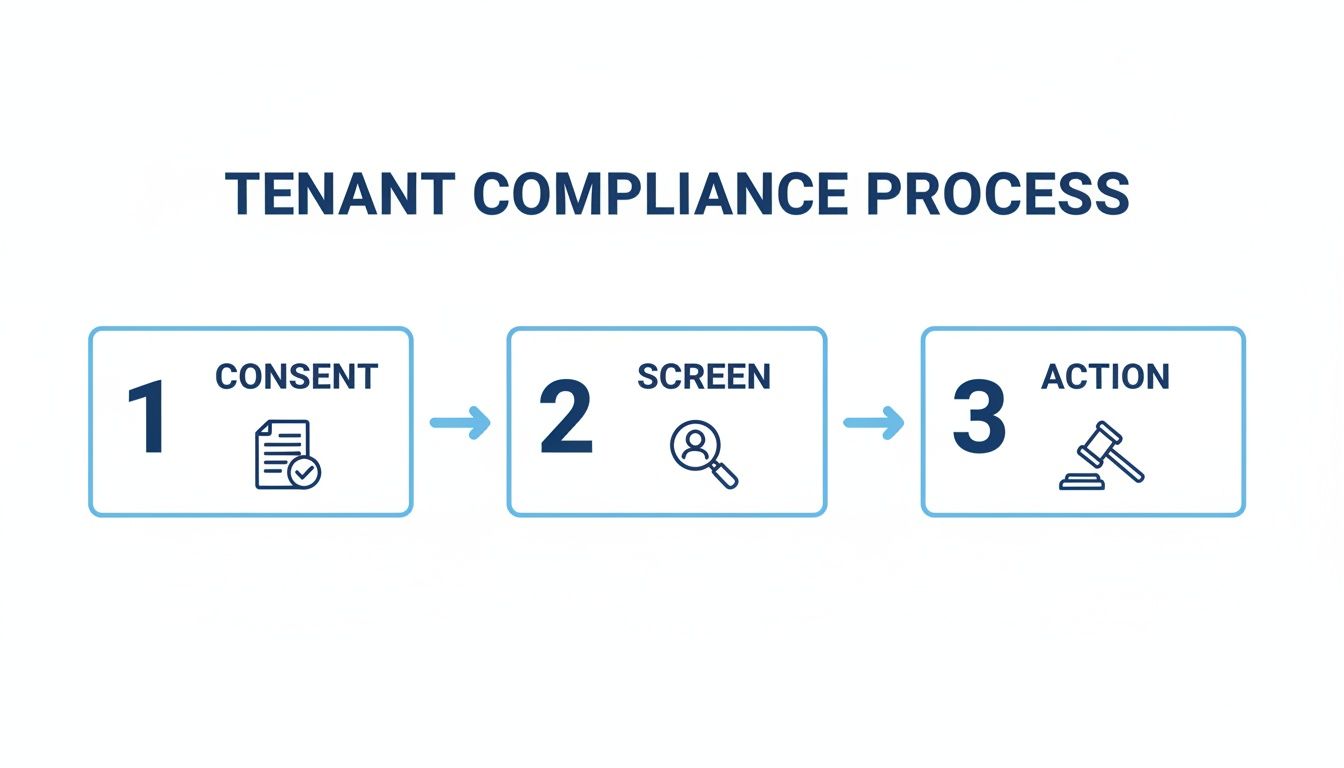
This simple, structured workflow leads directly to faster, more defensible leasing decisions at scale.
The impact on your key operational metrics is significant. By eliminating the manual back-and-forth of scheduling and initial qualification, you can dramatically lower your average DOM. Furthermore, your lead-to-tour and tour-to-application conversion rates increase because you are nurturing higher-quality prospects from the very first interaction.
The Financial Impact of an Integrated Funnel
A streamlined leasing process isn't just about operational efficiency; it translates directly to better financial performance and higher resident retention. AppFolio's 2023 Renter Preferences Report found that renter satisfaction is on the rise, with 66% of renters satisfied with their property managers—a notable increase from 55% the prior year.
This improvement is closely linked to modern, efficient digital processes. When screening is integrated and seamless, you select higher-quality residents who contribute to a more stable community. With 57% of satisfied renters stating their property manager is a key reason they would renew, the link between a superior leasing experience and long-term asset performance is undeniable. You can dive into more renter preferences and satisfaction data on Multifamily Executive.
When your leasing automation platform communicates directly with your property management system via API, you create a single source of truth. Data flows seamlessly, eliminating manual entry errors and providing a complete view of a prospect's journey from initial inquiry to resident.
By building this automated bridge, you not only improve your own metrics but also enhance the entire applicant experience. This modern approach attracts better tenants, reduces costly vacancies, and ultimately drives profitability across your entire portfolio.
To see how this works in practice, explore the Showdigs and AppFolio integration and learn how it automates these critical leasing steps for large portfolios.
Your AppFolio Screening Questions, Answered
Got questions about optimizing AppFolio's tenant screening for a large portfolio? Here are direct answers to common questions from operations directors and portfolio managers.
How Can I Create Different Screening Criteria for Different Properties?
This is essential for managing a diverse portfolio, and AppFolio handles it effectively with its Screening Configurations feature.
Think of these as unique profiles you build for different asset classes. You can have a "Class A Multifamily" configuration with stringent credit and income requirements and a separate "Suburban SFR" profile with more flexible criteria. When a new application is submitted, you simply assign the correct configuration. This enforces consistent, property-specific standards across your portfolio without manual oversight.
Does AppFolio Help with Sending Adverse Action Notices?
Yes, and this is one of its most critical compliance features for scaled operations. When you must deny an applicant or approve them with conditions (e.g., a higher deposit) based on their screening report, AppFolio can generate and send the adverse action notice for you.
The system automatically populates the letter with all the required FCRA disclosures and credit bureau contact information, mitigating a significant legal risk for your team.
At scale, you can't afford to leave compliance up to chance. Automating adverse action notices isn't just a convenience; it's a necessity. It removes the risk of human error from a crucial legal step and gives you a clean audit trail for every single application.
Can I Automate the Initial Screening of Leads Before a Tour?
While AppFolio's deep screening is designed for the formal application stage, you can and should automate pre-qualification much earlier in the leasing funnel.
This is where integrating with a leasing automation tool like Showdigs delivers significant ROI. You can set up automated "knockout questions" that confirm a prospect meets your basic criteria (e.g., income level, move-in date, pet policies) before they can book a tour. This is a game-changer for ensuring your agents only spend time on genuinely qualified leads, which massively boosts your lead-to-tour conversion rate and reduces wasted time.
What Is the Typical Turnaround Time for a Report?
Speed-to-lease is paramount, and a key advantage of AppFolio's integrated screening is the rapid delivery of results, which is crucial for reducing your Days on Market (DOM).
For most reports—including credit and eviction history—the turnaround time is just a few minutes. Criminal background checks may occasionally take longer if they require manual courthouse record pulls, but the process is significantly faster than traditional methods. This speed enables your team to secure qualified tenants before they sign a lease elsewhere.
By integrating Showdigs with your AppFolio workflow, you can automate the top of your leasing funnel. This ensures only pre-qualified, high-intent prospects are scheduled for tours, saving your team countless hours and accelerating your leasing velocity. See how to supercharge your leasing operations.
.png)