



For property management companies managing 1,000+ rental units, scheduling tours with a spreadsheet is like trying to direct airport traffic with a notepad. It’s not just messy—it’s a direct threat to your revenue. Every day a unit sits vacant, you're losing money. This is where call center scheduling systems become the central command for a modern, scalable leasing operation. They transform operational chaos into a predictable revenue engine by capturing every lead 24/7 and slashing costly Days on Market (DOM).
Why Manual Scheduling Fails at Scale
Every time a prospect’s call goes to voicemail or an email sits unanswered for hours, they’re already scheduling a tour with your competitor. This isn't a small hiccup; it’s a massive revenue leak, multiplied across a portfolio of hundreds or thousands of doors. The simple truth is that manual processes cannot keep pace with the speed of today's rental market, where immediate response is expected.
Each missed connection hammers your most critical metrics, from your lead-to-tour conversion rate to your Days on Market (DOM). When a leasing agent is drowning in administrative tasks, they can't possibly jump on every hot lead the second it comes in. That delay is where qualified prospects are lost and revenue evaporates.
The Shift to Automated Leasing Operations
To stop the bleeding, tech-forward property managers are embracing automation. It's part of a much bigger trend in property management. The global contact center software market is expected to explode, growing from USD 72.6 billion in 2025 to USD 172.6 billion by 2030. This signals a massive industry-wide move away from reactive, manual work and toward proactive, automated systems that work around the clock to convert leads.
Instead of relying on scattered notes and overflowing inboxes, every prospect interaction can be tracked, scheduled, and optimized for speed-to-lease.
Capturing Every Opportunity to Reduce DOM
Think of a call center scheduling system as your portfolio's air traffic controller for leasing. It intelligently routes every inquiry to the right place without needing a human to step in, ensuring no lead ever gets dropped.
Here’s what that looks like in a large-scale operation:
- 24/7 Lead Capture: A prospect can book a tour at 10 PM on a Tuesday or 7 AM on a Sunday. You capture their interest the moment it happens—not just during business hours—dramatically increasing your lead-to-tour conversion rate.
- Reduced Vacancy Costs: By getting prospects from inquiry to tour in minutes instead of days, these systems directly shrink your DOM. That’s real revenue back in your pocket, faster.
- Improved Agent Focus: When you automate the tedious scheduling back-and-forth, your leasing team is free to focus on high-value activities: building relationships and closing leases.
For any property management company serious about scaling, this technology is no longer a "nice-to-have." To see how these trends are reshaping the industry, check out our insights on the future of property management.
Key Features That Drive Leasing Performance
High-performing call center scheduling systems are much more than digital calendars. They are sophisticated engines built to shrink the time it takes to get from lead to lease. For property managers with large, distributed portfolios, these features have a direct impact on revenue by slashing vacancies and boosting lead-to-tour conversion rates. They’re the secret to turning a chaotic flood of inbound inquiries into a smooth, efficient leasing machine.
Nail the First Impression: IVR and Smart Routing
The first piece of the puzzle is Interactive Voice Response (IVR). This is your automated front desk, working 24/7 to instantly pre-qualify prospects before they ever speak to a live agent. It asks critical screening questions like, "Are you looking for a pet-friendly unit?" or "What’s your ideal move-in date?" This simple step filters every inquiry, ensuring your leasing agents only spend their valuable time on serious, qualified leads who meet your criteria.
Once a lead is qualified, intelligent call routing takes over. The system doesn't just blindly forward the call; it directs the prospect to the agent best equipped to help them—based on property location, specific expertise, or availability. This creates a seamless handoff and a superior experience for the potential renter, increasing the likelihood of a successful tour booking.
Optimize Your Team and Your Calendar
Great scheduling isn't just about the prospect; it's also about maximizing your team's efficiency. This is where Workforce Management (WFM) features are a game-changer for large portfolios. These tools analyze historical inquiry data to predict peak demand periods. This allows you to staff your leasing team appropriately, avoiding the costly mistake of missing calls during the critical spring leasing season.
To get the most out of your team, understanding the ins and outs of a modern employee scheduling app is a great starting point. These platforms form the backbone of efficient staffing.
Finally, real-time calendar synchronization is what ties it all together. It eliminates the frustrating—and costly—mistake of double-booking a tour for a popular rental. By integrating directly with your Property Management System (PMS) and individual agent calendars, the system guarantees that when a prospect books a showing, that time slot is instantly locked in everywhere. This automation is non-negotiable when managing hundreds of showings across a multi-market portfolio.
For a portfolio with 1,000+ units, wiping out double-bookings and scheduling conflicts does more than just save administrative headaches. It protects your brand's reputation and prevents qualified leads from getting frustrated and moving on to the next listing.
The difference between old-school methods and an automated system is night and day. Here’s a quick look at how they stack up for enterprise property managers.
Manual vs. Automated Scheduling Systems for Property Management
All these features work in concert to build a system that captures every lead, maximizes your team's time, and ultimately accelerates the entire leasing cycle.
This is where a dedicated partner can really move the needle. The Showdigs Live Operations Team, for example, uses this exact technology to give property managers professional, on-demand support that scales right alongside their portfolio.
Calculating the ROI of Automated Scheduling
As any operations director knows, new technology investments must deliver a clear return on the bottom line. A call center scheduling system is no exception. The return on investment (ROI) here isn’t about fuzzy metrics like "saving time"—it's about plugging revenue leaks caused by vacancy and boosting your portfolio's net operating income (NOI).
First, you need to quantify the real cost of a vacant unit. Every single day a property sits empty, it's revenue you will never get back.
The Real Cost of a Vacant Day
Let's calculate the financial impact for a 1,000-unit portfolio where the average rent is $1,800 a month.
- Daily Rent Per Unit: $1,800 / 30 days = $60
- Total Daily Revenue at Stake: 1,000 units x $60/day = $60,000
That math is sobering. For every single day you can shave off your average Days on Market (DOM) across the whole portfolio, you recapture $60,000 in revenue that would have otherwise been lost forever. A small efficiency gain in your leasing process has a massive financial ripple effect.

Connecting Automation to Revenue
This is where automated scheduling proves its worth. Traditional 9-to-5 leasing is a leaky bucket. Prospects search for their next home after work and on weekends, but that’s exactly when most leasing offices are closed. An automated system engages those leads the second they inquire, turning a casual search into a booked tour before that person has a chance to click on a competitor’s listing. This immediate engagement is key to maximizing lead-to-tour conversion.
The data backs this up. In 2023, the average call abandonment rate was a whopping 5.91%, with many callers hanging up after waiting on hold for just over three minutes. Each one of those dropped calls is a lost leasing opportunity. It’s no surprise the market for on-call scheduling solutions is projected to hit USD 3.2 billion by 2028. Property managers are tired of losing revenue to operational friction. You can discover more insights about the on-call scheduling market and its growth drivers.
ROI Calculation: Unlocking Annual RevenueLet's say a 500-unit portfolio implements an automated system and reduces its average DOM by just 5 days.
- Daily Rent Per Unit: $1,800 / 30 = $60
- Revenue Saved Per Vacancy: 5 days x $60 = $300
- Total Annual ROI (assuming 50% annual turnover): 250 units x $300 = $75,000 in additional annual revenue.
That’s a clear financial win, directly attributable to one change: capturing and converting leads more effectively. By turning missed calls and email delays into scheduled showings, an automated system delivers a powerful, measurable ROI that portfolio managers can take to the bank.
Integrating Scheduling Into Your PropTech Stack
A standalone tool, no matter how powerful, creates data silos that will hamstring your operations at scale. For a call center scheduling system to truly drive performance, it must be a seamless extension of your core property management software (PMS). Think of it as creating a single source of truth for your entire leasing funnel—this API-driven connection is what unlocks real operational efficiency across your portfolio.
The bridge between these systems is an Application Programming Interface, or API. An API acts as a universal translator, allowing different software platforms to communicate in real-time. It’s what ensures that when a prospect books a tour through the scheduling system, that information instantly and automatically populates in your PMS.
Eliminating Errors and Manual Work
Without that direct integration, your team gets stuck with the painful—and error-prone—task of manual data entry. An agent takes a call, books a showing, then has to jump over to AppFolio or Rentvine to update the property status and create a guest card. This double-work isn't just a time-sink; it’s a breeding ground for mistakes that lead to double-booked tours and frustrated prospects.
A proper integration makes this entire process frictionless. Key data points flow automatically between systems, including:
- Property Availability: The second a lease is signed in your PMS, that property is automatically pulled from the showing calendar. No more accidental showings on rented units.
- Prospect Information: New leads captured by the scheduling system are instantly created as guest cards in your core database, triggering your established follow-up sequences.
- Agent Calendars: Tour assignments get synced with individual agent calendars in real-time, preventing scheduling conflicts before they happen.
This level of automation is essential for standardizing processes across a multi-market portfolio. It ensures every single lead is handled with the same speed and accuracy, regardless of location. Similarly, understanding how to connect various PropTech services, such as integrating RON services via API, is crucial for building a cohesive ecosystem that just works.
Building a Connected Leasing Ecosystem
The integration process is about mapping data fields and defining automated workflows. For example, you can set a rule that automatically kicks off a follow-up email sequence from your CRM the moment a tour is marked 'complete' in the scheduling platform.
This creates a powerful, interconnected web of tools that work together to nurture leads from their first click to lease signing. This synergy doesn't just make your team more productive; it provides a much clearer, data-driven view of your entire leasing funnel. To see how these connections work in practice, you can explore the various integrations that connect showing platforms to core systems.
A Phased Rollout for Your Entire Portfolio
Trying to launch new technology across a large, distributed portfolio all at once is a recipe for operational chaos. For a call center scheduling system, a rushed deployment leads to confused agents, broken processes, and a wasted investment. The smart approach is a phased rollout. It’s a strategic framework that lets you standardize your process, identify and fix issues, and build momentum before a full-scale launch.
It’s no surprise that the on-call scheduling software market is exploding—it hit USD 3.6 billion in 2024 and is on track to reach a staggering USD 39.7 billion by 2033. This isn't just a tech trend; it's a fundamental shift in how businesses operate. You can read the full research about on-call scheduling software trends to see what’s driving this growth. For property managers, this signals a clear need for a well-thought-out implementation plan to stay competitive.
Phase 1: Needs Analysis and Vendor Selection
Before looking at software demos, take a hard look at your current leasing operations. Map out your lead-to-tour process, step by step. Where are the bottlenecks? Are you losing leads after 5 PM and on weekends? Are double-bookings from manual entry errors hurting your reputation? This internal audit provides a concrete checklist for what your operation actually needs.
When vetting vendors, look for platforms built for the unique challenges of managing distributed portfolios at scale. Zero in on these three critical factors:
- PMS Integration: How deep and reliable is the integration with your core system, whether it’s AppFolio or Rentvine? A clunky connection is a non-starter.
- Scalability: Can the platform handle your current door count and your five-year growth plan without performance degradation?
- Agent Tools: Is the interface intuitive for your leasing team, or is it a confusing system they'll avoid using?
This first phase is about defining what success looks like for your business, so you can choose a technology partner that helps you achieve your specific DOM reduction and lead conversion goals.
This diagram shows how a solid API is the bridge connecting your Property Management System to an automated booking platform, making the whole process seamless.
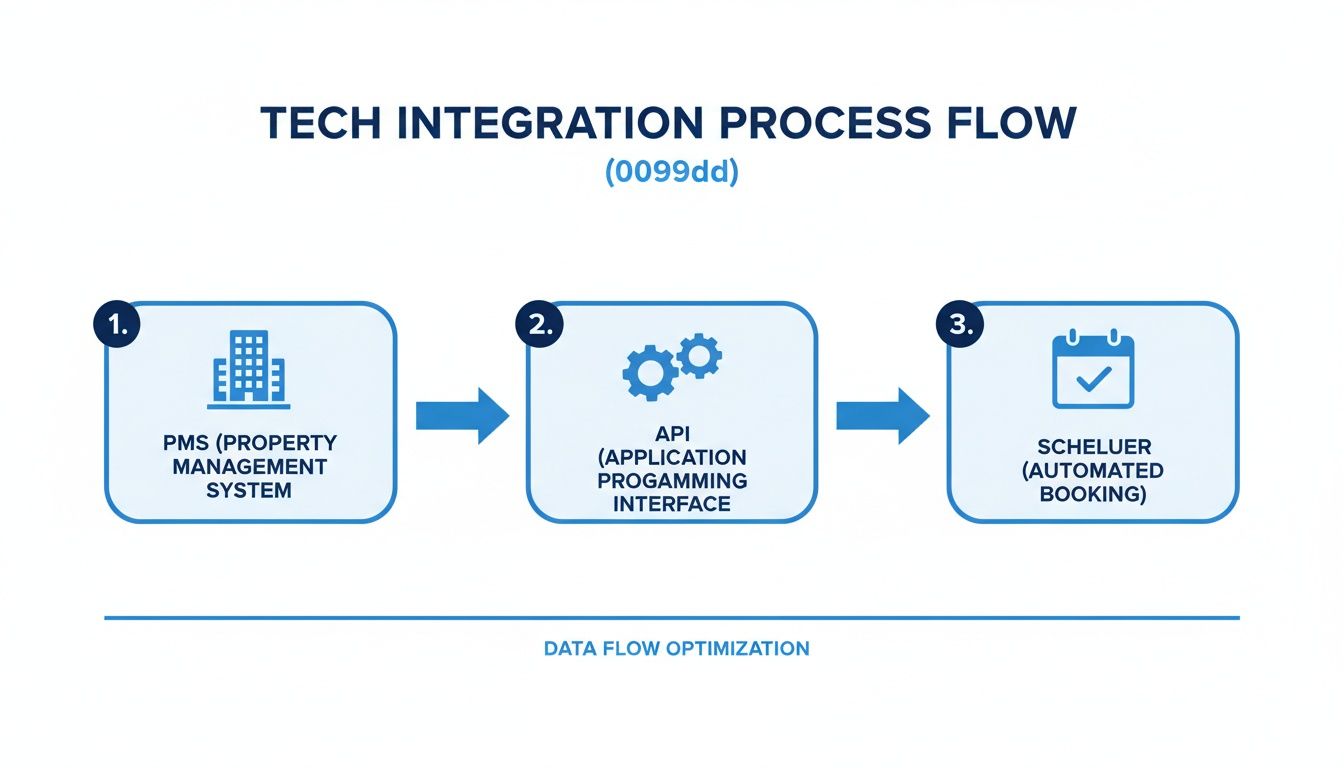
The central idea is that everything hinges on this automated data flow. It eliminates manual grunt work and ensures everyone is operating from a single source of truth.
Phase 2: The Controlled Pilot Program
Once you've selected a vendor, resist the urge to roll it out portfolio-wide. Instead, run a small, controlled pilot program. Choose a sample of 25-50 units in one market and treat it as a test lab. This provides a safe environment to see what works and what breaks in the real world.
The main goals during this pilot are:
- Establish Baseline KPIs: Track your current metrics for lead response time, lead-to-tour conversion rate, and cost-per-lease. You can't measure improvement if you don't know your starting point.
- Refine Training Materials: Use the pilot team's experience to create practical training documents and videos that address real-world scenarios.
- Identify Integration Quirks: No integration is perfect. This is your chance to find and fix any data sync issues before they can cause chaos across your entire portfolio.
The feedback from your pilot team is invaluable. They are on the front lines and will spot friction points that no executive will see. Listen to them—it will make the full launch exponentially smoother.
Phase 3: Portfolio-Wide Launch and Optimization
After a successful pilot, you're ready for the portfolio-wide launch. This phase is about solid execution and clear communication. Announce the rollout well in advance, conduct comprehensive training for all leasing agents, and establish clear support channels for any issues that arise.
But going live isn't the finish line. Continuously monitor your KPIs to measure the real-world impact on your Days on Market and lead conversion rates. Solicit ongoing feedback from your team. The goal is to ensure your new call center scheduling system doesn't just get implemented—it becomes a core component of a high-performance leasing machine built to scale.
Frequently Asked Questions
When evaluating new technology for a large portfolio, you need straight answers, not sales fluff. Here are some of the most common questions we hear from enterprise property managers about implementing a call center scheduling system.
How Does This System Scale With a Growing Portfolio?
Scalability is non-negotiable. No one wants to adopt a solution only to outgrow it in a year. A true enterprise-grade scheduling system is built to expand with you, whether you’re managing 500 units today or scaling to 5,000 tomorrow.
Here’s how it keeps pace with your growth:
- Cloud-Based Infrastructure: Modern platforms are built on the cloud, enabling them to handle fluctuating inquiry volume without performance issues.
- Process Standardization: The system enforces one clear, repeatable scheduling process across every property. Adding a new building or entering a new market becomes a simple plug-and-play operation, not a logistical nightmare.
- Automated Agent Allocation: As your team grows, the system intelligently routes inquiries and tasks based on availability and specialization, preventing bottlenecks and agent burnout.
Think of it as building a solid operational foundation. It ensures your leasing operations stay efficient and uniform, even as your portfolio doubles in size.
What Is the Impact on My Existing Leasing Team?
A common fear is that automation will make leasing agents obsolete. The reality is the opposite: it makes them more valuable by freeing them to focus on revenue-generating activities.
Currently, your team likely spends hours on administrative tasks: playing phone tag, manually booking appointments, and entering data into a PMS. A scheduling system automates that low-value work.
The purpose of a call center scheduling system isn't to reduce headcount. It's to increase the revenue generated per team member by transforming administrative time into productive, high-performance leasing activity.
With the tedious tasks handled, your agents can pour their energy into building relationships with qualified renters, conducting high-quality tours, and guiding applicants through the leasing process. That direct focus is what pushes your lead-to-tour conversion rates and speed-to-lease to new heights.
How Secure Is Our Prospect and Property Data?
In property management, data security is not just a feature; it's a fundamental requirement. You’re handling sensitive prospect information and property access details, so there is zero room for error. Any reputable call center scheduling system is built with enterprise-level security from the ground up.
Key security features to look for include:
- Data Encryption: All information, both in transit and at rest, should be encrypted, making it unreadable to unauthorized parties.
- Role-Based Access Controls: You control who sees what. A leasing agent doesn't need the same system permissions as an operations director, and the platform should allow you to configure these controls easily.
- Compliance Adherence: Top-tier platforms are designed to comply with data privacy regulations like CCPA, giving you and your clients peace of mind.
Ultimately, a centralized, secure system is infinitely safer than managing operations through scattered spreadsheets and shared inboxes, which are common targets for data breaches. Centralizing leasing data in one secure platform is one of the smartest ways to reduce your operational risk.
Ready to slash your Days on Market and convert more leads into leases? Showdigs provides the AI-backed automation and on-demand agent network you need to scale your leasing operations. Schedule a demo today and see how we help large portfolios turn vacancies into revenue, faster.
.png)
.png)