


When you're comparing property management software for a large-scale portfolio, everything boils down to two critical metrics: speed-to-lease and cost per door. Standard platforms can't handle the operational complexity of managing hundreds, or even thousands, of distributed rental units. Every day a property sits empty, that revenue loss multiplies across your entire portfolio, impacting your bottom line at scale.
For enterprise-level operators managing 1,000 to 10,000+ units, you need more than a simple software subscription. You need an operational partner with powerful leasing automation, seamless PMS integrations, and a provable track record of slashing Days on Market (DOM).
Defining the Enterprise Challenge in Software Selection
For property managers juggling 1,000 to 10,000+ units, selecting new leasing software isn't just an operational choice—it's a high-stakes financial decision impacting portfolio-wide revenue. The core challenge is finding a platform that can scale across multiple markets, standardize processes for a remote-first team, and directly improve your unit economics. Generic software buckles under the pressure of a distributed portfolio that lacks onsite staff.
The cost of vacancies at this scale is massive, which is why a thoughtful comparison is so critical to making a profitable tech investment. The property management tech market is projected to reach $4.85 billion by 2030, according to Grand View Research, driven by an intense demand from large operators for sophisticated tools that solve enterprise-level problems.

This image nails the complexity large-scale operators face. You need a central command center to effectively manage assets that are spread across different geographic regions. The right technology provides that visibility, turning scattered data points into actionable intelligence that drives down DOM and boosts revenue.
Key Evaluation Pillars for Enterprise Software
When vetting solutions, prioritize features that solve your biggest, most expensive problems. This means finding the best tools for property management workflow automation to eliminate manual tasks and improve your cost per door efficiency.
Here are the pillars you should build your evaluation around:
- Leasing Automation Efficiency: Does the software accelerate the entire leasing funnel, from initial lead capture to a completed tour, without requiring manual intervention from your team? Your lead-to-tour conversion rate depends on it.
- Robust Integration Capabilities: Will this platform create a two-way sync with your core Property Management System (PMS) like Yardi or AppFolio? You need a single source of truth, not more data silos that bog down your operations.
- Measurable Revenue Impact: Can the provider demonstrate a clear financial return? Demand hard data on average DOM reduction and lead-to-tour conversion rate improvements, backed by case studies from portfolios of a similar size and type.
Thinking about the future of property management requires focusing on these strategic pillars, not just checking off features on a list.
The Big Players in Leasing Automation: A Quick Overview
When you start looking at enterprise-level leasing automation, a few names always come up: Showdigs, Tenant Turner, ShowMojo, and Rently. On the surface, they all promise to fill your vacancies faster. But for large portfolios, the underlying operational models are vastly different.
Picking the right one isn't just a software choice—it's a strategic decision that directly impacts your Days on Market (DOM) and your lead-to-tour conversion rate. A platform that doesn’t fit your distributed portfolio can create more operational headaches than it solves. The right one, however, can unlock significant revenue gains.
What's Each Platform's Angle?
Every one of these solutions has found its own sweet spot by focusing on a specific part of the leasing puzzle. This is crucial, because what works for a 300-unit apartment building with onsite staff is entirely different from what’s needed for 3,000 single-family homes scattered across five states.
Here’s a breakdown of how the four major players approach the problem:
- Showdigs: Purpose-built for distributed portfolios (SFR and multifamily without onsite staff), Showdigs utilizes a unique hybrid model. It combines smart automation software with a managed network of on-demand, licensed real estate agents. This enables both self-guided and agent-led tours—often on the same day—without requiring in-house leasing agents in every market. The entire focus is on converting high-intent leads into tours immediately to slash DOM.
- Tenant Turner: Tenant Turner excels at top-of-funnel lead management. Its core strength is a centralized call center and software that handles all inbound leasing inquiries. They pre-screen every prospect against your specific criteria and schedule tours, which takes a massive administrative load off your centralized team.
- ShowMojo: As an early innovator in self-showings, ShowMojo is known for its highly customizable software. For operators who want granular control over every aspect of the leasing process, from prospect messaging workflows to lockbox security rules, this platform provides an extensive set of configurable settings.
- Rently: Rently is fundamentally a hardware-driven company. Its primary focus is smart-lock technology that enables self-touring at massive scale. It is the go-to choice for large operators who are committed to a 100% self-showing model, giving prospects secure, on-demand access to vacant units.
The Bottom Line: The biggest difference is how each platform solves the "last mile" of leasing: getting a qualified prospect through the door of a vacant unit. Are you seeking on-demand field agent expertise, centralized lead processing, deep software customization, or a hardware-first self-touring model? Your operational needs will point you in the right direction.
To help clarify these differences at a glance, we've put together a simple comparison table.
High-Level Comparison of Leading Leasing Automation Platforms
Here's a quick overview of the primary focus and ideal portfolio type for each major software solution.
PlatformPrimary FocusBest Fit ForKey DifferentiatorShowdigsHybrid Showings & FieldworkDistributed SFR & multifamily portfolios without onsite staffOn-demand network of licensed agents for agent-led tours & fieldworkTenant TurnerCentralized Lead ManagementTeams needing top-of-funnel administrative supportCall center service for pre-screening and schedulingShowMojoCustomizable Self-ShowingsManagers who need granular control over tour settingsHighly configurable, rule-based automation workflowsRentlyHardware-Driven Self-TouringPortfolios committed to a 100% self-showing modelIntegrated smart-lock and access control hardware
Think of this as the 30,000-foot view. Now, we’re ready to dive in and see how each platform stacks up against the criteria that matter most to large-scale property managers. We’ll start with the most critical metric: turning a lead into a tour.
Comparing Lead-to-Tour Conversion and Showing Automation
For any large-scale property management company, the most expensive metric is a vacant day. Period. The speed at which a qualified lead turns into a completed tour is the single biggest lever you can pull to shrink your Days on Market (DOM) and boost portfolio revenue. When you’re comparing platforms, this workflow isn't just another feature—it's the core of your leasing engine.
An inefficient lead-to-tour process creates friction, causing high-intent renters to lose interest and lease elsewhere. At scale, a delay of even 24 hours multiplied across thousands of units adds up to a staggering revenue loss. This is why a deep dive into each platform's showing automation and lead nurturing capabilities is critical.
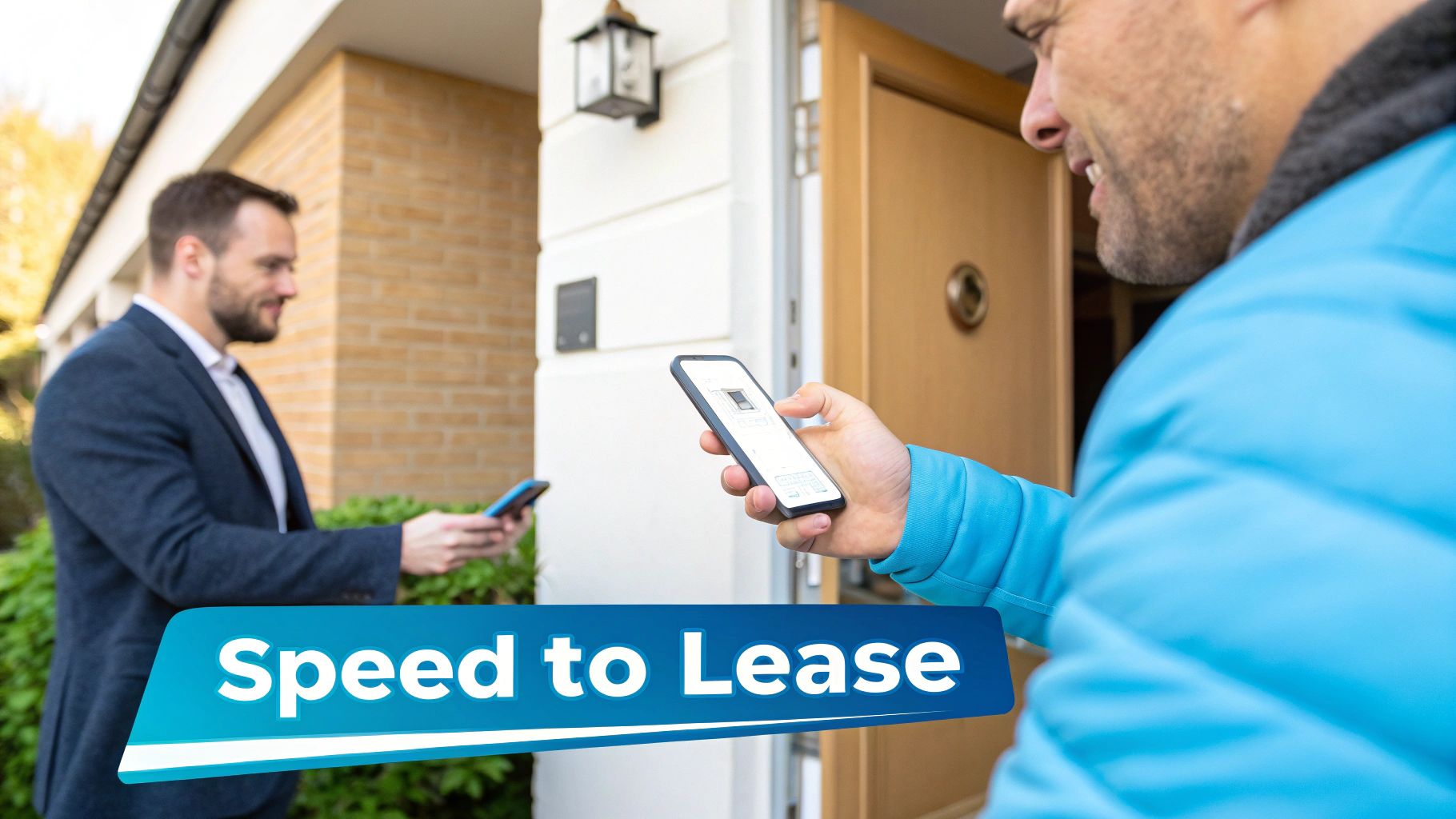
The real takeaway here is the intense focus on immediate conversion. Enabling same-day showings is how you capture a renter's interest when it's at its absolute peak, maximizing your lead-to-tour conversion rate.
Automated Scheduling Logic and Speed
The logic that drives your automated scheduling has a direct impact on your speed-to-lease. Each platform approaches this challenge with a different philosophy, built for different operational styles.
- ShowMojo’s Rule-Based Customization: This platform provides deep, granular control. You can set up complex rules for showing availability based on time of day, lead source, or specific property attributes. It's powerful for managers who want to micromanage every detail of the self-showing process, but it requires significant setup and ongoing optimization to function at scale.
- Tenant Turner’s Centralized Approach: Tenant Turner shines at top-of-funnel management with its call center and software combo. It pre-qualifies leads based on your criteria before showing them tour options. This ensures only serious prospects get on the calendar, but the handoff from the call center can introduce a delay compared to fully automated, instant scheduling.
- Showdigs’ Hybrid On-Demand Model: Showdigs is built around one central goal: converting leads to tours immediately. The platform’s automation is designed to offer the very next available tour time, whether that’s a self-tour or an agent-led showing. By plugging into a network of on-demand agents, it can offer same-day, agent-led tours that other platforms cannot—a game-changer for PMs obsessed with DOM reduction and lead conversion.
Here’s a real-world test for any system: managing a sudden surge of 500 new leads across 50 properties over a weekend. A truly scalable platform must schedule, confirm, and facilitate these tours without any manual intervention to prevent leads from going cold and to capitalize on peak renter interest.
Nurturing Leads From Inquiry to Tour
Getting the lead is just the first step; keeping them engaged is what prevents them from going cold. The communication tools inside each platform play a huge role in keeping prospects interested.
Most platforms will give you automated email and SMS follow-ups. But the real difference-maker for larger operations is the ability to add a human touch at critical moments without bloating your payroll. While great software automates a lot, some businesses find value in supplementing their teams with outsourced appointment setters.
Showdigs solves this by integrating its on-demand agent network directly into the workflow. If a prospect has a specific question that automation can't handle or simply prefers a guided tour, the system can deploy a live, local agent. This hybrid approach delivers the efficiency of automation with the conversion power of a personal touch.
The Financial Impact of Conversion Speed
Let's calculate the revenue impact. For a 1,000-unit portfolio with an average rent of $2,000/month (or ~$67/day), every single day a unit sits vacant costs your portfolio $67,000. Shaving just three days off your average DOM across the entire portfolio adds up to over $200,000 in recovered annual revenue.
This simple calculation makes it crystal clear why the platform with the fastest, most reliable path from lead to lease delivers the biggest ROI.
When you're comparing leasing automation platforms, the ultimate question is which one converts the most leads in the shortest amount of time. While customizable rules and centralized screening have their place, the ability to meet renter demand for immediate, same-day tours—both guided and self-serve—is the most direct path to lower DOM and a healthier bottom line.
Comparing Scalability and Remote Operations Management
Managing a rental portfolio that spans multiple markets—or even thousands of doors in one city—is a complex logistical challenge. Success hinges on technology that can standardize processes, centralize oversight, and enable effective remote management. For large-scale operators, a platform's ability to support property management at scale isn't just a feature; it's the foundation of their business model.
When you're comparing software, scalability means more than just handling a larger number of units. It’s about maintaining quality control and operational consistency without needing in-house staff on the ground in every location. To achieve this, you need robust tools like customizable workflows, role-based permissions, and a centralized dashboard that provides a clear view of portfolio performance, no matter where your team is located.
The Remote Operations Scenario
Let's apply this to a real-world test. Imagine a Director of Operations in Phoenix who needs to oversee and quality-check 100 showings happening simultaneously across Dallas and Atlanta. How does each platform provide the necessary remote control over a distributed portfolio?
This is the daily reality for multi-market property management companies. The chosen software must do more than just schedule tours; it must ensure they are executed to company standards, protecting the brand and maximizing the chance of conversion.
Key Takeaway: True scalability is measured by your ability to maintain quality control and operational consistency as your portfolio grows geographically. If your processes break down when you enter a new market, your software isn't built for enterprise-level growth.
A Tale of Two Approaches: Hardware vs. Hybrid
When it comes to managing remote operations, the leading platforms diverge into two main camps: a hardware-centric model focused on self-touring, and a hybrid model that combines automation with a managed human workforce.
- Rently's Hardware-Centric Model: Rently’s strategy is centered on its smart lock technology. For our director in Phoenix, this means they can remotely grant and monitor access for 100 self-tours. Their dashboard will show who entered which property and when, providing excellent security and access control. It’s an effective solution for portfolios fully committed to a 100% self-showing model, as it eliminates the need to coordinate field staff. The trade-off, however, is the lack of direct quality control over the showing itself. The director knows the tour happened, but they have no visibility into the property's condition or the prospect's real-time feedback.
- Showdigs’ Hybrid Workforce Model: Showdigs tackles the remote management challenge by pairing its software with a network of on-demand, licensed agents. For our director in Phoenix, the platform still automates the scheduling of those 100 tours, but it also dispatches local agents in Dallas and Atlanta to conduct them. This provides a vital layer of quality control. Each agent follows a standardized checklist, provides post-tour feedback, and reports on property condition directly from the app. This creates a powerful feedback loop, allowing the director to "see" what's happening on the ground without leaving their desk. This model is purpose-built for companies that need to manage without onsite staff but refuse to sacrifice the conversion power of a professional, agent-led tour.
Building a Remote-First Operation
For large portfolios, the choice between these two models boils down to operational priorities. If your primary goal is to provide secure, on-demand access at the lowest possible cost per tour, a hardware-first approach like Rently’s is highly effective. It is a clean, automated solution for self-touring at scale.
However, if your focus is on DOM reduction and optimizing the entire lead-to-lease funnel, the hybrid model offers a significant advantage. It provides the efficiency of automation and the irreplaceable value of a human touch, ensuring every prospect interaction is positive and professional. This approach allows property managers to build a true remote-first operation that doesn't sacrifice quality for scale—delivering a serious competitive edge in any market.
Comparing ROI and Total Cost of Ownership
When evaluating software for a large portfolio, the monthly subscription fee is just the tip of the iceberg. The real cost—and the real return—comes from its impact on operational efficiency and, most importantly, revenue. For any CFO or Director of Operations, the business case must extend beyond the pricing page to model the financial impact on a 1,000-unit portfolio.
Total Cost of Ownership (TCO) includes not just the software license, but also the staff hours spent on manual tasks, hardware costs for smart locks, and the massive opportunity cost of inefficient processes. The best ROI comes from platforms that directly attack your single biggest expense: vacancy.
Calculating the True Cost Per Showing
A crucial KPI for any large-scale operator is the cost-per-showing. This metric reveals the true efficiency of your leasing operations.
To get an accurate picture, your formula must include:
- Staff Time: The fully-loaded cost (salary, benefits, taxes) of leasing agents or admins scheduling, following up, and driving to showings.
- Subscription Fees: The per-unit or flat cost of your leasing automation software.
- Hardware Costs: For self-showing, this includes the purchase, installation, and maintenance of smart locks and lockboxes.
- Travel Expenses: Mileage, fuel, and vehicle wear-and-tear for in-house agents covering a distributed portfolio.
When you add it all up, a manually coordinated, in-house model is often far more expensive than it appears. A system that reduces staff intervention and travel time can dramatically lower this per-showing cost, directly improving your cost per door metric.
The Revenue Impact of DOM Reduction
This is where the financial analysis becomes compelling. The most powerful ROI calculation for any enterprise PM is the revenue recovered by reducing Days on Market (DOM). Every day a unit sits empty, you lose money—multiplied across your entire portfolio.
Let's model the impact on a 1,000-unit portfolio.
ROI Model for a 1,000-Unit Portfolio (Illustrative)
MetricWithout Automation (Baseline)With Automation (Projected)Annual Financial ImpactAnnual Vacancies500 (50% turnover)500 (50% turnover)-Average Rent/Day$60 ($1,800/month)$60 ($1,800/month)-Average Days on Market (DOM)18 days13 days (5-day reduction)-Total Annual Vacancy Loss$540,000 (500 x 18 x $60)$390,000 (500 x 13 x $60)-Revenue Recovered--$150,000
This calculation makes it clear: a platform that can shave just a few days off your average vacancy period delivers an ROI that dwarfs its subscription cost. The speed-to-lease gained from same-day showings and instant lead follow-up isn't just an operational perk; it's a significant revenue driver.
As you can see, managing these operations effectively from a distance hinges on having solid systems for reporting, quality control, and leveraging a distributed team.
Building the Business Case
When pitching a new software investment, the conversation must shift from "How much does it cost?" to "How much revenue will it generate and what operational costs will it reduce?" For platforms like Showdigs, which pair automation with an on-demand agent network, the business case is built on measurable results.
The model demonstrates how offering same-day, agent-led tours—something incredibly difficult and expensive to scale with an in-house team—directly accelerates the lead-to-lease cycle. This speed is what reduces your DOM, creating a clear and compelling financial argument that resonates with any stakeholder focused on portfolio performance and profitability. The investment ceases to be a cost center and becomes a direct contributor to your bottom line.
Comparing PropTech Stack Integration Capabilities
For any property manager with a growing portfolio, standalone software isn't just inefficient—it's an operational liability. Every disconnected system creates another data silo, leading to manual data entry, process friction, and a fractured view of your leasing pipeline. When you onboard a new platform, it must integrate seamlessly with your existing tech stack, especially your core Property Management System (PMS).
The quality of these integrations separates a tool that streamlines your business from one that complicates it. A shallow, one-way integration might only sync a prospect’s basic contact info, forcing your team to manually update showing feedback or application statuses in another system. This creates a huge drag on efficiency and defeats the purpose of automation.
Depth of Integration: What to Look For
When you’re comparing leasing software, you must analyze the depth and direction of the data flow. Is it a one-way data push, or does it support a genuine two-way sync?
Key questions to ask when evaluating any PMS integration:
- Data Sync Frequency: Does data update in real-time, or is there a delay? For leasing, real-time is non-negotiable to prevent double-bookings and ensure availability is always accurate.
- Scope of Data Flow: Does the integration go beyond basic guest cards? Look for a two-way sync of showing feedback, application statuses, leasing agent notes, and marketing source data.
- API Capabilities: Does the platform offer a robust, well-documented API? This is critical for connecting other essential tools in your PropTech stack and building custom workflows tailored to your operations.
A truly scalable integration acts as an extension of your PMS, not just a bolt-on accessory. It ensures your core system remains the single source of truth for all leasing activities, from first inquiry to signed lease. This eliminates errors and can save hundreds of administrative hours.
Platform Integration Snapshots
Every major leasing platform takes a slightly different approach to integration, usually catering to specific operational needs. While most connect with the big PMS providers like AppFolio, Yardi, and RentManager, their functional capabilities vary significantly.
Platforms like ShowMojo and Tenant Turner offer solid integrations that handle the critical job of syncing leads and scheduling data. This is table stakes for automating the top of your leasing funnel. Likewise, Rently focuses heavily on ensuring its smart home hardware communicates seamlessly with scheduling software, which is crucial for self-touring.
However, for property managers who need a complete, end-to-end view of their leasing operations, a deeper integration is essential. To see how a system can connect with your entire tech stack, you can explore detailed breakdowns of available property management software integrations. Showdigs, for example, was built to not only sync prospect data but also to push valuable on-the-ground agent feedback directly into the PMS. This gives portfolio managers a real-time view of what's happening in the field without ever leaving their primary system.
A Few Common Questions
When you're comparing leasing software, especially for a large or spread-out portfolio, the same questions tend to pop up. Here’s a look at what experienced operators are asking when they evaluate leasing automation platforms.
Which Software Is Best for Slashing Days on Market Across a Distributed Portfolio?
For property managers trying to cut down DOM across properties that are geographically scattered—especially those without staff on-site—you need a solution that pairs smart automation with actual feet on the ground. This is exactly where a platform like Showdigs shines.
The model is simple but powerful: it combines sophisticated scheduling software with a network of licensed showing agents ready to go. This hybrid approach is what makes same-day, agent-led tours not just possible, but easy. That speed is everything when it comes to converting a hot lead before they move on. While self-showing options like Rently or ShowMojo can certainly help reduce DOM, the ability to provide a human touch on demand—without adding to your payroll—gives hybrid models a serious edge for remote portfolios.
How Do I Figure Out the Real ROI of Leasing Software?
Calculating the true return on investment goes way beyond just looking at the monthly subscription fee. For a large portfolio, you have to dig a bit deeper to see the full financial picture.
- Vacancy Cost Reduction: This is the big one. Figure out your average daily rental revenue for a single unit. Now, multiply that by the number of days you can realistically shave off your DOM. Across a 1,000-unit portfolio, even saving just a few days per vacancy can mean tens of thousands of dollars in recovered revenue.
- Operational Efficiency Gains: Think about the hours your team spends on repetitive tasks like answering initial inquiries, scheduling tours, and driving all over town. Tally up those hours and translate them into real payroll savings.
- Cost Per Tour Analysis: Compare your current, fully-loaded cost for every single tour (don't forget to factor in salary, benefits, and travel expenses) with the cost under a new, more efficient model.
When you add up these savings, you get a much clearer understanding of the software's true financial impact. It builds a business case that's pretty hard to ignore.
What’s the Biggest Implementation Mistake I Can Make?
The single costliest mistake we see is failing to redesign your internal processes to actually take advantage of the new automation. Too many companies just slap a powerful new software on top of their old, clunky workflows, which completely cancels out the benefits.
For instance, if your new platform automates lead follow-up and pre-screening, your team has to be trained to trust that system. Their focus needs to shift to higher-value activities, like closing the deal with already-qualified applicants. A successful rollout requires a real commitment to rethinking your processes, giving your team solid training, and setting new performance metrics that align with what the technology does best. If you skip that step, you're just paying for fancy features you never really use.
Ready to see how the right blend of software and on-demand agents can slash your DOM and supercharge your lead-to-tour conversion rates? Showdigs is built for property management at scale. Schedule a demo today and find out how we help large portfolios turn vacancies into revenue, faster.
.png)