


Managing a student housing portfolio at scale is a completely different ballgame. It's an operational whirlwind defined by high-turnover leasing cycles, per-bed contracts, and the unique dance of coordinating with both students and their parental guarantors. For any operator managing hundreds or thousands of units, manual processes don't just slow you down—they directly impact revenue. Specialized property management software for student housing is the only way to drive the automation and efficiency needed to stay profitable.
Navigating the High-Turnover World of Student Housing
Unlike conventional rentals, the student housing market is tethered to the academic calendar. This creates an intense, compressed leasing season where entire portfolios turn over simultaneously. The pressure to minimize vacancy is immense, from coordinating chaotic mass move-ins to ensuring every single bed is filled before the first day of class. Every day a bed sits empty during that critical summer leasing rush is lost revenue that can never be recovered.
Trying to manage this predictable chaos with spreadsheets and manual processes is a recipe for operational failure and significant financial loss. Juggling individual leases, sending rent reminders to students and guarantors, and coordinating a mountain of maintenance requests during peak turnover is a fast track to costly errors. For large portfolios, these inefficiencies multiply, directly increasing your cost per door and eroding margins.
The Shift to Scalable Technology
The only way to manage this complexity at scale is to implement technology built for these specific challenges. This operational need is why the student housing software market is booming. It hit a value of USD 3.81 billion in 2023 and is projected to nearly double by 2030, driven by the global demand for smarter, more efficient housing solutions.
Take a platform like AppFolio, for example. It’s designed to address the specific needs of this sector from start to finish, from per-bed leasing to guarantor management.

This highlights the necessity of a unified system that handles everything—from marketing and leasing to financials and maintenance—all tailored to the rhythm of student life. For a great deep dive into these market dynamics, check out this complete survival guide to student housing in the Netherlands.
Ultimately, the right software turns these operational headaches into a competitive advantage. It provides the framework to not just survive the seasonal rush but to maximize occupancy and revenue with precision. While the risks in student housing are unique, so are the rewards when managed with the right technology stack. You can learn more in our guide on the risks and rewards of renting to students.
Key Features Every Student Housing Software Needs
Standard property management software will fail when faced with a student housing portfolio. It’s not built for the complexity of high turnover, roommate management, and a calendar that revolves around semesters. To scale your operations effectively, you need tools designed for this specific asset class. The right features aren't just a nice-to-have; they are essential for protecting revenue, reducing operational drag, and maintaining team sanity across hundreds or thousands of units.
The most critical distinction—and where generic software falls short—is the shift from a “per-unit” to a “per-bed” leasing and accounting model. Imagine a single four-bedroom apartment with four students, each on an individual lease with a separate guarantor. Your typical software sees one unit. A large-scale operator sees four distinct financial obligations. This complexity is precisely why a purpose-built solution is non-negotiable for any enterprise-level portfolio.
Individual Lease and Financial Tracking
The ability to manage individual lease liability is the single most critical feature. Your software must treat every student in a shared unit as a separate financial entity.
- Separate Ledgers: Each student requires their own ledger for rent, fees, and security deposits. When one roommate pays late, it must not impact the financial standing of the others.
- Guarantor Portals: A dedicated portal for parents or guarantors is a game-changer for operational efficiency. It allows them to view balances, make payments, and receive communications directly, significantly reducing the administrative burden on your team.
- Roommate Matching & Room Assignment: Advanced platforms often include tools to facilitate roommate matching or assign specific rooms within a unit, providing a significant value-add that can differentiate your properties in a competitive market.
Without this granular tracking, accounting teams burn countless hours manually reconciling payments and pursuing individual late fees—an operational bottleneck that is impossible to scale.
Advanced Communication and Automation
Effective communication is paramount in student housing, especially during the frenetic move-in and move-out periods. A robust property management software for student housing must feature intelligent, automated communication tools.
For a portfolio of 1,000+ units, sending bulk, customized messages by building, floor, or move-in cohort is essential. This level of automation prevents your team from drowning in thousands of individual emails while ensuring every resident receives timely, accurate information about key pickups, inspections, and deadlines.
This is where automation directly drives revenue. Automated renewal offers, for instance, can significantly improve retention rates and reduce the vacancy costs associated with turnover. To see how this works in practice, explore our deep dive on AI-driven marketing and leasing automation.
Simplified Financial and Fee Management
Student housing finance extends beyond simple monthly rent. Your software must be flexible enough to manage the diverse charges associated with student living.
- Installment Billing: Student leases often bill for an entire academic term in equal installments. Your software must accommodate this structure rather than forcing a standard monthly cycle.
- Ancillary Fee Management: The platform should make it simple to apply and track one-off fees for items like parking, activity fees, or damage charges.
- Individual Security Deposit Handling: The system must track security deposits by the individual resident, not by the unit, to ensure accurate and compliant refund processing at move-out.
Specialized financial tools prevent revenue leakage and ensure clean, auditable accounting. This is why the industry is rapidly adopting cloud-based platforms. The student housing Software-as-a-Service (SaaS) market hit USD 2.15 billion in 2024, with cloud solutions capturing 46% of the market due to their scalability and flexibility. This trend underscores the critical importance of integrated systems for managing the unique financial workflows of student portfolios.
When evaluating software, it's crucial to distinguish between core functionalities and advanced features that drive optimization at scale.
Essential vs. Advanced Features in Student housing Software
Feature CategoryEssential Functionality (Must-Have)Advanced Functionality (For Scale & Efficiency)Leasing & AccountingIndividual ("by the bed") lease trackingDynamic, real-time pricing tools for bedsSeparate ledgers for each resident/guarantorAutomated renewal offers and campaignsGuarantor portal for payments and communicationIntegration with university billing systemsCommunicationBulk email and SMS capabilitiesAI-powered chatbots for instant lead responseCentralized resident communication portalAutomated workflows for move-in/move-outOperationsOnline maintenance requestsPreventative maintenance schedulingDigital document storage and e-signaturesMobile inspection apps with photo-taggingReporting & AnalyticsBasic occupancy and delinquency reportsPre-leasing velocity and trend analysisStandard financial reportingCompetitor benchmarking and market analysis
The "essential" column ensures operational viability. The "advanced" column is where large operators gain a decisive competitive edge, enabling data-driven decisions and a leaner, more profitable business model.
Accelerating Your Leasing Cycle to Minimize Vacancy
In student housing, the leasing cycle is an all-out sprint. Unlike traditional rentals where vacancy costs accumulate gradually, student housing revenue is won or lost in one incredibly tight season. Every day a bed sits empty after the semester begins is revenue you can never get back.
This makes speed-to-lease the single most critical KPI for your portfolio's financial health.
For large-scale operators, the primary challenge is managing the massive influx of leads, tours, applications, and lease signings that occur simultaneously. Manual coordination leads to dropped leads, slow response times, and costly vacancy. The only way to win is to transform your leasing process into a high-speed, automated funnel that crushes your Days on Market (DOM) and maximizes your lead-to-tour conversion rate.
Calculating the True Cost of Vacancy
Let's quantify the financial impact. The revenue loss from even a few extra vacant days is staggering when multiplied across an enterprise portfolio.
Consider this conservative calculation for a 1,000-bed portfolio:
Vacancy Cost Calculation Example:
- Portfolio Size: 1,000 beds
- Average Rent per Bed: $850/month
- Daily Rent per Bed: $850 / 30 days = $28.33
- Goal: Reduce Days on Market (DOM) by just 7 days
By trimming only one week off your average DOM, the financial impact is substantial: $28.33 (daily rent) x 7 days x 1,000 beds = $198,310 in recovered revenue. This isn't a theoretical gain; it's the direct ROI from optimizing your leasing velocity.
Automating the Journey from Lead to Lease
Compressing your leasing timeline is about eliminating friction at every step. This is where modern property management software for student housing becomes an absolute necessity. The objective is simple: move a prospective student from initial inquiry to a signed lease as quickly as possible, before a competitor captures their attention.
Key software features that enable this speed-to-lease are:
- Automated Tour Scheduling: Instantly responding to a lead with a self-scheduling link is non-negotiable. This captures high-intent prospects 24/7, boosting lead-to-tour conversion rates before your team even starts their day.
- Self-Guided and Virtual Tour Integrations: Today's students expect on-demand experiences. Offering self-guided tours accommodates their schedules, while virtual tours are essential for capturing out-of-state students and satisfying parental guarantors.
- Instant Digital Lease Signing: The moment an applicant is approved, the lease should be in their inbox. E-signature capabilities eliminate the final bottleneck, securing the commitment while prospect interest is at its peak.
By automating these critical touchpoints, you eliminate the manual delays that cause hot leads to go cold. The entire process becomes a seamless, self-service experience that aligns perfectly with the expectations of a tech-native generation.
Deploying a Scalable Showing Solution
For property managers with large, distributed portfolios, the logistics of showing season are an operational nightmare. Coordinating staff, managing no-shows, and ensuring a consistent tour experience is a significant challenge. A hybrid approach, combining smart software with on-demand services, can be a transformative solution.
Platforms like Showdigs can automate the entire showing process. Leads are qualified and scheduled automatically, and a network of on-demand agents is dispatched to conduct tours. This frees your in-house leasing team from logistical coordination and travel time, allowing them to focus on high-value activities like nurturing qualified applicants and closing leases. You can learn more about how to optimize your leasing funnel with automation to see this model in action.
This is especially powerful for portfolios without onsite management. It provides the scalability to handle thousands of tours during the peak spring and summer rush without the cost and complexity of hiring a large seasonal staff. The result is a faster, more cost-effective leasing cycle that directly reduces vacancy and improves your bottom line.
Building Your Integrated Proptech Ecosystem
For any large-scale operator, a standalone software platform is a liability. Your property management software for student housing must serve as the central hub of your entire technology stack, not an isolated data silo. Without seamless integration, your teams are forced to toggle between systems, manually re-enter data, and pull disparate reports that fail to provide a complete operational picture.
A fully integrated ecosystem allows data to flow freely between your property management system (PMS), accounting software, CRM, and specialized leasing tools. This creates a single source of truth—the foundation of an efficient, scalable operation. It eliminates the data silos that create bottlenecks, cause miscommunication, and critically, slow down your speed-to-lease.
Mapping Your Integration Strategy
Before evaluating new software, you must map your existing tech stack and identify critical integration points. A robust Application Programming Interface (API) is non-negotiable; it's the digital bridge that enables different platforms to communicate and share data automatically.
Don't just accept a vendor's claim that they "have an API." You must dig deeper with pointed questions to assess its true capabilities:
- API Documentation: Is their documentation clear, comprehensive, and usable for your technical team?
- Data Sync Frequency: Does data sync in real-time, or is there a delay? For leasing operations, real-time updates are critical to avoid double-booking tours or leasing the same bed twice.
- Endpoint Availability: Can the API provide access to all the data points you need, including lead sources, lease details, payment statuses, and maintenance logs?
- Support and Reliability: What is the vendor's uptime guarantee and support protocol when an integration fails? A powerful API is useless without reliability.
The goal is to create a seamless, automated workflow from first contact to signed lease, which is fundamental to minimizing vacancy rates.
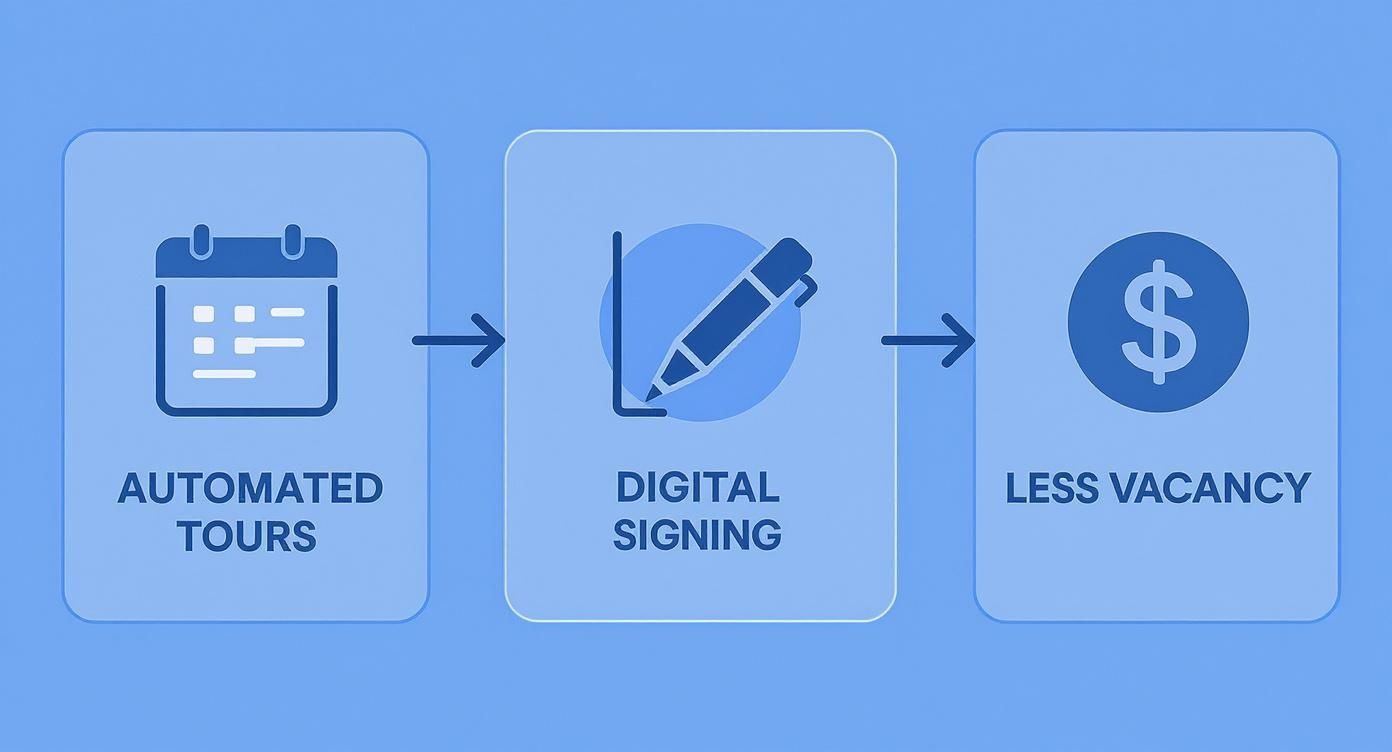
As this illustrates, the process is linear and logical. Automating tours and enabling digital lease signing directly results in reduced vacancy and increased revenue.
The Financial Impact of a Unified System
A connected ecosystem directly impacts your bottom line by providing a single source of truth for portfolio-wide reporting. When your leasing platform automatically pushes data to your accounting system, you gain a real-time, accurate view of your financial performance. This enables faster, more informed decisions on everything from marketing spend allocation to renewal strategies.
The market recognizes the importance of this technological backbone. The global student housing software market is projected to reach USD 2.5 billion by 2033, growing at a CAGR of 12.3%. This growth is fueled by the demand for advanced tools that deliver the real-time data and predictive analytics necessary to manage a modern portfolio. You can explore the details of these market growth projections and the technologies driving them.
Ultimately, building an integrated proptech ecosystem is about future-proofing your operations. It ensures that as your portfolio scales and you adopt new tools, your technology infrastructure can adapt and grow with you, maintaining efficiency and control across every asset.
Here's how to calculate the true ROI of your software investment.
When evaluating property management software for student housing, the subscription fee is just the starting point. For any large-scale portfolio, the decision must be driven by return on investment (ROI).
The right platform is not an expense; it is a revenue-generating asset that should pay for itself by optimizing your most critical key performance indicators (KPIs). To build a compelling business case, you must look beyond cost and model the financial impact on your operations, quantifying gains from vacancy reduction, improved leasing efficiency, and workflow automation.
A clear ROI framework demonstrates exactly how technology drives profit.
A Practical Framework for Calculating Software ROI
Focus your ROI calculations on three core operational areas where technology delivers the greatest financial impact, directly addressing the primary challenges of the intense student leasing cycle.
- Reduce Vacancy Loss (The DOM Impact): This is your most direct and powerful metric. Calculate your current average Days on Market (DOM) per bed, then model the revenue impact of reducing that number.
- Formula: (Average Daily Rent per Bed) x (Number of Days DOM Reduced) x (Total Number of Beds) = Total Recovered Revenue
- Example: For a 1,500-bed portfolio with an average daily rent of $30, reducing DOM by just 5 days recovers $225,000 in lost revenue ($30 x 5 days x 1,500 beds).
- Increase Lead-to-Lease Conversion Rates: A faster, automated leasing process converts more prospects into residents. Improving your conversion rate allows you to fill units faster without increasing marketing spend.
- Formula: (New Conversion Rate - Old Conversion Rate) x (Total Leads) x (Average Lease Value) = Incremental Revenue
- Example: Increasing your conversion rate from 10% to 12% on 5,000 leads for leases with an annual value of $9,000 adds $900,000 in new revenue.
- Decrease Operational Costs: Automation significantly reduces the administrative hours your team spends on repetitive tasks like responding to inquiries, scheduling tours, and processing applications.
- Formula: (Hours Saved per Unit Annually) x (Average Staff Hourly Wage) x (Total Units) = Annual Operational Savings
- Phase 1: Discovery and Configuration (Weeks 1-3): This foundational stage involves working closely with the software provider to map data migration from your legacy system, configure user roles and permissions, and customize workflows to match your operational model. This is where you define success metrics.
- Phase 2: Pilot Program (Weeks 4-6): Select one or two properties to serve as a pilot group. This allows you to test the end-to-end system—from leasing and maintenance to accounting—in a live but contained environment. It’s your opportunity to identify and resolve unforeseen challenges before a full-scale rollout.
- Phase 3: Training and Expansion (Weeks 7-12): Using insights from the pilot, refine your training materials and begin rolling out the software to the rest of the portfolio in logical phases (e.g., by region or property type). Conduct role-specific training for leasing agents, maintenance coordinators, and accounting staff to ensure each team member understands how the platform enhances their specific functions.
- Data Migration & System Configuration (Weeks 1-3): This intensive phase involves working with the vendor to cleanse and migrate data from legacy systems while configuring workflows, user permissions, and reporting templates.
- Pilot Program (Weeks 4-6): Test the full functionality of the software at a select number of properties to identify and resolve any process gaps or technical issues in a controlled environment.
- Full Rollout & Training (Weeks 7-12): Following a successful pilot, expand the implementation across the remaining portfolio. This phase must include comprehensive, role-specific training to ensure high user competency and adoption.
When you quantify these three areas, the conversation shifts from software cost to a strategic discussion about revenue generation and operational excellence. The final calculation proves that the investment is not just justified; it is essential for profitable growth.
Building Your Business Case
With these figures, you can construct a powerful, data-driven business case for your leadership team.
Present the total projected ROI alongside the total cost of the software. This approach reframes the technology from a simple expense to a critical driver of portfolio performance.
An effective software solution should deliver an ROI that far exceeds its cost, with measurable results visible within the first leasing season. By focusing on metrics like reduced vacancy and improved operational efficiency, you can clearly demonstrate how the right property management software for student housing actively contributes to your bottom line.
Implementing New Software Across Large Teams
Selecting the right property management software for student housing is only the beginning. The success of the investment hinges on a successful implementation across your entire organization. For large, geographically dispersed teams, a poorly planned launch can create chaos, hinder user adoption, and negate the technology's potential. A structured, scalable implementation plan is crucial to realizing a return on your investment from day one.
Treat the transition as a strategic operational project, not an IT task. Success depends on clear communication, a phased rollout strategy, and securing buy-in from the frontline users who will interact with the system daily. You are not just installing software; you are fundamentally upgrading your operational processes.
The Phased Rollout Framework
Attempting a portfolio-wide "flip the switch" launch is a recipe for failure. A phased approach allows your team to manage the change, resolve issues in a controlled environment, and build positive momentum.
Driving Adoption and Managing Change
Even the most powerful software is worthless if your team doesn't use it correctly. Driving adoption is about clearly communicating the "why" behind the change. How does this new system reduce their daily administrative friction and help them achieve their goals?
A key part of managing this transition is setting clear expectations and providing robust support. A successful implementation isn’t just about flipping a switch; it’s about guiding your team through a new way of working that ultimately leads to better performance and less administrative friction.
Identify "champions" within your team—tech-savvy individuals who are enthusiastic about the new platform. Empower them to act as internal trainers and advocates, helping their peers navigate the learning curve.
Establish clear support channels, whether through the software vendor or an internal project lead, to provide rapid assistance. A structured onboarding program is critical. Providers like AppFolio are known for their comprehensive programs designed to guide teams through a smooth transition. The ultimate goal is to make the new system the easiest, most efficient way for your team to perform their duties, embedding it as an indispensable tool in your daily operations.
Common Questions About Student Housing Software
When evaluating property management software for student housing, several critical questions consistently arise. Securing clear, direct answers is essential to selecting a platform that will drive efficiency and deliver a strong ROI across a large portfolio.
Here are the straightforward answers to the questions we encounter most frequently from enterprise-level operators.
How Is This Different from Standard Multifamily Software?
The fundamental difference lies in the leasing and accounting model. Standard software is designed for a one-lease-per-unit structure. Student housing platforms are purpose-built for the complexity of per-bed leasing.
This means they can natively handle individual leases for multiple tenants within a single unit, maintain separate ledgers for parental guarantors, and process installment-based billing for academic terms rather than simple monthly rent.
This functionality is not a "nice-to-have"; it is the core requirement. Without it, your accounting team would be forced into manual workarounds to split payments and track individual delinquencies—an operational bottleneck that creates inaccurate reporting and revenue leakage at scale.
Can This Software Integrate with My Existing Systems?
Yes, but the quality and depth of the integration are what matter. A modern platform must offer a robust API that enables seamless, real-time data flow between your core PMS, accounting software, and leasing tools.
The objective is to establish a single source of truth for your entire portfolio. Before committing, demand the vendor's API documentation and confirm that it supports real-time data synchronization for mission-critical data points like unit availability and leasing status.
What Is a Realistic Onboarding Timeline for a Large Portfolio?
For a large portfolio, a phased rollout is non-negotiable. A realistic timeline is typically 60–90 days, broken into distinct stages:
How Quickly Can We Expect to See ROI?
You should expect to see a measurable return on investment within the first full leasing season.
The most immediate financial gains will come from reductions in Days on Market (DOM) and improvements in lead-to-lease conversion rates. By automating top-of-funnel activities like tour scheduling, prospect follow-up, and digital lease execution, you dramatically accelerate the entire leasing cycle. This translates directly into reduced vacancy loss and increased top-line revenue.
Ready to slash your vacancy days and automate your leasing cycle? Showdigs combines intelligent software with an on-demand network of showing agents to get leases signed faster. Learn how Showdigs can optimize your portfolio's performance.
.png)