




Think of your property manager business plan as more than just a document—it's your strategic blueprint for operational scalability. It's the roadmap that lays out your company's mission, your tech-driven operational model, and ultimately, your path to profitability when managing distributed portfolios. This is where you define how you solve enterprise-level challenges, who you serve, and how you’ll scale from 100 to 10,000 units.
Defining Your Blueprint for Scalable Growth

Your executive summary is the most critical page in your entire business plan. For a property management company built for scale, this isn't an introduction; it’s a high-impact pitch designed to convince investors or large portfolio owners that you can efficiently manage hundreds, or even thousands, of distributed units. It must immediately grab their attention by showcasing a clear, tech-driven plan for reducing Days on Market (DOM) and maximizing revenue.
Consider it the highlight reel of your entire operation. This is where you define your mission and prove how your model is purpose-built to solve the unique challenges of multi-market property management.
Articulating Your Mission and Value
Your mission statement must be concise and reflect a commitment to operational excellence at scale. Ditch generic promises. Instead, focus on tangible outcomes that speak directly to your ideal client profile (ICP)—an operations director managing a portfolio of 100 to 10,000+ units.
Your value proposition must answer one simple question: Why should a large-scale property owner choose you? The answer always comes back to solving their biggest pain points and improving their key metrics.
- Operational Scalability: Demonstrate how your framework is built to manage portfolios across multiple markets without degrading service quality or efficiency.
- Cost Per Door Efficiency: Detail your strategies for driving down operational costs for each unit, directly impacting the owner’s net operating income (NOI).
- Metric-Driven Results: State your dedication to key performance indicators (KPIs) that matter to enterprise clients, such as a 30% reduction in Days on Market (DOM) or a 50% improvement in lead-to-tour conversion rates.
Your executive summary needs to tell a compelling story. It’s about how you take chaotic, geographically dispersed portfolios and turn them into streamlined, profitable assets. You’re not just promising better management; you’re promising superior financial performance through smarter, automated operations.
To help structure this critical section, here’s a quick-reference table outlining the key components your executive summary should include for an enterprise audience.
This table ensures you cover all the bases, making your executive summary a powerful tool for attracting the right partners and investors.
Highlighting Your Competitive Edge
What truly sets you apart from other companies managing portfolios of a similar size? Your competitive advantage is embedded in your PropTech stack and standardized, repeatable processes. This is where you showcase your remote management framework and explain how you maintain tight quality control without requiring onsite staff at every property.
Mention your strategic use of automation for tour scheduling and lead follow-up, which directly accelerates the speed-to-lease. Exploring different property management growth strategies can help you refine what aligns with your goals. By framing technology as the core of your operational engine—not just an add-on—you position your company as a forward-thinking partner equipped for the challenges of managing large, geographically scattered rental portfolios.
Understanding Your Market and Sizing Up the Competition
A property management business plan is only as strong as its foundation—and that foundation is a deep understanding of your market. Before you can map out a strategy to manage thousands of units, you must analyze industry trends, define your ideal client profile (ICP), and know your competitors' operational weaknesses. This isn't just about crunching numbers; it's about turning data into a competitive edge that resonates with enterprise-level decision-makers.
The property management industry is rapidly expanding. The global market is set to grow from USD 24.01 billion in 2025 to a massive USD 52.99 billion by 2033, reflecting a compound annual growth rate (CAGR) of 10.5%. In the U.S. alone, the industry is projected to reach $136.9 billion in revenue in 2025. This growth creates a significant opportunity for companies built to solve the scaling challenges that hinder the 35% of managers currently operating between 101-500 units. To dive deeper, you can explore the full property management market report.
Zeroing In On Your Target Market
For an enterprise-level operation, a generic "we serve landlords" approach is a path to failure. You need to get granular and focus on the specific segments where your scalable model provides the most value. Start by building a crystal-clear ideal client profile (ICP).
- Portfolio Size and Type: Are you targeting owners with 100-1,000 single-family rentals (SFRs)? Or are you built for institutions managing 5,000+ multi-family units without on-site staff?
- Geographic Focus: Is your operational model designed to dominate a single metro area or to facilitate multi-market management across several states?
- Client Pain Points: What keeps large portfolio managers up at night? It's inconsistent processes, high Days on Market (DOM), poor lead-to-tour conversion rates, and the revenue loss from every vacant day.
A deep understanding of your ICP’s challenges is your greatest asset. Your business plan must show exactly how your operational model solves these high-stakes problems, turning their pain points into your unique value proposition.
Once you’ve defined these parameters, you can realistically size up your Total Addressable Market (TAM). This is a strategic tool that proves your growth potential and guides your entire sales and marketing engine.
Running a Competitor Analysis That Actually Matters
Your competitor analysis must be more than a list of local PMs. The goal is to identify operational gaps in the market where your tech-first, efficiency-driven model can win. You don't just need to know what your competitors do; you need to analyze how they do it and where they fall short.
Key Areas to Dig Into
This deep-dive analysis does more than shape your strategy—it becomes a powerful part of your sales pitch.
Imagine telling a potential client, "Our automated showing system reduces Days on Market by an average of 10 days compared to competitors using manual methods, which for your 500-unit portfolio, translates to over $200,000 in recovered annual revenue." At that point, you’re not just selling a service. You’re selling a measurable financial outcome.
Designing Your Services and PropTech Stack
Your service offerings are the engine of your business, and your PropTech stack is the high-octane fuel. For large-scale property managers, a well-defined service menu paired with a powerful, integrated technology stack isn't a luxury—it's the only way to profitably manage hundreds or thousands of units across multiple markets. This section of your business plan details exactly how you deliver superior, measurable results.
Moving beyond a simple percentage-based management fee is critical. Sophisticated property owners and institutional investors expect partners who offer tiered service packages and can generate ancillary revenue. This allows you to tailor solutions, from a basic "lease-only" package to a full-service, white-glove management agreement. It also means providing comprehensive support, from maintenance to compliance, through a range of various landlord services.
This chart breaks down the essentials of market analysis—sizing up the market, spotting trends, and knowing your competition.
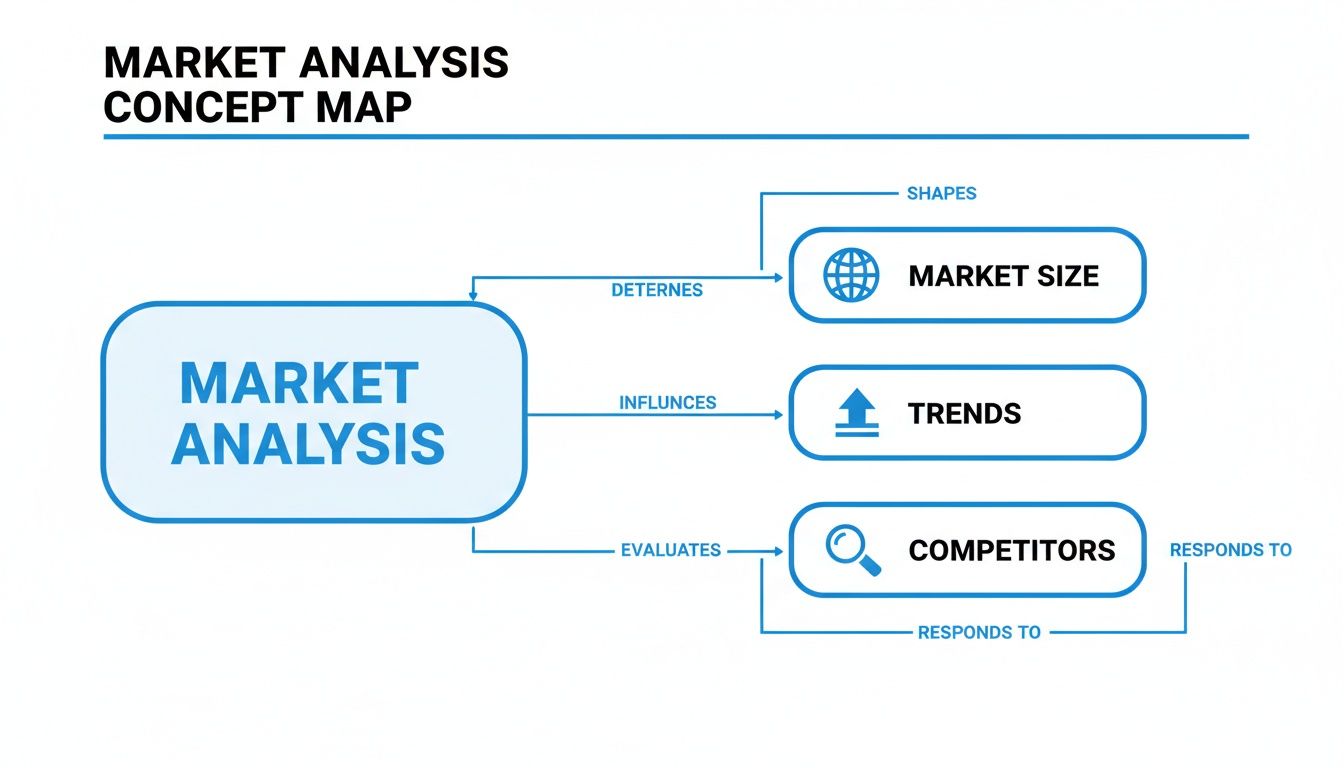
This visual is a reminder that your services must be a direct response to market demands and competitor shortcomings.
Structuring Tiered Service Packages
To attract and retain large clients, you must structure your services to demonstrate value and scalability. A tiered model is ideal, allowing owners to select the level of involvement that aligns with their portfolio strategy.
Here's an effective way to structure your offerings:
- Leasing Tier: A foundational package focused purely on minimizing vacancy. It’s perfect for owners who handle day-to-day operations but need an expert leasing engine to reduce DOM. This includes marketing, automated lead response, tour scheduling, tenant screening, and lease execution.
- Management Tier: This mid-level option includes all leasing services plus core operational management, such as rent collection, financial reporting, and routine communication. It appeals to owners seeking a hands-off approach to daily operations while retaining control over major capital decisions.
- Full-Service Tier: The premium, all-inclusive solution. It bundles leasing, management, and proactive asset management—including maintenance coordination, vendor management, and strategic advice on rent optimization and ROI improvement. This package showcases your full operational capabilities.
Building Your Core PropTech Stack
The heart of any scalable property management company is an integrated PropTech stack. Your technology choices directly impact your ability to manage more doors per employee, slash Days on Market (DOM), and boost lead-to-tour conversion rates. The goal is to build a seamless system where technology automates repetitive tasks, freeing your team to focus on high-value activities.
Digital trends are reshaping the industry. The property analytics market, for example, is growing at 18.15% annually, part of a larger wave pushing the global property management market toward a projected $42.78 billion by 2030. Technologies like automated rent collection and self-scheduling tours are driving massive efficiency gains.
Here's a look at the essential tech stack for competing at an enterprise level.
Essential PropTech Stack for Enterprise PM Companies
Building a scalable operation means choosing technology that integrates seamlessly. Below are the core categories and leading platforms that form the foundation of a tech-enabled service model.
This table isn't just a list; it's a blueprint for operational efficiency.
The most powerful PropTech stacks are interconnected ecosystems. The key is seamless API integration, especially between your PMS and your leasing automation platform. This enables data to flow freely, eliminates manual entry, and creates a single source of truth for your entire operation.
When your system is truly integrated, a lead from Zillow can be automatically nurtured, invited to a tour, screened, and approved—all without a leasing agent touching a keyboard. That's the automation required to manage thousands of units. For a deeper look at your options, check out our guide on the best property management software. This is how you build a service model where technology does the heavy lifting, freeing your team to focus on client relationships and strategic growth.
Building Your Operational and Management Framework
A great strategy on paper is meaningless without an operational framework that can execute it at scale, especially when managing thousands of units across different markets. True scalability isn't about adding more people; it's built on a bedrock of standardized, repeatable processes and a clearly defined team structure. This section of your business plan is the engine room, detailing exactly how you’ll deliver consistent, high-quality service as your portfolio grows.
Your operational plan must be designed for remote efficiency from day one. It should map out how technology—not a physical office in every city—will drive quality control and standardized workflows across your entire portfolio. This is the only way to manage properties at scale without being crushed by the overhead of onsite staff.
Designing a Team Structure That Scales
As you grow, your team must transition from a generalist model to a specialized one. In the early days, one person might handle leasing, maintenance, and owner calls. That breaks down quickly. To manage over 1,000 units effectively, you need specialized roles that foster expertise and drive efficiency.
- Portfolio Managers: The strategic leads for a block of properties. They are the primary contact for owners, focusing on asset performance, financial reporting, and high-level client satisfaction.
- Leasing Coordinators: This role has one critical focus: fill vacancies fast. They own the entire lead-to-lease funnel, leveraging automation for marketing, lead response, tour scheduling, and application processing.
- Maintenance Coordinators: The command center for all maintenance. They field work orders, dispatch vendors, and manage budgets, solving problems quickly to protect asset value.
- Field Agents: In a remote model, you still need on-the-ground support. This includes specialized showing agents, move-in/move-out inspectors, and maintenance technicians, often coordinated through on-demand platforms like Showdigs to ensure speed and quality control.
This specialization ensures every critical function is handled by an expert, allowing your company to operate like a well-oiled machine, even as you expand into new markets.
Standardizing Your Workflows for Remote Ops
Consistency is the cornerstone of scalable property management. Your business plan must detail your standardized workflows for every stage of the property lifecycle. These aren't loose guidelines; they are documented, step-by-step processes integrated into your Property Management Software (PMS).
Create detailed playbooks for core operations:
- Owner Onboarding: A checklist-driven process to smoothly gather all property details, owner documents, and access information.
- Property Marketing & Leasing: A standardized playbook for photos, listing syndication, automated lead follow-up, and tour scheduling designed to slash your Days on Market (DOM).
- Maintenance & Repairs: A clear protocol for handling work orders, from intake to vendor assignment and invoicing, ensuring prompt resolutions and cost control.
- Financial Reporting: A templated monthly reporting package that gives owners a clear, consistent snapshot of their investments' performance.
The goal is to create a "plug-and-play" system. When you onboard a new property or enter a new market, you're not reinventing the wheel. You apply the same proven operational blueprint to deliver predictable results and a uniform client experience every time.
Aligning Your Team With Industry Realities
Building an efficient team structure is essential for growth. The U.S. residential property management industry employs around 720,000 people. While some giants manage massive portfolios, a significant 35% of companies oversee between 101-500 units. This is the common plateau where operational drag halts growth. By creating specialized roles and tech-driven workflows, you can break through this barrier and scale effectively. For a deeper dive into these numbers, you can discover more insights about property management statistics.
By meticulously mapping out your team and operational workflows, your business plan demonstrates a clear, credible path to managing a large, distributed portfolio both efficiently and profitably. This operational rigor is what separates companies that top out at 500 units from those built to manage 5,000.
Forecasting Financials and Tracking Key Metrics

This is where your operational strategy connects to your bottom line. For any property management company targeting enterprise clients, a solid financial plan isn’t just about showing profit—it’s about proving your model is efficient, scalable, and delivers superior returns for owners. You must translate your tech-forward workflows into hard numbers that investors and large portfolio managers can't ignore.
Getting these projections right requires a meticulous approach. Understanding the role of a Financial Planning and Analyst can be helpful, as you need to tell a financial story that’s both compelling and credible. Forget simple revenue goals; we're talking about a granular breakdown of your cost structure and performance benchmarks.
Building Your Financial Projections
Your projections should paint a clear picture of growth over the next three to five years. Start by detailing your startup costs—from legal fees and software setup to your initial marketing push. Then, map out your recurring operating expenses with precision.
Key Operating Expenses to Forecast:
- Payroll and Benefits: Plan for specialized roles like Portfolio Managers and Leasing Coordinators as you scale.
- Technology Subscriptions: Include your PMS, leasing automation tools like Showdigs, and maintenance platforms.
- Marketing and Sales: Earmark a budget for campaigns targeting owners of large portfolios.
- Overhead Costs: Account for office space (if applicable), insurance, and professional services.
With expenses mapped out, project your revenue. While management fees will be the core, a truly scalable model builds in other income streams.
Ancillary Revenue Streams:
- Leasing and Renewal Fees: A one-time charge for placing a new tenant or renewing a lease.
- Maintenance Markups: A small, transparent percentage added to vendor invoices for coordination.
- Late Fees and Application Fees: These contribute directly to your bottom line and add up across a large portfolio.
By forecasting both expenses and diverse revenue streams, your property manager business plan demonstrates a sophisticated understanding of your company’s financial engine.
Identifying KPIs That Drive Scalable Growth
For serious operators, a standard profit and loss statement is just the beginning. The true story of your success is told through Key Performance Indicators (KPIs) that directly reflect your operational efficiency and asset management capabilities. These are the numbers that prove the ROI of your technology and streamlined processes.
Your KPIs are the pulse of your operation. They shift the conversation with clients from "how much does it cost?" to "how much value do you create?" Tracking these metrics allows you to identify bottlenecks, optimize workflows, and showcase a clear competitive advantage.
Focus on a handful of high-impact KPIs that tell the most important parts of your story.
Critical KPIs for Large Portfolios:
- Days on Market (DOM): The ultimate test of your leasing engine. A low DOM means less vacancy loss and higher revenue for owners. It's the metric that matters most.
- Lead-to-Lease Conversion Rate: This KPI tracks the effectiveness of your entire leasing funnel, from first inquiry to signed lease. A high conversion rate proves your marketing and showing process is optimized.
- Cost Per Door: Calculate your total operating cost divided by the number of units managed. This is a crucial measure of your scalability and operational leverage.
- Revenue Per Unit (RPU): The total income generated from each unit, including rent and ancillary fees, giving a complete picture of asset performance.
- Tenant Turnover Cost: The sum of all costs tied to a vacancy—lost rent, marketing, make-ready work, and leasing commissions. Showing how you minimize this number is a powerful value proposition.
When you embed these KPIs into your financial projections, your business plan becomes a dynamic tool. It doesn't just chart a course to profitability; it builds a framework for continuous improvement and data-driven decisions—exactly what sophisticated, large-scale clients look for in a partner.
Crafting a Sales Strategy for Large Portfolios
Landing owners of large, distributed portfolios requires precision, not a wider net. Your sales and marketing strategy can’t be a generic pitch about "great service." It must be a sophisticated, data-driven engine designed to win over high-value clients who think in terms of operational efficiency, ROI, and key performance metrics. This is where your business plan transforms from an internal document into a powerful tool of persuasion.
The foundation of your strategy should be a brand that communicates expertise in scale and technology. Your entire online presence, from your website to your social media, must serve as a living case study of operational excellence. Replace stock photos with dashboards showing improving KPIs, infographics on how you slash Days on Market (DOM), and testimonials from owners who trust you with their 500+ unit portfolios.
Develop a Data-Driven Content Strategy
To capture the attention of enterprise-level clients, your content must go beyond simple blog posts. Your target audience is obsessed with metrics, so deliver what they value. Focus every piece of content on solving their biggest financial and operational challenges.
Create data-rich assets that prove your expertise:
- Case Studies: Detail how you took a 1,000-unit portfolio and cut its average Days on Market by 35% in six months. Be specific about the revenue impact—quantify the dollar amount of vacancy loss recovered.
- ROI Calculators: Build interactive tools on your website. Allow a prospect to input their portfolio size and current vacancy rate to see the potential revenue recovery with your system.
- Data-Driven Insights: Publish white papers analyzing lead-to-tour conversion benchmarks for portfolios over 500 units. This positions you as an industry authority, not just another PM.
The goal is to educate prospects on the very metrics you excel at improving. This builds immense trust and pre-qualifies them before they even contact you. A sharp content strategy is your best tool for generating high-quality property management leads that are ready to talk scale.
Adopt a Consultative Sales Approach
When you get in the room with an owner of a large portfolio, a standard sales pitch will fall flat. These are sophisticated operators who have heard it all. Your approach must be consultative, focused entirely on diagnosing their specific pain points and prescribing a precise, technology-backed solution.
Your sales process should feel less like a presentation and more like a high-level operational audit. Instead of listing services, ask targeted questions to uncover inefficiencies in their current leasing process. This immediately positions you as a strategic partner, not just another vendor.
Frame every conversation around their key metrics. Kick off with diagnostic questions that get to the heart of their operational bottlenecks.
Key Diagnostic Questions to Ask:
- "What's your current average Days on Market across the portfolio, and do you know what each vacant day is costing you in real dollars?"
- "How are you currently tracking lead-to-tour conversion rates, and what are your benchmarks for success?"
- "What are the biggest challenges you face in standardizing showing quality and processes across different markets?"
Once you’ve identified a critical pain point—like a slow speed-to-lease in a remote market—you can present your solution. Don't talk about features. Show them exactly how your automated showing platform or standardized workflows will directly impact their bottom line. For example, project how shaving just five days off the DOM across 500 units could add tens of thousands of dollars in annual revenue. That transforms the conversation from a cost discussion into an investment in provable ROI.
Common Questions About Property Management Business Plans
When you’re creating a property manager business plan for large, scattered portfolios, a few key questions always arise. Answering them correctly is the difference between a plan that sits on a shelf and one that lands high-value clients.
How Detailed Should My Financial Projections Be?
For enterprise-level clients and investors, your financial projections need to be more than a simple P&L. Map out your revenue based on tiered fee structures and ancillary income streams. Most importantly, your plan must show how your operational Key Performance Indicators (KPIs) directly impact the bottom line.
For example, don't just state you'll use automated showings. Show how that technology leads to a 15% reduction in Days on Market (DOM), and then translate that into hard numbers—quantifiable revenue gains for property owners. This detail demonstrates a sophisticated grasp of unit economics, which is exactly what large portfolio managers want to see.
What's the Most Critical Section for Attracting Investors?
While every section is important, investors and enterprise clients focus on two areas: your Operational Plan and your Financial Projections. This is where you prove your business can truly scale. They need to see a clear, repeatable system for managing thousands of units remotely without sacrificing quality.
Your operational plan should detail your tech stack and the standardized workflows that drive efficiency. Your financials then provide the proof, connecting those operational strategies to concrete metrics like a lower cost per door and higher revenue per unit. This data-driven narrative is what elevates a standard plan into an investment-grade blueprint for scalable growth.
A common mistake is overemphasizing the total market size. Sophisticated investors and clients care less about the entire market and more about how your specific model creates a competitive advantage through superior efficiency and measurable results.
Ready to build a leasing operation that gives you a powerful competitive advantage? Showdigs provides the AI-backed leasing automation and on-demand agent network you need to slash Days on Market and optimize your lead-to-tour conversion at scale. Learn how Showdigs can transform your portfolio's performance.
.png)
.png)