


When you’re managing a portfolio of 100 to 10,000+ units, the property manager cost is much more than a line item on a spreadsheet. It’s a powerful lever that directly impacts your operational efficiency and, ultimately, your portfolio’s profitability. The real cost isn’t just the monthly management fee—it’s a complex web of direct expenses and indirect vacancy losses that can make or break your bottom line at scale.
The Real Cost of Property Management for Large Portfolios
For operators at the enterprise level, calculating the true cost of management means looking far beyond a simple percentage. While the sticker price matters, the real financial drain often comes from inefficient, labor-intensive processes hidden within your leasing cycle. The cost of every vacant day is a direct hit to your Net Operating Income (NOI).
Across most major markets, third-party property management fees typically hover between 8% and 12% of the monthly rent for single-family rentals. For a multi-market portfolio, even a small difference in that percentage has a massive financial impact.
For a 1,000-unit portfolio averaging $2,000/month in rent, a single percentage point difference—say, moving from 10% down to 9%—translates into $240,000 per year in savings. That’s a significant gain, but it often pales in comparison to the revenue lost from operational bottlenecks.
Shifting Focus from Fees to Operational Efficiency
The management fee is just the tip of the iceberg. For large portfolios, the most significant hidden costs are tied to vacancy days and the sheer labor required to fill an empty unit. Every day a property sits vacant, it actively loses revenue. The manual effort spent coordinating showings, chasing down leads, and processing applications multiplies that loss across every single door you manage.
This is where the concept of cost per door becomes absolutely essential. An operationally clunky system, even with a lower management fee, will cost you more through inefficiency. Why?
- Prolonged Days on Market (DOM): A slow response to leads and a cumbersome tour scheduling process directly inflate vacancy loss. Reducing DOM by just a few days across a large portfolio can add hundreds of thousands of dollars back to the bottom line.
- Low Lead-to-Tour Conversion: If you can't offer same-day showings, you're sending qualified leads straight to competitors and wasting marketing spend.
- High Labor Costs: Manually coordinating schedules for a team of leasing agents across a distributed portfolio is expensive, frustrating, and simply doesn't scale.
The most forward-thinking property managers understand this: the biggest opportunity for savings isn't in haggling over half a percentage point on a management fee. It's in systemizing leasing operations to slash the days—and dollars—lost to vacancy.
Ultimately, the goal for any large-scale operator is to build a lean, scalable leasing engine. By focusing on technology that automates repetitive, time-consuming tasks and shrinks the lead-to-lease timeline, you can fundamentally lower your true cost of operations. The key is to analyze how you can improve your property management operations to drive down vacancy and boost NOI across your entire portfolio.
Breaking Down Common Management Fee Models
For enterprise operators, the way you structure management fees directly shapes your portfolio's bottom line and what your team prioritizes day-to-day. For those managing properties across different markets, the choice between a percentage-based or a flat-fee model isn't just about accounting—it's a core strategic decision. Each model creates different financial outcomes when applied across hundreds or thousands of doors.
Getting this right is essential. If you’re not already familiar, it’s worth exploring the nuances of commercial property management fees to see how those complex structures can inform residential strategies. This knowledge helps you build a more profitable, predictable business.
The Percentage-Based Fee Model
This is the industry standard. The percentage-based model ties your earnings directly to the gross rent collected, typically between 8% to 12%. For a growing portfolio, it feels like a natural fit because your revenue scales up alongside performance.
But when you're operating at an enterprise level, this model starts to show its cracks. In expensive markets, that fixed percentage can eat into your margins on properties that don't actually require more work. A 10% fee on a $3,500/month rental in a major city nets you $350, but the same fee on a $1,500/month unit in a smaller market only brings in $150. Is the workload to lease that unit really 2.3x higher? Often, it’s not.
This compensation gap can unintentionally steer your team’s focus. It's human nature to prioritize higher-rent units because they generate more revenue, which can leave other properties on the back burner—even if they’re the ones that need more attention to get leased.
The Flat-Fee Model
On the flip side, the flat-fee model gives you something incredibly valuable for large-scale operations: predictability. You pay a set dollar amount for each unit, every month, regardless of rent. This makes financial forecasting a breeze and keeps your cost per door consistent across your entire portfolio, from Class A to Class C properties.
The real beauty of a flat-fee structure is its transparency. It turns property management from a fluctuating variable into a fixed, predictable operational cost, which is exactly what you need for precise budgeting and performance analysis at scale.
Of course, it's not perfect. The biggest knock against the flat-fee model is that it can weaken the incentive to be proactive. If a manager gets paid the same whether a unit is rented for top dollar or is sitting empty, where’s the urgency to market aggressively or push for rent increases? This is a critical flaw for operators focused on maximizing portfolio value.
Choosing the Right Model for Scalability
For large, geographically diverse portfolios, the best answer is often a hybrid approach that combines predictability with performance incentives.
You might set a lower flat fee to cover the basic management tasks, then add performance bonuses tied to key metrics that truly matter to your bottom line, like reducing Days on Market (DOM) below a target threshold or achieving specific occupancy rates. This setup gives you predictable baseline costs while still motivating your team to lease faster and maximize revenue—the two things absolutely critical for success at scale.
Ultimately, the right model comes down to your portfolio’s mix and your operational goals. The objective is always the same: structure your fees to maximize net operating income (NOI) across every single door you manage.
Uncovering the Hidden Costs That Inflate Your Expenses

The monthly management fee is just the tip of the iceberg when it comes to your real property manager cost. For large-scale portfolios, the true financial drain often comes from a series of smaller, ancillary charges that quietly add up across hundreds or thousands of units, directly chipping away at your net operating income (NOI).
Focusing only on that headline management percentage means you’re missing the bigger financial picture. True operational efficiency demands a clear-eyed look at every single dollar spent to get and keep a unit occupied.
Common Ancillary Fees That Add Up
Beyond that base percentage, your management contract will almost certainly include several other charges for specific situations. Each one might seem minor on its own, but when multiplied across a large portfolio, they become a major expense line.
Here are the key fees to watch for:
- Leasing or Tenant Placement Fees: This is often the biggest extra cost you'll face. It’s a one-time charge, typically 50% to 100% of the first month's rent, for placing a new tenant. For a 1,000-unit portfolio with a 40% annual turnover and an average rent of $2,000, this fee alone can easily top $400,000 per year.
- Lease Renewal Fees: Some managers charge a flat fee (e.g., $100-$300) or a small percentage just to renew a lease with an existing tenant.
- Maintenance Markups: It’s common for property management companies to add a markup, usually 10% to 20%, on top of what vendors charge for repairs. This compensates them for coordination but directly inflates your maintenance budget.
- Eviction Coordination Fees: If you have to evict a tenant, your manager will likely charge a flat fee of $200-$500 plus any legal costs for their time filing paperwork and attending court.
- Vacancy Fees: This one is a major red flag. Some contracts allow the manager to keep collecting their full management fee even when a unit is empty, arguing that they are still actively marketing it.
These charges are exactly why a low management percentage can be so misleading. A company offering a 7% fee but loading up on markups and leasing charges could easily cost you more than another company with a straightforward 9% fee and fewer add-ons.
Shifting your focus from negotiating the management percentage to optimizing the total cost per lease is the most impactful financial move an enterprise-level operator can make. This KPI reveals the true, all-in expense to fill a vacancy.
Calculating Your Real Cost of Vacancy
The most significant hidden expense isn't a fee at all—it's the lost opportunity of an empty unit. Every single day a property sits vacant is pure, unrecoverable revenue loss. For large-scale operators, this is where you must be laser-focused.
To grasp the impact, you need to calculate your cost of vacancy per day. The formula is simple:
(Annual Gross Potential Rent / 365 Days) = Cost of Vacancy Per Day
Let's put that into perspective. For a portfolio of 1,000 units with an average rent of $2,000/month, the annual gross potential rent is $24 million. That means every single day of vacancy across the portfolio is costing you over $65,000.
When you combine that daily revenue loss with leasing fees and marketing expenses, you see the enormous financial pressure to slash your Days on Market (DOM). A system that can shorten your leasing cycle by just a few days can pour hundreds of thousands of dollars back to your bottom line—a far bigger win than shaving a point off a management fee.
Why Are Traditional Property Management Costs Going Up?
If you've been watching your operational expenses tick upwards, you're not imagining things. It's a direct result of the squeeze traditional management companies are feeling: labor shortages, soaring maintenance costs, and complex regulations make the old-school, manual way of managing properties more expensive than ever.
For companies managing large, distributed portfolios, these rising costs hit even harder. The same systems that might have worked for 50 doors buckle under the weight of 500 or 5,000, creating operational logjams that burn cash.
The Real Culprits: Manual Labor and Inefficiency
While the economy plays its part, the single biggest reason management costs are climbing is the industry's reliance on people-powered processes. This is never more obvious than in the leasing funnel.
Consider the labor hours your team burns on a single vacant unit:
- Fielding Inquiries: Answering the same questions from dozens of prospects, many of whom are unqualified.
- Manual Pre-Screening: Wading through emails and calls to find serious renters.
- Coordinating Showings: The endless game of phone tag to schedule tours that work for both the agent and the prospect.
- Conducting In-Person Tours: Drive time, gas, and direct labor cost for every showing—many of which go nowhere.
Now, multiply those hours by hundreds of turnovers a year across a scattered portfolio. The operational cost becomes staggering. These inefficiencies are passed straight to you through higher fees and longer vacancy periods.
At its core, the traditional property management model trades human hours for tasks that could be automated. It's an expensive and unscalable equation, especially as labor costs continue to climb.
Squeezed by a Tough Economy
Beyond the day-to-day grind, external market forces are tightening the screws. According to the CBRE Facilities Management Cost Index, the cost for services, maintenance, and labor jumped by 3.3% in 2023, with another 2.5% increase expected for 2024. This tells us that even if your manager’s fee percentage stays the same, their internal cost to do the job is rising fast.
It's no wonder the industry is feeling the pressure. A recent National Apartment Association survey found that 76% of property management professionals named "Operational Efficiencies" as their top challenge. It’s a clear signal that the old way of doing business is no longer sustainable at scale.
This is where the business case for a new approach becomes crystal clear. To break this cycle of rising costs and protect your NOI, it's time to shift from a people-powered model to a technology-enabled one. By automating the most time-draining parts of leasing, you can fix your unit economics and build a more resilient, scalable operation.
How Technology Reduces Your True Cost Per Door
As an enterprise property manager, you're constantly fighting rising operational costs. Labor, maintenance, and regulatory compliance are getting more expensive every year. Simply trimming expenses here and there is like putting a band-aid on a broken pipe—it’s not a real solution.
To truly lower your property manager cost, you have to change the operational model from being people-dependent to being technology-powered.
Modern PropTech, especially leasing automation, attacks the most expensive and unpredictable parts of your business. This isn't about replacing your team; it's about giving them tools to focus on high-value tasks—closing deals and building relationships—while software handles the repetitive tasks that inflate your cost per door. This move turns your leasing process from a fluctuating, unpredictable expense into a fixed, scalable system.
Labor expenses are climbing faster than anything else.
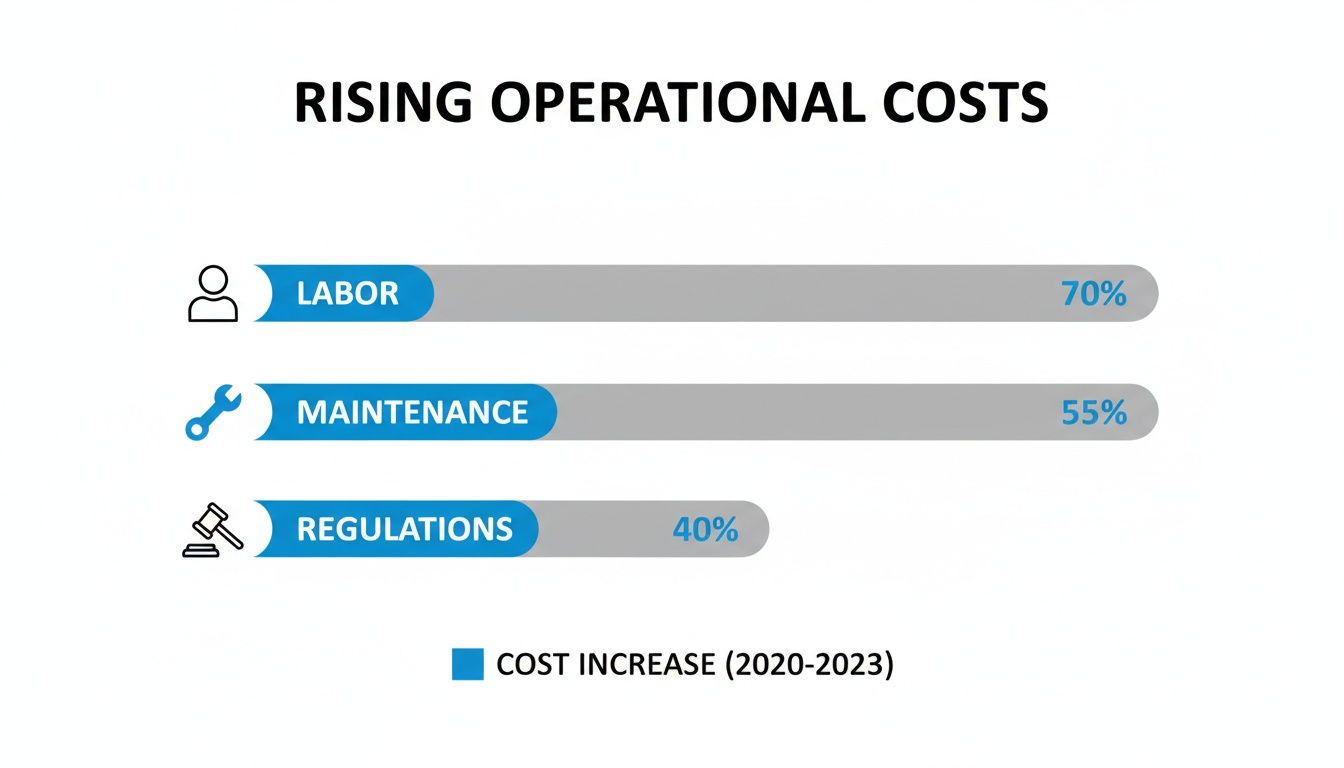
This data makes it clear: controlling manual labor costs through automation isn't just a nice-to-have; it's essential for maintaining profitability at scale.
From Manual Grind to Automated Efficiency
The old-school way of leasing is a funnel clogged with manual steps. You're answering the same questions repeatedly, pre-screening a flood of applicants, and playing phone tag to schedule a single showing. Every one of those steps costs time and money.
Leasing automation breaks that cycle. Imagine tools that instantly respond to leads, let prospects schedule their own tours 24/7, and tap into a network of on-demand agents to show properties. This shaves hours of work off every single vacancy.
This isn't a niche trend. The global property management software market was valued at $24.18 billion in 2024 and is expected to more than double to $52.21 billion by 2032. When you switch from coordinating showings over the phone to a system like Showdigs with self-service bookings and on-demand agents, you're fundamentally lowering the true cost to manage each door.
It’s not just about saving time—it’s about leasing properties faster. A qualified renter won't wait for a callback. When they can instantly book a showing for that same afternoon, your chances of getting that lease signed skyrocket. In this market, speed-to-lease is everything.
By investing in leasing automation, you’re not just buying software. You're investing in a system that directly reduces your two most significant hidden costs: labor and vacancy loss. This is the core of modernizing your operations for scale.
The Real Impact On Your Bottom Line
So, what does this actually look like in your bank account? The goal is simple: drive down your Days on Market (DOM). Every day a unit sits empty, you're losing money. Period.
Let's look at how much a manual leasing process can really cost compared to an automated one for a large portfolio.
ROI Analysis of Manual vs Automated Leasing Operations
The table below breaks down the costs and time for a 1,000-unit portfolio, assuming a 40% annual turnover rate (400 units).
*Cost per showing is lower with on-demand networks, and fewer showings are needed due to better pre-qualification.
The numbers don't lie. By automating, this portfolio saves over $149,000 a year and cuts its average vacancy time by 11 days. That’s a massive, tangible impact on your net operating income.
This shift isn't just about keeping up with trends; it's about survival and growth. To get a deeper understanding of where the industry is heading, it's worth exploring the discussions around the future of property management and seeing how you can prepare. At the end of the day, technology gives you the control and predictability you need to build a leaner, more profitable, and scalable business.
Building the Business Case for Lowering Operational Costs
When you manage a large portfolio, the conversation around property manager cost needs a serious upgrade. The real money isn't saved by shaving half a point off a management fee. It’s unlocked by overhauling your operations to attack your single biggest expense: a vacant unit.
To get buy-in for new tech or systems, you need a compelling business case. That starts with an audit of what your leasing process really costs and a clear projection of the potential returns. The goal is to stop playing defense by cutting small costs and start playing offense by generating more revenue. It’s about focusing on the big-picture metrics that actually move the needle on your Net Operating Income (NOI), like your true cost per lease and the total cost of vacancy.
A Framework for Calculating ROI
To justify an investment in leasing automation, you need a clear, data-driven argument. This framework breaks it down into actionable steps so you can show the real financial upside of modernizing your leasing operations. And beyond just technology, having a solid grasp of strategies to reduce operational costs and boost efficiency will make your overall business case that much stronger.
Step 1: Calculate Your Daily Cost of Vacancy
First, you need to know exactly how much revenue you’re losing every single day a unit sits empty. This one number highlights the urgency of shrinking your Days on Market (DOM).
- Formula:
(Total Annual Gross Potential Rent / 365 Days) = Cost of Vacancy Per Day - Example: For a 1,000-unit portfolio with an average rent of $2,000/month, your annual gross potential rent is $24 million. That means every single day of vacancy across the portfolio costs you a staggering $65,753.
Step 2: Audit Your All-In Leasing Expenses
Next, figure out your actual "cost per lease." This isn't just the leasing fee. It includes every dollar and every minute your team spends getting a unit filled—from marketing spend to the hours they pour into manual tasks like chasing down leads and coordinating tours. You must convert that time into a real dollar amount.
The most convincing business cases are always built on a foundation of solid data. When you measure the true cost of your manual processes, you reveal the massive financial leverage that automation can provide. Suddenly, a software expense doesn't look like a cost anymore—it looks like a high-return investment.
Step 3: Model the Financial Gains
Finally, model the impact of getting more efficient. Even a small improvement in your leasing speed delivers huge returns when you're working at scale.
- Scenario: Imagine your 1,000-unit portfolio has a 40% annual turnover, meaning 400 units need to be leased each year. If new technology helps you cut your average DOM by just 7 days, the math is simple.
- Formula:
(Units Turned Annually x DOM Reduction x Daily Vacancy Cost per Unit) = Annual Revenue Recaptured - Calculation:
(400 units x 7 days x $65.75 per unit/day*) = $184,100
*(Based on a $2,000/month unit)
Just like that, this model shows a $184,100 revenue boost from a modest 7-day improvement. This is the heart of your business case. It proves that investing in systems that speed up your lead-to-lease timeline is a direct investment in your portfolio's performance.
To take these numbers to the next level, you can use a business health check with key leasing metrics to see how your current operations stack up against industry benchmarks.
Answering Your Top Questions
What’s a Fair Property Management Cost for a Large Portfolio?
When you're managing a portfolio of 100 to 10,000+ units, "reasonable cost" stops being about a simple percentage and starts being about your cost per door. While the industry benchmark might hover around 8% to 12% of gross monthly rent, that number is misleading for enterprise-level operators.
A lower management fee from an inefficient manager will cost you more than a higher fee from a top-tier operator. The real game is played in the operational metrics. You need to dig into their Days on Market (DOM) and lead-to-tour conversion rates. At scale, those two numbers have a much bigger impact on your net operating income (NOI) than a single percentage point on a fee.
How Does Technology Actually Impact the Cost of Property Management?
Technology completely rewrites the cost equation. It allows you to swap unpredictable, labor-heavy tasks for fixed, scalable software costs. Leasing automation platforms, for example, directly target your biggest operational expenses: the hours your team spends chasing leads, scheduling tours, and running showings.
This creates a powerful one-two punch:
- It slashes direct labor costs. You're cutting down on the repetitive, administrative grind required for every single vacancy.
- It plugs the leak of vacancy loss. By enabling same-day showings and instant lead responses, technology dramatically shrinks your DOM. That’s pure revenue recaptured.
So while there's a software expense upfront, the ROI from lower labor costs and reduced vacancy almost always leads to a much lower true cost per door, especially for large portfolios.
Can I Negotiate Property Management Fees for a Big Portfolio?
Absolutely. Negotiation is expected when you’re bringing a large portfolio to the table. But the smartest negotiations don't fixate on just the base management fee. Instead, they focus on performance and goal alignment.
Rather than trying to shave a percentage point off the top, propose a performance-based or hybrid model. You could negotiate a lower base fee in return for bonuses tied to hitting specific, meaningful KPIs.
Picture this: You agree on a lower flat fee per door, but with bonuses that kick in when your manager hits a sub-21-day average DOM or surpasses a 40% lead-to-tour conversion rate. This structure gets your manager's financial incentives pointing in the exact same direction as yours: maximizing portfolio performance and leasing speed.
Ready to slash your vacancy days and fundamentally lower your true cost per door? Showdigs combines AI-powered leasing automation with an on-demand network of licensed agents to get your properties leased faster. Book a demo today and see how we help enterprise-level operators reduce DOM and boost their bottom line.
.png)