




Your property rental application isn't just paperwork. For large-scale property management companies, it's a critical control point in the leasing funnel that either accelerates revenue or inflates vacancy costs across your entire portfolio. A slow, manual application process is an operational bottleneck that directly eats into Net Operating Income (NOI).
When you're managing a portfolio of 1,000+ units, every day a property sits vacant due to a clunky application process represents significant lost revenue. It's time to reframe the application from an administrative task to a high-performance conversion tool engineered to slash your Days on Market (DOM).
This shift isn't just strategic; it reflects a massive industry trend. The global market for property management software is projected to grow substantially, driven by the demand for digital solutions that meet both tenant expectations and the operational needs of large portfolios. For enterprise operators, adopting efficient, automated systems is no longer a competitive advantage—it's a requirement for survival.

Rethinking Your Rental Application as a Revenue Driver
For property managers juggling hundreds or even thousands of units, the application is the final, critical step in converting a qualified lead into a signed lease. Every day a property sits empty due to a slow system, you're losing revenue. It's time to stop thinking of the application as a chore and start seeing it for what it is: a conversion tool designed to slash your Days on Market (DOM).
The High Cost of Application Friction
Application friction—any hurdle that slows down or deters a qualified applicant—is a silent portfolio killer.
Let's run a quick ROI calculation. If a property rents for $2,000 a month, each vacant day costs you approximately $67. A seemingly minor two-day delay in processing an application doesn't seem like much. But multiply that across a 1,000-unit portfolio with standard turnover rates, and that small snag can easily cost you $40,000+ in lost revenue annually.
This is why top-tier operators are replacing manual processes with systems built for speed, scale, and consistency. The entire objective is to create a seamless, frictionless path from a successful property tour straight to a submitted application, maximizing your lead-to-tour conversion and minimizing vacancy loss.
For a large, distributed portfolio, standardization isn't a luxury; it's a core operational requirement. A consistent, automated application process ensures every lead receives the same high-quality experience, minimizing drop-off and accelerating lease signings across multi-market operations.
Core Pillars of a Scalable Application Framework
A high-performance property rental application process is built on three pillars: speed, accuracy, and scalability. This requires a strategic approach that blends smart technology with optimized workflows.
Here is a framework for implementation:
- Standardize Across the Portfolio: A uniform application and screening criteria for every property is non-negotiable. It ensures Fair Housing compliance and simplifies remote team training at scale.
- Automate Repetitive Tasks: Integrating your digital application forms with your Property Management Software (PMS) via API is a game-changer. It eliminates manual data entry, reduces errors, and frees up leasing agents to focus on high-value, revenue-generating activities.
- Ensure Seamless System Integration: Your showing platform, application software, and screening services must communicate seamlessly. When these systems are integrated, you create a cohesive workflow that accelerates the leasing cycle. For managers focused on key performance metrics, it's crucial to optimize your leasing funnel from initial lead to final signature.
- Focus on the Applicant Experience: Today's renters expect a mobile-first experience. An intuitive, mobile-friendly application that can be completed in minutes will dramatically increase completion rates and help you secure high-intent prospects before your competitors do.
Designing an Application That Applicants Actually Complete
Applicant drop-off is the silent killer of your leasing velocity. Every time a qualified prospect abandons an application, you're not just losing a potential tenant—you're adding days to your vacancy rate and taking a direct hit to your revenue. The design of your application is just as important as the questions you ask.
Today's renters expect a smooth, simple digital experience. A clunky, hard-to-use form is an immediate operational red flag that can make even the most interested prospect reconsider.

Embrace a Mobile-First Mindset
The modern rental journey happens on a smartphone. From the initial property search to scheduling a tour, your prospects are mobile. If they have to pinch and zoom to fill out their name, you’ve already created unnecessary friction.
A mobile-first design is about building the entire experience for a thumb. This means large, tappable buttons, simple fields, and a layout that minimizes typing. Think about the best consumer apps—they break down complex actions into simple, manageable steps. Your application must do the same.
Break It Down Into Easy Sections
No one wants to face a single, endless form. That wall of questions is psychologically intimidating and a primary cause of high drop-off rates. A more effective approach is to segment the application into logical, bite-sized sections.
- Personal Info: Start with the easy parts—name, contact details, and co-applicant information.
- Rental History: Next, ask for past addresses, landlord contacts, and reasons for moving.
- Employment & Income: Dedicate a separate section for job details, income verification, and work history.
- Final Consent & Submission: Conclude with authorizations for background checks and the final agreement.
This step-by-step approach, especially when paired with a progress bar, provides a sense of accomplishment. It transforms a chore into a series of small wins, significantly improving completion rates.
Mini Case Study: A 2,000-unit property management company increased their application completion rate by over 35% simply by switching from a single-page PDF to a multi-step, mobile-first digital application. This single change directly resulted in a more robust pipeline of qualified leads and a measurable reduction in their portfolio-wide Days on Market.
Use Smart Logic and Keep Your Branding Consistent
A truly scalable application is both efficient and trustworthy. There's no reason to ask a single applicant about co-tenants or make someone without a pet fill out a detailed pet information section.
This is where conditional logic is essential. This technology dynamically alters the form based on user inputs, hiding irrelevant fields and creating a shorter, personalized path for each prospect. This respects their time and streamlines the process.
Finally, your branding must be consistent. Your application should have the same look and feel as your website and marketing materials. A professionally branded, secure form reassures prospects that their sensitive data is safe, making them far more likely to submit. A cohesive digital presence reinforces your company’s professionalism from lead to lease.
Building a Legally Defensible Application Process at Scale
When managing properties across state lines—or even different municipalities—legal compliance isn't a single checkbox. It's a complex, ever-shifting landscape where what's legal in one market could lead to a lawsuit in another. For property managers operating at scale, building a standardized yet flexible compliance framework is non-negotiable.
It all starts with the Fair Housing Act (FHA). This is your national baseline, prohibiting discrimination based on race, color, religion, national origin, sex, disability, and familial status. However, states and cities often add their own protected classes, like source of income or marital status. Your application and screening process must account for all of them.
Standardizing Your Screening Criteria
To maintain a fair and legally defensible process across thousands of units, you need a single, objective set of screening criteria. This becomes your company's gold standard, ensuring every applicant is evaluated consistently.
Your standardized policy must be crystal clear on:
- Income Verification: A consistent income-to-rent ratio (e.g., 3x the monthly rent) applied universally.
- Credit History: A defined minimum credit score and a clear policy on handling collections or bankruptcies.
- Rental History: Specific rules regarding prior evictions, late payment patterns, and landlord references.
- Criminal Background: A policy aligned with HUD guidance, focusing on convictions relevant to the safety of the property and residents, not a blanket ban.
This master policy serves as your core playbook. From there, create location-specific addendums. For example, if you manage units in a city with "source of income" protections, your addendum will clarify that housing subsidies must be counted toward the applicant's income.
A clear, written, and consistently applied screening policy is your single most important tool for mitigating legal risk. It removes subjective decision-making from the process, ensuring every application is reviewed fairly and in accordance with the law.
Managing Application Fees and Disclosures
Application fees are a compliance minefield for multi-market operators. Some states have no limits, while others cap the fee to the exact cost of the screening report. Your operational playbook must specify the maximum allowable fee for every jurisdiction. The best practice is to automate this in your property management software to prevent costly errors.
State-specific disclosures are equally critical. Your property rental application must be intelligent enough to automatically attach required notices—like Megan's Law or lead-based paint warnings—based on the property’s address.
Secure Data Handling and Record Retention
A rental application contains a trove of Personally Identifiable Information (PII). A data breach can be a financial and reputational disaster. Ensure your systems use strong encryption for all data, and restrict access to sensitive information to only essential team members.
Finally, establish a rock-solid record retention policy. Federal laws like the Fair Credit Reporting Act (FCRA) and FHA, plus various state rules, dictate how long you must keep application records for both approved and denied applicants. A safe standard is to retain all records for at least three to five years. This documentation is your defense against potential discrimination claims. And don't forget the final step: proper adverse action notices, which are a critical piece of a compliant, risk-averse process.
Automating Your Application and Screening Workflow
For large portfolios, manual processing isn't just inefficient—it's a direct threat to your bottom line. Automation transforms your application process from a series of manual chokepoints into a smooth, self-sustaining workflow that reduces cost per door.
The moment a qualified prospect completes a tour, their interest is at its peak. A clunky, delayed application process gives them time to cool off and explore other options. Speed-to-lease is won or lost in the transition from tour to application.
Integrating Applications with Your Core Systems
The foundational step is system integration. Your online application must connect directly with your Property Management Software (PMS) via an API. This single connection eliminates manual data entry, a major time sink and source of errors that can derail the screening process.
When an applicant submits their information, it should automatically create a guest card in your PMS, triggering a cascade of automated actions. This is the bedrock of scaling your leasing operations.
Implementing Automated Pre-Screening and Verification
Once the application data is in your system, you can set up workflows that use conditional logic to instantly filter applicants based on your pre-defined criteria.
- Automated Pre-Screening Questions: Use the application itself as your first filter. Simple yes/no questions about pets, move-in dates, or income thresholds can immediately flag applicants who don't meet your criteria.
- API-Triggered Background Checks: Instead of an agent manually initiating a background check, your PMS can trigger it automatically via an API call to your screening provider the moment an application is marked complete.
- Instant Notifications: The system should send automated updates. The applicant gets an email confirming receipt, and your leasing agent gets a notification that a new, pre-qualified application is ready for final review.
This hands-off approach ensures that by the time a human gets involved, the applicant has already cleared the initial hurdles. Your team can then focus their energy on decision-ready candidates. Many property managers now explore dedicated leasing automation technologies that handle these steps seamlessly.
This diagram breaks down how to standardize, disclose, and secure applicant information at scale.
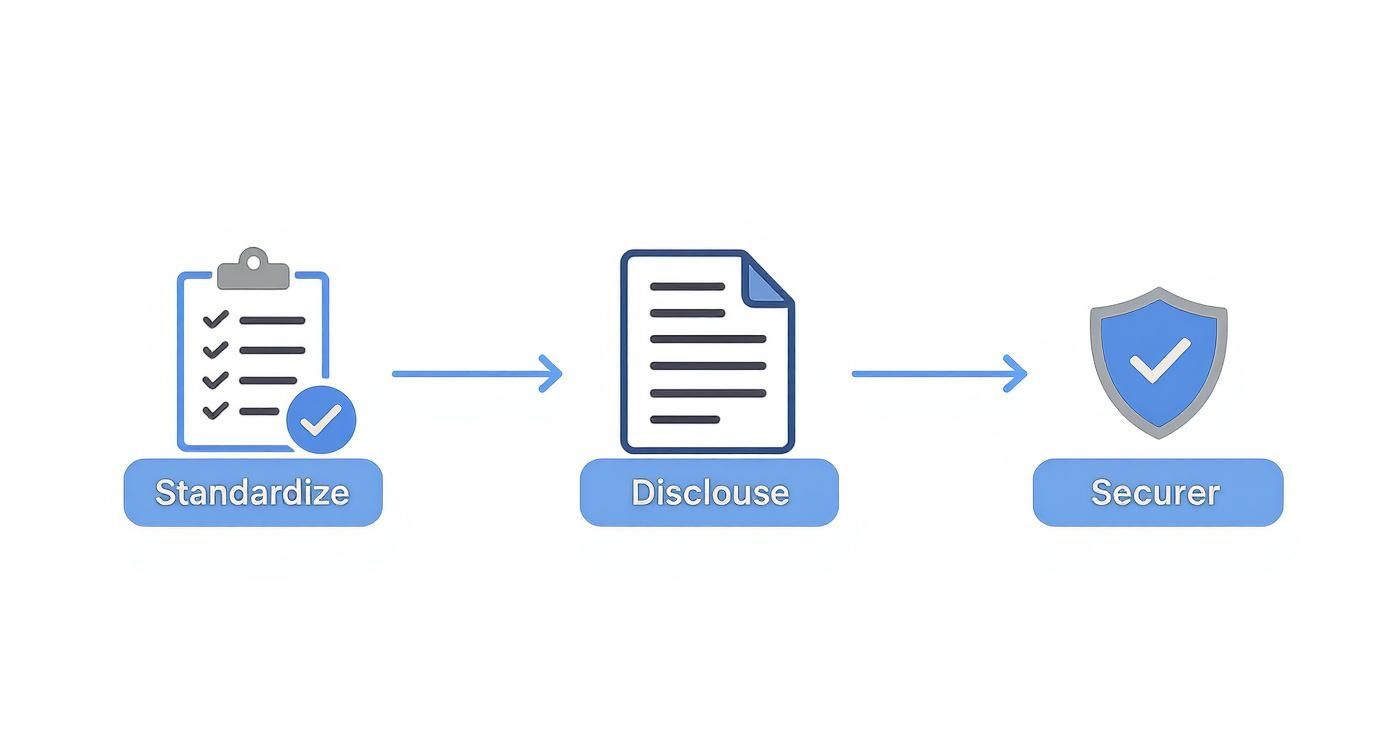
Automating these compliance and data-handling steps is a game-changer for reducing manual errors and speeding up the entire leasing cycle.
A fully automated workflow doesn't just make your team faster; it makes them more effective. It frees them from repetitive administrative tasks so they can focus on high-value interactions and building relationships.
To illustrate the impact, let's compare manual tasks with their automated solutions.
Application Workflow Automation Opportunities
Manual TaskAutomation SolutionImpact on DOM ReductionAgent manually sends application links post-tour.System automatically texts application link after a completed tour.Significant. Captures high-intent prospects immediately.Staff re-enters applicant data from PDF into PMS.Online application data syncs directly to the PMS via API.High. Eliminates data entry lag and human error.Agent manually initiates background/credit checks.PMS triggers screening automatically upon application submission.High. Speeds up qualification by hours or even days.Team sends manual email updates to applicants.Automated status notifications for receipt, review, and decision.Moderate. Improves prospect experience and reduces inquiry calls.
Each automated step shaves valuable time off the leasing process, directly contributing to a lower Days on Market (DOM) across your portfolio.
Closing the Loop from Tour to Application
The final piece of the automation puzzle is connecting the on-site showing experience with your digital workflow. Modern tour scheduling platforms are indispensable here. Imagine a prospect finishes a self-tour. While still at the property, they receive an automated text with a direct link to the property rental application.
This immediate follow-up is powerful. It capitalizes on interest at its peak, dramatically boosting the likelihood they will complete the application on the spot. By linking tour completion directly to the application trigger, you create a closed-loop system that ensures no qualified lead is lost.
This is what separates average leasing operations from elite ones. It's about systematically shrinking your lead-to-lease time, which is the key to maximizing NOI. For more strategies, check out our guide on how to find and screen for ideal tenants.
Implementing Advanced Fraud Prevention and Verification
Application fraud is a calculated, growing threat that can cause significant financial damage to your portfolio. A single fraudulent tenant can result in months of lost rent, costly legal battles, and extensive property damage. A simple document review is no longer sufficient—you need a modern, tech-enabled defense to protect your assets.
The days of glancing at a PDF pay stub are over. Today's sophisticated fraud demands a sophisticated response, incorporating digital tools designed to instantly verify documents, identify inconsistencies, and flag risks before they become liabilities.
Moving Beyond Manual Document Review
For large portfolios, manually verifying every document is a massive operational bottleneck and a significant point of failure. The sheer volume makes it nearly impossible for your team to catch every doctored bank statement or fake employer reference. Technology is your best line of defense.
Modern verification platforms can:
- Analyze Document Metadata: These tools check for hidden signs of digital alteration that are invisible to the naked eye.
- Cross-Reference Data Points: They instantly compare information across the application and financial documents to flag discrepancies.
- Identify Synthetic Identities: Advanced systems can detect patterns associated with synthetic identities created from a mix of real and fake information.
This automated approach not only catches more fraud but also accelerates the verification process, allowing your team to approve qualified applicants faster.
Fraudulent applications are designed to prey on the chaos of a busy leasing season. By automating that first layer of verification, you take back the advantage and empower your team to make faster, more confident decisions.
Equipping Your Team to Spot Red Flags
While technology handles the heavy lifting, a well-trained leasing team remains an essential part of your fraud prevention strategy. Provide them with a practical checklist of common red flags to watch for.
Train them to be skeptical of:
- Suspicious Email Domains: An applicant listing a generic Gmail or disposable email address for an employer contact warrants a second look.
- Unverifiable Employment: A company phone number that goes to a personal cell or a business with no online presence is a major warning sign.
- Inconsistent Personal Information: Small variations in names or dates of birth across documents can indicate a larger deception.
Combining human intuition with powerful technology creates a multi-layered defense. As rental scams become more common, it's crucial to implement checks for images for authenticity in the AI era to combat digital document fraud.
The Power of AI-Powered Verification
The final piece of a modern fraud prevention framework is AI-powered risk assessment. These services analyze thousands of data points in seconds to generate a comprehensive risk score for each applicant, providing a nuanced view of their profile and highlighting specific areas of concern.
This near-instant analysis is a game-changer for large portfolios. It provides the data-backed confidence to approve legitimate applicants quickly, helping to reduce your Days on Market (DOM), while flagging high-risk applications for deeper manual review.
Recognizing these threats is the first step, and you can learn more about how Showdigs helps property managers combat the growing epidemic of rental scams with integrated solutions.
Tracking the KPIs That Truly Matter for Leasing Performance
If you can't measure it, you can't improve it. For any data-driven property management company, the application process is a goldmine of information that reveals the health of your entire leasing funnel. Tracking the right KPIs turns your application from an administrative step into a powerful diagnostic tool.
It’s easy to get lost in vanity metrics. Elite operators focus on the numbers that have a direct financial impact on the portfolio. These are the KPIs that operations directors use to justify new technology, prove ROI, and demonstrate operational excellence.
Essential Application Process KPIs
Here are the core metrics every large-scale operator should have on their dashboard to measure the performance of their property rental application workflow.
- Formula: (Total Submitted Applications / Total Started Applications) x 100
Consider the financial impact: a seemingly small 5% improvement in your lead-to-lease conversion rate for a 1,000-unit portfolio can translate into tens of thousands of dollars in added annual revenue, driven by systematically reducing vacancy loss across every property.
Optimizing these KPIs has a direct, causal relationship with your most important portfolio-level metric: Days on Market (DOM). By making your application easier to complete and faster to process, you shrink the time between a prospect’s initial interest and their move-in date. That incremental improvement, multiplied across thousands of units, is how sophisticated operators protect their NOI and consistently outperform the competition.
Answering Your Top Questions
We get a lot of questions from property managers looking to tighten up their rental application process. Here are a few of the most common ones we hear.
How Can I Speed Up Application Processing Without Sacrificing Accuracy?
This is all about smart automation and API integration. The key is to connect your online application directly to your property management software and screening provider.
When you use an API to link these systems, you eliminate manual data entry. The moment an applicant submits, it can automatically trigger background and credit checks. By the time a leasing agent reviews the file, the initial screening is already complete. This hands-off approach dramatically reduces processing time while maintaining high standards.
What Is the Best Way to Handle Application Fees Across Multiple States?
Managing application fees across different states is a major compliance risk. The solution is system-enforced standardization.
First, you must document the maximum allowable application fee for every jurisdiction where you operate. Then, build those rules directly into your property management software. This ensures the system automatically charges the correct, legally-compliant fee based on the property’s address, removing human error from this critical compliance step.
An optimized application process directly impacts your most critical metric: Days on Market. Every hour saved in processing is an hour closer to a signed lease, which, when multiplied across a large portfolio, translates into a significant reduction in vacancy loss and a direct boost to your Net Operating Income.
How Do We Encourage More Applicants to Complete the Application?
A high drop-off rate is almost always a symptom of friction. A clunky, confusing application process will cost you qualified tenants.
Adopt a mobile-first design. Break the application into small, digestible sections—Personal Info, Rental History, Employment—and include a progress bar. Use conditional logic to hide questions that are irrelevant to a specific applicant. This creates a faster, cleaner experience that respects the applicant's time and keeps them engaged through to submission.
Ready to transform your leasing process from lead capture to lease signing? Showdigs combines on-demand agent services with powerful automation to slash your Days on Market and optimize your lead-to-lease funnel. We can show you how our platform helps property managers scale operations efficiently and boost their NOI.
.png)