




For property managers overseeing large, distributed portfolios, the Kissimmee rental market presents a unique operational challenge: stability. The average rent in Kissimmee hovers around $2,288 per month, and it barely budges. This predictability is a goldmine for scalable operations, but only if the right systems are in place to minimize vacancy loss.
Success in this market isn't about chasing volatile price swings. It’s about building a hyper-efficient leasing workflow that systematically reduces Days on Market (DOM) and converts the steady stream of tenant demand into signed leases at maximum velocity.
Decoding The Kissimmee Rental Market
For enterprise-level property managers, Kissimmee operates at a unique crossroads. On one hand, a massive, tourist-driven economy fuels constant housing demand. On the other, a rapidly growing residential population requires a scalable management infrastructure. This dynamic creates both consistent opportunity and specific operational hurdles for property management companies operating at scale.
The goal isn't just to glance at rent comps. It's about a deep analysis of the data to understand what drives tenant behavior and pricing. Winning in this market means building a high-velocity leasing funnel that turns qualified leads into signed leases—fast. This is where your Days on Market (DOM) becomes the most critical Key Performance Indicator (KPI) you track.
Understanding Market Stability and Opportunity
Kissimmee’s rental market moves with a steady rhythm, not dramatic jolts. As of October 2025, the average rent for all properties is $2,288. That’s a negligible $12 dip from last month and just a $2 decrease from last year. This market has been holding steady right around the $2,300 mark, providing a stable foundation for financial forecasting.
With 1,657 available rentals, inventory is healthy, meaning competition for qualified tenants is high. For portfolio managers, this allows for confident pricing within established bands. Higher-end single-family homes, for example, consistently list between $4,000 and $5,000+, and there are over 113 of those premium units on the market right now.
To give you a quick snapshot of the key numbers, here’s a breakdown of the Kissimmee rental scene.
Kissimmee Rental Market At-a-Glance
These figures tell a clear story: the most significant opportunity for revenue growth isn't aggressive rent hikes. It’s all about accelerating your speed-to-lease.
The Operational Imperative: In a stable market like Kissimmee, every day a unit sits vacant represents a direct and avoidable loss of revenue. For a portfolio of 500 units at an average rent of $2,300, reducing DOM by just 3 days across the portfolio recovers nearly $115,000 in annual revenue. The most impactful strategy is a relentless focus on compressing the leasing timeline.
The Influence of Short-Term Rentals
You can't analyze Kissimmee's rental market without acknowledging the impact of short-term rentals. The constant flow of tourists and hospitality workers creates a unique ecosystem. For a deep dive, you can check out detailed Kissimmee Airbnb analytics, which offers insights into seasonal demand and pricing ceilings that directly influence the long-term market.
For property managers, this dynamic means:
- A steady pool of tenants: People move here for jobs in tourism and service, creating a consistent need for housing.
- Competition for inventory: Some owners will flip properties between long-term and short-term use, which can squeeze supply.
- Higher tenant expectations: Renters accustomed to the responsiveness of the hospitality industry often expect a higher level of service and faster communication from their property manager.
Ultimately, mastering the rental game in Kissimmee comes down to running a tight, efficient operation. The rest of this guide will provide actionable frameworks for pricing, neighborhood targeting, and leasing automation to help you slash your DOM and boost lead-to-tour conversion rates across your entire portfolio.
Setting The Right Rent For Your Properties
In Kissimmee, setting the right rent is the single most important lever for minimizing vacancy and accelerating lease-up velocity. Get it wrong, and you're leaving money on the table. For property managers with large portfolios, even a small pricing mistake multiplied across hundreds of units results in a significant revenue shortfall.
The solution isn’t just glancing at city-wide averages. It's about a granular analysis to find the operational sweet spot. This means going beyond a generic market summary to analyze what specific property types and bedroom counts are moving fastest. When your team has this insight, they can make data-backed pricing decisions that attract qualified applicants faster. That means lower Days on Market (DOM) and a reduced cost-per-lease.
Analyzing Rent By Property Type And Size
While the overall market feels steady, a closer look reveals key differences between single-family homes and apartments. Recent data from Kissimmee’s rental landscape paints a clear picture. On average, single-family houses are leasing for $2,345 a month, while apartments are bringing in a slightly higher $2,398.
This data is gold for portfolio managers. It indicates that with 1,657 total listings on the market, you can find opportunities by focusing on specific asset classes, like 3-bedroom single-family homes, to capture better returns. For a deeper dive into local trends, check out the latest rent insights for Kissimmee on Apartments.com.
With this data, you can position your properties more strategically. If your portfolio is heavy on single-family homes, pricing them just a touch below comparable apartment complexes can create a powerful value proposition for renters seeking more space.
Finding The Pricing Sweet Spot
The most critical data point for any leasing operation is the price range that moves the fastest. In Kissimmee, 51% of all rental properties are priced between $1,501-$2,000. This is the heart of the market—it’s where the largest pool of qualified tenants is actively searching.
The data becomes more actionable when broken down by bedroom count. There's a clear trend toward larger units, which aligns perfectly with the family-oriented renters that constitute a huge part of Kissimmee's tenant base.
- 1-Bedroom Units: Average $1,527 (up 2% year-over-year)
- 2-Bedroom Units: Average $1,785 (up 3% year-over-year)
- 3-Bedroom Units: Average $2,162 (up 2% in the last 30 days)
That consistent climb for 2- and 3-bedroom properties signals strong, ongoing demand. For property managers, this means 3-bedroom homes aren't just rental units; they're high-demand assets that can be priced competitively to secure high-quality tenants quickly.
Before you set final numbers, it’s always best practice to use Zillow to validate your rent against the freshest comps in the immediate neighborhood. This final check ensures your pricing is not only based on broad data but is also sharp enough to compete block by block.
Operational Insight for Portfolio Managers: The data is crystal clear: 3-bedroom single-family homes priced between $2,000 and $2,400 are the sweet spot in Kissimmee, hitting the perfect balance of high demand and strong rental income. Aligning your available inventory with this pricing strategy is the fastest track to reducing Days on Market and maintaining high occupancy rates across your portfolio.
Pinpointing High-Value Kissimmee Neighborhoods
If you’re managing a large, distributed portfolio, you know “Kissimmee” isn’t just one market. It’s a patchwork of smaller, distinct submarkets, each with its own renter profile and operational considerations. To scale successfully here, you must move beyond generic real estate advice and analyze these areas from an efficiency-first, operational perspective.
This means thinking about Kissimmee in strategic zones, not just zip codes. When you align your marketing, pricing, and showing strategy with the characteristics of each submarket, you’ll see higher-quality leads, shorter vacancy periods, and a much smoother leasing process across your entire portfolio.
The Family-Friendly Suburbs
This is the core of Kissimmee's long-term rental market. Neighborhoods like Celebration, Hunter's Creek, and parts of Poinciana attract families looking to establish roots. The primary draws are A-rated schools, community parks, and a stable environment.
Here, you're mostly dealing with single-family homes, usually with at least three bedrooms. The tenants are often dual-income families and professionals who prioritize safety and community—attributes that directly correlate with lower turnover costs.
- Operational Focus: Marketing collateral should prominently feature school districts, playgrounds, and community events.
- Rent Ranges: Premium rents can be commanded here, especially for well-maintained homes in top school zones.
- Leasing Strategy: The leasing cycle may be longer. Families plan moves carefully, often months ahead. The goal is to secure a high-quality, long-term lease, minimizing future turn costs.
The Commuter Hubs
For tenants employed in Orlando, Lake Nona's Medical City, or other regional job centers, commute time is the primary decision driver. Areas with direct access to I-4, US-192, or SR 417 are gold. Think Buenaventura Lakes (BVL) and the neighborhoods bordering St. Cloud, which offer an optimal mix of convenience and affordability.
The renter base is a mix of young professionals, service industry workers, and anyone prioritizing reduced travel time. Inventory includes everything from single-family homes to townhomes.
Portfolio Insight: Commuter-focused submarkets tend to have a higher lease-up velocity. These tenants are often relocating for a new job and require immediate housing. This makes same-day showings an operational necessity. If you cannot show a property within hours of an inquiry, that lead will be lost to a competitor who can.
High-Demand Pockets Near Theme Parks
The closer you get to Walt Disney World and Universal, the faster the market moves. Areas in west Kissimmee and around ChampionsGate are magnets for hospitality and service industry professionals, creating a constant churn of rental demand.
This tenant pool may be more transient, but it’s incredibly reliable and constantly refreshed by the tourism economy. The primary operational challenge is managing higher turnover without losing revenue to vacancy days. A standardized, high-velocity showing system is non-negotiable.
To see the density of showing agent coverage in this key corridor, portfolio managers can review the Showdigs on-demand agent network map. It’s a powerful way to visualize how you can scale showing capacity across a dispersed portfolio without increasing internal headcount.
- Property Styles: A mix of apartments, townhomes, and smaller single-family homes.
- Tenant Profile: Typically younger individuals or couples working in tourism who prioritize proximity to their employer.
- Operational Imperative: Speed is everything. These renters need to move immediately. The single most effective way to reduce vacancy time is to automate your showing schedule to offer instant and after-hours tours. A slow response time directly results in lost leasing opportunities.
Making Sure You're Following Florida Landlord-Tenant Law
For any large-scale property management company, true profitability is a function of both occupancy and risk mitigation. A few legal missteps can quickly erode revenue gains, making a robust understanding of Florida's landlord-tenant laws non-negotiable. When managing a scattered portfolio in Kissimmee, you need standardized, scalable compliance workflows that your entire team can execute flawlessly.
This doesn't mean every team member needs to be a legal expert. It means baking compliance directly into your daily leasing and management technology and processes. Everything from how you handle a security deposit to when you enter a property for repairs must align with state statutes. If team members are operating with different procedures across hundreds of units, you are exposed to significant legal and financial risk.
Core Compliance Areas for Kissimmee Operations
To maintain compliance at scale, you must focus on the common areas where legal issues arise. These workflows must be standardized and executed consistently across your entire Kissimmee portfolio.
- Security Deposit Handling: Florida law is highly specific. You must notify the tenant in writing within 30 days where their deposit is being held. There are no exceptions.
- Notice of Entry: To enter a property for an inspection or repair, you must provide at least 24 hours' notice, except in a true emergency. This should be an automated communication workflow.
- Lease Termination and Eviction: The procedures for lease termination and eviction are incredibly rigid. Serving the wrong notice or missing a deadline can result in the entire process being dismissed, costing you months of time and lost rent.
The Florida Bar provides a helpful summary that outlines the key rights and duties for landlords and tenants, which is a crucial resource.
This checklist highlights the importance of written notices and adherence to legal timelines—critical components for any property manager operating a compliant, scalable business.
Building Compliance Workflows That Can Scale
The key to managing legal risk across a large portfolio isn't just knowing the rules; it's embedding them into your software and team training. A decentralized approach where each property manager interprets the law differently is a recipe for disaster.
Operational Imperative: When managing at scale, you cannot leave compliance to chance. Your operational playbook needs standardized checklists and automated alerts for key legal deadlines, such as security deposit notifications. This transforms a potential legal liability into a simple, repeatable, and auditable process.
For example, your property management software should trigger an automated task to issue the 30-day security deposit notice. When a maintenance request is logged, the system should generate and schedule the required 24-hour notice of entry to the tenant. By systemizing these steps, you reduce human error and ensure every property in Kissimmee is managed to the same compliant standard. It's the only way to effectively mitigate legal risk while focusing on the core business driver: filling vacancies.
How To Speed Up Your Leasing Operations
For property managers running large Kissimmee portfolios, strategy is all about speed-to-lease. Every day a rental home sits empty, it's a direct hit to your gross potential rent. Winning in this market isn't just about finding tenants; it's about systematically shrinking the time from initial inquiry to signed lease.
This requires a serious focus on overcoming the operational hurdles of managing hundreds of properties. You need a system that can handle high lead volume without breaking, a process to get qualified prospects through the door the same day they inquire, and the right technology to automate repetitive administrative tasks. Without these components, your team gets swamped, your Days on Market (DOM) creep up, and your best leads are lost to competitors.
From High Lead Volume to High Conversion Rates
Receiving hundreds of inquiries for your Kissimmee rentals is a good problem to have, but it can quickly lead to "lead blindness," where leasing agents can't distinguish serious renters from casual browsers. This is where speed becomes your most powerful competitive advantage.
A prospect who inquires about a rent in Kissimmee property on a Tuesday morning is likely contacting five other listings simultaneously. If your team takes hours to respond, you've already lost. The objective is to engage them instantly and schedule a tour before they even hear back from the competition.
The Revenue Impact of Speed: For a portfolio of 1,000 homes with an average rent of $2,300, trimming your average DOM by just five days adds over $380,000 back into your annual revenue. This isn't about cutting costs—it's about recovering lost income through sheer operational velocity.
Executing Same-Day Showings At Scale
The "same-day showing" is the holy grail for high-performing leasing teams. It means having the capability to show a property within hours of a lead's first contact. But when managing single-family homes scattered across Kissimmee, this becomes a massive logistical challenge for in-house staff.
This is where a hybrid, tech-enabled model provides a clear solution. A service like Showdigs tackles this problem by pairing smart scheduling software with a network of on-demand, licensed agents. This setup allows you to offer immediate tour availability across your entire Kissimmee portfolio without increasing fixed labor costs.
This flow chart gives a great visual of the key compliance steps every landlord needs to master.
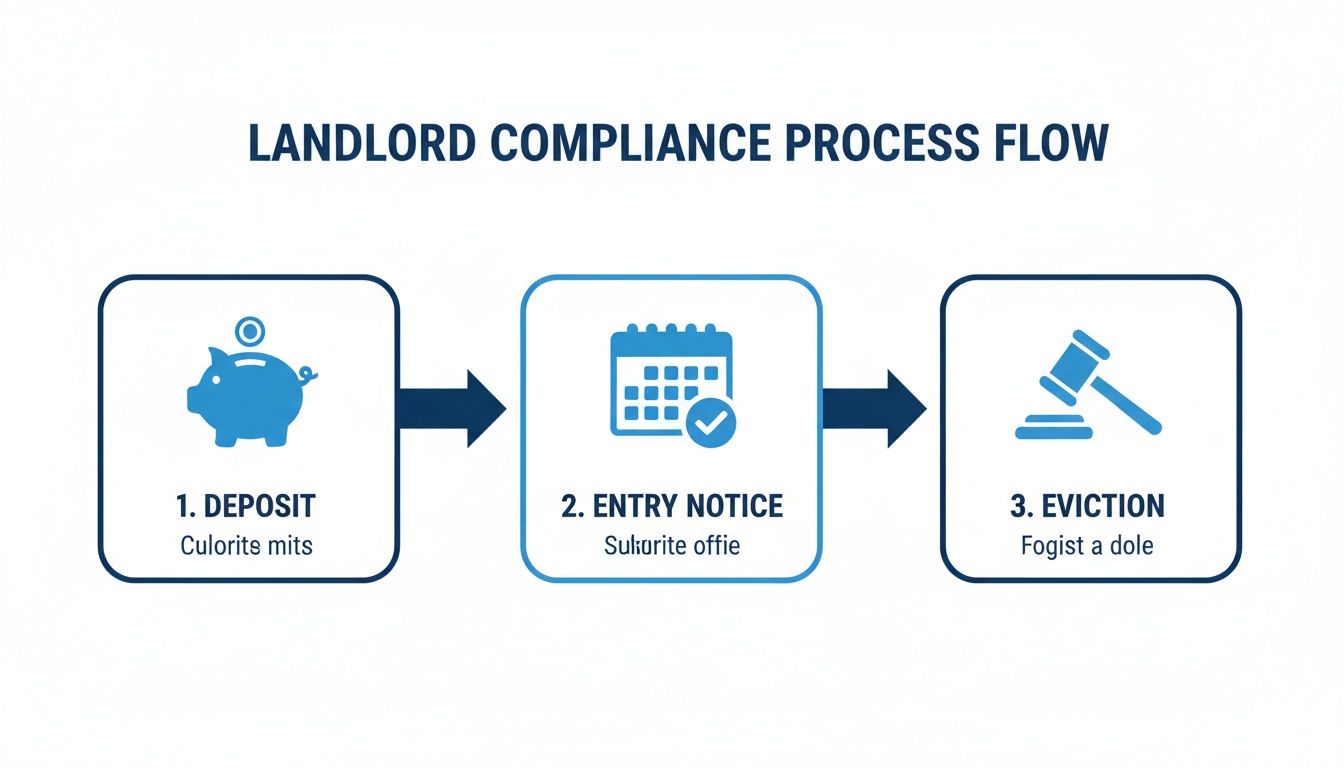
Standardizing your process for deposits, entry notices, and evictions is the foundation for scaling your operations while keeping risk low.
When a qualified lead comes in, the system can instantly book a tour with a local agent. A process that once involved days of phone tag and emails now happens automatically in minutes. This directly boosts your lead-to-tour conversion rate and reduces your DOM. For Kissimmee landlords who also manage short-term rentals, applying similar principles and learning the right strategies to increase Airbnb bookings is essential for maximizing occupancy.
Leveraging Automation For a Competitive Edge
Leasing cannot be accelerated at scale without automation. Manual follow-ups, scheduling coordination, and chasing down feedback are bottlenecks that destroy efficiency and allow qualified leads to go cold. The right technology stack removes these repetitive tasks from your team's workload, freeing them to focus on high-value activities: negotiating leases and managing owner relationships.
A robust leasing automation platform should handle several key functions:
- AI-Powered Communication: Instantly text and email every lead, answer basic questions, and pre-qualify them 24/7. You can see how AI-powered marketing automation for property managers transforms lead engagement and response times.
- Automated Tour Scheduling: Allow prospects to self-schedule tours online based on real-time availability, eliminating back-and-forth communication.
- Post-Tour Feedback Loops: Automatically send a survey after a showing to gather immediate feedback and push application links to interested prospects.
The table below breaks down the operational impact of this shift.
Manual vs Automated Leasing Workflow Comparison
By building these automated workflows, property managers can create a leasing machine that operates with speed and precision. This ensures no lead is left behind and every vacancy day is minimized—a direct strategy for improving the financial performance of your entire Kissimmee portfolio.
Your Playbook for Winning in Kissimmee
Market intelligence is one thing; turning it into scalable, repeatable action is what separates top-tier portfolios from the rest. For any company managing properties in Kissimmee, success boils down to a focused, three-part strategy that addresses the market's unique operational dynamics. This is your game plan for converting local insights into measurable financial results.
The fundamentals for a winning Kissimmee operation are simple but demand relentless consistency. Nailing these will directly impact your most important metrics, from Days on Market (DOM) to your all-in cost per door.
A Three-Step Framework for Success
Your team needs to be laser-focused on these key operational areas.
- Price with Precision, Not Averages: Stop using city-wide data for property-level decisions. Your pricing must be granular, reflecting the significant demand differences between property types and submarkets. Zero in on 3-bedroom single-family homes in family-friendly suburbs and commuter zones. Price them aggressively within the $2,000-$2,400 sweet spot to attract the best tenants before your competition does.
- Make Compliance Your Default Setting: Your legal workflows must be airtight, standardized, and scalable. Florida’s landlord-tenant laws offer no room for error, and a single mistake can be costly. Implement automated checklists for critical items like security deposit notices and notices of entry. This ensures every unit is managed to the same compliant standard, reducing legal risk to near zero.
- Use Automation to Lease Faster: In a stable market like Kissimmee, the biggest lever for revenue growth is your speed-to-lease. Manual processes are the enemy of scale. A system for same-day showings and automated lead follow-up is no longer a "nice-to-have"—it's an operational necessity for capturing motivated renters before they sign elsewhere.
The Bottom Line
It’s time to quantify the cost of vacancy across your portfolio. Pull out a calculator and determine your current average vacancy cost. How many days does a unit typically sit empty? What is the dollar value of that lost rent?
For a property with a monthly rent in Kissimmee of $2,300, every single day it sits vacant costs your owners over $75. When you manage hundreds of units, shaving even a few days off your average vacancy time adds up to a massive amount of recaptured revenue.
Evaluating a modern showing solution like Showdigs is one of the most direct ways to close that gap. By combining smart software with a network of on-demand agents, you can enable same-day showings, automate lead nurturing, and systematically reduce your DOM. This isn’t just about making your team more efficient; it's about driving measurable revenue growth in the competitive Kissimmee market.
Your Top Questions About Rent in Kissimmee, Answered
Every rental market has its own nuances, and Kissimmee is no exception. For property managers optimizing large portfolios, a few key questions consistently arise. Here’s a quick rundown of the essential information.
How Much Can I Realistically Charge For Rent In Kissimmee?
While the market-wide average rent sits around $2,300, this figure is merely a baseline. For single-family homes, which dominate the market, the true sweet spot is between $2,000 and $2,400. This is especially true for three-bedroom properties that attract stable, long-term family tenants.
However, pricing is hyper-local. A home in a sought-after school district like Celebration will always command a premium over a similar property near the tourist corridors. Before setting a final price, a granular comparative market analysis (CMA) is non-negotiable. It’s the only way to avoid extended vacancy periods.
What Is The Typical Tenant Profile In Kissimmee?
Kissimmee’s tenant base is a mix, driven by the two pillars of the local economy: tourism and the professional jobs in the greater Orlando area. You'll encounter three main segments:
- Hospitality and Service Professionals: This group requires proximity to the theme parks to minimize commute times. They seek convenience and may have income that varies seasonally.
- Families: This segment flocks to suburbs like Hunter's Creek for the schools and community amenities. They typically have a longer tenure, reducing turnover costs.
- Commuters: Professionals working in Orlando or the fast-growing Lake Nona area seek properties with direct access to I-4 and other major highways.
Are There Specific Local Ordinances I Should Know?
Absolutely. Beyond standard Florida landlord-tenant laws, Kissimmee has specific ordinances regarding short-term rentals—any lease under six months. Operating a vacation rental is restricted to designated zoning districts. A conditional use permit and a local Business Tax Receipt are typically required for legal operation.
It's critically important to ensure portfolio-wide compliance. Attempting to mix long-term and short-term leasing without adhering to city zoning regulations can result in significant penalties. Always verify a property's zoning with the City of Kissimmee Planning Division.
How Can I Avoid Common Rental Scams In The Area?
Rental fraud is prevalent in high-demand markets like Kissimmee and can damage your brand reputation. The best defense is a standardized, secure leasing process. Never request deposits via untraceable methods and always require an in-person or verified virtual showing before any funds are exchanged.
Scammers often steal photos from legitimate listings and repost them. Watermarking your marketing photos and using a professional, secure leasing platform makes it significantly harder for them to defraud prospective tenants. It's a simple step that builds trust with qualified applicants and protects your operations.
Ready to stop losing money on vacant properties? Showdigs combines smart automation with a network of on-demand showing agents to get your Kissimmee rentals leased faster. Slash your days on market and watch your lead-to-tour conversions climb. Discover how to automate your leasing funnel today!
.png)

.png)