



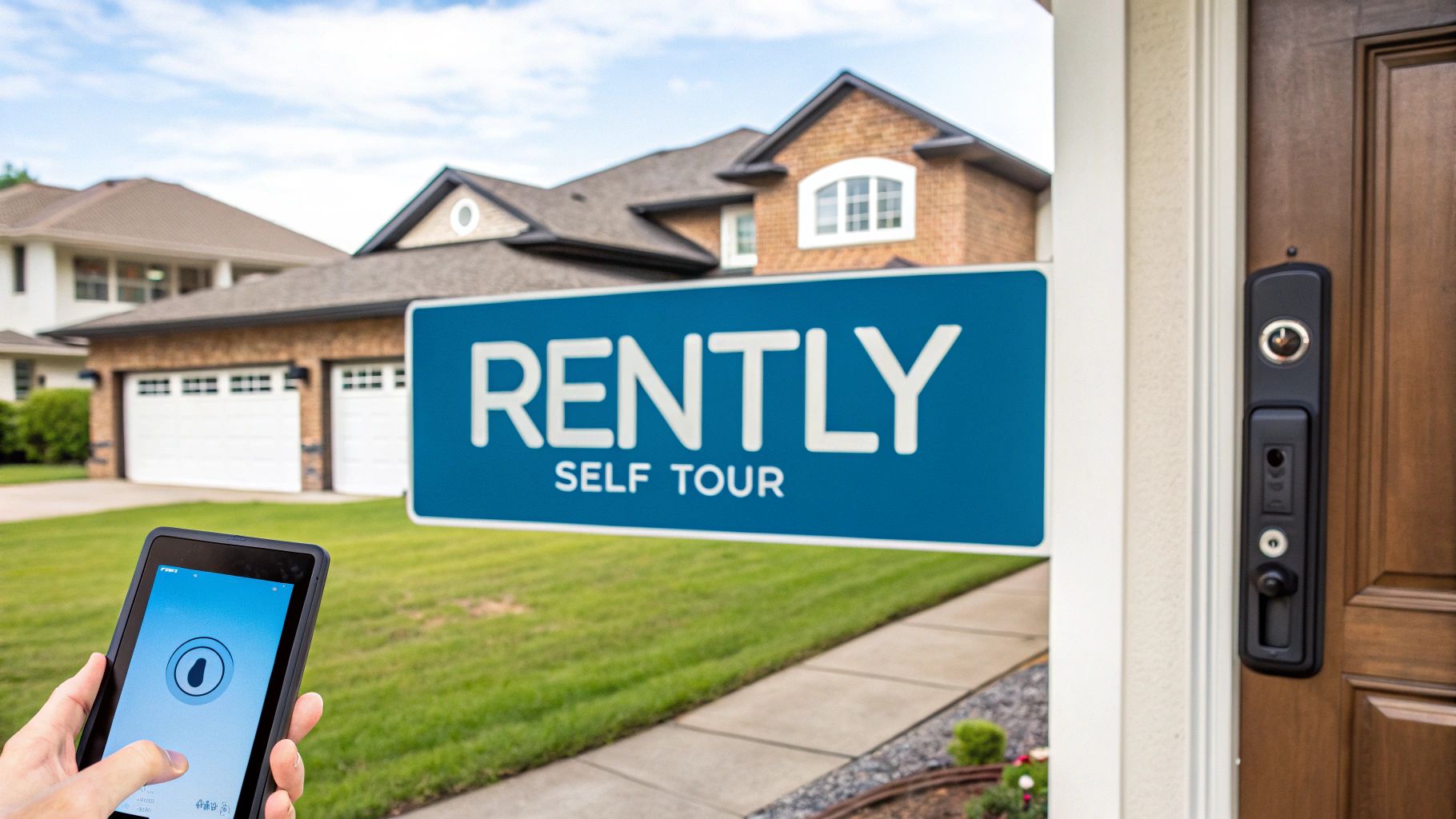
A Rently self tour system allows prospective tenants to view a vacant property on their own schedule, without an agent present. For property management companies overseeing hundreds or thousands of scattered-site single-family homes, this technology can be a critical tool for operational scalability and reducing vacancy loss. It combines smart lockboxes, ID verification technology, and scheduling software to create an on-demand leasing experience.
How The Rently Self Tour Actually Works For Large Portfolios
When managing hundreds of properties, the traditional showing model becomes a significant operational bottleneck. Coordinating agent schedules with prospect availability across a dispersed portfolio is a logistical challenge that inflates Days on Market (DOM) and leads to missed opportunities. A Rently self tour system automates the top of the leasing funnel, converting a manual, high-effort task into a scalable process.
For instance, a qualified lead discovers a property listing at 9 PM on a Tuesday. Instead of submitting a contact form and waiting for a callback, they can book and complete a tour within the hour. This capability is pivotal for large-scale operators, as it drastically shrinks the lead-to-tour timeline and engages prospects at peak interest, directly impacting lead-to-tour conversion rates.
The Prospect's Journey: From Listing To Unlocking The Door
From the renter's perspective, the experience is designed for the instant gratification expected in today's market, which is essential for optimizing tour conversion rates.
The process is broken down into four automated steps:
- Instant Booking: A prospect clicks a "Tour Now" button on a listing and is directed to Rently's portal to select an available time slot.
- Quick Pre-Screening: Before confirming the tour, the system prompts the prospect to register, capturing their information and initiating the identity verification process.
- Secure ID Check: The renter uploads a photo of their government-issued ID and a selfie. Rently's software verifies their identity. Often, a credit card is required on file, a surprisingly effective deterrent against unauthorized activity.
- One-Time Access Code: Upon verification, a unique, single-use access code is sent to their smartphone. This code is only valid for the scheduled time slot, ensuring tight access control.
This entire workflow operates without manual intervention from your team, freeing up leasing agents from scheduling logistics to focus on higher-value activities like processing applications and executing leases.
The Tech And Ops Behind The Curtain
The system's backbone is a Rently smart lockbox installed on the property, which serves as the physical access point.
When a prospect arrives, they enter their one-time code into the Rently app. The app communicates with the lockbox to release the key. Many systems incorporate geofencing, meaning the code will not function unless the prospect's device is physically present at the property—an added layer of security.
For a portfolio manager, the primary operational benefit is the comprehensive digital audit trail. Every property access—who, when, and for how long—is logged in the Rently dashboard. This provides unparalleled oversight for remote property management operations without requiring staff to leave the office.
This automated workflow is the key to scalable leasing. It eliminates the geographical and time constraints of agent-led showings, enabling high-volume operations across multiple markets. The system is engineered to handle hundreds of tours per day, a critical component for reducing vacancy loss and maximizing portfolio revenue.
Calculating The Operational Impact On Your Portfolio
For property management companies managing hundreds or thousands of units, every technology investment must demonstrate a clear, measurable return. Implementing a system like Rently is a strategic business decision aimed at improving core financial and operational key performance indicators (KPIs).
The two most critical metrics for any large portfolio are Days on Market (DOM) and lead-to-tour conversion rates. Every day a property remains vacant represents lost revenue. The primary bottleneck in the leasing process has historically been tour scheduling. By offering on-demand, 24/7 showings, you eliminate this constraint, preventing qualified leads from disengaging and moving on to a competitor.
Quantifying The Reduction In Vacancy Loss
The most direct financial benefit of a self-tour system is a significant reduction in DOM. Agent-led showings are constrained by business hours, traffic, and agent availability. Rently, however, facilitates tours before work, after dinner, and throughout the weekend. This is particularly impactful, as research indicates a significant portion of prospects prefer to view properties outside of standard 9-to-5 hours.
This increased accessibility accelerates the leasing cycle. Consider the financial impact: for a portfolio of 1,000 units with an average rent of $2,000/month, the daily cost of vacancy is $66,667. Reducing the average DOM by just a few days can add hundreds of thousands of dollars to your annual revenue.
The core objective is speed-to-lease. By removing human-centric delays, you convert interested prospects into signed tenants more rapidly, which directly improves your portfolio's net operating income (NOI).
This is part of a larger shift in consumer behavior. Self-guided experiences are a rapidly growing segment of the global tours market, driven by consumer demand for flexibility and control—the same attributes modern renters prioritize. You can dive deeper into this shift by exploring the future of self-guided tours.
Comparing Operational Costs Agent-Led vs Self-Tour
A true ROI analysis requires comparing the fixed cost of a self-tour system against the variable and often hidden costs of traditional showings. An agent-led tour's expense extends far beyond their time on-site.
Consider these operational inefficiencies:
- Windshield Time: For distributed single-family portfolios, agents often spend more time driving than conducting tours.
- Administrative Overhead: The back-and-forth communication required to schedule, confirm, and reschedule tours consumes significant staff hours.
- No-Show Costs: When a prospect fails to show up, the agent's time and travel expenses are sunk costs.
- The Human Bottleneck: A single agent can only be in one place at a time, creating a hard cap on daily tour capacity.
To illustrate this, let’s compare the two models.
Agent-Led vs Rently Self Tour Operational Comparison
MetricTraditional Agent-Led ShowingsRently Self Tour SystemTour AvailabilityLimited to agent schedules (typically 9-5, Mon-Fri)24/7/365, including evenings and weekendsCost StructureVariable (per-tour agent pay, fuel, drive time)Fixed (monthly software fee, one-time hardware cost)ScalabilityLow; more tours require more agentsHigh; can run unlimited simultaneous toursCost Per TourHigh and unpredictable, especially with no-showsLow and predictable, decreases with volumeLeasing VelocitySlower, constrained by scheduling bottlenecksFaster, driven by on-demand prospect accessStaff TimeHigh; consumed by scheduling and drivingLow; staff focuses on lead nurturing & applications
The Rently model shifts the cost structure from a reactive, people-dependent expense to a predictable, technology-driven one. While there is an upfront hardware cost and a recurring software fee, this cost is amortized across the entire portfolio. It allows for a virtually unlimited number of concurrent tours without increasing payroll.
This is the essence of cost per door optimization at scale. Your team is liberated to focus on high-value work—such as processing applications and closing deals—instead of being mired in low-value logistics.
Managing Security And Risk For Unattended Showings
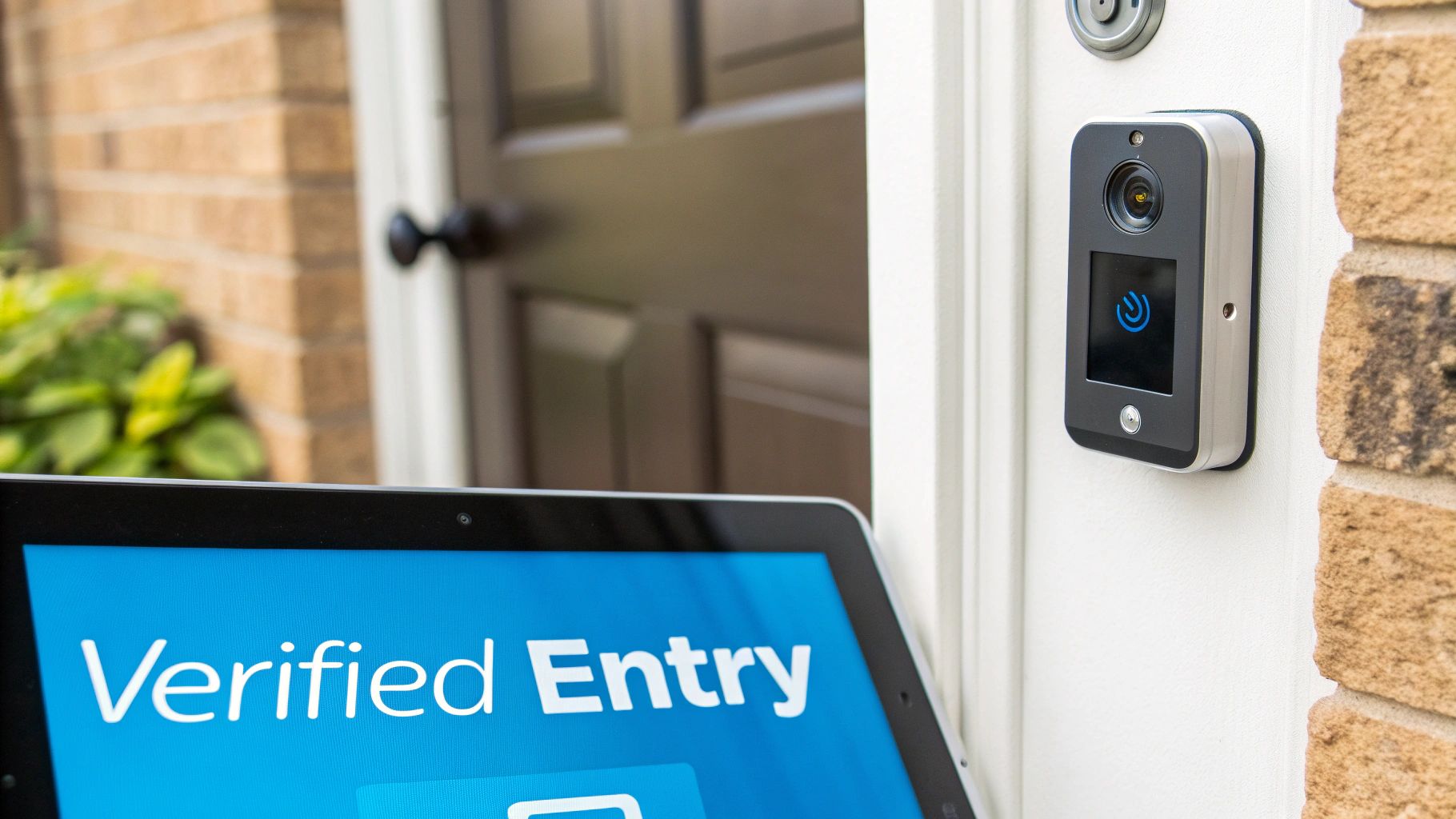
For any property manager overseeing a large portfolio, the concept of unattended showings can raise valid security concerns, from property damage to squatting.
However, modern self-touring platforms are engineered specifically to mitigate these risks. The process is not based on blind trust but on a calculated, data-driven framework. A well-designed system transforms a perceived liability into a secure, auditable process that can offer more accountability than traditional agent-led showings.
A Rently self tour creates a digital perimeter around your asset, deploying multiple layers of security before a prospect gains entry.
Rently's Multi-Layered Security Framework
The system's security is founded on rigorous prospect verification. Rently's platform functions as a digital gatekeeper, ensuring only qualified, identified individuals access your properties.
Here’s how it works:
- Multi-Factor Identity Verification: Prospects must prove their identity by uploading a government-issued ID, which is then cross-referenced with a live selfie to confirm a match.
- Credit Card Holds: Requiring a valid credit card and placing a temporary hold is a powerful psychological deterrent. It communicates that the prospect is financially accountable for leaving the property in its original condition.
- Geofencing Technology: Access codes are rendered useless until the system verifies the prospect's smartphone is physically located at the property, preventing code sharing and remote access attempts.
The smart lockbox provides the final layer of security, creating an immutable digital record of every entry and exit, complete with a name and a precise timestamp. This centralized audit trail for your entire portfolio is a level of oversight nearly impossible to achieve with manual key management. You can learn more about what goes into the most secure self-showings to see how these systems are engineered.
A Practical Risk Mitigation Checklist
While technology provides a robust foundation, effective on-the-ground operations are crucial for minimizing risk at scale. A standardized protocol is necessary to protect your assets.
Here’s a simple checklist your operations team can implement:
- Set Strict Showing Hours: Disable self-touring capabilities during late-night hours (e.g., from 9 PM to 7 AM) to prevent unauthorized overnight stays.
- Conduct Scheduled Property Checks: Implement weekly or bi-weekly walkthroughs of vacant properties by your team or an on-demand service to identify and address issues proactively.
- Automate Post-Tour Feedback: Trigger an automated text or email immediately after a tour to request feedback on the property's condition, providing an early warning system for any problems.
- Monitor Your Access Logs: Regularly review the digital audit trail in your Rently dashboard to identify red flags, such as multiple entries by the same individual or unusual access times.
By combining powerful technology with consistent operational protocols, you can scale your leasing operations confidently. Risk is not eliminated, but it becomes a managed component of a highly efficient system.
Tying Rently Into Your Enterprise Tech Stack
The effectiveness of any leasing technology is contingent on its ability to integrate with your existing systems. For large-scale property management, a platform like Rently cannot operate in a silo. It must connect directly with your core property management software (PMS) to prevent manual data entry that negates efficiency gains.
Seamless integration is the foundation of automation at scale. When your showing platform connects with systems like Yardi, AppFolio, or RentManager, you establish a single, unified workflow. This ensures that data, from listings to lead status, flows automatically between systems, maintaining perfect synchronization.
The Critical Role of API Integrations
The technology enabling this connection is the Application Programming Interface, or API. An API acts as a secure data bridge between your PMS and Rently, allowing them to share information in real-time without manual intervention. This is how you achieve true automation at the top of your leasing funnel.
A robust integration means that when a property's status changes in your PMS, its details—address, rent, photos, and descriptions—are automatically pushed to Rently. This eliminates duplicate data entry, a major source of inefficiency for teams managing thousands of units. The reliability of this connection often depends on solid API design best practices, which govern how cleanly these systems communicate.
For enterprise operators, the objective is to maintain a "single source of truth." Your PMS should serve as the central hub of record, with Rently functioning as a specialized, automated extension of your leasing operations. This architecture prevents data discrepancies and ensures operational consistency across your portfolio.
A Phased Rollout Plan for Multi-Market Portfolios
Attempting to deploy a new system across a large, multi-market portfolio simultaneously is a recipe for failure. A phased rollout is a more strategic approach, minimizing disruption and allowing you to refine your processes based on real-world data.
Here’s a proven framework for a successful launch:
- Phase 1: The Pilot Program (1-2 Months)
- Goal: Test and perfect the entire self-touring workflow in a controlled environment.
- Action: Select a single market or a small cohort of properties (e.g., 50-100 units). Deploy the lockboxes, activate the integration, and meticulously monitor every step—from lead capture to post-tour feedback.
- Metrics to Watch: Lead-to-tour conversion rate, average time from inquiry to tour, prospect and team feedback, and hardware reliability.
- Phase 2: The Expansion (3-4 Months)
- Goal: Apply learnings from the pilot to scale the solution to additional markets.
- Action: Create standardized training materials and installation checklists based on the successful pilot. Roll out Rently to several more key regions, ensuring local teams are fully trained.
- Metrics to Watch: Reduction in Days on Market (DOM), cost-per-tour, and integration performance under increased volume.
- Phase 3: Full Deployment (5-6 Months)
- Goal: Establish the new system as the standard showing method across the entire portfolio.
- Action: With a proven operational model, execute the full-scale launch. The process should now be a well-documented, efficient machine with clear protocols for all related tasks.
- Metrics to Watch: Portfolio-wide vacancy rates, operational cost savings, and overall leasing velocity.
- Installation Protocols: Develop a simple, repeatable installation process for your in-house maintenance team or a third-party vendor.
- Battery Management: Smart lockbox batteries have a finite life. Implement a proactive replacement schedule integrated with your PMS to automatically trigger a work order before a device fails.
- Inventory Tracking: Maintain a centralized inventory log of all lockboxes, tracking their location, status, and maintenance history.
- Rently's Approach: Rently provides an end-to-end, hardware-centric experience. The lockbox and software are a single, tightly integrated system, offering precise control over unattended access. This is ideal for portfolios where the primary goal is a completely hands-off, prospect-driven touring model.
- Tenant Turner/ShowMojo's Approach: These platforms function as a central command hub for managing leads and coordinating various showing types. They offer flexibility, allowing you to plug in different showing methods (self-tours, agent-led tours), but the hardware and software are not as deeply integrated as with Rently.
- Portfolio Density and Geography: Are your properties concentrated in a few neighborhoods or scattered across a wide geographic area? Rently delivers maximum ROI for dispersed single-family rentals where agent drive time is a major operational cost. For a dense multifamily building, the efficiency gains may be less pronounced.
- Average Rent Price and Asset Class: Are you managing Class A, B, or C properties? For high-end rentals, prospects often expect a personalized, guided experience. A fully automated tour might not align with the premium service expectations for a Class A asset. In such cases, a hybrid solution like Showdigs could be a better fit.
- Team Capacity and Structure: Is your team overburdened with low-impact tasks like scheduling and key management? If your leasing agents are consumed by administrative duties instead of closing deals, a Rently self-tour system can automate the top of the funnel and liberate their time for revenue-generating activities.
- The Scattered SFR Portfolio: You manage 500+ single-family homes across a large metropolitan area. Your agents are losing significant time and resources to travel between appointments. Rently eliminates these geographical constraints, enabling dozens of concurrent tours without a single agent on the road.
- The High-Volume, Mid-Market Operator: Your portfolio consists of thousands of Class B or C units where speed-to-lease is paramount. Prospects in this market segment prioritize convenience and speed. An on-demand, self-tour system meets their expectations and drastically reduces your DOM.
- Mandatory ID Verification: Prospects must upload a valid, government-issued ID that is verified by the system.
- Credit Card Holds: Rently typically places a small temporary hold (e.g., $0.99) on a prospect’s credit card. This is not for revenue but to create a financial paper trail and a sense of accountability that deters illicit activity.
- Digital Audit Trails: Every entry is logged with a name and a timestamp, providing a complete access history for each property that is accessible remotely.
Managing Lockbox Logistics at Scale
Software integration is only half the equation. You must also address the physical challenge of managing thousands of smart lockboxes across different states. This requires a standardized logistical framework.
Effective hardware management includes:
For any property manager building an enterprise-grade tech stack, understanding the full landscape of property management software integrations is crucial for creating a connected, automated operation.
How Rently Stacks Up Against Other Showing Solutions
The leasing technology landscape is not a one-size-fits-all market. For property managers of large portfolios, selecting a showing solution is a strategic decision that impacts operational efficiency, cost-per-door, and overall financial performance. A Rently self tour system represents a fully automated, hardware-integrated model that gives prospective tenants complete control.
To make an informed decision, it's essential to compare Rently to other leading solutions like Tenant Turner, ShowMojo, and hybrid models such as Showdigs. The optimal choice depends on your specific portfolio composition, operational workflows, and financial objectives.
Fully Automated vs. Lead Management Platforms
Platforms like Tenant Turner and ShowMojo are best understood as sophisticated lead management systems. They are designed to pre-qualify leads, manage inquiries, and schedule showings. They centralize communication and are compatible with various lockbox types, including Rently's.
The decision hinges on whether you prefer a single, all-in-one system or a flexible software hub that can orchestrate multiple tour types.
The Hybrid Model: Bringing in the Human Element
The most significant departure from Rently's model is the strategic re-introduction of a human element. While full automation solves scheduling challenges, it can introduce new ones. Who ensures the property is show-ready? Who can answer a prospect's questions on-site or provide the personal interaction that secures a lease? This is where hybrid solutions excel.
Showdigs, for example, combines powerful scheduling automation with a network of on-demand, licensed real estate agents. This creates a flexible model adaptable to the specific needs of each property—a critical advantage for a large, diverse portfolio.
For operators managing thousands of doors, the ultimate goal is not just automation but scalable quality control. A hybrid model provides a dynamic solution, allowing you to use full self-showings for some properties while deploying on-demand agents for high-value units or simply to ensure a property is always in pristine condition.
This approach reflects a broader trend. The U.S. tour operators industry, projected to reach USD 12.3 billion in 2025, thrives on offering curated experiences that blend convenience with human expertise. The industry's 20.6% compound annual growth rate underscores that while consumers value autonomy, they still appreciate a human touch. You can dive deeper into this trend with IBISWorld's industry analysis.
Feature Comparison Of Leading Showing Solutions
For enterprise-level property managers, the decision ultimately rests on scalability, security, and cost-per-tour. These KPIs are fundamental to operational success. The table below compares how leading platforms address these critical features.
FeatureRentlyShowdigsTenant TurnerShowMojoPrimary ModelFully Automated Self-ToursHybrid (Self-Tours & On-Demand Agents)Lead Management & Scheduling SoftwareLead Management & Scheduling SoftwareHuman InterventionNone (Prospect-led)Optional (On-demand agents for tours, checks)Minimal (Agent scheduling)Minimal (Agent scheduling)Scalability MethodHardware DeploymentSoftware + Agent NetworkSoftware DeploymentSoftware DeploymentSecurity ProtocolID Verification, CC Hold, Geo-fencingID Verification, Agent Oversight OptionVaries by LockboxVaries by LockboxBest ForGeographically dispersed SFR portfoliosMixed portfolios needing flexibility & quality controlCentralizing high-volume lead qualificationHigh-volume scheduling across tour types
This comparison highlights that the choice is not merely technological but philosophical. Do you prioritize full automation, or do you require a flexible solution that can adapt to different assets and market conditions?
For a more granular analysis of how these models impact metrics like DOM and cost-per-lease, our Showdigs vs. the competition guide provides a deep-dive analysis designed for managers of large portfolios.
Is A Rently Self-Tour Strategy Right For You?
Choosing a showing strategy is a critical decision that directly impacts your revenue and operational efficiency. The debate between a fully automated platform like Rently, a hybrid model, or traditional agent-led showings is not about finding the "best" solution, but the right fit for your portfolio and your strategic goals.
A Rently self-tour strategy excels in specific scenarios but may be less suitable in others. For large operators, this decision must be based on a data-driven analysis of your assets to ensure it aligns with your objectives for ROI and leasing velocity.
This decision tree illustrates how your portfolio's physical distribution should inform your strategy.
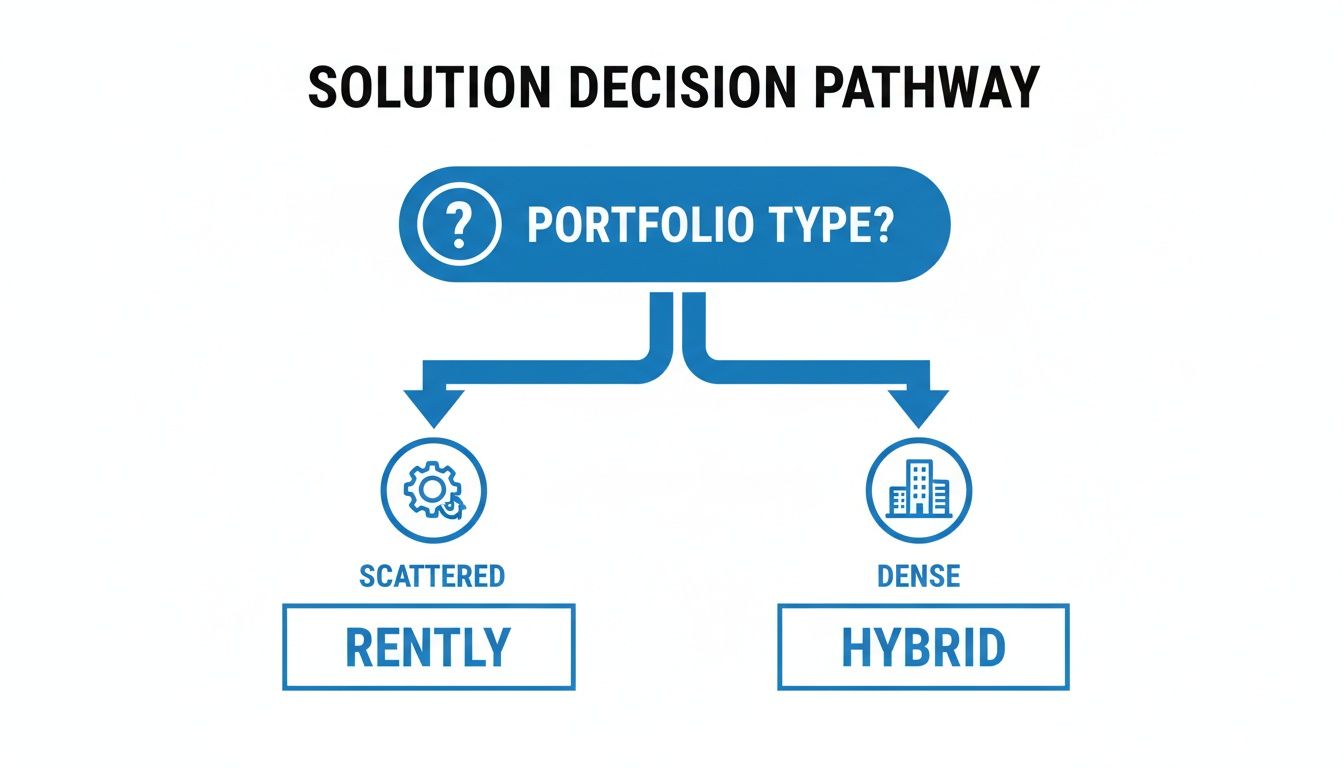
The conclusion is clear: for geographically dispersed single-family homes, full automation is often the most efficient path to lease. For densely clustered properties, a hybrid approach that maintains a human element for quality control may be more advantageous.
Key Factors For Your Decision
To determine if Rently’s all-in automation model is right for your operations, you must objectively assess your portfolio. Answering these questions will guide you toward the optimal path for reducing DOM and optimizing your cost per door.
For enterprise-level property managers, the objective is to build a scalable, repeatable leasing engine that minimizes vacancy loss. The right technology should eliminate operational bottlenecks, not create new ones. Analyze your current lead-to-lease timeline to identify where slowdowns occur.
Scenarios Where Rently Excels
A fully automated strategy provides a significant competitive advantage in several specific scenarios. If your portfolio matches one of these profiles, Rently should be a primary consideration.
Ultimately, the decision to implement Rently must be based on your specific operational pain points and financial goals. Remember, facilitating tours is just one part of the leasing process. A crucial component of successful management is attracting qualified residents. For a deeper dive, review this landlord's guide to finding good tenants. By carefully analyzing your needs, you can implement a system that not only streamlines operations but also drives significant revenue growth.
Common Questions About Rently
Considering adding Rently to your proptech stack? Let's address the most common questions from property managers of large portfolios, focusing on cost, security, and integration with your existing technology.
How Does The Pricing Work For A Large Portfolio?
For operators managing hundreds or thousands of doors, Rently converts showing expenses from a variable, per-tour cost to a fixed, predictable line item. The model typically includes a one-time hardware cost per smart lockbox and a recurring monthly software fee per unit.
This structure is designed for cost per door optimization. Once the fixed software fee is established, the cost per showing decreases as tour volume increases. This can significantly lower your average cost per tour compared to paying agents for their time and travel for each appointment.
How Does Rently Keep My Properties From Getting Damaged or Attracting Squatters?
This is the primary concern for managers new to self-tours. Rently's security is not just a lock; it's a comprehensive framework designed to vet prospects before they gain entry. Its multi-step verification process is often more rigorous than what a busy leasing agent might perform.
Key security layers include:
This digital footprint provides a level of oversight nearly impossible to achieve with manual key handoffs. It is a powerful tool for remote risk management, especially for geographically dispersed portfolios.
Can We Integrate Rently With Our Current PMS?
Yes, this is a non-negotiable requirement for any large-scale operation. Rently is designed to integrate with major property management software platforms such as Buildium, AppFolio, and Yardi.
This API connection is what enables a seamless workflow. Property data—rent, photos, availability—is automatically synced from your PMS to your Rently listings. This eliminates manual data entry, reduces human error, and ensures your leasing operation runs on a single source of truth. For multi-market portfolios, this consistency is critical.
Ready to see how a hybrid showing model can reduce days on market and give you more operational control across your portfolio? Showdigs combines powerful automation with an on-demand network of licensed agents to provide the fastest, most secure path from lead to lease. Learn more about how Showdigs works.
.png)

.png)