



For property managers overseeing hundreds or thousands of rental units, the traditional leasing model is a significant operational bottleneck. Self guided tours are no longer a novelty; they are a strategic imperative for shifting from a manual, high-cost process to an automated, on-demand system designed for enterprise-scale property management.
This isn't just about meeting modern renter expectations for instant access. It's a fundamental operational strategy to slash Days on Market (DOM), reduce cost per door, and directly impact portfolio revenue. For every day a unit sits vacant, you're losing money—a problem that multiplies exponentially across a large portfolio.
The Operational Shift to On-Demand Leasing at Scale
In large-scale property management, small inefficiencies create massive financial drag. Coordinating agent schedules across a dispersed portfolio of single-family rentals or multi-family units without onsite staff introduces delays that directly erode your net operating income.
Consider the financial impact: a qualified lead forced to wait 24 hours for a showing is a lead you risk losing to a competitor with a more agile system. Self guided tours dismantle this bottleneck by providing immediate, on-demand access.
By implementing a scalable, on-demand leasing system, you transition from a reactive model burdened by manual coordination to a proactive, automated framework. Instead of managing agent calendars, you're managing secure access through technology. This empowers you to get a high-intent prospect through the door the moment they inquire—even at 8 PM on a Saturday—drastically improving your speed-to-lease.
This operational transformation has a direct, measurable impact on your most critical KPIs:
- Drastic DOM Reduction: Providing same-day, instant tours is the fastest way to shorten the leasing cycle. Shaving just a few vacancy days across a 1,000-unit portfolio can recover tens of thousands of dollars in lost revenue annually. For a property with $1,800/month rent, each vacant day costs $60.
- Lower Cost Per Door: Automation eliminates the high operational overhead of agent-led showings. By cutting "windshield time," scheduling coordination, and administrative tasks, you directly improve your cost-per-door efficiency and reallocate resources to growth activities.
- Improved Lead-to-Tour Conversion: Today's renters prioritize speed and convenience. Removing the friction of scheduling captures high-intent leads before they lose interest or find another property, significantly boosting your lead-to-tour conversion rates.
From Bottleneck to Revenue Engine
For operators managing large portfolios, the real value of self guided tours is turning the leasing process from a cost center into a 24/7 revenue engine. It standardizes the showing experience across multi-market portfolios, ensuring every property offers the same seamless, secure access. This is essential for maintaining brand consistency and operational control without requiring onsite staff at every location.
The real power of self guided tours at scale isn't just filling vacancies faster. It's about creating a predictable, automated system that minimizes revenue loss. When a prospect can tour a property within an hour of finding it online, you’ve built a massive competitive advantage.
To maximize this potential, integrating your leasing technology with other data sources is key. For example, you can elevate your business with a real estate data API to automate and enrich operational workflows even further.
Ultimately, this model is about eliminating the lag time that costs you money every single day. By building a leasing system that maximizes your portfolio's accessibility and profitability, you're setting up your operations for serious, sustainable growth.
Building Your Tech Stack For Automated Showings at Scale
Successfully implementing self guided tours across a large, distributed portfolio hinges on your technology stack. This isn't about a single application; it's about building an integrated ecosystem where every component communicates seamlessly. The objective is a fully automated workflow that handles lead capture, prospect verification, secure access, and feedback collection—all without manual intervention from your team.
For any operator managing hundreds or thousands of units, this tech stack must be enterprise-grade: secure, reliable, and deeply integrated with your existing Property Management Software (PMS), such as Appfolio or RentManager. When the right hardware and software work in harmony, leasing shifts from a logistical nightmare to a revenue-driving machine.
This flow chart visualizes how automation transforms costly delays into measurable profit and ROI.
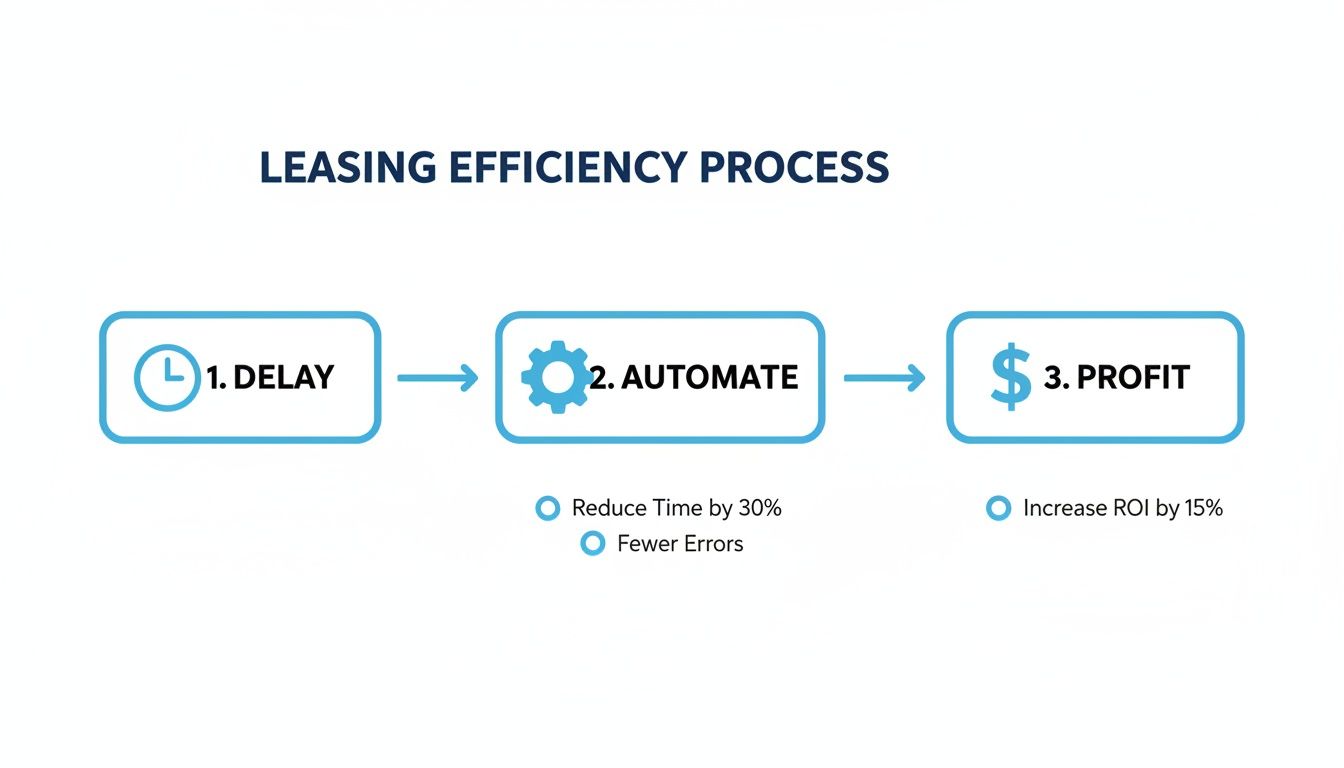
It’s clear: replacing manual coordination with an automated system is the fastest path to slashing vacancy loss and boosting your portfolio's financial performance.
Core Components Of An Enterprise-Grade Stack
To achieve true automation at scale, three components are critical. Each one manages a key step in the self-touring process, and their seamless integration is what determines the success of your program.
- Intelligent Scheduling Software: This is the central brain of your leasing operation. It must sync with your listings, capture leads 24/7, and allow prospects to book tours instantly. For large-scale operations, a robust API is non-negotiable for integration with your PMS to ensure real-time vacancy and pricing data accuracy.
- Secure Access Hardware: This is your remote keymaster, typically consisting of smart lockboxes or permanent smart locks. The critical feature is their ability to receive unique, time-sensitive access codes directly from your scheduling software, eliminating the dependency on physical keys and manual coordination.
- Reliable Prospect Identity Verification: Before any access code is generated, an automated system must confirm that prospects are who they say they are. This is your digital security checkpoint, an essential layer for protecting scattered assets without manual oversight.
A truly scalable tech stack isn't just a list of software. It's a unified system. The moment a prospect books a tour online, the system should automatically vet their identity, generate a one-time code, and deliver it—all without a single human touchpoint.
Smart Lockboxes Vs. Permanent Smart Locks
For managers of single-family rentals and distributed multi-family units, the "lockbox vs. permanent lock" decision is a frequent topic. Both have a strategic place in a large portfolio.
Smart Lockboxes offer maximum flexibility. They can be easily moved between properties as units are leased, making them a cost-effective solution for portfolios with consistent turnover. Their adaptability is a major advantage for growing property management companies.
Permanent Smart Locks provide a more integrated, premium experience. They become a permanent fixture of the home, offering a valuable amenity to tenants and eliminating the need to manage device logistics. For higher-end properties or long-term holds, this is often the more streamlined and secure option.
To build a cohesive and scalable system, it's vital to understand how each piece of technology fits into the larger puzzle. The table below breaks down the essential components, their primary role, and what to look for when you're managing a large-scale operation.
Essential Tech Stack Components For Self Guided Tours
Ultimately, a well-designed tech stack ensures a seamless flow of information, from the first click on a listing to the final tour feedback survey. This integration is what allows you to automate the entire leasing funnel effectively.
Choosing The Right Software Foundation
The software you select acts as the central nervous system for your entire self-showing operation. When comparing platforms, prioritize those built to handle the complexities of managing hundreds or thousands of units. This means robust API capabilities, detailed reporting on metrics like lead-to-tour conversion, and integrations that work seamlessly with your core systems. For a deeper dive, check out our guide on how to choose self-showing software.
This shift toward integrated tech is happening across industries. For example, the self-guided audio tour market was valued at USD 97.65 million and is projected to reach USD 169.95 million by 2032. According to Verified Market Research, this growth is driven by smartphones and apps providing on-demand experiences—the same expectation today's renters bring to their housing search.
Your technology should reduce operational complexity, not add to it. By choosing partners based on reliability, security, and integration capabilities, you're building a foundation that not only reduces your Days on Market but also positions your company to scale efficiently.
Crafting Your Security And Liability Playbook
Implementing self guided tours is a game-changer for reducing DOM and improving leasing efficiency, but it also introduces new security and liability considerations. For property managers responsible for large, distributed portfolios, a casual approach to security isn't just risky—it's a direct threat to your assets and bottom line.
A proactive, standardized security playbook is non-negotiable for protecting your assets and ensuring your automated leasing model is both profitable and defensible.
This isn't about creating cumbersome procedures. It's about building a smart, scalable security framework that mitigates risk before a prospect even sets foot on the property, all without compromising the on-demand experience that drives lead conversion. It begins with robust, upfront verification and clear, enforceable access rules for every single tour.
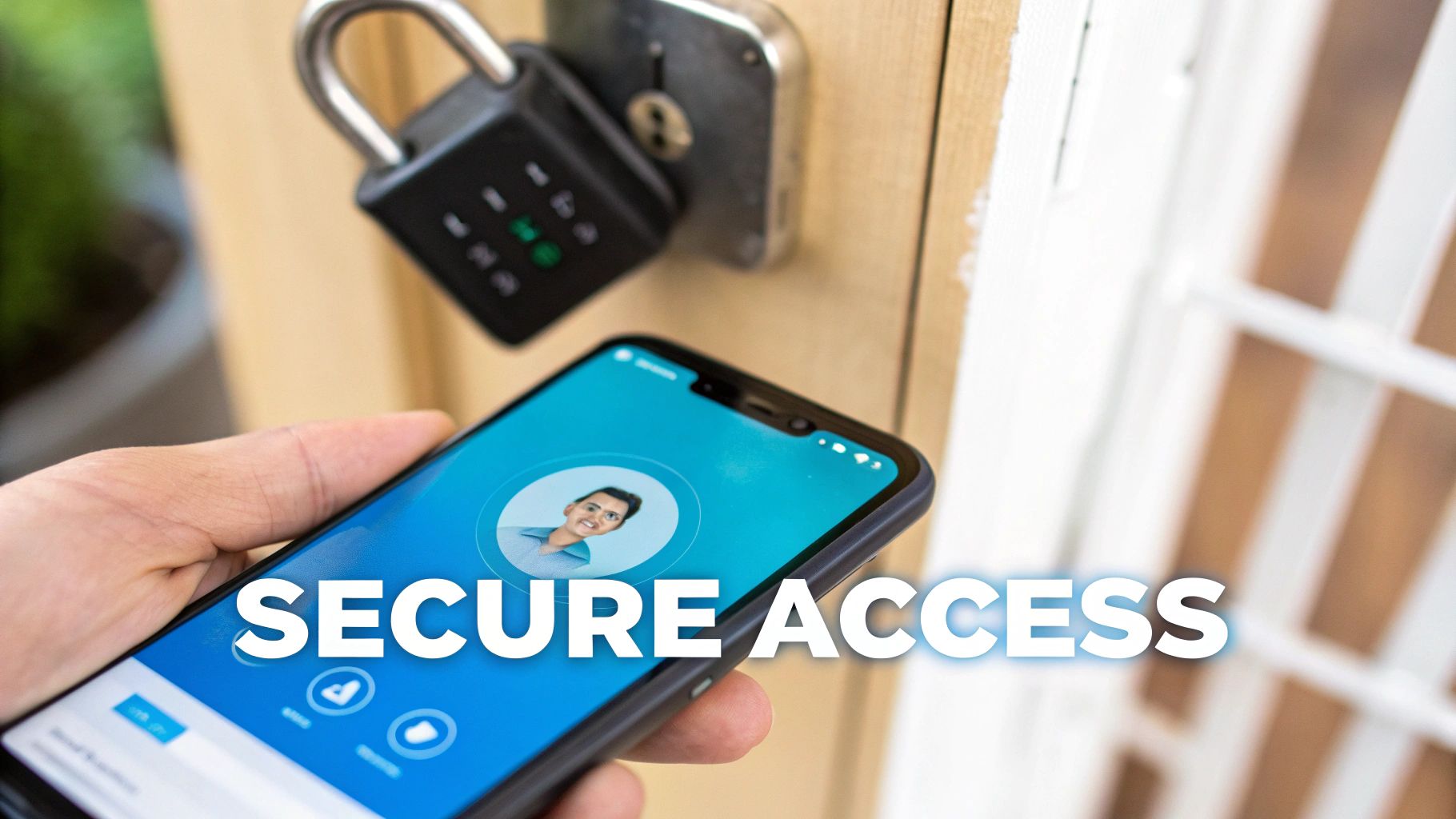
This image perfectly captures the fusion of technology and physical security—the core of a modern self-showing system. True security in this model comes from ensuring only verified, legitimate prospects receive an access code.
Prospect Verification And Access Control
Your first line of defense is a mandatory, automated identity verification process. Requiring prospects to submit a government-issued ID and a biometric selfie before a tour is approved serves as a powerful deterrent for bad actors. This digital gatekeeper works 24/7, pre-screening every individual who requests access to your properties.
Once a prospect is verified, the next layer is controlling access itself. A best-in-class self-showing platform provides granular controls that maintain security even when your team is managing remotely.
Key access controls for your playbook include:
- Time-Limited Access Codes: Every code must be unique to the prospect and should expire shortly after their tour window closes, preventing unauthorized re-entry.
- Defined Showing Hours: Restrict self guided tours to specific hours, such as 8 AM to 8 PM, to prevent late-night activity and maintain community standards.
- Geofencing Confirmation: Advanced systems can require a prospect's phone to be physically at the property before an access code becomes active, adding a powerful layer of real-time security.
By automating these rules, you build a system that is both highly secure and infinitely scalable. It removes human error from the equation and guarantees your security protocols are applied consistently across every single property, whether you manage 100 units or 10,000.
Insurance And Legal Safeguards
Technology is a critical component, but your legal and insurance frameworks must be updated to align with self-tour operations. Assuming your existing policies provide adequate coverage is a significant risk that could leave your company exposed.
First, engage in a direct conversation with your insurance provider. You need explicit confirmation that your general liability policy covers incidents that may occur during an unaccompanied showing. Be prepared to detail your security measures—such as mandatory ID verification and one-time access codes—as this can facilitate obtaining the necessary coverage. To prepare for this conversation, review the features that enable the most secure self-showings and discuss them with your agent.
Beyond insurance, your legal documents require review. Consult with your attorney to draft specific language for your lease agreements or a tour addendum that directly addresses self-tours.
This language should clearly state that:
- Prospects tour the property entirely at their own risk.
- The property management company is held harmless for any personal injury or loss of belongings during the tour.
- The prospect acknowledges and consents to the security and monitoring measures in place.
This multi-layered approach—combining automated verification, strict access controls, appropriate insurance coverage, and clear legal language—creates a comprehensive security playbook. It's what allows you to confidently scale your self guided tour program, knowing you’ve minimized risk while protecting your assets, owners, and prospects.
Flip Your Marketing Funnel for On-Demand Showings
When you introduce self-guided tours, you're doing more than just adding a new feature. You're transforming your marketing from a passive brochure into an active lead conversion machine. Your property listings are no longer static pages; they're now direct doorways to an instant showing. This shift means rethinking how you handle marketing and lead management to capture high-intent prospects the moment they're interested.
This is about meeting renters' expectations for instant gratification. If a prospect has to fill out a contact form and wait for a callback, you've created friction. That delay is often enough to lose them to a competitor who can move faster. Offering immediate, self-service tour scheduling eliminates this friction, which can drastically boost your lead-to-tour conversion rates and reduce vacancy time.
Tweak Your Listing Copy and CTAs
Your marketing copy must reflect the on-demand nature of self guided tours. Vague calls-to-action like "Contact Us for a Showing" are obsolete. Your new language must be direct, create urgency, and communicate "immediate access."
This means embedding clear, action-oriented CTAs directly into your listings on Zillow, Apartments.com, and your own website. Your listing becomes the top of an automated leasing funnel, and the CTA is the key that unlocks it.
Actionable Listing Copy Examples:
- Headline: Tour This Home In Minutes! Self-Guided Showings Available Now.
- Description: Why wait? See this home on your schedule. Click to book your private, self-guided tour instantly. No agent needed. Available 8 AM to 8 PM daily.
- Button Text: Use powerful verbs like "Tour Now" or "Unlock Instant Access."
- Banner Copy: See it Today! Book a Self-Guided Tour and Visit in the Next Hour.
The goal is to make it clear that a tour is not a future appointment; it's an immediate action they can take right now. This simple linguistic shift positions your properties as the most accessible on the market, capturing high-intent renters before they look elsewhere.
By making the call-to-action about immediate access—'Tour Now'—you align your marketing with the core benefit of self guided tours. This isn't just a scheduling feature; it's your primary competitive advantage in a crowded market.
Automate Your Lead Response Workflow
Once a strong CTA captures a lead, speed is paramount. A prospect waiting for a human response is a lead going cold. This is where automated workflows become non-negotiable for large-scale property management. Your system must engage prospects instantly, guiding them from initial interest to a scheduled tour in seconds.
An optimal automated workflow includes:
- Instant Engagement: The moment a prospect clicks your "Tour Now" link, an automated text and email should be sent.
- Direct Scheduling Link: The initial message must contain a direct link to your scheduling platform where they can book their tour immediately.
- Smart Follow-Up: If a tour isn't booked within 15 minutes, an automated follow-up can nudge them, perhaps highlighting a key property feature to reignite interest.
This hands-off process ensures no lead falls through the cracks and closes the leaks that kill conversion rates. By delivering the scheduling link instantly, you satisfy their need for immediate results and secure their interest before they move on. An effective marketing automation for your leasing tech stack is the engine that powers this machine, ensuring every lead is handled with maximum efficiency.
By aligning your marketing messages and lead management with the power of on-demand tours, you create a seamless leasing machine that works 24/7, converting leads faster and keeping your portfolio's vacancy rates at a minimum.
Measuring The ROI Of Your Self Guided Tour Program
For data-driven property management companies, launching a self-guided tour program is just the beginning. The real work is proving its worth in hard numbers. You need to move past vanity metrics and rigorously quantify success, focusing on the operational and financial outcomes that directly impact your portfolio's bottom line.
This means every decision—from the tech you choose to the marketing CTAs you write—should be measured by its ability to cut down on vacancy loss and boost operational efficiency. This data-first approach is what gives you the insights to optimize your process, justify tech spending, and show stakeholders the real financial upside of automated leasing.
Key Performance Indicators That Actually Matter
To get a clear picture of how your self guided tours are performing, you need to zero in on a handful of high-impact KPIs. These are the metrics that show you the health of your leasing funnel and the direct financial return of your automation efforts.
- Lead-to-Tour Conversion Rate: This is a critical metric. It tells you what percentage of interested prospects actually make it through the door. A low rate is a red flag, often pointing to friction in your scheduling process or a clunky user experience.
- Average Time from Inquiry to Tour: In the on-demand world we live in, speed is everything. This KPI measures how fast you turn initial interest into a physical tour, directly reflecting how well your automated response system is working.
- Days on Market (DOM) Reduction: This is the metric that hits the bottom line the hardest. Tracking the change in average DOM before and after rolling out self guided tours gives you the clearest picture of their financial impact.
- Cost Per Showing: By calculating all the expenses tied to showings—think agent time, gas money, and administrative work—and comparing traditional tours to automated ones, you can quantify your direct operational savings.
The rule of thumb here is simple: if a metric doesn't tie back to either reducing vacancy loss or lowering your cost per door, it’s probably a distraction. Keep your reporting focused on the KPIs that prove your self guided tour program is a profit center, not just another expense.
Calculating The Financial Impact
Turning these KPIs into a tangible ROI calculation is what really separates the pros, especially when you're managing a large portfolio. Let's walk through a quick scenario to see how even small improvements can lead to massive financial wins.
Imagine you manage a 1,000-unit portfolio where the average monthly rent is $1,800. That means the daily cost of a single vacancy is $60 ($1,800 / 30 days).
If implementing self guided tours shaves just three days off your average DOM for each vacancy, the math gets very compelling, very fast.
- Revenue Saved Per Unit: 3 days x $60/day = $180
- Portfolio-Wide Impact (at 50% annual turnover): 500 units x $180 = $90,000 in recovered annual revenue.
Suddenly, the conversation shifts from "How much does this software cost?" to "How much revenue can this system bring back into the business?" That's the power of optimizing your speed-to-lease.
Below is a quick-glance table of the most critical KPIs to keep on your dashboard.
KPIs To Measure Self Guided Tour Performance
Tracking these metrics gives you a clear, data-backed story to tell about the value of your leasing operations.
Benchmarking And Continuous Optimization
Once you're tracking these core metrics, the next step is to benchmark your performance and constantly look for ways to improve. This data-driven feedback loop is what allows you to scale effectively without breaking your processes.
This push toward self-service isn't unique to real estate. Consumer demand for independent, on-demand experiences is growing across all sectors. This preference directly applies to how modern renters want to find their next home.
To get a truly comprehensive handle on the financial success of your program, it’s worth digging into strategies on how to measure marketing ROI effectively. By applying these proven frameworks, you can build a powerful business case for more investment in leasing automation, proving that every dollar you spend is generating a real, measurable return.
Frequently Asked Questions About Scaling Self Guided Tours
Transitioning to an automated showing model is a significant operational change. It’s natural to have questions, particularly when managing a large, distributed portfolio. Addressing these concerns head-on is crucial for a successful rollout. The most common questions from enterprise-level operators center on three key areas: security, cost at scale, and the prospect experience.
How do we prevent property damage or squatting?
This is the primary concern for most portfolio managers. The solution is a multi-layered security strategy, not just a single piece of hardware.
The foundation is mandatory, automated identity verification. Before a prospect receives an access code, they must submit a government-issued ID and a live selfie for biometric matching. This single step is a powerful deterrent against those with malicious intent.
Beyond verification, your technology platform must provide tight access controls:
- Unique, time-sensitive codes are non-negotiable. Each code should be valid for one prospect, for one specific time slot, and expire immediately after.
- Strict showing hours (e.g., 8 AM to 8 PM) prevent late-night activity and give you full control over the schedule.
- Real-time activity logs create a clear digital audit trail of who entered the property and when, ensuring accountability.
Is the technology expensive to implement across a large portfolio?
While there is an upfront investment, the ROI is typically realized quickly through reduced vacancy loss and lower operational overhead. The key is to analyze the cost per door, not just the total investment. Calculate how many days of vacancy the technology must prevent to pay for itself. As demonstrated earlier, saving just a few days of vacancy per unit can result in tens of thousands of dollars in recovered revenue across a portfolio.
Think of it as a budget reallocation. You are shifting spend from variable costs—like agent commissions, mileage, and administrative hours—to a fixed, scalable technology that works 24/7. It's a strategic shift from manual labor to intelligent automation that drives efficiency at scale.
This trend extends beyond property management. The broader self-guided tour market is projected to grow at a 15% CAGR through 2033, reaching an estimated USD 500 million. Why? Because consumers across all industries demand on-demand, self-service experiences. You can explore this market trend further with data from Data Insights Market Research. The investment is not just a cost; it’s a strategic necessity to meet modern expectations and remain competitive.
Will prospects have a poor experience without an agent?
Many property managers worry that an unassisted tour will feel impersonal or leave prospects with unanswered questions. However, many modern renters prefer to tour a home on their own, without the pressure of a leasing agent present. It allows them to envision themselves in the space and discuss it openly.
A positive experience hinges on preparation. Ensure the property is "tour-ready" with lights on, clear instructions, and perhaps small informational cards highlighting key features like new appliances or smart home technology. A robust self-showing platform will also automate follow-up, sending texts or emails to gather feedback and outline next steps. This automated engagement keeps prospects feeling supported throughout the process, even without a physical agent present.
Ready to slash your Days on Market and scale your leasing operations with a secure, automated self-showing solution? Showdigs provides the enterprise-grade technology and on-demand support to convert leads faster and maximize your portfolio's revenue. Learn how Showdigs can transform your leasing process today.
.png)