



For property management companies scaling portfolios into the thousands of units, self tour rental homes are no longer a novelty—they are a core component of an efficient, revenue-driven leasing operation. Offering on-demand, 7-day-a-week showings is the single most effective strategy to slash vacancy costs by accelerating the entire leasing cycle and capturing qualified leads the moment their interest peaks.
This isn't about modernization for its own sake; it's a direct driver of revenue, operational efficiency, and portfolio-wide scalability.
The Business Case for On-Demand Access at Scale
When managing hundreds or thousands of scattered-site units, traditional agent-led showings become an operational bottleneck. Coordinating schedules, managing drive times between properties, and absorbing the cost of no-shows directly inflates your cost-per-lease and extends Days on Market (DOM). Every delayed tour is a missed revenue opportunity.
Self tours transform this high-friction model into a streamlined, automated workflow engineered for scale.

Today's renters operate in an on-demand economy. They expect the same immediacy when searching for a home as they do ordering a ride-share or streaming a movie. By offering self tour rental homes, you align your leasing operations with modern consumer behavior, creating a significant competitive advantage. Instead of forcing a qualified lead to wait 24-48 hours for an agent's availability, you empower them to tour the property within minutes of discovery—capturing them at their highest point of intent.
Reducing Days on Market at Scale
Every day a property sits vacant, it erodes your net operating income. Self-guided tours directly combat this revenue loss by expanding showing availability to evenings and weekends—precisely when most qualified tenants are actively looking. According to Zillow, 49% of renters prefer to search for properties outside of standard business hours.
This 24/7 accessibility dramatically increases tour volume, which directly correlates to a shorter time-to-lease.
For enterprise-level portfolios, speed-to-lease is the primary lever for maximizing revenue. When a prospect can tour a home the moment they discover it online, you convert them at peak interest. A 24-hour delay can mean losing that lead to a competitor with more accessible listings.
Boosting Lead-to-Tour Conversions
The traditional leasing funnel is notoriously leaky, with significant drop-off between initial inquiry and a completed tour. Each manual touchpoint—phone tag, email chains, scheduling confirmations—introduces friction and increases the likelihood of a lead going cold. Self-tour automation eliminates these friction points entirely.
By adopting automated scheduling and access systems, property managers can reduce administrative time spent on leasing by up to 50%, primarily from automated lead nurturing and tour coordination alone.
Before implementing a self-tour system, it's critical to weigh the pros and cons of self-showings. For large portfolios, the operational efficiencies and improved lead conversion rates overwhelmingly justify the investment, ensuring you maximize the value of every marketing dollar spent.
Financial Impact of Self Tours on a 1,000-Unit Portfolio
To quantify the impact, let's analyze the unit economics for a 1,000-unit portfolio. Implementing a self-tour system is a financial strategy that directly enhances revenue and profitability at scale.
Note: Based on a portfolio with 40% annual turnover, $2,000 average monthly rent. Conversion rates are illustrative.
The data is unequivocal. Shifting from manual to automated showings results in hundreds of thousands of dollars in direct revenue recovery from reduced vacancy loss, plus significant operational savings. This allows you to reallocate leasing resources from low-value fieldwork to high-impact activities like lead generation and closing applicants.
Building Your Technology Stack for Self Guided Tours
Successfully deploying self-guided tours across a large, distributed portfolio requires more than just a smart lock. It demands an integrated technology stack that can manage thousands of units across multiple markets without creating operational drag.
Without the right technology infrastructure, you risk trading one set of operational challenges for another. The system must create a seamless data flow, from prospect discovery to post-tour feedback, all synced with your core property management system.
The Cornerstone: Access Control Technology
The foundational layer of your self-tour stack is access control. For managers of scattered-site portfolios, this choice directly impacts security, cost-per-door, and scalability.
There are three primary hardware options for self tour rental homes:
- Wi-Fi Smart Locks: Offer real-time control but require a stable internet connection, which can be an unreliable and costly dependency in vacant properties.
- Cellular Smart Locks: Mitigate the Wi-Fi issue by using a dedicated cellular connection, offering more reliability for vacant homes but at a higher hardware cost.
- Smart Lockboxes: Represent the most flexible and cost-effective solution for large-scale deployment. They generate unique, time-sensitive access codes without requiring any on-site connectivity, making them ideal for rapid, portfolio-wide implementation.
Choosing the right hardware is a critical first step. You can learn more about how to implement self-showings with a smart lockbox to see how this technology fits within a scalable leasing framework.
Your access control hardware is the foundation; it must be reliable, secure, and cost-effective at scale.
A centralized dashboard is essential for remote management, providing portfolio-wide visibility into all showing activity, lead conversion metrics, and property performance without manual reporting.
The Brain: Leasing Automation Software
The second component is the software that orchestrates the entire leasing journey. This is the central nervous system of your operation.
A robust leasing automation platform acts as a force multiplier for your team. It should pre-qualify leads, perform identity verification, and automate all communication, freeing up your leasing agents to focus exclusively on converting high-intent, qualified applicants.
Modern renters expect a self-service experience. They don't want to wait for a return call; they want to book a tour instantly. Seamless, on-demand scheduling is no longer a perk—it's a baseline expectation.
For enterprise-scale operations, your platform must include non-negotiable features: automated scheduling synced with calendars, AI-driven lead qualification to filter out unqualified inquiries, and robust ID verification to prevent fraud.
Critically, it requires deep, bi-directional integration with your Property Management System (PMS). Whether you run on AppFolio, RentManager, or another enterprise-grade system, data must flow seamlessly. This eliminates manual data entry and establishes a single source of truth for your entire leasing pipeline.
Designing Secure and Scalable Showing Workflows
With the right technology in place, the next step is designing a workflow that operates seamlessly across a portfolio of thousands of units. A scalable workflow for self tour rental homes is more than just distributing access codes; it's an automated, secure journey for every prospect.
This requires mapping every touchpoint, from initial lead capture to post-tour feedback collection, and automating each step to ensure a consistent, professional experience that operates 24/7 without human intervention.
Automating the Prospect Journey
The primary goal is to eliminate manual tasks. The process begins with automated pre-screening questions that are triggered the moment a prospect inquires. These questions vet for essential criteria—income, move-in date, pets—ensuring your team only engages with qualified leads.
Once a lead is qualified, a fully automated sequence takes over:
- SMS & Email Cadences: Automated messages guide the prospect through scheduling, send confirmation and reminder notifications, and deliver pre-tour instructions.
- ID Verification Prompts: Before a tour is confirmed, the system automatically requests a government-issued ID and a live selfie for identity verification.
- Post-Tour Feedback Requests: Immediately after the tour window closes, an automated survey is sent to capture feedback while the experience is top-of-mind.
This level of automation creates a superior prospect experience and liberates your team from repetitive administrative tasks, allowing them to focus on revenue-generating activities.
The diagram below illustrates how core technologies should integrate, creating a frictionless flow of data from the access hardware to your central property management system.
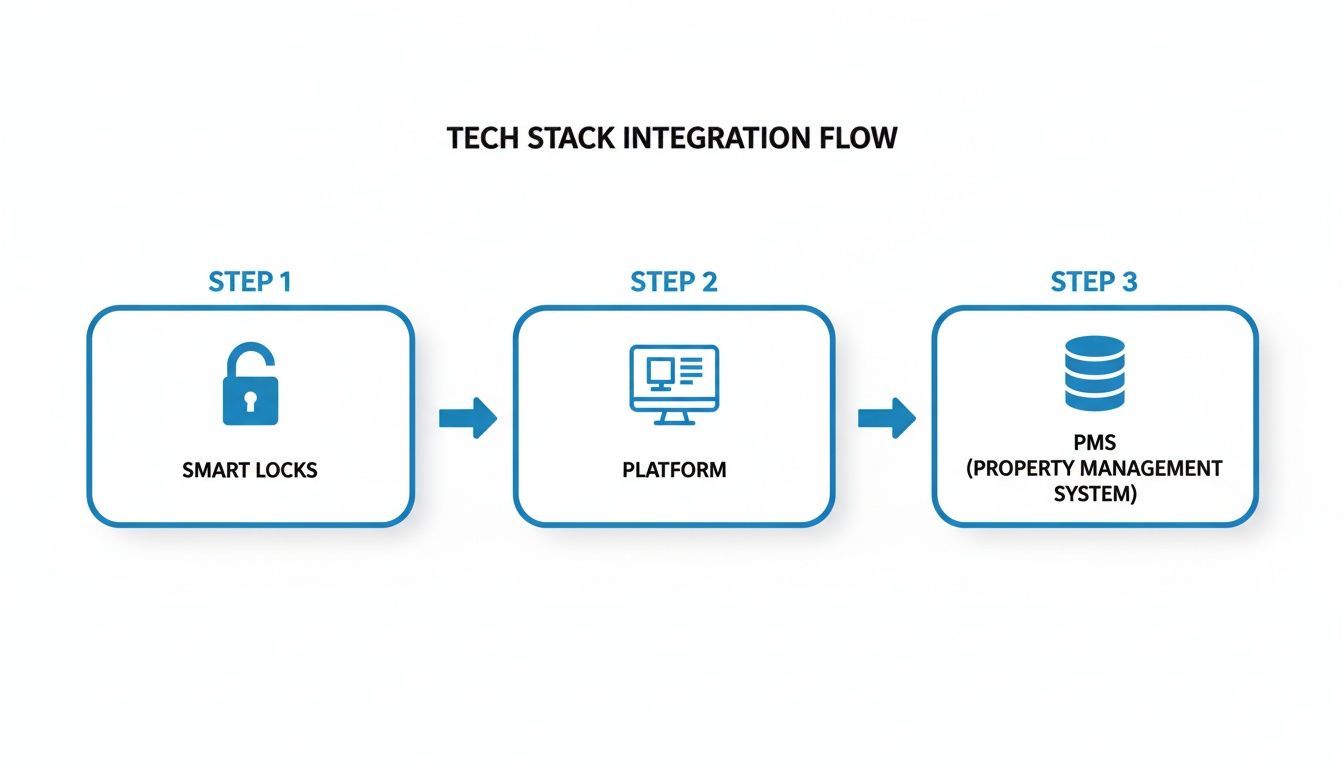
This integration is critical for scale. It ensures every action is logged in a central system, eliminating data silos and the need for manual data reconciliation.
Fortifying Access Control and Security
For any property manager operating at scale, security is non-negotiable. Your workflow must incorporate multiple layers of defense to mitigate risk and protect assets. Simply using a static lockbox code for all visitors is operationally inefficient and a major security liability.
A secure, enterprise-grade self-tour system treats property access like a financial transaction. It uses multi-factor verification to confirm prospect identity and leverages technology to ensure their physical presence at the property before granting temporary, auditable access.
Modern platforms achieve this through several key features. The first is generating unique, one-time-use access codes that expire immediately after the scheduled tour. This eliminates the risk of unauthorized access from shared or reused codes.
Additionally, geofencing technology provides another critical security layer. This feature requires the prospect's smartphone to be within a specified proximity of the property before an access code can be activated, preventing codes from being shared remotely.
To see these security protocols in action, review a detailed breakdown of the most secure self-showings technology available for property managers. By layering ID verification, unique codes, and location tracking, you can deliver on-demand convenience without compromising security.
Marketing Listings to Attract Self-Tour-Ready Tenants
Implementing a best-in-class self-tour technology stack is only half the battle. If prospects don't know they can tour on their schedule, you lose your primary competitive advantage. Your marketing strategy must prominently feature on-demand access as a core benefit. This isn't just another amenity; it's a powerful hook to attract motivated, modern renters.
Your marketing language needs to be direct, action-oriented, and focused on convenience. Every listing on Zillow, Apartments.com, and your corporate website should lead with the promise of immediate access.
Crafting Compelling Listing Copy
Passive, generic language fails to create urgency. Your copy must empower the renter and drive immediate action.
Replace outdated phrases with powerful calls-to-action (CTAs) that convert:
- "Tour On Your Schedule. Instantly." This is direct, benefit-driven, and sets the expectation of immediate access.
- "On-Demand Self-Tours Available 8 AM - 8 PM Daily." This clearly communicates your extended availability, highlighting a key competitive differentiator.
- "Skip the Wait. Book Your Private Self-Tour in 60 Seconds." This appeals to the modern renter's desire for speed and control.
Integrate these CTAs into your listing headlines and the first sentence of your property descriptions. Make the self-tour option the most prominent feature. To amplify your reach, consider targeted real estate PPC marketing strategies to ensure your marketing spend is focused on prospects actively seeking the convenience you offer.
You are reframing the showing process from a gatekept appointment to an on-demand service. It's a feature they can use instantly, similar to an e-commerce transaction.
Making It Easy to Go from "Interested" to "Touring"
Finally, the booking process must be frictionless. A "Book a Self-Tour" link should be a large, unmissable button on every listing, social media post, and email communication. Don't force prospects to search for it.
The vacation rental industry provides a powerful precedent: over 70% of bookings occur online due to the frictionless, instant booking process. This same principle applies directly to long-term rentals. An effortless scheduling experience can significantly increase tour volume.
By positioning your portfolio as modern, accessible, and convenient, you attract higher-quality tenants who are prepared to act quickly. This isn't just about filling tour slots; it's a strategic initiative to reduce your DOM and accelerate lease signings across your portfolio.
Don't Let Your Tech Work in Silos: Integrating Self Tours with Your PMS
A standalone self-tour platform, no matter how powerful, is an operational liability. Without deep, bi-directional integration with your core Property Management System (PMS), you create data silos and force your team into the same manual data entry you sought to eliminate.
To achieve true operational scale, your entire tech stack must communicate seamlessly.
This communication is enabled by robust API integrations, which act as the connective tissue for your entire leasing workflow. It ensures that all data—from initial lead inquiry to application submission—flows automatically between your leasing platform and your PMS.
What a Real Integration Looks Like
A true integration is a two-way street of information, synced in near real-time. This establishes a single source of truth, providing your entire team with a unified, up-to-the-minute view of the leasing pipeline without toggling between systems.
For property managers using enterprise systems like AppFolio or Rentvine, this means a prospect's entire journey is captured and tracked centrally.
- Guest Card Sync: A new tour booking automatically creates or updates a guest card in your PMS, eliminating manual entry.
- Tour Status Updates: A completed tour is automatically logged in the prospect's PMS record, triggering the next step in your automated follow-up sequence.
- Prospect Feedback: Post-tour survey responses are attached directly to the prospect's profile, equipping your leasing agents with crucial context for follow-up.
How This Plays Out in the Real World
Imagine a prospect schedules a tour on your website. Instantly, a lead is created in AppFolio. After the tour, their feedback—"great location, but the kitchen is too small"—is logged on their guest card. Your leasing agent sees this, understands their needs, and can immediately suggest another available property with a renovated kitchen.
This isn't merely a convenience; it's a strategic advantage. It eliminates data entry errors, which represent a significant hidden operational cost. More importantly, it empowers your team with the right information at the right time.
A disconnected tech stack relegates your team to being manual data processors, wasting hours each week reconciling information. A deeply integrated system transforms them into a proactive leasing force, focused on high-value conversations that drive lease signings.
Ultimately, integrating your self tour rental homes platform with your PMS is non-negotiable for scalable growth. It ensures data integrity, process efficiency, and allows your team to focus on what matters most: converting qualified leads and reducing costly vacancy days across the portfolio.
How Do You Know If Self-Tours Are Actually Working? Measuring ROI at Scale
Deploying self tour rental homes across a large portfolio is a significant operational investment. To justify the strategy and optimize performance, you must measure what matters. For operators managing hundreds or thousands of units, success is defined by tracking key performance indicators (KPIs) that tie directly to revenue and operational efficiency.
This isn't about feeling innovative; it's about leveraging hard data to prove that self-tours are reducing vacancy loss and streamlining your entire leasing operation. The most successful operators are obsessed with a handful of core metrics that paint a complete picture of their leasing funnel performance.
The KPIs That Actually Matter for Self-Tours
To prove the value of your self-tour program, you must move beyond anecdotal evidence and focus on quantifiable metrics. For scattered-site portfolios, these KPIs are non-negotiable.
These metrics provide a data-driven view of your entire leasing process from lead to lease:
- Lead-to-Tour Conversion Rate: This KPI measures the effectiveness of your top-of-funnel marketing and scheduling process. It is the percentage of inquiries that result in a completed tour. A high conversion rate indicates a frictionless, compelling user experience.
- Tour-to-Application Ratio: This metric measures tour quality. What percentage of prospects who tour a property submit an application? A strong ratio demonstrates that your pre-screening is effective and the self-tour experience successfully showcases the property's value.
- Days on Market (DOM) Reduction: This is the ultimate bottom-line metric. You must benchmark the average DOM for properties with self-tours against those with traditional agent-led showings. This provides the clearest evidence that on-demand access is accelerating your leasing cycle.
Tying DOM Reduction Directly to Revenue
Reducing Days on Market isn't just an operational win; it's a direct injection of revenue back into your business. The calculation is simple but powerful, especially when demonstrating financial impact to stakeholders and property owners.
For a 1,000-unit portfolio, every single day shaved off the average vacancy period translates into tens of thousands of dollars in recovered annual revenue. This isn't theoretical—it's measurable cash that improves your net operating income.
Here’s a simple framework to calculate the financial impact:
- Calculate Daily Vacancy Cost: (Average Monthly Rent / 30 Days) = Cost Per Vacant Day
- Determine Days Saved Per Lease: (Average DOM Pre-Self-Tours) - (Average DOM Post-Self-Tours) = DOM Reduction
- Calculate Revenue Gained Per Unit: (Cost Per Vacant Day) x (DOM Reduction) = Revenue Recovered
- Project Portfolio-Wide Impact: (Revenue Recovered) x (Total Annual Turnovers) = Total Annual Revenue Gained
By consistently tracking these KPIs, you can begin to optimize your leasing engine. A/B test different pre-screening questions, follow-up cadences, or listing copy and measure the impact on your conversion metrics. This data-driven approach is what transforms a self-tour program from a convenient feature into a predictable, revenue-generating machine.
Got Questions About Self Tours? We've Got Answers.
When managing a scattered portfolio of single-family homes, rolling out a new process like self touring is bound to bring up some questions. It's smart to think through the details. Here are a few of the most common things property management leaders ask us.
How Do You Keep Properties Secure With Self Tours?
Let's be clear: security is way more than just a smart lock. It’s a complete system.
A solid self-tour platform doesn't just hand out a code. First, it starts with serious ID verification. We're talking about requiring prospects to upload a government-issued ID and then take a live selfie to make sure it's really them.
Then, you have the access control itself. Modern smart locks and lockboxes generate unique, time-sensitive access codes for every single tour. That code is good for that specific time slot and then it's gone—no reusing it later.
And for an extra layer of accountability? Many systems also capture credit card details to further validate who's going in. Everything is logged digitally—who accessed the property and exactly when—so you have a full audit trail.
Can Self Tours Actually Integrate With My PMS Like AppFolio?
Absolutely. In fact, if a self-tour platform doesn't integrate with your PMS, you should walk away. Deep API connections are non-negotiable for any serious operator.
A good integration means data flows both ways between your self-tour system and your property management software. Think about it: guest cards, tour feedback, and leasing status updates all sync up automatically.
This is huge. It completely eliminates the mind-numbing task of manual data entry for your team and ensures everyone is working from the same, up-to-date information. It creates one single source of truth for your entire leasing pipeline.
What’s The Real Impact on Days on Market?
This is where things get exciting. While every market is a little different, we consistently see property managers slash their Days on Market (DOM), often by 25% to 50%.
The reason is simple: you’re offering 24/7 showing availability.
You capture those motivated, high-intent leads the second they find your listing, whether it's at 10 PM on a Tuesday or 7 AM on a Sunday. For a large portfolio, cutting DOM by even a few days per unit adds up to a massive amount of recovered revenue over the year. It's a direct impact on your bottom line.
Ready to cut your Days on Market and put your leasing operations on autopilot? See how Showdigs provides distributed portfolios with the fastest, most efficient path from lead to lease. Schedule your demo today and discover how our integrated, AI-powered platform can drive revenue and operational excellence for your portfolio.
.png)