


If you manage a small-to-midsize property management company, you know the grind. Juggling spreadsheets, chasing down rent checks, and deciphering cryptic maintenance texts is part of the job—but it doesn't scale. For property managers focused on growing their door count, manual processes are a direct threat to profitability.
That's where a tool like TenantCloud comes in. It’s a cloud-based platform designed to pull those scattered operational tasks into one centralized system.
So, What Is TenantCloud and How Does It Actually Work?
Think of it as the operational command center for your rental portfolio. Instead of bouncing between a dozen different apps and documents, TenantCloud gives you a single dashboard to manage everything from listing a vacant unit to collecting rent and handling repairs.
The primary goal is to systematize the chaos of property management. For companies scaling from 50 to 500+ properties, this kind of system is essential for maintaining control and efficiency. It’s built to solve the most common time-sucks that erode profitability: chasing late payments, coordinating with vendors, and digging through files for lease agreements.
Here’s a peek at the main dashboard, which gives you a high-level snapshot of key operational metrics.
As you can see, it’s designed for clarity. You can immediately see your occupancy rates, any outstanding maintenance tickets, and a summary of your financials without needing to run complex reports.
Why Property Management Is Moving to Cloud-Based Systems
The shift to platforms like TenantCloud isn't just a trend; it's an industry-wide move toward operational efficiency at scale. The demand for automation in real estate is exploding.
In fact, the global property management software market is projected to grow from $5.88 billion in 2025 to $11.54 billion by 2033. This massive growth underscores how critical these tools have become for running a modern, scalable rental business. For large portfolios, manual operations are no longer viable.
The Core Features for Portfolio Management
TenantCloud’s toolkit is built around the day-to-day lifecycle of a rental property. It’s focused on practical, operational tools that drive efficiency.
- Financial Management: This is the core. It automates online rent collection, tracks income and expenses per property, and generates financial reports.
- Leasing and Tenant Screening: You can syndicate listings to major rental sites, process online applications, and run background checks—all from within the platform.
- Maintenance Coordination: Tenants submit maintenance requests (with photos) through their portal. You can then assign the job to a vendor and track it to completion, creating a digital record of every repair.
Diving into TenantCloud's Core Features
Think of TenantCloud as the central nervous system for your rental operations. It’s built to bring all the core, day-to-day tasks under one roof, reducing administrative overhead and standardizing processes. The platform follows the natural journey of a tenancy—from listing and leasing to daily operations and financial reporting.
This diagram shows how TenantCloud unifies the three most critical operational pillars.
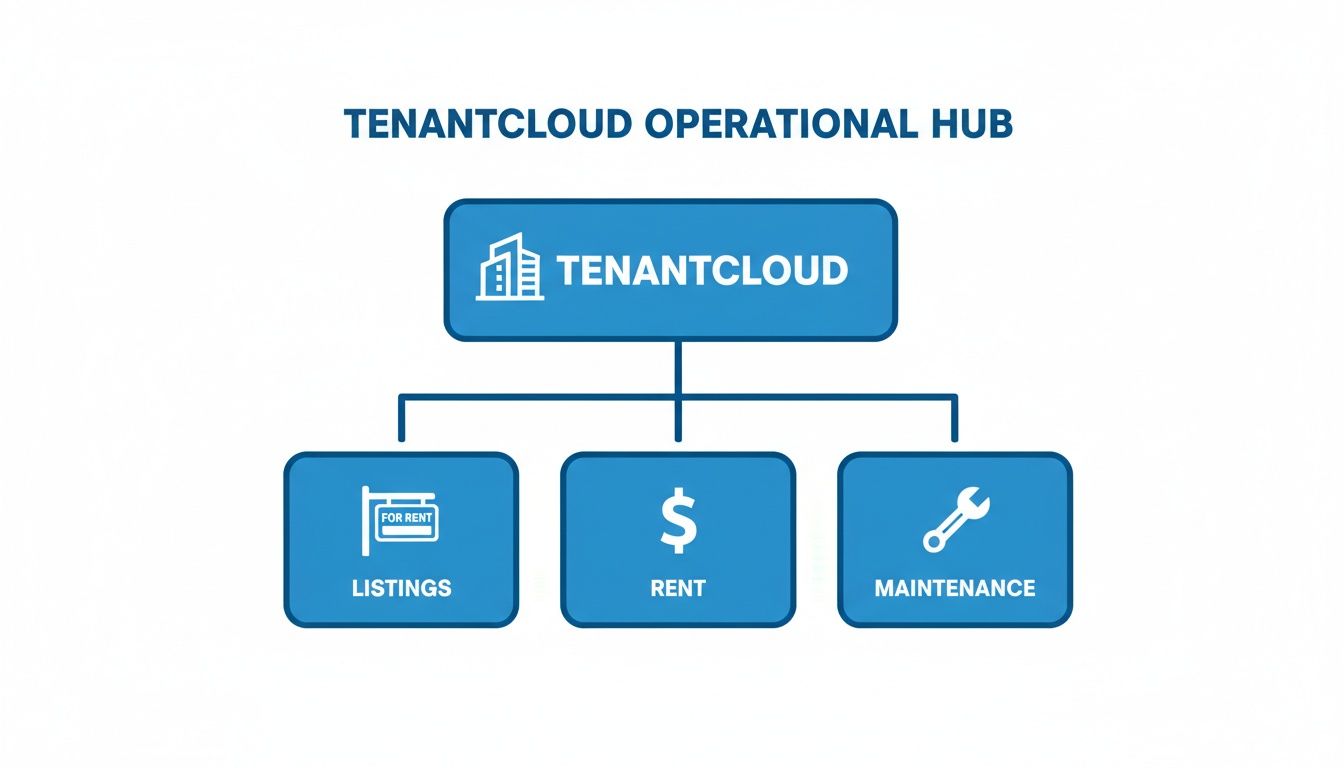
It’s all about connecting listings, rent collection, and maintenance in one cohesive system so your team isn't jumping between disparate spreadsheets and applications.
Financial Management and Rent Collection
Consistent cash flow is the lifeblood of any portfolio. TenantCloud streamlines this with a robust online payment system. Tenants can pay with ACH or a credit card, and you can automate late fees. This feature is critical for enforcing lease terms consistently across hundreds of units without manual intervention.
For a portfolio of 1,000 units, automating rent collection can save over 150 hours of administrative work per month. It removes your team from the business of chasing payments and manually reconciling accounts. The system also generates key financial reports like P&Ls and balance sheets, providing a clear, real-time view of portfolio performance.
Maintenance and Work Order Coordination
Nothing damages tenant retention faster than a mishandled maintenance request. TenantCloud gives tenants a portal to submit work orders with photos and details, creating an instant digital paper trail for every issue.
From there, you can assign the ticket to your team or an outside vendor, monitor its progress, and log all associated costs. It’s a structured workflow that prevents requests from falling through the cracks—a major operational risk for multi-market portfolios.
For a growing portfolio, a standardized maintenance process is a necessity. A system that tracks requests from start to finish doesn't just improve efficiency; it provides invaluable data on recurring property issues, vendor performance, and overall operational costs per door.
Leasing and Tenant Management
The platform also provides tools to manage the leasing funnel. You can push your listings out to popular rental sites to maximize exposure. Prospects apply online, and you can run background and credit checks right inside the software.
Once a tenant is approved, you can send a digital lease for e-signature and store all documents within the system. TenantCloud even helps with move-outs. To ensure fairness and transparency, you can use a move-out cleaning service checklist for security deposits to standardize the process across your portfolio.
While these are great all-in-one features, property managers laser-focused on reducing vacancy loss often integrate specialized tools. For example, pairing TenantCloud with an AI marketing automation for leasing tool creates a powerful combination: one system to manage backend operations, and another to supercharge leasing and slash your Days on Market (DOM). This hybrid approach is common for portfolios over 500 units where speed-to-lease is a critical KPI.
Diving into TenantCloud's Pricing and Plans

Selecting the right software tier is a critical decision for a growing company. Get it right, and your technology scales with you. Get it wrong, and you’re either paying for unused features or hitting a growth ceiling. The TenantCloud pricing structure is designed to scale, but a strategic assessment of your operational needs is essential.
The key is to weigh the monthly cost against the direct impact on your operational efficiency and cost per door at each tier.
The Free and Starter Plans
TenantCloud's Free plan is an entry point for DIY landlords with a few properties. It covers essentials like online rent collection and maintenance requests. However, for any professional property management company, the unit limits and lack of automation make it unsuitable for scalable operations.
The Starter plan is a significant step up, designed for smaller but growing portfolios. It unlocks crucial features like automatic late fees and e-signatures. While not built for large-scale management, it provides a solid framework for systematizing core tasks and moving away from spreadsheets.
The Growth and Business Plans for Scaling Up
For mid-sized property management companies managing 100+ units, the conversation begins with the Growth plan. This is where TenantCloud evolves into a serious operational tool.
It unlocks several game-changers for scaling portfolios:
- QuickBooks Online Sync: This integration is critical for maintaining accurate financials without hours of manual data entry.
- Vendor Network Access: A centralized system to assign, track, and pay your contractors streamlines maintenance operations.
- Lease Builder Templates: Standardizing lease agreements across the portfolio reduces administrative burden and legal risk.
For a portfolio manager, upgrading to the Growth plan is a strategic shift from managing properties to optimizing operations. Syncing financials and centralizing vendor management directly improves your cost-per-door efficiency.
The top-tier Business plan is geared toward larger firms that require sophisticated team permissions and owner reporting. It includes features like a dedicated owner portal for financial transparency and advanced accounting tools. It’s designed for managers who serve multiple property owners and need to provide crystal-clear reporting while managing a larger in-house team.
Ultimately, the choice between Growth and Business depends on your operational complexity, team size, and the number of owner-clients you report to.
So, What’s the Real Deal with TenantCloud?
No single software is a silver bullet, especially in the complex world of property management. TenantCloud offers a strong value proposition, but it's crucial to assess its strengths and limitations against the needs of a large-scale, distributed portfolio.
The biggest draw is its all-in-one functionality at an accessible price point. It centralizes core operations—rent collection, maintenance, and tenant communication—into one dashboard. For small to mid-sized portfolios struggling with disconnected systems, this consolidation is a huge operational win.
Where It Really Shines for Growing Portfolios
TenantCloud is a game-changer for managers who need a full suite of tools without an enterprise-level budget. It’s built to simplify day-to-day operational management.
- Cost-Effective: It provides a robust feature set for a fraction of the cost of larger enterprise systems, making it a strong contender for budget-conscious portfolios.
- User-Friendly Interface: The platform is relatively straightforward, allowing teams to get up and running without extensive training cycles.
- Centralized Operations: By combining accounting, leasing, and maintenance, it reduces the need to juggle multiple subscriptions and reconcile data from different sources.
Potential Growing Pains for Large-Scale Operations
However, what works for 100 doors doesn't always scale to 1,000. As portfolios expand across multiple markets, some of TenantCloud’s all-in-one features can feel restrictive for operators obsessed with KPIs like DOM and lead-to-tour conversion rates.
The property management software market is projected to more than double from USD 27.95 billion in 2025 to USD 54.16 billion by 2032, as detailed in this property management software market trajectory report. This growth is driven by the need for cloud systems that can handle immense scale and complexity. For large enterprise players, this means platforms must be built for high-volume, high-velocity leasing.
An all-in-one system prioritizes broad functionality over deep specialization. For a large portfolio, where every vacant day represents significant lost revenue, even minor inefficiencies in the leasing process can have a major financial impact. Optimizing metrics like cost-per-door and Days on Market (DOM) often requires specialized tools.
For enterprise-scale operators, here are a few potential drawbacks to consider:
- Limited Customization: Large portfolios often have unique workflows and require custom reporting. TenantCloud offers more of a one-size-fits-most solution and may lack this level of flexibility.
- Advanced Accounting Needs: While the accounting tools are solid, companies with complex ownership structures or strict trust accounting requirements may need more advanced functionality.
- Customer Support at Scale: Some users have reported challenges with customer support response times. For a company managing thousands of units, immediate support is non-negotiable.
How to Integrate TenantCloud with Your Tech Stack

No modern property management company operates in a silo. A truly scalable operation relies on an interconnected tech stack. While an all-in-one platform like TenantCloud serves as the operational core, its true power is unlocked when integrated with specialized tools that target specific, high-impact KPIs.
For any manager focused on financial clarity and efficiency, the connection between a property management system and accounting software is non-negotiable. TenantCloud addresses this with a critical native integration.
Native QuickBooks Online Integration
The platform’s built-in sync with QuickBooks Online is a cornerstone feature for managers focused on operational efficiency. This direct integration automates the flow of financial data, eliminating the time-consuming and error-prone task of manual entry.
When rent is paid through TenantCloud, the transaction is automatically logged in QuickBooks. This provides a real-time, accurate view of your portfolio's financial health. For large portfolios, this automation directly lowers administrative costs and ensures reliable financial reporting—both essential for data-driven decision-making.
Extending Functionality with Zapier
Beyond native connections, TenantCloud can be linked to thousands of other applications using a connector like Zapier. This enables the creation of custom workflows tailored to the unique needs of a large-scale operation. Zapier acts as a bridge, automating tasks between TenantCloud and other essential software.
Here are a few practical examples of automations for large portfolios:
- Marketing Automation: When a new lease is signed in TenantCloud, automatically add the tenant's information to an email platform like Mailchimp to initiate a welcome and onboarding sequence.
- CRM Updates: Create a new contact in your CRM (e.g., HubSpot) the moment a prospective tenant submits an application, ensuring seamless lead tracking.
- Team Notifications: Send an alert to a specific Slack channel whenever a high-priority maintenance request is submitted for a high-value property.
For enterprise operators, integrations are fundamental to scaling. An integrated tech stack ensures that leasing, operations, and finance work from a single source of truth, minimizing data silos and maximizing efficiency.
By connecting your core PMS with specialized leasing and showing platforms, you can build a powerful, end-to-end system. For property managers looking to slash Days on Market and boost lead-to-tour conversions, exploring available property management software integrations is a critical step toward building a truly automated and scalable leasing engine.
TenantCloud vs. Specialized Leasing Automation Tools
When building your property management tech stack, it is critical to understand the difference between a core Property Management System (PMS) and a specialized leasing automation platform. This isn't about which is “better”—it’s about defining their complementary roles, especially for large-scale operators where speed-to-lease is paramount.
Think of an all-in-one platform like TenantCloud property management software as the central nervous system for your portfolio. It’s designed to manage the entire tenancy lifecycle, from accounting and maintenance to tenant communications. Its strength is its operational breadth, providing a stable foundation for day-to-day management.
The PMS vs. The Leasing Engine
On the other side are specialized platforms like Showdigs. These are not a central nervous system but a high-performance engine built for one purpose: accelerating the leasing process. They focus entirely on the front-end of the rental cycle, where every hour counts. These tools are engineered to solve enterprise-level challenges by crushing Days on Market (DOM) and maximizing lead-to-tour conversion rates.
For property managers with hundreds or thousands of scattered-site properties, this distinction is critical. Your PMS manages the asset long-term, but a leasing automation tool directly impacts your top-line revenue by filling vacancies faster. If a 1,000-unit portfolio with an average rent of $1,500/month reduces its average DOM by just five days, it recovers over $250,000 in annual revenue.
The industry's shift to cloud solutions highlights this need for specialization. The tenant billing software market alone is projected to grow from USD 455.18 million in 2025 to USD 676.99 million by 2030, according to the latest tenant billing market analysis. This growth is driven by cloud platforms offering superior flexibility and integration capabilities.
The most effective tech stacks for large portfolios integrate a core PMS with a specialized leasing engine. This creates a powerful synergy where the PMS handles backend operational stability, while the leasing platform drives front-end speed, revenue, and profitability.
These systems aren't competitors; they're strategic partners. By pairing a robust PMS with a dedicated leasing automation platform, large-scale operators can optimize both backend efficiency and front-end revenue generation. To see a direct comparison, check out our guide on Showdigs vs. other leasing software.
Answering Your Top Questions About TenantCloud
Let's address the most common questions from property managers evaluating TenantCloud for their scaling operations.
Is TenantCloud a Good Fit for Large Portfolios Over 500 Units?
While TenantCloud excels for small to mid-sized portfolios, managers overseeing 500+ units may find its leasing capabilities limiting if their primary KPI is Days on Market (DOM). Its strength lies in providing a cost-effective, all-in-one operational platform.
For large operators where cost-per-door and speed-to-lease are critical, TenantCloud becomes a powerful backend system when integrated with specialized leasing automation tools. This strategy allows your team to manage backend operations efficiently in TenantCloud while a dedicated leasing platform accelerates front-end activities, converting leads to leases at scale.
How Secure Is Tenant and Financial Data on TenantCloud?
TenantCloud employs industry-standard security measures, including data encryption, to protect your and your tenants' information. All payment processing is handled through secure, PCI-compliant gateways to safeguard sensitive financial data.
Security is a shared responsibility on any cloud platform. Enforcing strong, unique passwords and enabling two-factor authentication across your team are essential practices for protecting your portfolio's data.
Can I Migrate Existing Property Data into TenantCloud?
Yes, TenantCloud is designed for data migration. You can import property, unit, and tenant data using CSV files. The platform provides pre-formatted templates to ensure data integrity during the import process.
A pro-tip for large-scale migration: dedicate time to cleaning and standardizing your data before you begin the import. This preparatory work prevents frustrating errors, ensures data accuracy from day one, and dramatically speeds up your team's onboarding process.
Accelerate your leasing process from lead to lease. Showdigs combines AI-powered automation with an on-demand agent network to slash your Days on Market and maximize lead-to-tour conversions for your entire portfolio. Book a demo to see it in action.
.png)