


Your rental application is so much more than a piece of paperwork. It’s the first real gatekeeper between a qualified lead and a signed lease, and it’s a powerful tool for cutting down on vacancy time and boosting portfolio revenue. But for property managers juggling large, distributed portfolios, a clunky or confusing application process is a significant operational bottleneck. It actively pushes away qualified renters and drives up your Days on Market (DOM), directly impacting your bottom line.
Turning Applications Into A Revenue Driver
Every single day a property sits empty, it’s a direct hit to your NOI. For operators managing hundreds or even thousands of units, the application process is where lead generation converts to revenue. Yet, it's often the biggest bottleneck in the entire leasing funnel. A slow, inefficient system doesn't just frustrate potential tenants; it costs you real money by extending vacancy periods and scaring off the best applicants who expect—and demand—a fast, digital experience.

Let's calculate the real financial impact. Consider a portfolio of 1,000 units with an average rent of $2,000/month. The daily cost of vacancy for this portfolio is over $66,000. If your sluggish application workflow adds just five days to your average DOM, you're looking at a $330,000 annual revenue loss. That’s capital you could have captured with a more efficient, scalable process. This isn't just an operational headache; it's a significant financial leak that compounds as you scale.
The High Cost of an Outdated Process
Paper applications, manual data entry, and delayed responses are operational liabilities. Today’s renters have high expectations and very little patience. If they can’t apply from their phone in minutes or don’t receive prompt communication, they’re moving on to the next listing. This friction creates several costly problems for enterprise-level operators:
- Increased Days on Market (DOM): Every delay—from a hard-to-find "apply now" button to manual data entry—adds another day to your vacancy cycle, eroding revenue.
- Lower Lead-to-Lease Conversion: High-quality prospects will abandon your funnel if the process is cumbersome. This directly tanks your conversion rates and wastes marketing spend.
- Reduced Scalability: A manual application process is impossible to scale efficiently across a multi-market portfolio. It creates massive inconsistencies and opens the door to significant compliance risks.
The U.S. Apartment Rental industry is on track to hit a market size of $295.3 billion in 2025. This massive scale highlights the critical need for operational efficiency. Industry analyses show that up to 30% of leads are lost simply due to slow response times—a staggering amount of wasted opportunity for large portfolios.
Your rental application should be viewed as a strategic asset, not just a form. Optimizing it is a direct lever for increasing leasing velocity, attracting higher-quality tenants, and improving overall operational efficiency.
Ultimately, a seamless application workflow is foundational to a high-performing portfolio. You can invest heavily in lead generation, but if your application process is a brick wall, that marketing spend is wasted. This guide provides a framework for transforming the tenant application from a tedious administrative chore into a powerful tool for optimizing your leasing funnel and driving revenue at scale.
Building A High-Conversion Application Template
A generic, downloadable rental application is a huge liability for any serious property management company. It fails to capture the necessary data for risk assessment, often includes non-compliant questions, and creates a clunky user experience that drives qualified applicants away.
The goal isn't just to collect information. It's to create a frictionless, mobile-first experience that moves a prospect from interested to submitted in minutes, not hours, maximizing your lead-to-tour conversion rate.
This blueprint goes beyond basic fields to help you build a scalable, high-conversion template. The objective is to be comprehensive yet quick, ensuring you get everything you need without causing applicant fatigue.
Core Components Of A Scalable Application
Every field on your application must justify its existence—is it for legal compliance, risk assessment, or operational efficiency? Anything extraneous adds friction and increases the probability of form abandonment.
Here’s a breakdown of the non-negotiable sections for managing a multi-market portfolio.
Essential Personal Information
This is the foundation. Keep it clean and simple to build momentum for the applicant from the start.
- Full Legal Name & Date of Birth: Critical for running accurate background and credit checks.
- Contact Information: Phone and email are essential for automated communications, follow-ups, and lease delivery.
- Government-Issued ID: Require a clear photo of a driver’s license or other valid ID for identity verification.
- Number of Occupants: Collect a count of all proposed occupants, including minors, to ensure compliance with occupancy standards.
Detailed Rental History
This section is your best predictor of future tenant behavior. Vague questions yield vague answers; be specific to uncover potential red flags.
- Current & Previous Addresses (Last 3-5 Years): Always include fields for landlord or property manager contact information for verification.
- "Have you ever been served a notice to pay rent or vacate?"
- "Have you ever broken a lease agreement?"
- "Was any portion of your security deposit withheld? If yes, please explain why."
A well-structured rental history section is a diagnostic tool. It helps you identify patterns—like frequent moves or a history of disputes—that could directly impact your portfolio's financial performance.
Employment And Income Verification
This is where you confirm an applicant's financial ability to pay rent. Your role is to make it as easy as possible for them to provide proof.
- Current Employer & Supervisor Contact: Be sure to get dates of employment and their official job title.
- Gross Monthly Income: Clearly state your income-to-rent ratio upfront (e.g., 3x the monthly rent) to set expectations.
- Proof of Income: Offer multiple options for providing proof, such as digital uploads of pay stubs, offer letters, or bank statements. For portfolios at scale, integrating with an automated income verification service is a game-changer that slashes manual review time.
Before we move on, let's put this all together in a clear format. A great application balances need-to-know information with nice-to-have details, without overwhelming the applicant.
Essential vs Optional Fields In A Scalable Rental Application
This table should serve as a solid starting point. The goal is to create a template that’s both comprehensive for your team and straightforward for the applicant.
Ensuring Fair Housing Act Compliance
Let’s be crystal clear: compliance isn't optional—it’s a core risk management function. One improperly worded question can spiral into a costly discrimination claim. The Fair Housing Act (FHA) prohibits discrimination based on race, color, religion, sex, national origin, familial status, or disability.
Your application must be completely neutral. NEVER ask about:
- Marital Status: You can ask for the number of occupants, but not about their relationships.
- Race or National Origin: Strictly prohibited.
- Disability: Avoid all questions about physical or mental health. You must, however, provide a section where applicants can request reasonable accommodations.
- Familial Status: Don't ask if they have children, are pregnant, or are planning to have kids.
By standardizing a compliant template across your entire portfolio, you create a defensible and consistent process. This uniformity is absolutely vital when you’re managing properties across different markets with their own local regulations.
The right digital tools help enforce these standards automatically, ensuring your leasing agents always use the most up-to-date and compliant version. Ultimately, improving the user experience and locking down compliance are key to achieving industry-leading conversion rates in your leasing funnel.
Automating Your Workflow From Tour To Screening
Having a perfectly crafted, compliant rental application is only half the battle. If your follow-up process is manual, slow, and clunky, you’re still losing qualified applicants and watching your Days on Market (DOM) tick upward.
The most critical moment to capture a prospect's interest is right after a successful property tour. That’s the golden window. Excitement is at its peak, and any delay creates friction that kills conversion.
Modern leasing at scale cannot afford manual handoffs. Instead of making an applicant wait for an agent to follow up, leading property management companies use automation to bridge this gap. A platform like Showdigs can trigger an automated email or text with a direct link to your application the second an agent marks a tour as "complete." This immediate touchpoint capitalizes on the prospect's positive experience, dramatically increasing the likelihood they'll apply immediately.
Mapping The Ideal Digital Workflow
When you're managing hundreds or thousands of scattered-site properties, removing human touchpoints from repetitive tasks is the secret to scaling profitably. An automated workflow delivers consistency, speed, and a superior applicant experience every time. It’s all about moving a prospect from the tour to the screening stage with minimal staff involvement.
A fully optimized workflow should include these key automated touchpoints:
- Instant Application Delivery: The application link hits their inbox or phone immediately post-tour. Strike while the iron is hot.
- Automated Submission Confirmation: The moment they submit, an email confirms their application is in the queue and sets expectations for next steps.
- Seamless Fee Collection: Integrated payment gateways handle application fees automatically, eliminating manual invoicing and payment chasing.
- Direct Handoff to Screening: The completed application and all associated data are automatically pushed to your screening service, initiating background and credit checks without delay.
This flowchart gives a simple, clear view of the applicant’s journey, showing them exactly what's needed at each stage.
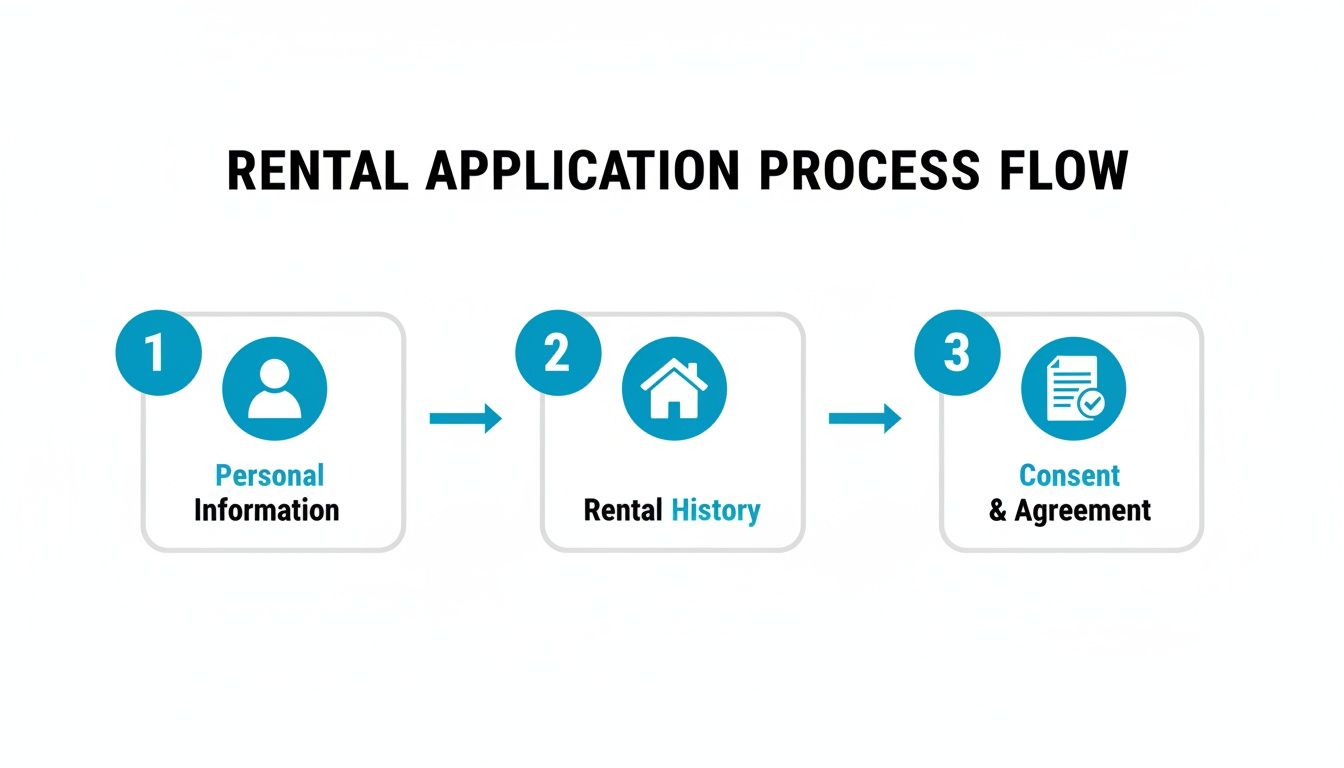
A clean, streamlined process like this cuts down on confusion and reduces the chances of applicants abandoning the form halfway through.
The Impact Of Automation On Processing Time
The peer-to-peer (P2P) rental apps market is seeing massive growth. It's projected to be worth $19.6 billion in 2025 and is forecasted to hit a staggering $55.2 billion by 2035. Property rentals are the biggest piece of this pie, making up 42.7% of the total revenue in 2025.
This trend is fueled by a renter demographic that expects seamless, digital, on-demand experiences. This puts immense pressure on large-scale property managers to automate. You can dive deeper into this trend in the full market analysis on futuremarketinsights.com.
This digital-first mindset directly impacts how quickly you need to process applications. A manual system is fraught with delays—an agent might be driving, in another showing, or buried in paperwork. A hot lead goes cold fast. Automation eliminates these bottlenecks.
Mini Case Study: Slashing Application Time at Scale
An enterprise PM company with 2,000+ scattered-site properties was stuck with a 72-hour average application processing time. Agents were manually emailing links, checking for fee payments, and then keying applicant data into their screening software.By implementing an integrated leasing automation platform, they built a fully automated workflow. Post-tour applications were sent instantly via API trigger. An integrated payment processor confirmed fees on the spot, and an API connection pushed applicant data directly into their screening system.
The result? They cut their average application processing time to under 24 hours—a 66% reduction that directly lowered DOM and significantly improved their lead-to-lease conversion rate.
A unified dashboard allows your leasing team to stop chasing paperwork and focus on high-value activities, like reviewing screening reports and making final leasing decisions. By automating the workflow from tour to screening, you not only accelerate your entire leasing cycle but also free up your team to manage more doors per person, directly improving your cost-per-door efficiency.
Integrating Applications With Core PM Systems
A great application for tenants to rent is a solid start, but its true power is unleashed when it communicates seamlessly with your other systems. For property managers operating at scale, data silos are operational poison. Manually entering application details into your Property Management Software (PMS) is not just slow—it's a surefire way to introduce costly errors, create compliance risks, and kill the momentum you've built with a prospect.
True operational efficiency comes from a tech stack where data flows automatically. This is where Application Programming Interfaces (APIs) are essential. Think of an API as a secure bridge that allows your leasing platform to communicate directly with your PMS, whether it's AppFolio, RentManager, or Yardi.
This connection transforms a series of discrete tasks into one smooth, intelligent workflow. When a prospect books a tour, a guest card is created instantly in your PMS. After you approve an application, all verified information—names, contacts, move-in date—is pushed directly into the PMS to generate the lease. No copy-pasting, no typos, no lag time.
The Power of A Single Source of Truth
When your systems are integrated, you create a single source of truth for your entire leasing pipeline. This portfolio-wide visibility is a game-changer for operations directors tracking performance across different markets.
Instead of guessing, you can measure the metrics that drive revenue:
- Lead-to-Tour Conversion Rate: See exactly which marketing channels deliver qualified renters.
- Tour-to-Application Rate: Identify properties or agents struggling to convert showings into applications.
- Application-to-Lease Conversion: Pinpoint bottlenecks in your screening or approval process that are extending vacancy days.
This level of insight allows you to shift from reactive problem-solving to proactive optimization. You can finally make data-driven decisions that directly reduce your Days on Market (DOM) and boost the bottom line.
An integrated system doesn't just eliminate busywork; it provides the hard data needed to diagnose and fix process holdups across your portfolio, turning insights into revenue.
Evaluating PropTech Integration Capabilities
Not all integrations are created equal. When evaluating a new leasing automation tool, its ability to integrate with your existing tech stack is paramount. A shallow integration might only sync a name and email, but a deep, bi-directional one automates entire workflows.
Before committing to a new platform, your operations team should run through this integration evaluation checklist.
Your Integration Evaluation Checklist
- Core PMS Compatibility: Does it have a pre-built, robust integration with your PMS (e.g., AppFolio, RentManager, Yardi, Rentvine)?
- Bi-Directional Sync: Does data flow both ways? For example, can a unit marked as "rented" in your PMS automatically update its availability in your showing calendar?
- Automated Guest Card Creation: Does the system automatically generate a guest card for every new lead without fail?
- Applicant Data Push: Can you push approved applicant data directly to your PMS to auto-populate a lease agreement?
- API Documentation & Support: Is the API well-documented with reliable support? This is crucial for building custom workflows and ensuring long-term scalability.
Performing this technical due diligence is essential for future-proofing your operations. To see what this looks like in practice, it's worth exploring the details of leading property management software integrations that high-performing PMs rely on to maintain leasing velocity.
Optimizing Applicant Screening For Speed And Quality
A great application for tenants to rent is just the first step. It gets prospect data into your system, but the screening process is where you protect your clients' assets and your portfolio's bottom line.
When managing hundreds or thousands of doors, you can't rely on gut feelings. Your screening must be a standardized, scalable, and fully compliant system that delivers predictable results every time. Any inconsistencies at this stage don't just add to your Days on Market (DOM)—they expose you to serious Fair Housing Act (FHA) liability.
The goal is to build a clear, data-driven framework that empowers your team to make fast, confident, and legally sound leasing decisions. Think of it as your final gatekeeper against bad debt, evictions, and long-term revenue loss.
The Four Pillars Of A Standardized Screening Process
To build a process that scales without breaking, you need to establish uniform criteria across four key areas. These rules must be documented and applied to every single applicant, without exception, to ensure compliance and consistency.
- Credit Checks: A raw score isn't enough. Set a minimum threshold (e.g., 620), but also define your rules for major red flags like recent bankruptcies, serious delinquencies, or collections accounts from past rentals or utilities.
- Criminal Background Searches: This area is a legal minefield. Work with legal counsel to create a policy that follows HUD guidance and local ordinances. The focus should be on convictions relevant to the safety of the property and residents—blanket bans are a significant compliance risk.
- Eviction History Analysis: An eviction filing is a major red flag. Your policy must be clear on how you handle them. For example, how do you treat an eviction from last year versus one from five years ago? Consistency is key.
- Income Verification: The industry standard—a gross monthly income of 3x the rent—is a solid benchmark. It must be your official, written policy. You also need to define what qualifies as acceptable income and what documentation is required for proof.
By standardizing these four pillars, you remove guesswork and personal bias from the equation. This creates a repeatable system that not only protects your assets but also dramatically mitigates the legal risk associated with inconsistent screening.
Leveraging AI For Faster And More Accurate Decisions
At scale, manually sifting through every application detail is a massive time-suck. This is where modern PropTech provides a significant competitive edge. AI-powered screening tools can analyze an applicant's data against your criteria in seconds, often providing a holistic "tenant score" or a clear recommendation. This goes beyond credit, blending income, rental history, and other data points to create a comprehensive risk profile.
This technology helps your team move faster and make decisions based on data, not hunches. And speed is critical. The explosion in short-term rentals, with user numbers expected to hit 860 million in 2024, has intensified competition across the entire rental market. In this environment, slow, manual processes can cause a 20-40% drop-off in leads.
Automated systems that integrate screening into the leasing workflow can slash administrative work by 50% and have been shown to cut vacancy rates by 15-25%.
Ensuring your applications flow seamlessly into your core property management system is key. Specialized Property Management solutions can bridge this gap. When your leasing platform automatically pushes applicant info into an AI screening tool, you create a powerful, hands-off workflow.
This setup minimizes human error and shortens your lead-to-lease timeline. It’s not just about filling vacancies faster; it’s about selecting higher-quality tenants who pay on time and have a higher propensity to renew. For a deeper look into this topic, check out our guide on how to master prospect screening for ideal tenants.
Turning Your Application Into A Competitive Advantage
A rental application is far more than paperwork—it’s the engine that drives your entire leasing operation. For property managers with large-scale portfolios, treating it as just another administrative task is a surefire way to see vacancy rates climb and revenue slip away.
It's time to reframe the application as a critical competitive advantage. The right approach can shave days or even weeks off your lead-to-lease cycle.
The strategies outlined here provide a solid framework for transforming a common bottleneck into a high-powered conversion tool. It starts with a conversion-focused, mobile-first template that is both comprehensive and compliant. The goal is to gather all essential data without creating frustrating friction for your best applicants.
From Document To Data-Driven Asset
The real operational leverage comes from automating the entire workflow, starting the moment a tour ends.
By integrating your application process directly into your core Property Management Software, you create a seamless flow of information. This eliminates manual data entry, reduces human error, and provides a portfolio-wide view of your entire leasing funnel. Your team can finally stop chasing paperwork and start making rapid, data-driven leasing decisions.
An application isn’t the end of the leasing journey—it’s the beginning of a profitable tenancy. By optimizing every step, you reduce Days on Market, improve operational efficiency, and drive significant revenue growth across your entire portfolio.
Ultimately, an integrated system transforms the application from a static form into a dynamic, data-generating asset. The call to action for operations directors is clear: audit your current process against this scalable framework.
Every improvement you make translates directly into lower vacancy costs and a stronger bottom line, positioning your leasing operations to win at any scale.
Common Questions, Answered
Got questions about building a rental application process that scales? You're not alone. Here are some of the most common things property managers ask when trying to cut down vacancy days and get their leasing operations humming.
How Can We Speed Up Application Processing Across Hundreds Of Units?
The key is eliminating manual handoffs through automation. When you automate the workflow, everything accelerates.
As soon as a prospect finishes a tour, an application link should hit their inbox—capturing peak interest. Using an integrated system means the application fee is collected automatically, and the applicant's data is pushed directly to your screening service.
This simple change eliminates delays and frees up your leasing team to review final reports instead of chasing paperwork. For portfolios with hundreds of doors, this can reduce the average processing time from days to under 24 hours.
What Is The Biggest Compliance Risk In A Rental Application?
Hands down, it's violating the Fair Housing Act (FHA). It’s surprisingly easy to do inadvertently.
Asking questions that touch on protected classes—race, religion, familial status, disability—is a direct path to a discrimination claim. Even seemingly neutral policies can have a "disparate impact" on a protected group, which can result in the same legal jeopardy.
The best way to mitigate this risk? Create a single, legally-vetted application template and use it consistently for every property, every time. Consistency is your best defense.
How Long Should We Keep Tenant Applications On File?
A clear, consistent record-keeping policy is non-negotiable.
For applicants you approve and who sign a lease, their application becomes part of their permanent tenant file.
For denied applicants, the standard practice is to retain their applications for at least two years. This period aligns with the statute of limitations for filing a discrimination complaint under the Fair Housing Act. Keeping these records ensures you have the necessary documentation if a claim arises. Always consult with your legal counsel to ensure your policy aligns with both federal and state laws.
Ready to turn your application process from a bottleneck into a high-speed leasing machine? Showdigs combines leasing automation, on-demand showings, and seamless PMS integrations to slash your Days on Market. See how we help large-scale operators convert more leads into leases.