


For property managers overseeing 100 to 10,000+ units, operational efficiency isn't just a goal; it's the bedrock of profitability. Every day a unit sits vacant directly impacts your bottom line, and a clunky tech stack can bleed revenue through slow lead-to-tour conversion and high Days on Market (DOM). For a 1,000-unit portfolio with an average rent of $1,500, a single day of vacancy across all units represents a potential revenue loss of $50,000. Choosing the right applications is critical for automating workflows, standardizing processes across multi-market portfolios, and ultimately, reducing the cost per door.
This guide analyzes the best property management apps through the lens of scalability, focusing on how each tool helps enterprise-level teams optimize the entire leasing lifecycle, from lead capture to lease signing. We'll evaluate each platform on its ability to solve the core challenges of remote management, drive down DOM, and deliver a measurable return on investment for large, distributed portfolios. Beyond the core management tasks, your app stack should streamline financial operations; consider integrating with or choosing tools that offer robust functionality like the best accounting software specifically designed for rental properties.
Here, you will find a detailed breakdown of the top platforms, complete with screenshots, direct links, and clear analysis of core features like leasing automation, tenant screening, and accounting. We cut through the marketing noise to provide an honest assessment of each app's ideal use case, strengths, and limitations, helping you build a technology infrastructure that scales your operations and maximizes revenue.
1. Showdigs
Showdigs stands out as a powerful leasing automation platform, uniquely engineered to accelerate the entire lead-to-lease cycle for distributed single-family and multi-family portfolios without onsite staff. It’s not just another property management app; it's a comprehensive solution that combines intelligent automation with an on-demand human element, directly addressing the core challenge of reducing costly days-on-market (DOM). Property managers can automate everything from listing syndication and AI-powered tour scheduling to tenant pre-screening and automated post-tour follow-ups, directly improving lead-to-tour conversion rates.
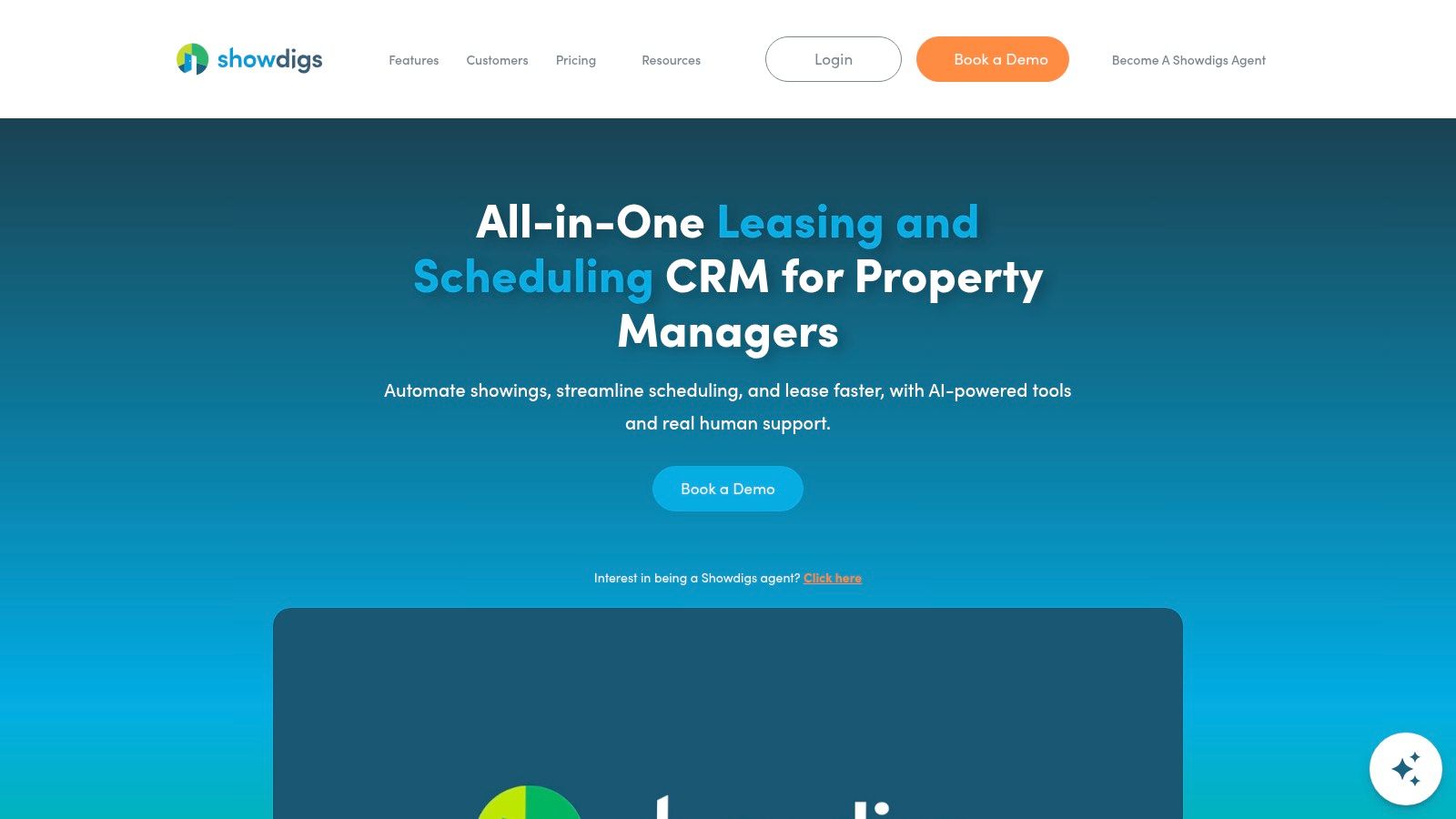
What makes Showdigs a top-tier choice for remote operations is its hybrid "human + tech" model. While the software handles administrative burdens, its standout feature is the network of vetted, licensed real estate agents who can conduct in-person showings on your behalf. This solves a major operational bottleneck for property managers managing geographically dispersed portfolios. The platform also offers secure, ID-verified self-showings and virtual tour options, providing unmatched flexibility to meet prospect demand instantly. This combination is a game-changer for scaling operations, as it is purpose-built to reduce DOM and optimize cost-per-door for large portfolios.
Key Details & Use Cases
- Best For: Large-scale property management companies (100-10,000+ units) seeking to reduce vacancy, standardize leasing across multi-market portfolios, and optimize cost-per-door efficiency without onsite staff.
- Standout Features: AI-powered tour scheduling, on-demand network of licensed agents for in-person showings, secure self-showing technology with ID verification, and deep PMS integrations.
- Integrations: Connects seamlessly with major enterprise systems like AppFolio, Rentvine, and Yardi, enabling a streamlined data flow that is critical for managing remote operations at scale.
- Pricing: Custom quotes and demos are provided by their sales team. An active subscription is required to access the on-demand agent network.
2. AppFolio Property Manager
AppFolio Property Manager is an end-to-end platform designed for growth-oriented property management companies. It stands out by offering a unified system that handles nearly every aspect of the business, from accounting and leasing to maintenance and owner reporting. This comprehensive approach makes it one of the best property management apps for enterprise teams looking to consolidate their tech stack and streamline operations across diverse portfolios, including residential and commercial properties.
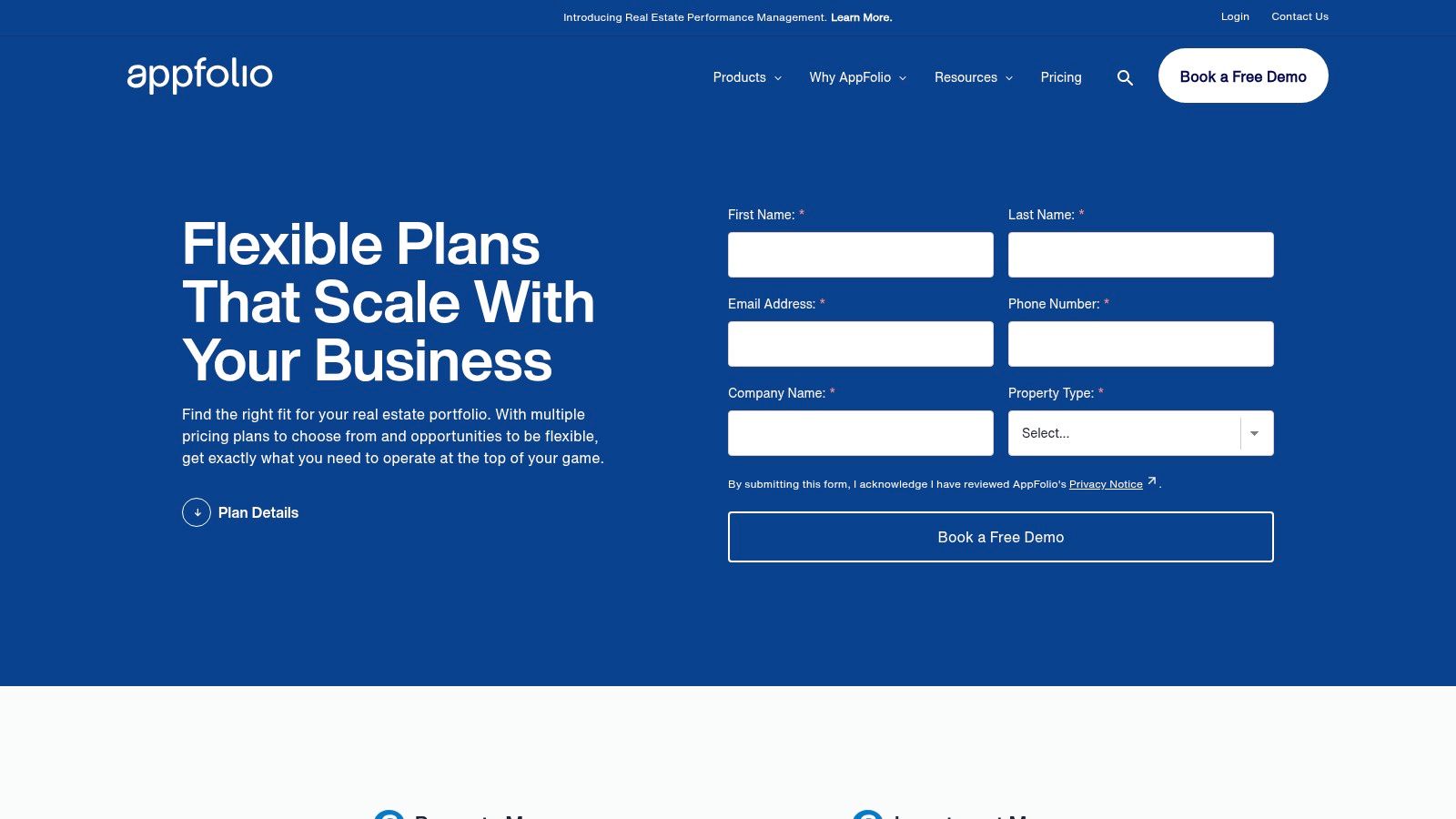
The platform is built to support scalability. Its core strength lies in its robust accounting features and automated workflows, which help reduce manual data entry and minimize errors. For property managers focused on reducing days on market (DOM), AppFolio’s marketing and leasing tools, including syndication to listing sites and online applications, are essential. The system also supports integrations with specialized leasing solutions, which can significantly enhance showing efficiency and speed-to-lease metrics. Learn more about the Showdigs and AppFolio integration to see how you can automate your showing workflows and reduce DOM across your portfolio.
Ideal Use Case & Key Features
AppFolio is best suited for property management companies with 50 or more units that are planning to scale significantly. It provides the infrastructure needed to manage complex operations without needing to piece together multiple disparate systems.
- Robust Accounting: Features institutional-grade accounting with online rent payments, owner statements, and customizable financial reports.
- Integrated Marketing & Leasing: Automates vacancy postings and manages online applications and tenant screening in one place.
- Value-Added Services: Offers optional add-ons like tenant liability insurance and debt collection to create new revenue streams.
- Mobile Functionality: Provides dedicated mobile apps for managers, owners, and tenants, facilitating on-the-go communication and task management.
Pricing
AppFolio's pricing is tiered, but specific per-unit costs are not publicly listed and require a sales consultation. This model is common for enterprise-level software.
- Core Plan: Aimed at smaller, growing portfolios.
- Plus & Max Plans: Designed for larger or more complex portfolios, offering advanced features like configurable workflows and performance insights.
- Onboarding Fee: A one-time fee is required for setup and training.
Pros:
- All-in-one platform reduces the need for multiple software subscriptions.
- Mature ecosystem with extensive support and training resources.
- Highly scalable to support portfolio growth from dozens to thousands of units.
Cons:
- Pricing is not transparent, requiring direct contact with sales.
- The cost can increase substantially with the addition of value-added services.
- Built-in leasing tools may lack the specialization needed for aggressive DOM reduction at scale.
Visit AppFolio Property Manager
3. Buildium (by RealPage)
Buildium is a well-established SaaS platform designed to serve the needs of small to mid-sized property management companies. Acquired by RealPage, it balances comprehensive functionality with user-friendly accessibility, making it a strong contender among the best property management apps. The platform provides a core suite of tools for accounting, leasing, maintenance coordination, and resident communications, all within a single, integrated system that aims to streamline day-to-day operational tasks.
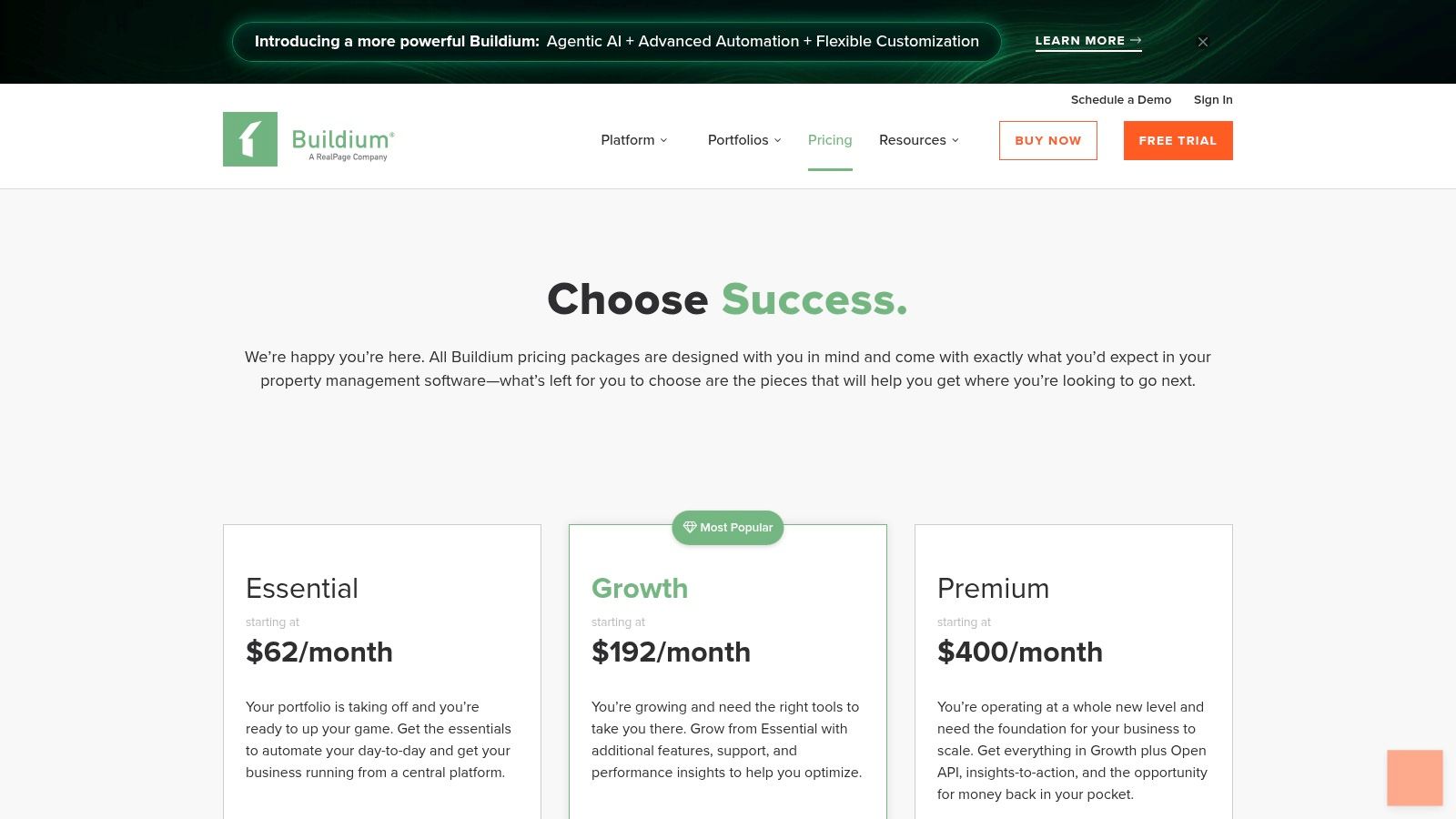
What sets Buildium apart is its transparent pricing structure and the inclusion of a free trial, allowing managers to evaluate the software before committing. Its tiered plans are designed to scale with a growing portfolio, offering more advanced features like eSignatures, business analytics, and AI-powered communication tools at higher levels. This approach provides a clear growth path for managers who need a robust operational backbone to support their business expansion without the initial complexity of an enterprise-level system.
Ideal Use Case & Key Features
Buildium is ideal for property managers with small to mid-sized portfolios (under 500 units) who need a powerful, all-in-one solution with predictable pricing. It's particularly effective for those prioritizing core operational efficiency in accounting and tenant management.
- Tiered Plans for Scalability: Offers three distinct plans (Essential, Growth, Premium) that allow managers to pay only for the features they need.
- Built-in Leasing & Screening: Includes tools for rental listings, online applications, comprehensive tenant screening, and eSignatures for lease execution.
- Comprehensive Accounting: Manages online payments, tracks expenses, handles vendor payments, and generates detailed financial reports.
- Integrated Portals: Provides dedicated online portals for owners, tenants, and board members to streamline communication and document sharing.
Pricing
Buildium offers transparent, tiered subscription plans based on the number of units managed, along with a 14-day free trial.
- Essential Plan: Starts at $55/month, covering core accounting, maintenance, and tenant communication features.
- Growth Plan: Starts at $174/month, adding features like unlimited eSignatures, performance analytics, and live phone support.
- Premium Plan: Starts at $375/month, unlocking business analytics, open API access, and priority support.
- Additional Fees: Transaction fees for online payments and individual fees for tenant screening may apply.
Pros:
- Transparent, publicly listed pricing and a free trial period.
- Strong feature set for core property management operations.
- User-friendly interface that is relatively easy to adopt.
Cons:
- Advanced analytics and API access are locked behind the most expensive plan.
- Additional transaction and screening fees can increase the total cost of ownership.
- May lack the deep customization required by large, enterprise-level portfolios.
4. Yardi Breeze
Yardi Breeze is a refreshingly simple and user-friendly platform designed for property managers who need powerful features without the complexity of enterprise-level software. It serves as a more accessible version of Yardi’s robust Voyager system, making it one of the best property management apps for small to mid-sized portfolios across residential, commercial, and other property types. The platform emphasizes ease of use, with a clean interface and straightforward workflows for core property management tasks.
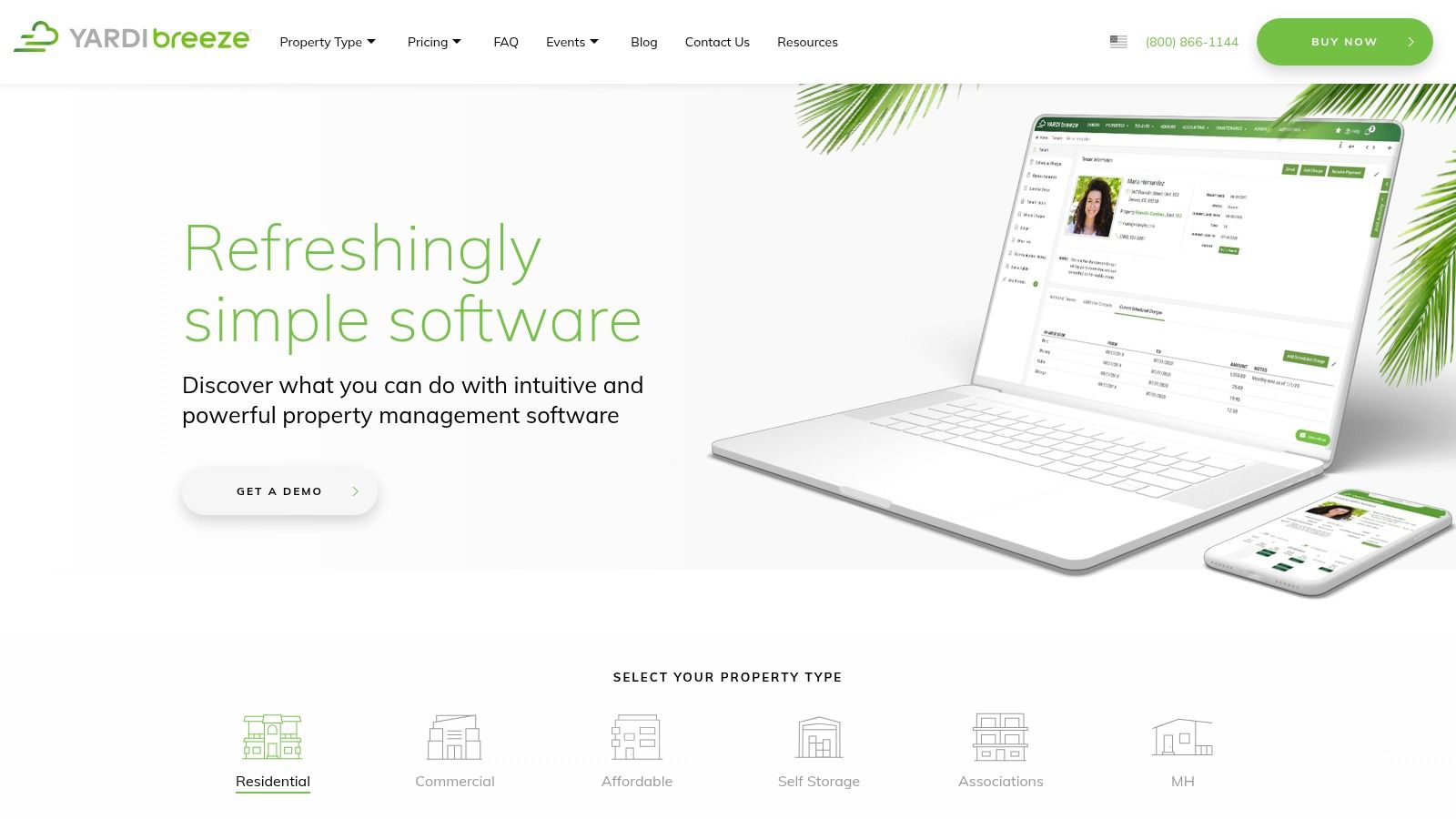
The primary strength of Yardi Breeze lies in its transparent, all-in-one approach. It effectively combines accounting, leasing, and operations into a single system with clear, per-unit pricing. For property managers focused on efficiency, the platform automates critical functions like rent collection, maintenance requests, and financial reporting. Its built-in marketing and leasing tools, including vacancy posting and prospect tracking, help teams reduce days on market (DOM) and maintain high occupancy rates.
Ideal Use Case & Key Features
Yardi Breeze is ideal for independent landlords and property management companies with smaller but growing portfolios who want an intuitive, cloud-based solution. The Breeze Premier plan offers more advanced features for those needing deeper accounting functionality and job cost tracking without committing to a full enterprise system.
- Simplified Accounting & Reporting: Includes tools for online rent payments, CAM recovery, and generating owner statements and financial reports.
- Integrated Leasing Workflow: Manages the entire leasing cycle from marketing and guest cards to online applications, tenant screening, and add-on renters insurance.
- Tenant & Owner Portals: Provides dedicated online portals for tenants to pay rent and submit maintenance requests, and for owners to view property performance.
- Accessible Support: Offers live chat support, which is a significant benefit for users who need quick answers without navigating complex support ticket systems.
Pricing
Yardi Breeze is known for its transparent pricing model, which is a key differentiator in the market.
- Breeze Plan: Starts at $1 per unit per month, with a minimum monthly cost (e.g., $100/month for residential).
- Breeze Premier Plan: Starts at $2 per unit per month, with a higher minimum monthly cost (e.g., $400/month for residential) for more advanced features.
- No Setup Fees: Yardi Breeze often advertises no setup or training fees, making it more accessible to get started.
Pros:
- Transparent, per-unit pricing makes budgeting predictable.
- Very intuitive and user-friendly interface reduces the learning curve.
- No onboarding or support fees on many plans, lowering the barrier to entry.
Cons:
- Minimum monthly fees can be costly for managers with very few properties.
- Less customizable than its enterprise-level counterpart, Yardi Voyager.
- Some advanced features are only available in the more expensive Premier plan.
5. DoorLoop
DoorLoop positions itself as an all-in-one property management software designed for ease of use and rapid implementation. It targets a broad audience, from small landlords to larger mixed-portfolio managers, by prioritizing an intuitive interface and transparent, self-serve purchasing options. This approach makes it one of the best property management apps for teams that need a comprehensive solution without the steep learning curve or lengthy sales process associated with enterprise-level platforms.
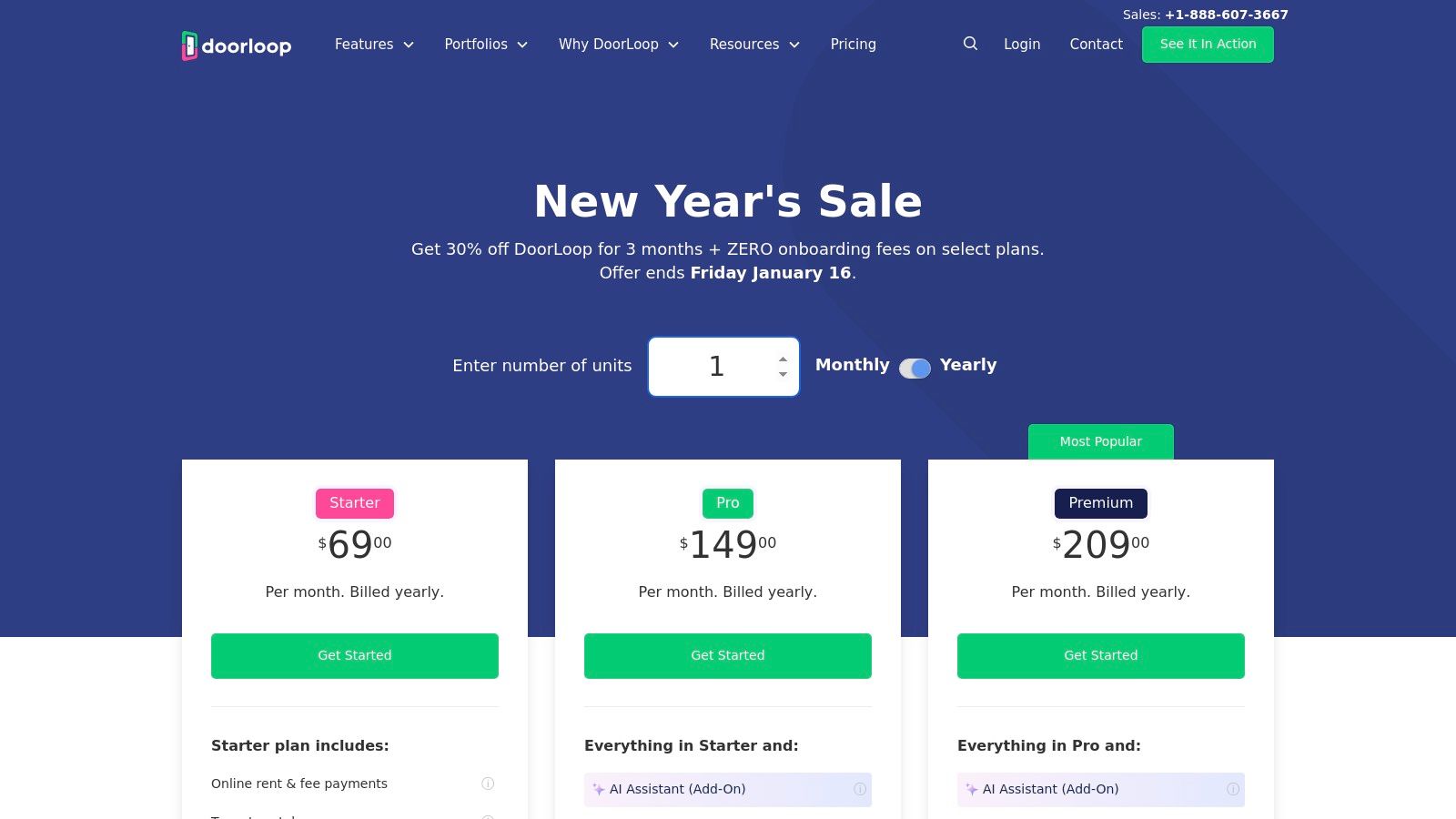
The platform delivers a full suite of core functionalities, including accounting, tenant screening, online rent collection, and maintenance management. Its mobile-first design ensures that most desktop features are available on its native iOS and Android apps, empowering managers to handle tasks on the go. While DoorLoop offers a robust feature set, its architecture also supports integrations with other tools. For property managers looking to enhance their operations with specialized automation, it's important to evaluate how platforms like DoorLoop can connect with other systems. You can discover more about the best AI-powered property management tools to complement your core software.
Ideal Use Case & Key Features
DoorLoop is best suited for property managers with small to mid-sized portfolios who value transparent pricing and a modern, user-friendly interface. It's a strong choice for those who want to get up and running quickly without extensive, mandatory training sessions.
- Full-Suite Functionality: Includes accounting, maintenance requests, marketing, tenant screening, eSignatures, and tenant/owner portals.
- Mobile-First Design: Native iOS and Android apps provide comprehensive functionality for managing properties from anywhere.
- Transparent Onboarding: Offers a quick setup process and straightforward purchasing options directly from its website.
- Flexible Billing: Provides both month-to-month and discounted annual billing plans to fit different budget cycles.
Pricing
DoorLoop's pricing is transparent and based on the number of units managed, with a 20-unit minimum on its starter plan.
- Starter Plan: Begins at $59/month for up to 20 units, covering essential features.
- Pro & Premium Plans: Offer more advanced features like owner portals, bank reconciliations, and API access at higher per-unit costs.
- Additional Fees: Some services, like ACH payments and eSignatures on lower tiers, may incur per-item fees.
Pros:
- Transparent, publicly listed pricing with flexible monthly or annual billing.
- Modern, intuitive user interface simplifies onboarding and daily use.
- Comprehensive mobile app functionality for true on-the-go management.
Cons:
- Lower-tier plans have per-transaction fees for services like ACH payments.
- May lack the deep customization and advanced reporting needed by enterprise-level portfolios.
- The 20-unit minimum on the starter plan may not be ideal for very small landlords.
6. Rent Manager
Rent Manager is a highly versatile and customizable platform designed for property management companies that require deep control over their operations. Its standout feature is its adaptability; it can be deployed as a standalone software or a cloud-based service, catering to diverse portfolios of any size. This flexibility, combined with powerful accounting and reporting capabilities, makes it one of the best property management apps for businesses with unique workflows or complex reporting needs that off-the-shelf solutions cannot meet.
The platform's core strength lies in its robust, double-entry accounting system, which supports both cash and accrual methods simultaneously. For property managers focused on data-driven decisions and operational efficiency, Rent Manager offers over 450 built-in reports and the ability to create custom ones. Its open API and extensive integration marketplace allow companies to build a truly bespoke tech stack, connecting leasing, maintenance, and accounting systems seamlessly to reduce manual tasks and improve speed-to-lease.
Ideal Use Case & Key Features
Rent Manager is best suited for established property management companies that need a high degree of customization and detailed financial reporting. Its power is ideal for teams that have outgrown simpler software and require a system that can be tailored to their specific operational processes.
- Advanced & Flexible Accounting: Provides a complete accounting engine with features like online rent collection, accounts payable, and bank reconciliations.
- Extensive Customization & Reporting: Offers unmatched reporting capabilities and allows users to customize everything from data fields to workflows.
- Open API & Integrations: A robust API allows for deep integrations with other specialized software, creating a powerful, interconnected system.
- Comprehensive Mobile Solutions: Features dedicated mobile apps (rmAppSuite Pro) for managers and staff to handle tasks in the field, from inspections to maintenance.
Pricing
Rent Manager’s pricing is quote-based and not publicly available. Potential customers must contact their sales team for a personalized demo and pricing structure based on their portfolio size and specific needs.
- Rent Manager Online: A per-unit, per-month fee that varies by portfolio size.
- Rent Manager Standalone: A one-time license fee for self-hosted deployment.
- Implementation & Training: Additional fees for onboarding and training are typically required.
Pros:
- Extremely customizable to fit unique business processes.
- Powerful reporting engine provides deep business insights.
- Open API allows for creating a best-in-class, integrated tech stack.
Cons:
- Pricing is not transparent and requires a sales consultation.
- The high degree of customization can lead to a steeper learning curve and longer implementation time.
- May be overly complex for small landlords or companies with basic needs.
7. Propertyware (by RealPage)
Propertyware, a RealPage company, is a comprehensive platform engineered specifically for the complexities of single-family property management. It provides an end-to-end solution that integrates accounting, maintenance, marketing, and robust reporting into a single system. Its focus on single-family workflows makes it a standout choice for managers who find other, more generalized platforms lack the specific features needed for scattered-site portfolios.
The platform emphasizes customization and operational control. Managers can create custom fields and reports, tailoring the system to their unique business processes. Propertyware also offers optional add-on services like leasing and maintenance call centers or website development, allowing companies to outsource specific functions as they scale. This combination of a core software suite with optional managed services makes it one of the best property management apps for single-family operators looking for a flexible, scalable solution.
Ideal Use Case & Key Features
Propertyware is best suited for professional single-family property management companies managing 100 or more units. Its tiered structure allows businesses to choose a plan that fits their current needs while providing a clear path for growth.
- Single-Family Focused Design: Every feature, from maintenance coordination to owner portals, is built with the challenges of managing non-contiguous properties in mind.
- Optional Managed Services: Includes add-ons like leasing and maintenance call centers and professionally designed websites to augment in-house teams.
- Advanced Customization: Users can create unlimited custom fields and reports, providing deep insights and adapting the software to specific operational needs.
- Integrated Communications: Features include two-way texting, eSignature capabilities, and dedicated portals for tenants, owners, and vendors to streamline communication.
Pricing
Propertyware offers transparent, tiered pricing based on the number of units, though monthly minimums and implementation fees apply.
- Basic Plan: Starts at $1.00 per unit/month, with a $250 monthly minimum.
- Plus Plan: Starts at $1.50 per unit/month, with a $350 monthly minimum, adding features like eSignatures and inspections.
- Premium Plan: Starts at $2.00 per unit/month, with a $450 monthly minimum, adding vendor portals and maintenance management.
- Transaction Fees: Additional costs apply for services like tenant screening and online payments.
Pros:
- Transparent per-unit pricing with clear feature tiers.
- Designed specifically for single-family property management workflows.
- Highly customizable to fit unique business processes.
- Optional services allow for operational outsourcing as needs change.
Cons:
- Monthly minimums can be a barrier for smaller portfolios.
- One-time implementation fees are required for setup.
- Total cost increases with transaction fees for payments and screening.
8. Rentvine
Rentvine is a modern property management platform that has gained traction by focusing on the single-family rental market. It stands out with a simple, all-inclusive pricing model and a strong emphasis on technology, including an open API for seamless integrations and an AI-assisted workflow engine. This approach positions Rentvine as a powerful and flexible option among the best property management apps for tech-savvy managers looking to automate tasks without paying for siloed features.
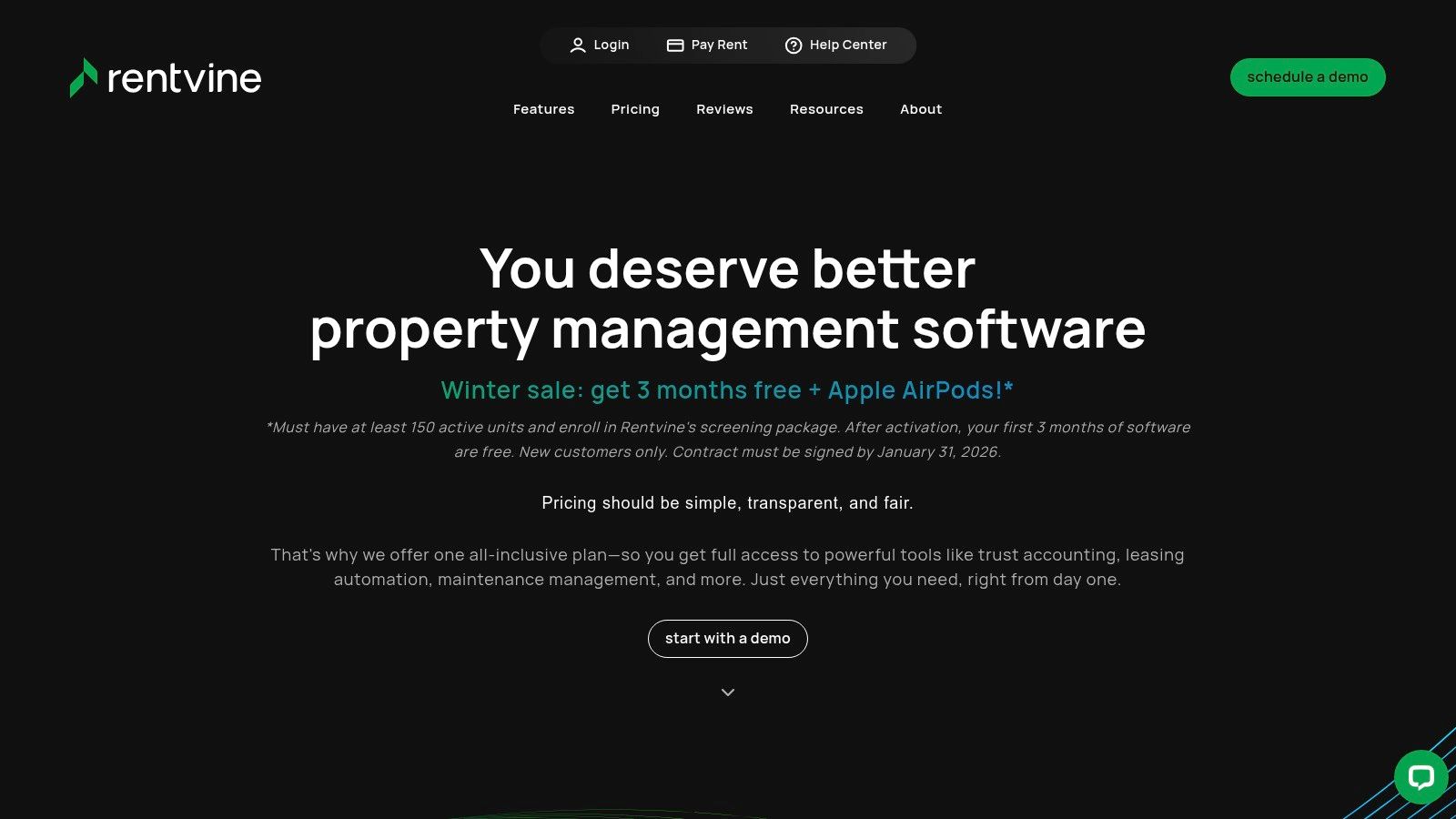
The platform is built to provide a unified experience, covering everything from trust accounting and owner portals to digital leasing and maintenance coordination. Its open API is a significant differentiator, allowing property management companies to build a custom tech stack that connects their core system with specialized tools for showings, marketing, or business intelligence. The built-in AI assistant further enhances efficiency by helping automate routine communications and administrative tasks, freeing up team members to focus on high-value activities.
Ideal Use Case & Key Features
Rentvine is best suited for single-family property managers who want access to a full suite of features without a complex, tiered pricing structure. Its open API and modern interface appeal to companies focused on building efficient, integrated, and scalable operations.
- All-Inclusive Features: One price gives access to all platform features, including trust accounting, portals, and digital leasing.
- Open API: Enables deep integrations with other software, allowing for a highly customized and powerful tech ecosystem.
- AI-Assisted Workflows: Includes a built-in AI assistant, "Ivy," to help automate communications and streamline repetitive tasks.
- Modern User Interface: Offers a clean, intuitive dashboard with custom views and powerful global search functionality.
Pricing
Rentvine uses a straightforward, per-unit pricing model where all features are included. However, different pages on their site have shown different prices, so it's best to confirm with their sales team.
- Per-Unit Fee: A flat fee is charged per unit per month.
- Minimum Monthly Charge: A minimum monthly fee applies, making it more suitable for portfolios of a certain size.
- No Module Gating: All features are included in the base price without requiring expensive add-ons.
Pros:
- Simple, transparent pricing model with access to all features.
- Open API and AI tools are ideal for building automated, modern workflows.
- Strong focus on customer support with a US-based team.
Cons:
- Pricing information has been inconsistent across their website; a direct quote is necessary.
- The minimum monthly charge may not be cost-effective for very small portfolios.
- As a newer platform, its third-party integration marketplace is still growing compared to more established competitors.
9. RentRedi
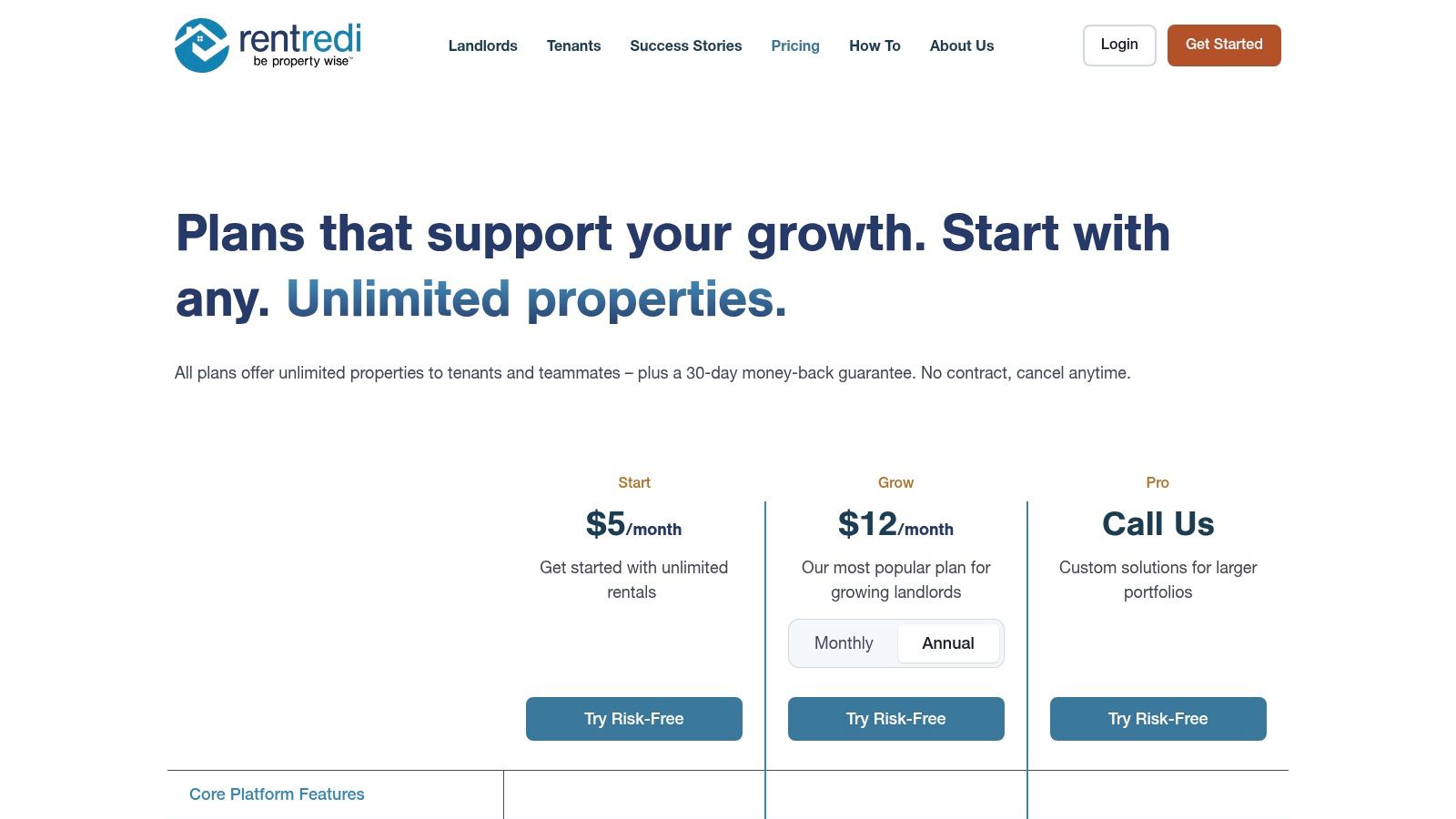
RentRedi targets independent landlords and property managers with a unique pricing model that prioritizes predictability. Instead of charging per unit, the platform offers flat-rate subscriptions with unlimited properties, tenants, and team members. This makes it a compelling choice for managers who are rapidly scaling their portfolios and want to avoid the escalating per-door costs common with other property management apps. The focus is on providing core management functionalities without financial surprises.
The platform is designed for self-service, allowing users to sign up and get started without a lengthy sales process. Key features include online rent collection via ACH, card, or even cash, along with comprehensive application management, tenant screening, and income verification. While it covers the essential financial and leasing workflows, its strength lies in its straightforward, all-inclusive subscription that simplifies budgeting for property management operations.
Ideal Use Case & Key Features
RentRedi is best for landlords and property managers with growing portfolios who value a predictable, flat-fee pricing structure over advanced, enterprise-level features. Its unlimited-door model is particularly cost-effective for portfolios exceeding 20-30 units.
- Unlimited Doors Per Subscription: Manage any number of properties and tenants under a single, predictable monthly or annual fee.
- Flexible Rent Payments: Tenants can pay via ACH, credit/debit card, or cash at over 90,000 retail locations, with payments tracked automatically.
- Full Leasing Cycle Management: Includes free listing syndication, online applications, and comprehensive tenant screening with credit, criminal, and eviction reports.
- Financial Tracking: Offers basic expense tracking and financial reporting tools to help managers monitor portfolio performance.
Pricing
RentRedi’s pricing is transparent and based on the subscription term, not the number of units.
- Monthly Plan: $29.95 per month.
- 6-Month Plan: $20 per month (billed every 6 months).
- Annual Plan: $12 per month (billed annually).
- Add-ons: Advanced accounting features powered by REI Hub are available for an additional fee.
Pros:
- Predictable and highly affordable pricing for large or growing portfolios.
- No per-unit fees, which delivers significant savings at scale.
- Direct online signup without needing a sales consultation.
- Includes a mobile app for both tenants and landlords.
Cons:
- Applicant-paid model for screening fees can be a deterrent for some prospective tenants.
- Lacks the advanced workflow automation and customization found in enterprise systems.
- Some features, like advanced accounting, require an additional subscription.
10. TurboTenant
TurboTenant is a popular choice for independent landlords and small-scale property managers, offering a free core platform that covers essential property management workflows. It stands out by providing a robust, no-cost entry point for managing listings, applications, screening, and rent payments. This accessibility makes it one of the best property management apps for those just starting out or managing a handful of properties without needing the complexity of an enterprise-level system.

The platform is designed for ease of use, allowing users to sign up and get started online without a lengthy sales process. Its core functionality focuses on filling vacancies quickly and simplifying rent collection. While the free plan is comprehensive, TurboTenant offers affordable paid tiers that unlock advanced features like state-specific lease agreements, e-signatures, and accounting tools. This tiered model allows managers to scale their toolset as their portfolio and operational needs grow.
Ideal Use Case & Key Features
TurboTenant is best suited for DIY landlords and managers with small portfolios (under 25 units) who need an easy-to-use, low-cost solution for core leasing and management tasks. Its straightforward interface minimizes the learning curve.
- Listings Syndication: Posts rental listings to multiple high-traffic websites to maximize visibility and generate leads.
- Online Applications & Screening: Includes a streamlined online application process and comprehensive tenant screening reports.
- Online Rent Collection: Facilitates online rent payments with features like automatic reminders and autopay to ensure consistent cash flow.
- State-Specific Leases: The premium plan provides access to landlord forms and state-specific lease agreements with e-signature capabilities.
Pricing
TurboTenant’s model is built around a free core service with optional paid upgrades.
- Free Plan: Includes marketing, lead management, applications, screening, and rent collection.
- Premium Plan: Priced at an affordable annual subscription, this plan adds unlimited state-specific leases, e-signatures, landlord forms, and expedited rent payouts.
Pros:
- Excellent free plan that covers all the essential functions for small landlords.
- User-friendly interface that is easy to set up and navigate.
- Affordable and transparent pricing for premium features.
Cons:
- Key features like lease agreements and e-signatures are locked behind a paywall.
- Lacks the advanced accounting and reporting features needed for larger portfolios.
- Applicants typically cover the cost of screening fees.
11. Rentec Direct
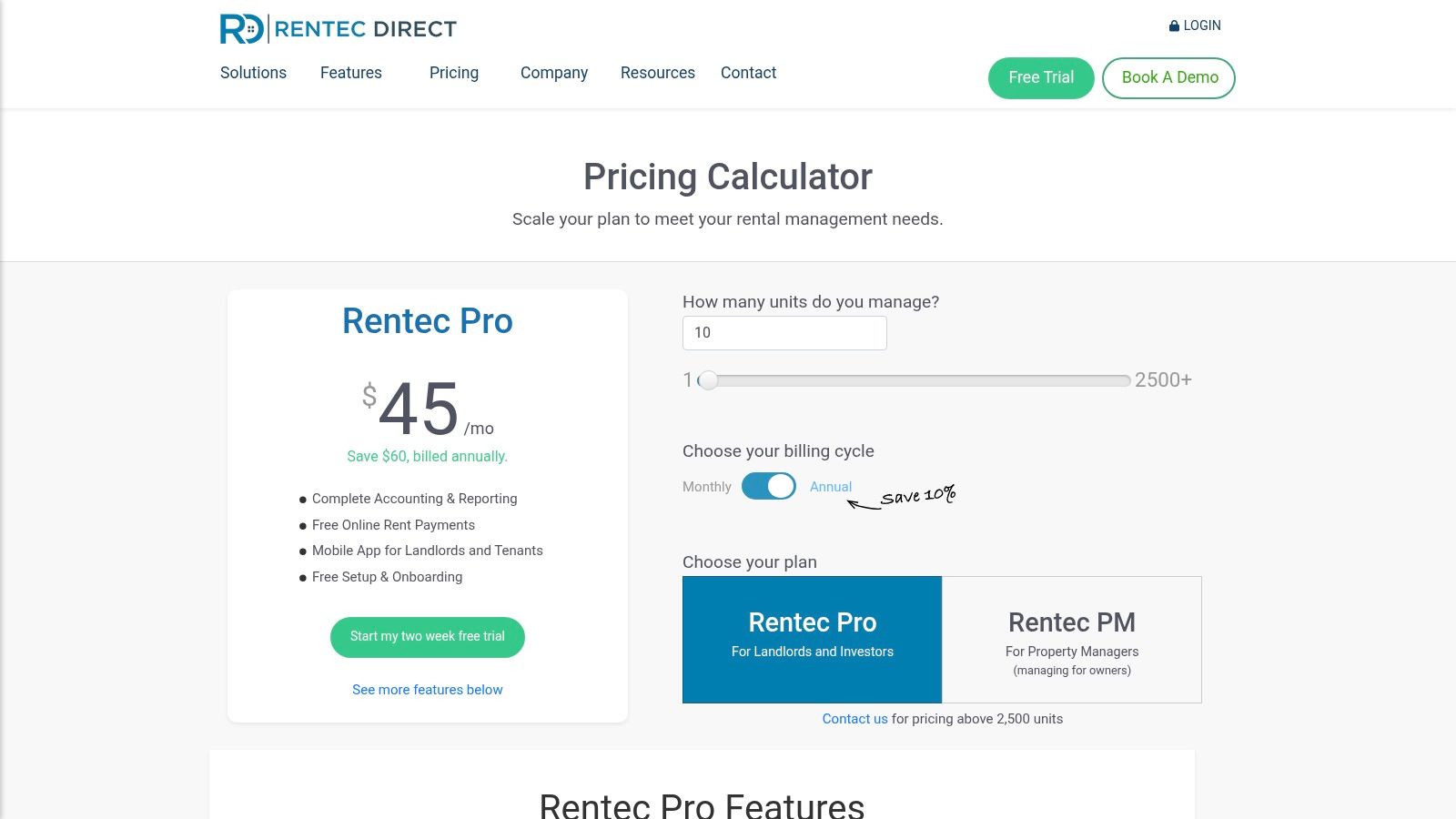
Rentec Direct provides straightforward, reliable software for landlords and property managers who prioritize core functionalities and transparent pricing. It stands out by offering two distinct plans: Rentec Pro for direct property owners managing their own portfolios, and Rentec PM for third-party managers who need trust accounting and owner reporting. This clear division makes it one of the best property management apps for those who want a solution tailored specifically to their business model without paying for unnecessary enterprise-level features.
The platform is designed for ease of use and quick implementation, supported by free setup and U.S.-based customer service. For property managers focused on efficiency, Rentec Direct’s automated tools for rent collection, maintenance tracking, and financial reporting help streamline daily operations. Its integrated marketing features, including vacancy syndication and online applications, are key for reducing days on market (DOM) and ensuring a steady flow of qualified leads. The simplicity of its system allows smaller to mid-sized teams to get up and running quickly.
Ideal Use Case & Key Features
Rentec Direct is best suited for independent landlords and small-to-mid-sized property management companies seeking a robust, no-frills platform with predictable monthly costs. Its separate plans ensure users only pay for the features they actually need, whether it's basic portfolio management or full trust accounting.
- Full Accounting & Reporting: Includes general ledger accounting, online rent payments via ACH or card, and detailed financial reports.
- Tenant & Owner Portals: Provides secure online portals for tenants to pay rent and owners to view statements, improving communication.
- Marketing & Leasing Tools: Automates vacancy postings to popular rental sites and manages online applications and tenant screening.
- Trust Accounting (PM Plan): The Rentec PM plan includes full trust account management and reporting, with capabilities for ACH payments to owners.
Pricing
Rentec Direct offers transparent, tiered monthly pricing based on the number of units managed, with no long-term contracts.
- Rentec Pro: Starts at $45/month for up to 10 units.
- Rentec PM: Starts at $55/month for up to 10 units.
- Free Trial: A two-week free trial is available for both plans.
- No Setup Fees: Onboarding and support are included at no extra cost.
Pros:
- Clear and affordable pricing structure with no hidden setup fees.
- Free U.S.-based customer support and onboarding.
- Simple, user-friendly interface that is easy to learn.
Cons:
- May lack the advanced automation and customization found in larger enterprise systems.
- Standard transaction fees apply for online rent and application payments.
- The user interface, while functional, is less modern than some competitors.
12. Hemlane
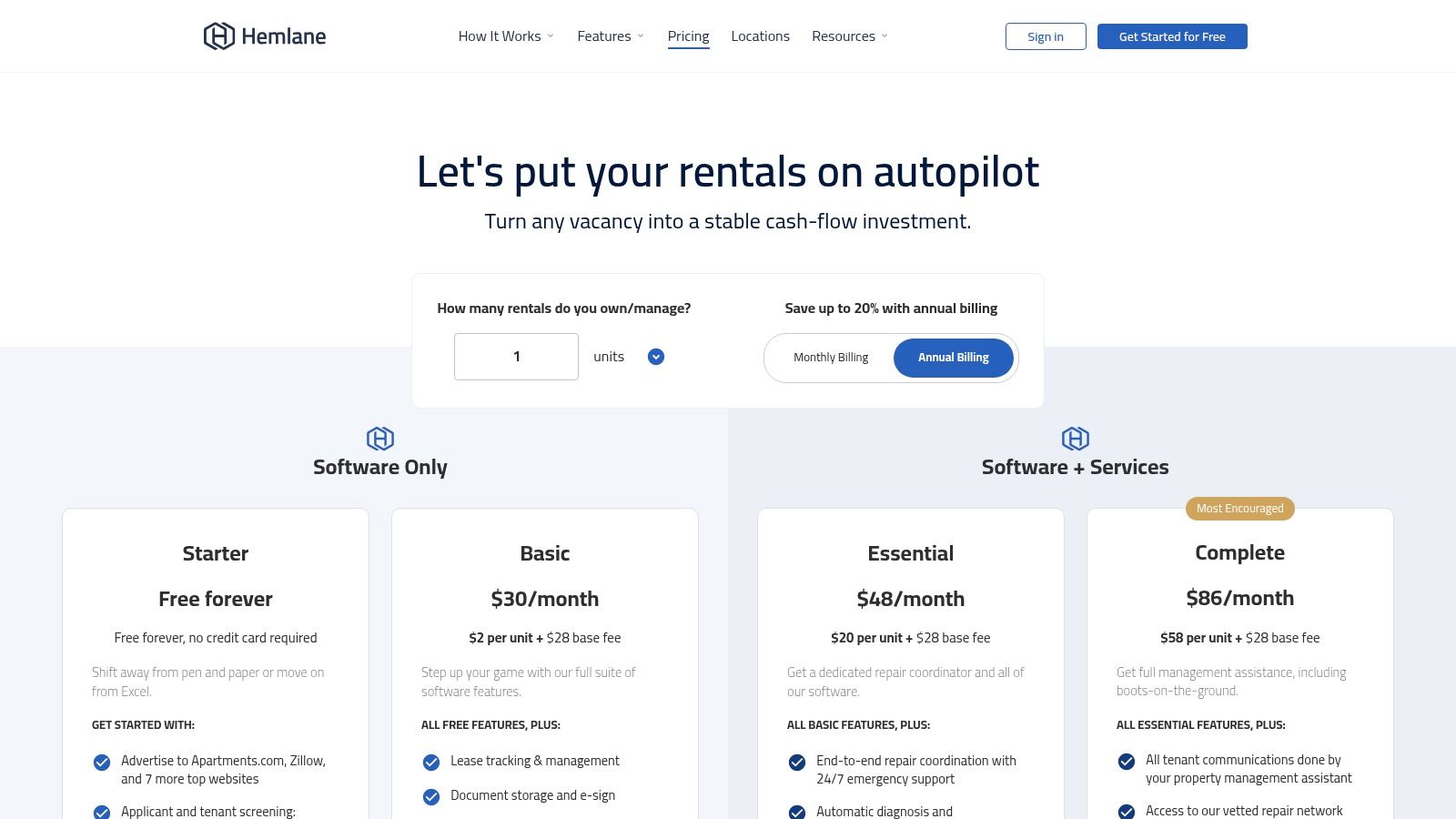
Hemlane introduces a unique hybrid model to the market, blending core property management software with optional, on-demand services. This structure is designed for owners and managers of single-family homes and small portfolios who want flexibility. It allows users to choose their level of involvement, from a pure software-as-a-service experience to a more hands-off approach with professional assistance for leasing and maintenance coordination. This makes it one of the best property management apps for those who need more than just software but less than a full-service management company.
The platform excels at giving landlords control while offloading time-consuming tasks. For instance, its 24/7 repair coordination service handles tenant maintenance requests from start to finish. For leasing, Hemlane connects users with local, licensed agents for showings, tenant placement, and inspections. This a-la-carte service model is powerful, allowing managers to scale support up or down based on immediate needs without long-term commitments. Managers looking to automate showings might also want to learn how to choose self-showing software for a fully integrated tech solution.
Ideal Use Case & Key Features
Hemlane is best suited for DIY landlords and small-scale property managers who want to automate core tasks while having access to professional support when needed. It effectively bridges the gap between self-management and full-service property management.
- Flexible Service Tiers: Offers three tiers, from a software-only "Basic" plan to an "Essential" plan with 24/7 repair coordination and a "Complete" plan that adds local agent support.
- Comprehensive Leasing Tools: Includes vacancy advertising to top listing sites, online applications, and thorough tenant screening.
- Full Financial Management: Provides online rent collection with free ACH transfers, expense tracking, and bank account synchronization.
- On-Demand Agent Network: Users can hire local real estate agents for specific tasks like showings, move-in/out inspections, and lease negotiations.
Pricing
Hemlane’s pricing is transparent, with a flat base fee plus a per-unit cost that decreases as the portfolio grows.
- Basic Plan: Starts at $30/month for one unit.
- Essential Plan: Starts at $40/month for one unit, includes repair coordination.
- Complete Plan: Starts at $108/month for one unit, includes agent matching and leasing support.
- Add-on services: Costs for specific agent tasks (like tenant placement) are separate.
Pros:
- Highly flexible model lets you choose the exact level of support needed.
- Transparent and predictable pricing structure.
- Access to a national network of licensed agents for on-the-ground tasks.
Cons:
- Service-heavy tiers can become expensive on a per-unit basis as you scale.
- Some premium listing site integrations come with additional costs.
- May lack the deep, enterprise-level features required by very large portfolios.
Top 12 Property Management Apps Comparison
Building Your Enterprise PropTech Stack for Maximum ROI
Navigating the landscape of the best property management apps can feel overwhelming, but for large-scale operators, the path to profitability is clear: build an integrated technology ecosystem that crushes key performance metrics. This review of platforms—from all-in-one powerhouses like AppFolio to niche solutions like RentRedi—highlights a critical truth for enterprise-scale operators: no single tool can be the best at everything. The most profitable and scalable property management companies don't search for a silver bullet; they architect a strategic PropTech stack.
The core of this stack is typically a robust Property Management System (PMS) like Yardi or Propertyware, which serves as the central nervous system for accounting, owner reporting, and tenant data. These systems are indispensable for financial and administrative control. However, for a KPI-driven organization focused on portfolio growth and profitability, the most significant revenue leaks occur at the top of the funnel—during the leasing process. This is where relying solely on the built-in, generalist features of an all-in-one system can cost you dearly in lost revenue.
From All-in-One to Best-in-Class Integration
The fundamental shift for scaling a portfolio from hundreds to thousands of units is moving from a single-app mindset to an integrated ecosystem. Your goal is to plug specialized, best-in-class solutions into your core PMS to optimize specific, high-impact workflows. The two most critical areas demanding this specialization are leasing and maintenance.
Leasing Automation: This is the engine of your revenue. Every day a unit sits vacant directly impacts your bottom line. While your PMS can track a lease, it's not purpose-built to slash Days on Market (DOM). A specialized platform like Showdigs is designed with a singular focus: optimizing the lead-to-tour-to-lease velocity. By automating tour scheduling, providing a network of on-demand agents for showings, and enabling same-day tours, it directly attacks the root cause of vacancy loss. Integrating a tool like this with your PMS ensures data flows seamlessly while your leasing team gains a powerful, specialized weapon to convert leads faster.
Maintenance Coordination: Similar to leasing, maintenance is a complex, high-volume operation that benefits immensely from dedicated software. A generic work order module in a PMS often lacks the depth needed for vendor management, detailed analytics, and resident communication at scale. To maximize the ROI of your PropTech stack, carefully consider your options for dedicated maintenance solutions. This guide on choosing property management maintenance software can help inform your decision by breaking down the key features needed to streamline repairs and protect your assets.
Your Actionable Next Steps
To build your optimal stack, start with a clear-eyed assessment of your current operations. Calculate the real cost of vacancy across your portfolio—what does a single vacant day cost you in lost revenue? This figure will immediately clarify where your investment will generate the highest return.
Next, audit your current workflows. Where are the bottlenecks? Is your team spending too much time manually scheduling showings? Are qualified leads dropping off because they can't get a tour quickly enough? The answers will guide you toward the right specialized tool.
Ultimately, selecting the best property management apps for your enterprise isn't about finding one perfect platform. It's about strategically combining a powerful PMS with specialized, high-ROI solutions that automate critical functions, drive down operational costs, and, most importantly, accelerate your speed-to-lease. This integrated approach is the proven framework for building a resilient, scalable, and highly profitable property management operation.
Ready to eliminate vacancy loss and supercharge your leasing operations? Discover how Showdigs provides an on-demand network of showing agents and powerful automation to help you cut Days on Market and sign leases faster. Schedule a demo to see how our purpose-built platform can transform your portfolio's profitability.
.png)