



When you see the price tag on a Zillow lead, it’s easy to think of it as a simple marketing expense. But for property managers overseeing portfolios of 100 to 10,000+ units, that initial number—which can range from $139 in a quiet suburb to over $223 in a bustling city—is just the tip of the iceberg. The real metric isn't the lead cost; it's the impact on your days on market (DOM) and overall revenue.
Understanding The Real Cost For Zillow Leads

If you're managing hundreds or even thousands of units, the sticker price of a lead is dangerously misleading. The KPI that truly impacts your portfolio's financial performance isn't the cost per lead—it's the fully-loaded cost per lease. This is the metric that actually impacts your bottom line, cost-per-door efficiency, and ultimately, your NOI.
Buying the lead is just the starting line. To get a true picture of your acquisition cost, you must account for every operational touchpoint required to convert that initial inquiry into a signed lease—a process where speed and efficiency are paramount.
Shifting Focus From Lead Price To Lease Cost
Looking only at Zillow's invoice means you're ignoring the significant internal resources poured into the leasing process. Every lead triggers a cascade of operational tasks, each with an associated cost. To calculate the true ROI on your Zillow spend, you have to track:
- Operational Overhead: What are the prorated salaries of the leasing agents and coordinators spending their time chasing down, nurturing, and scheduling tours for these leads? For large portfolios, this is a major line item.
- Lead-to-Tour Conversion Rate: A low conversion rate is a critical operational failure. It means your team is burning valuable hours on inquiries that go nowhere, which inflates the real cost of every successful tour and extends vacancy periods.
- Days on Market (DOM): Every day a unit sits vacant due to a sluggish leasing process is lost revenue. A 1,000-unit portfolio with a $1,500/month average rent loses $50,000 for every single day of vacancy across the board. This cost must be tied directly back to your lead conversion strategy.
The Impact Of Market Competition
The price of a Zillow lead is a direct reflection of local market dynamics. In hyper-competitive metro areas like NYC or LA, you can expect to pay around $223 per lead. In a less saturated ZIP code, that cost might drop to $139. This is driven by local property values and the number of other agents bidding for attention. Top advertisers often invest thousands of dollars a month in a single ZIP code. You can discover more insights about real estate lead costs to see how this plays out in different markets.
To give you a clearer picture, here’s a quick breakdown of how lead costs can vary by market type. Notice how competition directly influences what you'll pay just to get an inquiry.
Estimated Zillow Lead Cost By Market Type
This table illustrates the significant cost variation for Zillow leads based on market competition, providing a quick reference for portfolio managers operating in diverse geographic areas.
Market TypeEstimated Cost Per LeadTypical Monthly Spend (Per ZIP Code)Key DriverHigh-Competition Metro$200 - $250+$1,500 - $3,000+High agent density, high property valuesSuburban Market$160 - $200$800 - $1,500Moderate competition, steady demandRural/Low-Competition$130 - $160$400 - $800Fewer competing agents, lower demand
As you can see, simply budgeting for "Zillow leads" without considering the local context can quickly derail your marketing spend.
For enterprise-scale portfolios, this isn't just a marketing expense; it's a strategic investment. The key is to build an operational framework that minimizes cost-per-lease by maximizing the conversion potential of every dollar spent on Zillow.
Ultimately, a "cheap" lead that goes cold is infinitely more expensive than a pricier one your team can convert into a signed lease within 24 hours. Once you start analyzing the entire lead-to-lease journey, you’ll get a crystal-clear view of your true acquisition cost and can start fine-tuning your operations to reduce DOM and maximize revenue.
How Zillow's Pricing Model Really Works
First things first: Zillow doesn't sell leads at a flat rate. For large-scale property management companies, thinking that way is the fastest path to a busted marketing budget.
It’s much more like a stock market, where you’re constantly bidding for a renter's attention in a specific area. For property managers with multi-market portfolios, understanding this auction-style system is critical to optimizing marketing spend and achieving cost-per-door efficiency targets.
Your cost per lead on Zillow isn't a fixed number; it’s a dynamic variable shaped by the competition in every single ZIP code. What you're really buying is a percentage of visibility, or what marketers call "share of voice." If you buy a 50% share of voice, your listings are theoretically shown to half the renters looking in that area. But the price for that share? It changes constantly based on what everyone else is doing.
The 3 Big Levers Driving Your Cost
To get a grip on your Zillow spend, you need to understand the three main factors that dictate how much you'll pay for a lead. They explain why a lead for a two-bedroom in one submarket can cost you five times more than a nearly identical one just a few miles away.
Your final price boils down to:
- Local Competition: This is the big one. How many other property managers and agents are throwing money at the same ZIP code? The more bidders, the higher the price climbs for any meaningful exposure.
- Average Rents: Zillow's algorithm charges a premium for leads in neighborhoods where the average rent—and your potential revenue—is higher. It’s a value-based pricing model.
- Past Renter Demand: Zillow leverages its massive dataset on renter behavior. They know which ZIP codes get flooded with searches and inquiries year after year. If an area has a proven history of high demand, the leads there will cost more.
For a portfolio manager, the goal isn't just to find the cheapest leads. It's to identify the submarkets where the competition, rent value, and renter demand align to deliver the best possible return on investment, measured by speed-to-lease.
Shifting Your Budgeting Strategy
Once you grasp this, you can stop reacting and start planning. Instead of spreading your marketing budget evenly across all your properties, you can treat each ZIP code like its own micro-market with a unique P&L.
This lets you spot high-potential areas where you can capture leads without breaking the bank. It also helps you know when to pull back in oversaturated markets where the cost to acquire a single lease just doesn't make financial sense. It's a lot like breaking down ad agency pricing; you have to understand the mechanics to know what you're actually paying for.
By treating Zillow's pricing as a strategic variable instead of a fixed cost, you empower your team to make data-driven decisions that directly lower your cost-per-door. Your marketing budget stops being a simple expense line and becomes a tool for optimizing your entire portfolio, ensuring every dollar you spend is working to boost occupancy and revenue.
Calculating Your True Cost Per Lease
The price you pay Zillow for a lead is just the tip of the iceberg. For any data-driven portfolio manager, that initial sticker price means far less than the true cost per lease (CPL). This is your all-in, fully-loaded expense to get a qualified tenant moved into a unit, and it's the ultimate KPI for measuring the efficiency of your lead sources and your entire leasing operation.
Focusing only on the cost per lead can mask massive operational inefficiencies. A cheap lead that never converts is a waste of marketing dollars and, more critically, your team’s time. Calculating your true CPL provides an honest, clear-eyed view of your ROI and illuminates opportunities for optimization.
A Framework For True CPL
To get this metric right, you must look beyond the Zillow invoice and factor in every operational cost tied to that lead. The formula itself is simple, but it demands meticulous tracking of both direct and indirect expenses.
Your true cost per lease formula needs to include:
- Total Monthly Zillow Spend: The straightforward cost of leads for that month.
- Prorated Staff Time: The cost of your leasing team's time spent chasing, nurturing, and managing those Zillow leads, including salaries, benefits, and commissions.
- Showing Coordination Costs: All expenses involved in scheduling and conducting tours, whether using in-house agents or an on-demand, third-party service.
Once you have those numbers, the math is easy:
(Total Zillow Spend + Prorated Staff Costs + Showing Costs) / Number of Leases Signed from Zillow = True Cost Per Lease
This one powerful number connects your marketing budget directly to your team's real-world performance and operational efficiency.
The Impact Of Operational Drag
Let's run a quick scenario. Imagine you manage a 1,000-unit portfolio and spend $10,000 on Zillow leads in a month, generating 100 leads at $100 each. Your leasing team's prorated costs are $5,000, and coordinating/running showings adds another $2,000. Your total investment is now $17,000.
If your team is operating with an optimized, tech-enabled process and achieves a solid 10% lead-to-lease conversion rate, you sign 10 leases. Your true CPL is $1,700.
But what if operational bottlenecks—like slow response times or no weekend showing availability—cut that conversion rate in half to just 5%? Now you only sign 5 leases. Your CPL skyrockets to $3,400. You've doubled your acquisition cost without spending a single extra dollar on Zillow, and more importantly, your vacancy loss has increased significantly.
This shows exactly why a poor lead-to-tour conversion rate is one of the biggest drivers of high acquisition costs.
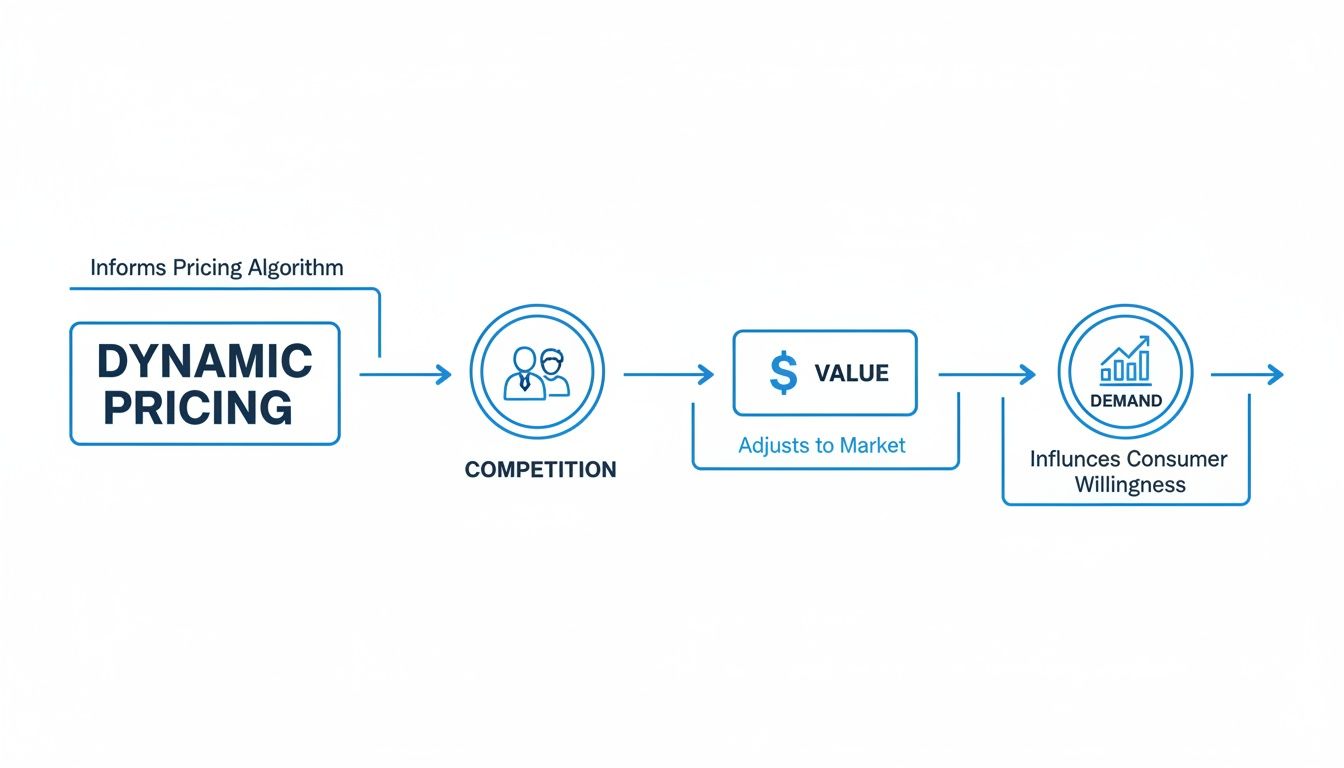
This flow illustrates how market competition, property values, and renter demand combine to set the initial lead price. But as we've seen, that's only where the story begins.
By tightening internal processes, you can significantly boost conversion rates and slash your true CPL. Automating initial responses, offering on-demand showings, and smoothing the tour-to-application pipeline are what turn Zillow's massive lead volume into profitable leases. Understanding your Showing Operations ROI is a huge piece of this puzzle, and you can get a better handle on it by exploring solutions with transparent on-demand showing pricing structures. This shift in focus ensures every dollar you spend on lead gen works as hard as it possibly can to reduce DOM.
Comparing Zillow To Alternative Lead Channels
Putting all your marketing eggs in one basket is a risky move, especially when you're managing a large, multi-market portfolio. While Zillow brings undeniable volume, you must weigh its value against other channels that offer different—and sometimes better—advantages. The goal for any enterprise-level property manager is to build a diversified, resilient lead generation engine that balances cost, quality, and scale.
A smart comparison goes beyond just the cost per lead. You need to analyze the entire lead lifecycle through the lens of key metrics like lead exclusivity, typical conversion rates, and scalability. This is where options like direct Google Ads and other Internet Listing Services (ILS) can play a strategic role.
Evaluating Lead Quality and Exclusivity
One of the biggest challenges with Zillow is lead sharing. When a prospect clicks the "contact" button, their info often gets sent to multiple property managers or agents simultaneously. This kicks off a frantic race to respond first, where the winner takes all and everyone else has wasted time and money. This model inherently suppresses your lead-to-tour conversion rates because you are always competing for the same renter.
Contrast that with leads from a channel like Google Ads, which are typically exclusive. When a renter searches for a home, clicks your ad, and fills out a form on your website, that lead is yours alone. This exclusivity gives your leasing team a massive advantage. They can nurture that lead and build a relationship, without worrying about a competitor swooping in.
For a portfolio managing thousands of units, lead exclusivity is a direct lever for improving cost-per-door efficiency. An exclusive lead means your team's follow-up efforts are invested in a one-on-one conversation, not a competitive sprint, dramatically increasing the odds of conversion.
Cost Per Lead vs. True ROI
At first glance, the cost per lead from Zillow and Google Ads might look similar. But when you dig into the actual return on investment, the story changes.
A Zillow lead might run you $20-$60, but remember, it's often shared. A Google Ads lead could cost between $25-$80, but it's 100% exclusive. That exclusivity frequently leads to 2-4x higher conversion rates and a 2.5x greater ROI, according to industry analysis. This makes exclusive leads a powerful choice for PMs who value quality over a high volume of shared inquiries. You can read a full analysis on lead costs and ROI to get a deeper understanding of these numbers.
This highlights a crucial point: paying slightly more upfront for an exclusive, high-intent lead is often a much smarter financial move than paying less for a shared lead with a low probability of conversion.
Lead Channel Comparison For Enterprise Property Management
To make a truly informed decision, it's helpful to see how these channels stack up side-by-side. The table below offers a comparative analysis based on the performance indicators that matter most for large-scale property management operations.
ChannelAverage Cost Per LeadLead ExclusivityTypical Conversion RateScalabilityZillow/ILS$20 - $60Low (Shared)Low to ModerateHigh (Volume)Google Ads (PPC)$25 - $80High (Exclusive)HighHigh (Budget-Dependent)Social Media Ads$15 - $50High (Exclusive)ModerateHigh (Audience-Dependent)Organic Search (SEO)$0 (Sweat Equity)High (Exclusive)Very HighModerate (Long-Term)
As you can see, the "best" channel depends on your immediate goals. While Zillow offers immense volume for top-of-funnel awareness, channels like Google Ads and SEO provide the high-quality, exclusive leads more likely to become signed leases, ultimately driving a better return on your marketing spend and reducing vacancy loss.
Strategic Channel Diversification
Relying solely on Zillow makes your entire leasing operation vulnerable to their algorithm tweaks, price hikes, and market saturation. A well-rounded strategy for a large portfolio should always include a mix of channels, each playing a specific role.
- Zillow/ILS Platforms: Use these to generate high-volume, top-of-funnel awareness. Go in knowing you need a rapid, automated follow-up system (like the kind powered by Showdigs) to have any chance of beating the competition to the tour.
- Google Ads (PPC): Perfect for capturing high-intent renters actively searching for what you offer. These exclusive leads tend to convert at a much higher rate.
- Social Media Advertising: Great for running targeted campaigns aimed at specific demographics or for retargeting prospects who have already visited your website.
- Organic Search (SEO): This is the long game. By creating valuable content, you attract renters naturally, building your brand's authority and generating "free" leads.
By building a multi-channel lead generation strategy, you create a more stable and predictable leasing pipeline. This approach reduces risk and lets you shift your budget to the channels delivering the highest ROI, ensuring your portfolio keeps vacancy low and your cost per acquisition optimized.
Actionable Strategies to Maximize Your Zillow ROI
You can't control Zillow's pricing model, but you absolutely control what happens after you get a lead. For property managers operating at scale, improving ROI on a significant Zillow spend isn't about finding cheaper leads—it's about converting more of them into signed leases, faster. This is how you directly reduce DOM and vacancy loss.
The entire leasing game is won or lost in the lead-to-lease workflow. Every minute of delay is a potential lease slipping through your fingers. It’s time to move past manual follow-ups and embrace the speed and automation modern renters expect.
Implement Instant Automated Responses
In the race for a renter's attention, the fastest property manager always wins. Zillow's own data shows that conversion rates drop sharply after just a few minutes. When dealing with hundreds or thousands of leads across a distributed portfolio, manual response is a recipe for lost revenue.
An automated response system is no longer a "nice-to-have"; it's a core component of a scalable operation. A winning setup includes:
- Instant SMS Engagement: The second a Zillow inquiry lands, an automated SMS should go out. It should thank them and, most importantly, provide a direct link to schedule a tour themselves.
- AI-Powered Nurturing: Let AI handle simple, repetitive questions about pet policies or amenities. This frees up your leasing team to engage with high-intent renters who are ready to see a property. Many of the best AI tools for real estate agents can automate these communications seamlessly.
- Persistent Follow-Up: If a prospect doesn’t book a tour immediately, the system should automatically follow up over the next 24-48 hours. This keeps your property top-of-mind without any manual effort.
This first touchpoint ensures no lead goes cold simply because your team was busy. It immediately boosts your lead-to-tour conversion rate.
Offer On-Demand and Self-Service Showings
Today's renters expect everything on-demand. Sticking to a rigid "Monday to Friday, 9 to 5" showing schedule creates friction and sends qualified leads straight to your competitors.
Offering flexible, on-demand showings is a game-changer. It allows you to capture serious prospects before other property managers can even return their calls.
Think about it: a unit sitting vacant over a weekend because you couldn't show it on a Saturday is a direct, measurable loss. For a property renting at $2,000/month, that's over $130 in lost revenue. On-demand showings turn every inquiry—day, night, or weekend—into a real leasing opportunity.
By using a flexible showing solution, you can offer tours seven days a week without burning out your team or increasing headcount. This simple operational shift caters directly to renter expectations and dramatically accelerates your leasing cycle.
Mini Case Study: Slashing DOM with On-Demand Showings
A multi-market property management company was managing over 1,500+ SFR units and struggling with an average Days on Market (DOM) of 28 days. They had a steady stream of Zillow leads, but their team couldn't keep up with showing requests, especially on evenings and weekends, leading to significant vacancy loss.
They partnered with Showdigs to completely overhaul their process:
- Integration: Zillow leads flowed directly into their Showdigs dashboard via API.
- Automation: Every lead instantly received an automated text with a link to a calendar showing tour availability 7 days a week.
- Execution: A network of local, licensed agents handled all on-demand showings, ensuring no lead was ever turned away.
The results were stunning. Within 90 days, the company slashed its average DOM from 28 days to just 16—a 43% reduction. Each unit now generated nearly two extra weeks of rent. Their Zillow spend remained the same, but the ROI skyrocketed because they could finally convert leads with maximum efficiency.
If you're looking for more ways to fill your pipeline, check out our guide on generating more property management leads.
Integrating Zillow Leads Into A Scalable Workflow
For a property manager juggling a large portfolio, a lead is only as good as the system in place to handle it. Buying thousands of Zillow leads is a fast way to burn through your budget if your operations can't keep up with the volume. The secret to scale isn't hiring more people to chase inquiries—it's building a smart, automated workflow that converts interest into a scheduled tour without manual intervention.
This is about moving past clunky spreadsheets and scattered inboxes. A modern, remote-first leasing operation needs a solid tech stack that can capture, qualify, and act on a flood of leads in real-time. For any PM managing a distributed portfolio, this is where API integrations are essential.
The Critical Role of API Integration
Manually entering leads from Zillow is a recipe for operational disaster at scale. It creates bottlenecks, invites data entry errors, and lets hot leads slip through the cracks. An API integration acts as a direct digital pipeline, instantly funneling every Zillow lead into your central leasing platform or CRM.
This connection is the bedrock of a scalable, remote-first leasing model. It ensures that:
- No Lead Gets Lost: Every inquiry is captured and tracked, eliminating the risk of leads disappearing into an overflowing email inbox.
- You Act Instantly: Leads are dropped right into your automated workflow the second they arrive, triggering your follow-up sequence immediately.
- Your Data is Clean: Automated entry removes human error, providing a reliable database for accurate reporting and data-driven decisions.
For a property manager overseeing thousands of units spread across different markets, a robust API is the difference between controlled, scalable growth and complete operational chaos. It allows your systems to do the heavy lifting, freeing your team for high-value tasks.
Building An Automated Lead-to-Tour Funnel
Once the API grabs a lead, the real magic begins. The goal is to create a hands-off journey that takes a prospect from "I'm interested" to a scheduled tour without a leasing agent having to pick up the phone. This is how you manage a large portfolio without burning out your team.
A best-in-class automated workflow looks like this:
- Instant SMS Response: The moment a lead comes in, the system sends a personalized text acknowledging their interest and sharing a direct link to your scheduling calendar.
- Self-Service Tour Scheduling: The prospect sees all available tour times—including nights and weekends—and books a showing that works for them, right from their phone.
- Automated Nurturing: If they don't book a tour right away, the system sends a few friendly follow-up reminders to keep your property top-of-mind.
- Post-Tour Feedback: After the showing, an automated message goes out to gather feedback and prompt them to apply, giving your team valuable insights and a clear next step.
This isn't just a process; it's an efficient machine designed to convert thousands of leads while keeping your cost per door as low as possible and minimizing DOM. To see how you can connect your listings for this kind of efficiency, check out our guide on using Zillow listings with Showdigs.
Common Questions We Hear About Zillow Lead Costs
When you're managing a large portfolio, every dollar in your marketing budget must be justified by its impact on revenue. Zillow is a powerful tool, but understanding its pricing and how to get a real return on your investment can be tricky. Here are the straight-up answers to the questions we hear most often from property managers trying to make Zillow work at scale.
How Much Should I Actually Budget For Zillow Leads Each Month?
There’s no magic number here. Your budget should be dictated by your market and your operational capacity. In a hot metro area, you could easily spend $1,500-$3,000+ a month on a single ZIP code just to get noticed. In a quieter suburban market, that number might be closer to $800-$1,500.
Instead of picking a number out of thin air, think in terms of your target cost per lease. Determine what you're willing to pay to acquire a tenant, and work backward to set your Zillow budget. More importantly, ensure your operational workflow can handle the lead volume you're paying for.
Are More Expensive Zillow Leads Better Quality?
Not necessarily. A higher price on a Zillow lead simply reflects higher competition and local rent values. It has no bearing on the renter's intent or qualification.
The real driver of lead quality is your speed-to-response. A pricey lead you engage in under five minutes is infinitely more valuable than a cheap one that goes stale in an inbox. Your follow-up process—not Zillow’s price tag—is what determines a lead's value to your portfolio.
My Zillow ROI Is Terrible. What Gives?
If your return on investment is poor, the problem is almost always a bottleneck in your lead-to-lease process. For large-scale operators, the two biggest ROI killers are slow response times and limited showing availability. Every minute you wait to engage a lead, the probability of conversion plummets.
A low ROI is an operational problem, not a marketing one. The fastest way to boost returns is to implement an automated, on-demand showing system that converts interest into tours instantly, 24/7, thereby slashing your DOM and maximizing revenue.
Stop letting operational drag destroy your Zillow ROI. Showdigs provides the AI-backed automation and on-demand showing network needed to convert leads at scale, slash your Days on Market, and maximize the value of every marketing dollar. Learn how Showdigs turns lead spend into signed leases, faster.
.png)