




Finding the right tenant isn't about luck or a good gut feeling—it's a system. For property management companies managing hundreds or thousands of units, it's a repeatable, legally-sound process that must be followed every single time to minimize vacancy costs and financial risk. The goal is to establish clear, objective standards before you even list a property, ensuring every applicant is measured against the same yardstick. This isn't just good business; it's how you reduce Days on Market (DOM) and maintain portfolio-wide profitability.
Building a Scalable Tenant Screening Framework
When you're managing a dispersed portfolio, you can't afford to play it by ear. Ad-hoc checklists and inconsistent rules don't just create operational chaos; they open you up to serious legal trouble. A scalable tenant screening framework is your operational playbook for moving beyond subjective calls and building a process that protects your assets and ensures every applicant receives a fair, compliant review.
This is about creating non-negotiable standards that your entire team can execute, whether you're managing 100 doors or 10,000. And it all starts before the "For Rent" sign ever goes up.
Defining Your Core Criteria
First, you need to get your ideal tenant profile down on paper. This has nothing to do with discrimination and everything to do with setting objective business standards that directly impact revenue and asset protection. These are the core metrics you must define portfolio-wide:
- Income-to-Rent Ratio: The industry standard is solid here. Require applicants to have a gross monthly income of 2.5x to 3x the monthly rent. This simple calculation is the first line of defense against potential defaults.
- Credit Score Minimums: Pick a number and stick to it. A minimum credit score (e.g., 650 or higher) is a strong indicator of financial responsibility. The key is consistency—this threshold must apply to every single applicant to maintain Fair Housing compliance.
- Rental History Standards: You're looking for positive references from previous landlords. No evictions, no major lease violations. Verifying a history of on-time rent payments is absolutely critical for forecasting a tenant's future performance.
- Criminal Background Policy: This requires careful, legal guidance. Establish clear, written guidelines for how you review criminal histories, ensuring they comply with the Fair Housing Act. The focus should always be on offenses that are directly relevant to the safety of the property and other residents.
This entire process can be boiled down into a simple, three-part flow that scales across any portfolio size.
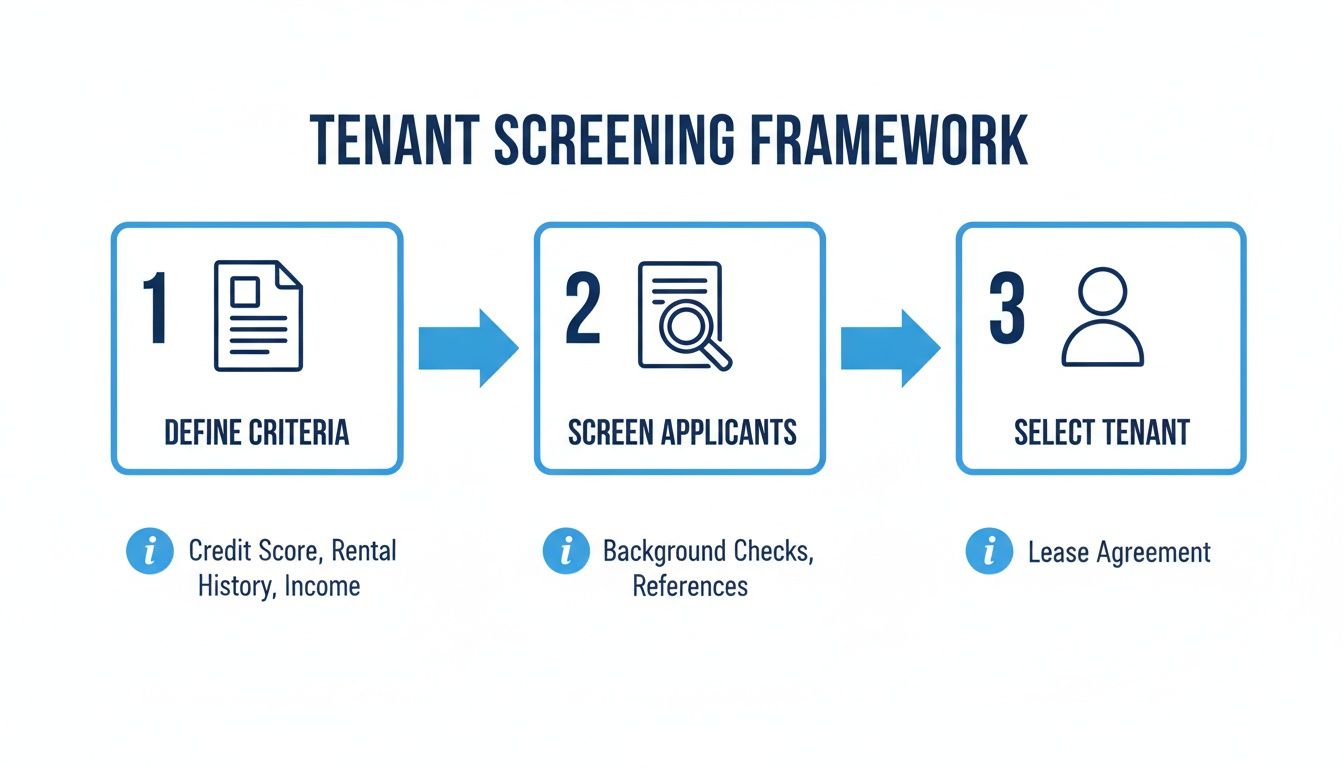
As you can see, a successful outcome is all about laying the groundwork with clear criteria before you even begin screening.
Aligning with Legal and Market Realities
A well-defined framework does more than just weed out unqualified applicants; it’s your best defense against discrimination claims. When you document your criteria and apply them uniformly to everyone, you create a clear, defensible record. It shows your decisions are based on sound business logic, not bias, which is essential for navigating the tangled web of federal, state, and local Fair Housing laws.
The industry is definitely moving in this direction. A 2023 report showed that property managers are leaning heavily on a comprehensive mix of data points: income verification (83.37%), rental history checks (78.06%), criminal background screenings (74.04%), and even applicant interviews (74.13%). This isn't surprising. As managers focus more on securing quality, long-term tenants, a data-driven approach is paramount. You can read the full research about these evolving landlord strategies to see how the landscape is changing.
A documented, consistently applied screening framework is the operational backbone of any large-scale property management company. It transforms screening from a reactive task into a proactive strategy that directly reduces vacancy days, minimizes costly evictions, and safeguards the portfolio's financial health.
Ultimately, it all comes down to creating a predictable, repeatable system. When every team member is working from the same playbook, you guarantee that every applicant is evaluated fairly and efficiently. That's the real key to scaling your operations without sacrificing profitability or compliance.
Once you have a solid, standardized framework in place, it’s time to put it to work. A truly meticulous approach to background and financial checks is what separates a high-risk applicant from a reliable, long-term tenant. This isn't just about pulling a report and glancing at a single score; it's about digging into the data to paint a complete picture of an applicant's financial habits and rental history.
For property managers with large portfolios, this diligence is non-negotiable. It directly impacts your bottom line by preventing costly evictions, minimizing turnover, and protecting your owner's asset. It’s an operational necessity that demands a deep dive into the details.

Go Beyond the Credit Score
A credit score offers a quick snapshot, but the real story is in the full report. I've learned to look for patterns, not just numbers. A single late payment from two years ago? Not a huge deal. But a consistent history of 30- or 60-day delinquencies tells a much different story.
Here are the key financial indicators I always analyze:
- Debt-to-Income (DTI) Ratio: A high DTI, even with a great income, can signal that someone is financially overextended and one emergency away from not being able to pay rent.
- Payment History: Look at their other major obligations. Chronic late payments on car loans or credit cards are a massive red flag for on-time rent.
- Collections Accounts: Multiple accounts in collections, especially from utilities or—even worse—previous landlords, suggest a pattern of unresolved financial responsibilities.
- Public Records: Things like bankruptcies or civil judgments require a closer look. Depending on your local laws, this might warrant a conditional approval with a higher security deposit.
Verify Income and Employment—No Exceptions
Never, ever take pay stubs at face value. In today's world, they're just too easy to fake. Direct verification is the only way to be certain about an applicant's stated income and employment status. When you contact an employer, you're not just confirming a job; you're assessing stability.
When you get an HR rep or manager on the phone, be direct and professional. I always ask a few pointed questions:
- "Can you confirm [Applicant's Name] is currently employed with your company?"
- "What is their official start date and current job title?"
- "Can you verify their gross monthly or annual salary?"
- "Is their position permanent, temporary, or on a contract basis?"
An applicant who provides fake references or falsified documents is an immediate "no." That level of deception is a crystal-clear indicator of future problems. To build more efficient workflows around this, you can learn more about prospect screening for ideal tenants and how to systematize these checks.
Interpret Criminal and Eviction Histories the Right Way
Navigating criminal and eviction records requires a careful, compliant, and consistent approach. Blanket policies—like denying anyone with any kind of criminal record—are a fast track to a fair housing violation. The key is an individualized assessment. You have to consider the nature of the offense, when it occurred, and its direct relevance to the safety of the property and other residents.
Always be aware of local "ban the box" laws, which can restrict when you can even ask about criminal history during the application process.
An eviction record is one of the strongest predictors of future rental problems. A filing, even one that didn't end in a formal removal, is a significant warning sign that the applicant has a history of failing to meet their lease obligations.
To help you stay consistent, here’s a quick reference table for the key areas we've discussed and the red flags to look out for.
Key Verification Areas and Red Flags to Watch For
This table serves as a mental checklist during the screening process, ensuring you cover all your bases before making a final decision.
Don't Skip the Landlord Reference Check
Finally, make the call. Contacting previous landlords provides invaluable context that no report can capture. Don't just ask the simple "Did they pay rent on time?" question. A structured conversation can uncover critical details about what it's really like to have this person as a tenant.
Here’s a simple script I’ve refined over the years:
Sample Landlord Reference Script:
- Intro: "Hi, this is [Your Name] with [Your Company]. I'm calling about [Applicant's Name], who listed you as a previous landlord and applied to rent one of our properties."
- Verification: "Could you confirm the dates they lived at your property at [Previous Address]?"
- Payments: "Did they consistently pay their rent on time? Were there any issues with late payments?"
- Property Care: "How would you describe the condition of the unit when they moved out?"
- Compliance: "Were there ever any lease violations or complaints from neighbors during their tenancy?"
- The Million-Dollar Question: "Based on your experience, would you rent to them again?"
That last question is everything. A hesitant "uhm..." or a flat-out "no" is often the most revealing piece of information you'll get. It’s a crucial piece of the puzzle in your screening process, and one you absolutely can't afford to ignore.
Navigating the Legal Landscape of Tenant Screening
One wrong move during tenant screening can lead to costly lawsuits and reputational damage. For property managers handling large, multi-market portfolios, mastering the complex web of federal, state, and local laws isn't just a good idea—it's essential for scalable, risk-averse operations.
Think of your screening process as your first line of defense against fair housing claims. Every single step, from the wording in a rental ad to the final decision, must be viewed through a compliance lens. The two big federal laws you must master are the Fair Housing Act (FHA) and the Fair Credit Reporting Act (FCRA).

Understanding the Fair Housing Act
The FHA is straightforward: you cannot discriminate against anyone based on seven protected classes. These are race, color, religion, national origin, sex (which includes gender identity and sexual orientation), disability, and familial status.
Here’s the catch: discrimination doesn't have to be intentional to be illegal.
A policy that seems fair on the surface can have a "disparate impact" on one of these groups, and that's enough to get you in hot water. For instance, setting an overly strict occupancy limit might seem like a simple way to prevent wear and tear, but it could unfairly penalize families with children. The golden rule is to make sure every single one of your screening criteria is directly tied to a legitimate business need, like verifying an applicant's ability to pay rent.
The Fair Credit Reporting Act Requirements
The FCRA governs how you handle consumer credit and background information. If you're using a third-party service to run these checks (which is a best practice for consistency and accuracy), you must follow its rules to the letter.
There are three key obligations you can't ignore:
- Permissible Purpose: You need a legal reason to pull someone's report. An applicant’s signed consent on their application form is what gives you this.
- Pre-Adverse Action: If you’re thinking about rejecting an applicant because of something in their report, you must first give them a copy of that report and a summary of their rights.
- Adverse Action Notice: If you officially deny them (or ask for a co-signer or a bigger deposit), you have to send a formal adverse action notice. This letter must name the reporting agency and tell the applicant they have the right to dispute the information.
That two-step notification process is where many property managers trip up. It's a simple, avoidable mistake. It's also vital to keep an eye on new legislation, which you can learn about in this Renters Reform Bill 2025 guide, as changes can directly affect your screening workflow.
The Rise of Automated Screening and AI
Automated screening platforms are ubiquitous, but they're facing increasing regulatory scrutiny. While they promise speed and efficiency—critical for reducing DOM—these tools can also bake in biases if they aren't implemented correctly. An algorithm is only as good as the data it's trained on, and flawed data can lead to unintentional discrimination at scale.
The tenant screening industry has exploded into a billion-dollar business with limited oversight. It's estimated that as many as 90% of U.S. landlords now rely on these tools. This has created a massive backlash over inaccurate reports and biased outcomes. In California, 66% of landlords use automated screeners, but a shocking 3% of renters even know which company was used to deny them.
This lack of transparency has real consequences. It has led to thousands of consumer complaints and hefty fines—just look at TransUnion's $23 million penalty in 2023.
As a property manager, this means you must demand transparency from your screening vendors. You need to know what criteria their algorithms are using and always have a human review the results before making a final decision. An automated recommendation should be just one data point, not the final verdict.
At the end of the day, a legally sound screening process is one that is documented, consistent, and based on objective business needs. Get to know the FHA, follow the FCRA's steps meticulously, and be smart about how you use automated tools. This foundation of compliance is what protects your business and ensures every applicant gets a fair shake.
Automating Your Screening Workflow for Efficiency
In a competitive rental market, every vacant day equals lost revenue. The problem is, manual screening processes are a huge operational bottleneck. They’re slow, clumsy, and prone to human error—all of which creates friction for the high-quality applicants you’re trying to attract. For property managers handling portfolios of 1,000+ units, this isn't just an annoyance; it’s a direct hit to the bottom line, negatively impacting cost-per-door metrics.
Turning that bottleneck into a competitive advantage is all about automation. It’s about creating a system that gets qualified prospects from interested to applied at lightning speed, so you can lock in the best tenants before the competition. This means ditching manual data entry and scattered paperwork for a smart, tech-driven process that focuses on speed-to-lease.
Pre-Screening Leads Before the Tour
One of the biggest time-wasters for any leasing agent is giving tours to people who were never going to qualify in the first place. Every hour spent with someone who doesn’t meet your basic income or credit standards is an hour that could have been spent closing a lease with a qualified applicant.
This is where pre-screening automation is a total game-changer. By building qualification questions right into your tour scheduling process, you can filter out unqualified leads automatically. Tools like Showdigs are built for this, ensuring that only prospects who meet your essential criteria can even book a showing.
When you qualify leads before a tour, you’re not just saving agent time. You’re also massively boosting your lead-to-tour conversion rate. Your team gets to focus only on high-intent prospects, which has a direct, measurable impact on your Days on Market (DOM) and overall portfolio revenue.
This upfront qualification also sets a professional tone from the get-go, showing applicants you respect their time while aligning your team’s efforts with actual revenue-generating activities.
Integrating Systems for Seamless Data Flow
Real operational efficiency happens when your tech stack talks to itself. Manually copying applicant info from your screening software over to your property management system (PMS) is just asking for typos and delays that extend vacancy periods.
Solid integrations are invaluable for large-scale operations. When your online application, screening provider, and PMS—like Appfolio or Rentvine—are all connected via API, the entire workflow becomes seamless. An approved applicant's data can automatically create a new lease agreement and resident profile, cutting out a huge chunk of tedious admin work.
This is what it looks like inside the Showdigs platform, which is designed to manage all these moving parts from one central place.
This kind of centralized hub is crucial for maintaining data integrity and accelerating the leasing process, especially when you're managing a large, distributed portfolio.
And this market is only getting bigger. The tenant screening services market was valued at USD 1.5 billion in 2023 and is expected to jump to USD 2.7 billion by 2031. That growth is being fueled by property managers using technology to lower their risk and keep vacancies down. You can learn more about the booming tenant screening services market and what it means for the industry.
Practical Automation for Faster Decisions
Beyond just connecting systems, a few key automations can slash your decision-making time.
- Automated Communication: Set up templates and triggers to instantly confirm you’ve received an application, ask for any missing documents, or send out status updates. An AI-powered assistant can field those initial questions 24/7, keeping your leads engaged. Check out our guide on the benefits of using an AI leasing assistant like Tori.
- Online Applications: A mobile-friendly online application isn’t optional anymore. It needs to let applicants upload documents, pay fees, and sign things electronically, removing any reason for them to delay.
- Automated Verifications: Use services that offer instant income and employment verification through secure connections to bank and payroll systems. This one step can shave days off your screening time.
Putting these automations in place means less administrative grunt work, faster decisions, and a scalable workflow that can support your portfolio’s growth without needing to hire more and more people.
Making the Final Decision and Onboarding Tenants
Alright, the applications are in, and you’ve done your homework. Now it’s time to make the final call. This isn’t about playing favorites; it’s about sticking to your standardized framework with precision and objectivity. When you're managing a large portfolio, a consistent, documented process is your absolute best defense against fair housing complaints and the secret to placing reliable, long-term residents.
This is where all that groundwork pays off. A solid process transforms what could be a subjective choice into a clear, business-based evaluation that anyone on your team can follow and replicate.

Using a Decision Matrix for Objectivity
To keep bias out of the picture and ensure every applicant is measured against the same yardstick, you need a decision matrix or a tenant scorecard. It's a surprisingly simple tool, but it’s incredibly effective for maintaining consistency, especially when you’re juggling multiple properties.
Your scorecard should assign points based on the core criteria you defined earlier. Think of it like this:
- Income-to-Rent Ratio: You could award points on a sliding scale. Maybe 5 points for 3x the rent, and 3 points for 2.5x.
- Credit Score: Assign points for different tiers. For instance, 5 points for 700+, 3 points for 650-699.
- Rental History: Give top points for glowing landlord references and a clean eviction record.
- Move-in Date: Need to fill a unit fast? Applicants who can move in sooner might get a bonus point, helping you knock down your Days on Market (DOM).
Simple, right? The applicant with the highest score is, by your own predefined standards, the most qualified. This point-based system creates a clear paper trail, proving your decision-making process is both fair and compliant.
Communicating Your Decision Professionally
How you deliver the news—good or bad—says a lot about your company. Professionalism is non-negotiable at this stage.
- Approval: Get an enthusiastic approval email out the door. Immediately outline the next steps: lease signing, how to pay the security deposit, and move-in coordination. You want to move them from applicant to resident smoothly and without any friction.
- Conditional Approval: Sometimes an applicant is almost perfect but just misses one of your criteria. You might offer a conditional approval, which could mean asking for a larger security deposit or a qualified co-signer. Just be crystal clear about the conditions and why you're asking for them.
- Denial: This is the one you have to handle with the most care. If your decision was based on anything in their screening report, you are legally required to send a formal adverse action notice. This notice must include the contact information for the screening company you used. This gives the applicant the chance to get a copy of their report and dispute any errors.
Ensuring a Smooth Onboarding Experience
A great onboarding experience is the first step toward a great tenancy. Once you've approved an applicant, your goal is to make their transition into the property seamless. A clunky, disorganized move-in can sour the relationship before it even starts.
This is where you finalize everything with official paperwork. After the decision is made, it's time for the legal formalities, which includes preparing standard residential lease agreements to make it official.
The final steps in your tenant screening process—lease signing, deposit collection, and key handover—should be as streamlined as the application itself. A smooth move-in sets the expectation for a professional landlord-tenant relationship from day one.
Your onboarding checklist should be the same for every property in your portfolio. Get the lease signed electronically, collect the security deposit and first month's rent, and schedule the move-in inspection. This final, well-executed step solidifies a positive start, which goes a long way toward boosting tenant retention and protecting the owner's asset.
Common Questions About Tenant Screening
Even if you’ve been in the property management game for years, tenant screening can still throw you a curveball. Every applicant is different, and staying efficient, fair, and legally compliant is the name of the game. Let's tackle some of the most common questions that pop up when you're trying to scale your screening process.
Where Do I Even Begin with Screening a Tenant?
Before a single application hits your inbox—before you even post the listing—your very first move is to nail down and document your screening criteria. Seriously. This single step is the bedrock of a fair, consistent, and legally sound process.
Think of it as your rulebook. It should spell out exactly what you’re looking for in every applicant:
- Income Requirements: Most PMs stick with a gross monthly income of 2.5x to 3x the rent.
- Credit Score Thresholds: What’s the minimum score you’re willing to accept? Put it in writing.
- Rental History Standards: Define what a "good" rental history means to you. No prior evictions is a common one.
- Criminal Background Policy: Your guidelines here need to align with HUD recommendations and local laws, focusing only on relevant offenses.
By setting these standards upfront, you ensure every applicant is judged by the same yardstick. This is your single best defense against any potential Fair Housing complaints.
How Do You Handle Applicants with No Credit History?
It happens all the time. You get a great applicant—a recent grad, a student, or someone new to the country—and they have zero credit history. Don’t panic. A thin credit file doesn't automatically signal a risky tenant; it just means you need to look at other signs of financial stability.
Instead of a FICO score, you'll have to pivot. Ask for different proof, like an official employment offer letter or recent bank statements showing they have enough cash on hand. Requiring a co-signer or a guarantor who does meet your financial criteria is another solid option. Even an informal rental history can give you a bit of insight.
When you're dealing with a thin credit file, just focus on what you can verify: solid income, stable employment, and good references. Approving them on the condition of adding a co-signer is often a safe, compliant way to move forward.
Can I Deny Someone Based on Their Criminal Record?
This is where things get tricky, and you need to tread carefully. Blanket policies that automatically reject anyone with a criminal record are a huge red flag for HUD and can easily land you in legal hot water. The best practice is to perform an individualized assessment for every applicant.
This assessment means looking at the bigger picture:
- What was the crime? Was it a minor offense, or is it something that could genuinely put other residents or your property at risk?
- How long ago was it? An issue from ten years ago is very different from one that happened last year.
- Is it even relevant? A conviction for financial fraud is a lot more relevant to a tenancy than a minor traffic violation.
And always, always be aware of local "ban the box" laws, which control when you can even ask about criminal history in the first place. For a deeper dive into common landlord questions, check out our guide on the top FAQs asked by landlords.
What Is a Tenant Screening At-a-Glance Checklist?
When you’re juggling a large portfolio, it's easy for small but crucial steps to get missed. A standardized checklist is your secret weapon. It keeps your team consistent and creates a paper trail showing that every single applicant went through the exact same fair process.
Here’s a simple checklist you can adapt for your team.
Tenant Screening At-a-Glance Checklist
This quick-reference checklist helps property managers ensure every critical screening step is completed, maintaining consistency and compliance for every single applicant.
Think of this checklist as a daily tool to reinforce a solid, defensible workflow for every application that comes your way.
To truly minimize vacancy and boost revenue, you need to optimize every part of the leasing funnel—from the moment a lead inquires to the final background check. Showdigs uses an AI-backed leasing automation platform to pre-screen leads, schedule tours with the best prospects, and plug right into your existing systems to get leases signed faster.
Discover how Showdigs can automate your leasing operations today.