



For property managers running a large-scale operation, thinking about costs as just a simple percentage of rent is a rookie mistake. The real key to profitability—especially when your portfolio climbs into the hundreds or thousands of units—is mastering your total cost per door.
This is the single most critical metric for growth. For KPI-driven operations teams, optimizing cost per door is directly linked to reducing Days on Market (DOM) and maximizing revenue per unit.
The True Cost of Managing Rental Portfolios at Scale
When you’re managing properties spread across different locations, just looking at a list of fees doesn't cut it. You have to start thinking of your operation like a sophisticated supply chain. Every single cost—from management fees and maintenance to the hidden price tag of a vacant unit—is a component that directly shapes your final product: a profitable, occupied rental.
This shift in mindset is what separates the companies that scale successfully from those that stagnate. It changes the conversation from, "How much is the management fee?" to "What's our all-in cost to operate each door, and how can we drive that number down while accelerating our speed-to-lease?" The first step to getting there is having a solid grasp on the fundamentals of property management.
Direct Costs: The Tip of the Iceberg
Direct costs are the obvious expenses on your balance sheet. But their impact isn't so simple; it multiplies exponentially across a large portfolio.
Take the standard property management fee. It typically falls between 8-12% of the monthly rent for a single-family home. On a $2,000-a-month property, that’s up to $240 right off the top. Now, imagine you have 1,000 units. That one line item suddenly balloons to $240,000 a month.
Tack on tenant placement fees, which often run anywhere from 50-100% of one month's rent, and you can see how fast these costs compound with every single turnover, directly impacting your unit economics.
Indirect Costs: The Hidden Margin Killers
For enterprise-level operators, indirect costs are where the real profit is either made or lost. These expenses are sneakier and harder to track, but they erode your bottom line by breeding operational inefficiency.
Here's where to look for these margin killers:
- Vacancy Costs: This isn't just about lost rent. It’s the money you’re burning on marketing, the utilities for an empty unit, and the administrative hours wasted on leads that go nowhere. Every day a unit sits empty, you're hemorrhaging revenue. According to the National Apartment Association, the average cost of a single turnover is nearly $1,800, a figure that skyrockets with extended vacancy.
- Inefficiency Costs: Think about the time your team spends on manual work—scheduling showings, chasing down leads, and playing phone tag with agents. That's a huge hidden expense that slows your entire leasing funnel to a crawl and tanks your lead-to-tour conversion rate.
- Turnover Costs: Getting a unit ready for the next tenant involves cleaning, repairs, and marketing. Without a tight, standardized process, these costs can spiral out of control and eat up your profits fast, further inflating your cost per door.
For a clearer picture, let's break down the major expenses you need to be tracking. These are the levers you can pull to directly influence your cost per door and overall profitability.
Your Portfolio's Key Cost Centers at a Glance
Ultimately, a deep understanding of both direct and indirect expenses is non-negotiable. It's the only way to accurately calculate your true cost per door and build a management operation that's not just big, but also incredibly profitable.
Decoding Property Management Fee Structures

When you're scaling a property portfolio, not all management fees are created equal. The way your costs are structured can either fuel your growth or silently drain your profits, especially when you’re talking about hundreds or thousands of doors.
Getting a grip on the two main models—percentage-based vs. flat-fee—is the first step to protecting your bottom line. Each one tells a very different story about predictability and where your manager's priorities really lie.
The most common setup is the percentage-based fee, which usually runs between 8% and 12% of the monthly rent collected. It seems simple enough, but at scale, this model can create a subtle misalignment. The incentive can shift toward just getting higher rents instead of focusing on peak operational efficiency and DOM reduction. Plus, your costs swing with rental income, making it a nightmare to forecast a precise budget for a large portfolio.
On the flip side, a flat-fee model brings predictability to the table. You pay a set price per unit, every single month, no matter what the rent is. This clarity makes financial planning a breeze and, more importantly, aligns everyone's goals toward the things that actually drive growth: keeping vacancies low and operational costs in check.
The Percentage Fee Illusion at Scale
For a growing portfolio, a low percentage fee can feel like a Trojan horse. That 8% might look fantastic on a proposal, but it can quickly become more expensive than a higher flat fee once all the extra charges get tacked on.
Key Insight: The real cost of a management contract isn't in that big, bold percentage. It's buried in the fine print. Add-on fees for leasing, renewals, and maintenance can easily double your effective management rate, especially if your properties are spread out.
Let's pull back the curtain on the common add-on fees that bloat your total property management costs.
Uncovering Hidden Ancillary Fees
Ancillary fees are where a seemingly good deal can fall apart. For operators with remote or multi-market portfolios, these little charges add up fast and just chip away at your margins. You have to keep a sharp eye out for them.
- Leasing Fees: This is the big one, often called a "tenant placement fee." It's a one-time charge for finding a new tenant and usually costs 50% to 100% of the first month's rent. During a high-turnover year, this fee alone can be a massive financial hit.
- Lease Renewal Fees: Some companies charge you—often a few hundred dollars—just for signing a renewal with a tenant who is already there. This is a head-scratcher, as it can actually disincentivize your manager from working to retain good, long-term tenants. Turnover suddenly looks more profitable for them.
- Maintenance Markups: It's standard practice for management companies to add a surcharge of 10% to 20% on top of what a vendor charges for repairs. Across a big portfolio, this markup becomes a significant and often hard-to-track operational expense.
- Eviction Fees: If an eviction is necessary, you’ll likely see a flat fee plus all the legal costs. It's a necessary evil, but it's another expense layered onto an already painful process.
Scenario Analysis: 1,000 Units
Let's run the numbers to see how this plays out in the real world. Imagine a 1,000-unit portfolio with an average monthly rent of $2,000 and an annual turnover of 30% (meaning 300 new leases a year).
Model A: Percentage-Based (8% Fee)
- Monthly Management Fee: $160,000 (8% of $2M)
- Annual Leasing Fees: $300,000 (300 units x $1,000 average placement fee)
- Total Annual Cost (Simplified): $2,220,000
Model B: Flat-Fee ($150/door)
- Monthly Management Fee: $150,000
- Total Annual Cost: $1,800,000
Even in this basic comparison, the straightforward flat-fee structure saves this portfolio over $400,000 a year. And that’s before we even factor in maintenance markups or other hidden fees. This is exactly why a deep dive into all potential property management costs is non-negotiable for achieving real profitability and efficiency at scale.
Controlling Your Operational Expenses
Management fees get all the attention, but it's the operational expenses—the silent killers of your portfolio's profitability—that can truly make or break your business. These are the relentless, day-to-day costs that chip away at your margins. For anyone managing hundreds or thousands of units, getting a handle on these expenses is just as critical as negotiating the perfect management contract.
Let's be real: rising operational costs are a massive headache for everyone in the industry. An overwhelming 93% of property management companies are feeling the squeeze from higher costs for vendors, materials, property taxes, and insurance. When you consider that maintenance and repairs alone can eat up 10-15% of your gross rental income, it’s painfully obvious that just reacting to problems as they pop up isn't going to cut it anymore. You can dive deeper into these property management industry trends on Buildium.com.
This is where you have to shift your mindset. Forget traditional, reactive management. It's time to get proactive and use technology to get ahead of problems before they become five-figure emergencies.
Implement Proactive Maintenance Schedules
A solid preventative maintenance program is your best defense against those dreaded middle-of-the-night emergency calls that end with a massive bill. Instead of waiting for an HVAC unit to die during a July heatwave, a proactive schedule keeps it tuned up, extending its life and keeping your residents happy.
For a large portfolio, this means creating standardized checklists and schedules that your team can apply to every single property. It's not just about saving money; it’s about creating a better, more stable living experience for your residents, which means fewer turnovers.
Your preventative maintenance playbook should absolutely include:
- HVAC Systems: Biannual inspections and simple filter changes can prevent most major breakdowns.
- Plumbing: Routinely checking for small leaks is a lot cheaper than dealing with catastrophic water damage.
- Roofing and Gutters: A seasonal once-over can stop rot and structural problems in their tracks.
- Appliance Servicing: Regular checks on washers, dryers, and refrigerators keep them running longer.
Leverage Scale for Vendor Negotiations
One of the biggest perks of managing a large portfolio is your buying power. Stop hiring vendors on a job-by-job basis. It’s time to start negotiating bulk contracts for all your recurring services. By guaranteeing a steady volume of work, you can lock in much better rates for things like landscaping, pest control, and cleaning.
To do this right, you need to know your numbers inside and out. For example, understanding the typical painting costs per square foot gives you a solid baseline for budgeting unit turnovers. Walking into a negotiation with that kind of data puts you in a position of strength.
Case Study in Action: A multi-market operator with 2,500 units started managing all their vendors through a single software platform. After analyzing their spending, they identified their top five service categories and negotiated portfolio-wide contracts. The result? An immediate 15% cut in their annual repair costs.
Use Technology to Monitor and Reduce Costs
Technology isn't just a nice-to-have anymore; it's an essential tool for reining in operational expenses. Smart home devices, once seen as a gimmick, are now a core part of cost control for large-scale operators.
Smart thermostats can automatically adjust the temperature in vacant units, saving a fortune on utility bills. Water sensors can send an alert the second a leak is detected, preventing a small drip from becoming a full-blown flood. And with centralized utility management software, you can spot unusual spikes in consumption across your entire portfolio, flagging a potential problem before it gets out of hand.
By bringing these technologies into your operations, you stop guessing and start making data-driven decisions. You gain the power to monitor, measure, and manage your expenses with precision. This isn't just about plugging leaks in your budget; it's about turning a major liability into a competitive advantage and protecting your profitability for the long haul.
Calculating the Real Cost of Vacancy and Inefficiency
For any large-scale property operator, Days on Market (DOM) isn't just another metric—it's a direct measure of lost revenue. Every single day a unit sits empty, it actively drains cash from your portfolio.
Thinking of vacancy as just "lost rent" misses the bigger picture entirely. It's a compounding problem that includes marketing spend, turnover costs, and administrative overhead. A vacant unit is like a factory machine left running overnight: it’s not producing anything, yet it's continuously draining power and resources.
To really get a handle on your expenses, you need to reframe vacancy as an active financial leak. That's the first step toward building an aggressive, automated solution to fix it.
The True Financial Drain of a Vacant Unit
To grasp the full impact, you have to calculate the total vacancy cost per day. This figure is your single most powerful motivator for optimizing your leasing process. It’s a simple formula that uncovers the hidden expenses eating away at your net operating income.
The calculation breaks down into a few key parts:
- Daily Lost Rent: This one’s the most obvious. Just take the monthly rent and divide it by the number of days in the month. For a property renting at $2,100 per month, that’s $70 per day straight out of your pocket.
- Daily Holding Costs: Empty units still cost money. These are the fixed expenses you’re paying no matter what, including utilities (electricity, water, gas), property taxes, insurance, and HOA fees.
- Marketing Expenses: Every day a unit is vacant, you're likely paying to keep it listed on various platforms. These daily advertising costs add up fast, especially across a large portfolio.
When you add it all up, the true cost becomes alarmingly clear. A single unit might be costing you well over $100 per day while it sits empty—a number that becomes staggering when you multiply it across dozens or hundreds of vacant properties.
This infographic gives you a visual breakdown of the main operational expenses that contribute to your overall holding costs.
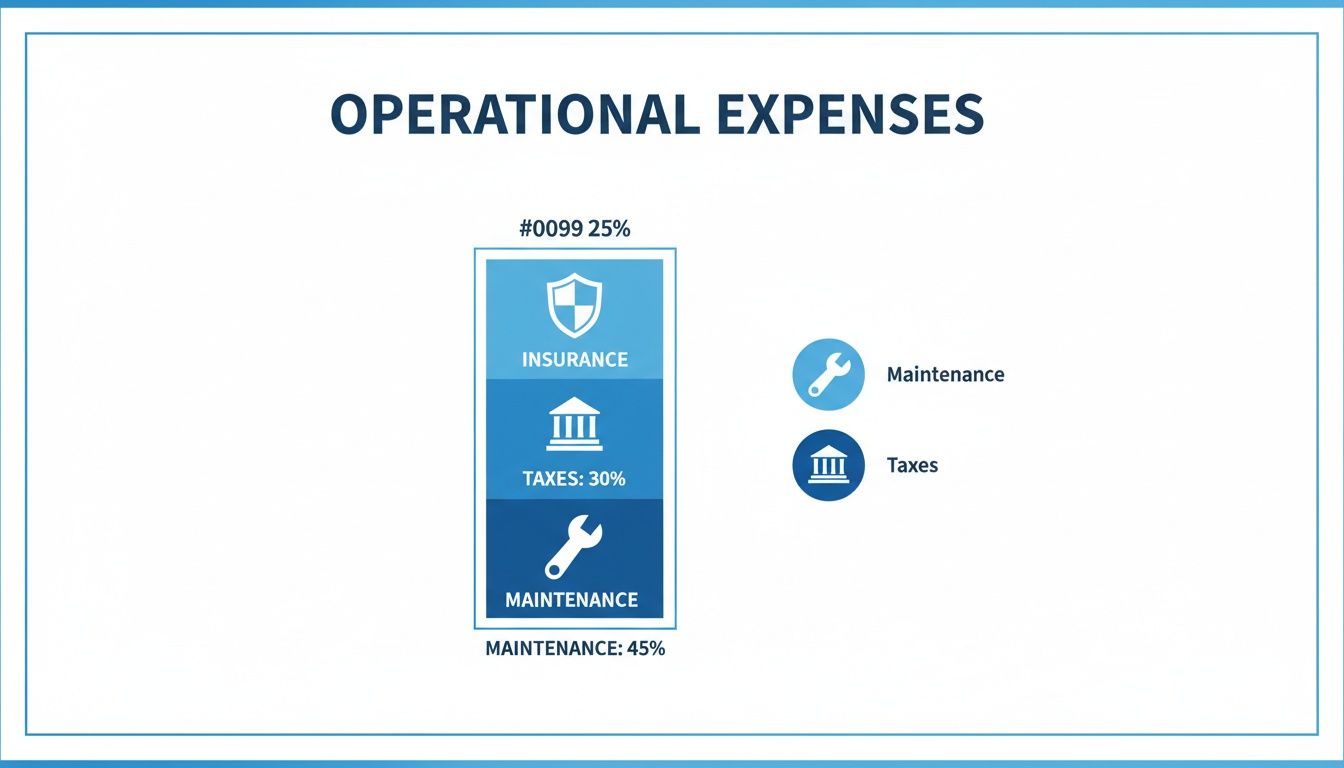
As you can see, things like maintenance, taxes, and insurance are significant, non-negotiable expenses you pay whether a unit is occupied or not. They are a direct and painful part of the daily cost of vacancy.
Connecting High Vacancy Costs to Leasing Inefficiency
High vacancy costs are almost always a direct symptom of a leaky leasing funnel. In a competitive rental market, speed is everything. Slow lead responses and clunky, manual scheduling are the top culprits that kill your speed-to-lease and drive your DOM through the roof.
The Critical Link: The longer it takes to get a qualified prospect from their initial inquiry to an in-person tour, the higher the chance they’ll sign a lease somewhere else. Every hour of delay directly increases your vacancy cost and lowers your lead-to-tour conversion rate.
This is where the administrative burden becomes a massive financial liability. If your team is stuck playing phone tag just to schedule one showing, that’s a direct hit to your bottom line. These delays don't just frustrate potential tenants; they actively push them toward your competitors who offer instant, on-demand viewing options.
For a deeper look into how this works, you can explore the connection between showing availability and vacancy rate in our detailed guide.
Modeling the Financial Impact Across a Portfolio
Understanding the daily vacancy cost is powerful, but seeing it at scale is what really drives the point home. Let's model this out.
The table below shows how quickly the costs stack up for just 100 vacant units. Even a few days on the market translates into tens of thousands in lost revenue and hard costs.
Vacancy Cost Impact Analysis Per 100 Units
As you can see, the financial drain is exponential. Now, let's flip it and look at the savings.
Consider a 1,000-unit portfolio with a conservative total vacancy cost of $90 per unit per day. If you can reduce your average DOM by just five days across your annual turnovers (assuming a 30% turnover rate, or 300 units), the savings are massive.
- Calculation: 300 units x 5 days x $90/day = $135,000 in recovered revenue.
This isn't just trimming expenses; it's a direct injection of cash back into your business. By focusing on DOM reduction and optimizing your lead-to-tour process, you turn an operational weakness into a powerful financial advantage. It proves that efficient leasing is one of the most effective ways to control your total property management costs.
How Technology Reduces Total Management Costs
Every property manager feels the squeeze between high operational costs and tight profit margins. When you're managing a large portfolio, old-school, manual-heavy processes just don't cut it anymore. They’re the primary source of the bloat that inflates your total property management costs. The answer isn't working harder; it's adopting smart technology that delivers a real, measurable return by attacking your biggest expenses.
Stop thinking of leasing automation as another line item on your budget. Instead, see it for what it is: your most powerful cost-cutting tool. When you automate repetitive, low-value work—like answering the first wave of lead emails, scheduling tours, or pre-qualifying applicants—you instantly slash administrative overhead. Your skilled leasing agents are freed from the grind of data entry, allowing them to focus on what truly matters: closing qualified tenants and strengthening owner relationships.
Shifting from Fixed to Flexible Labor Costs
One of the biggest financial drains, especially for scattered-site portfolios, is the fixed cost of leasing staff. You’re paying salaries and benefits whether you have five vacancies to fill or fifty. It’s an inefficient model that simply doesn't scale well, particularly across different geographic markets.
This is where an on-demand showing network completely flips the script. It transforms a rigid, fixed labor cost into a flexible, pay-as-you-go expense. You only pay for showings when you actually need them, perfectly aligning your expenses with leasing activity. For managers with distributed portfolios, this is a total game-changer, letting you service properties over a huge area without having to hire full-time staff in every single neighborhood.
The ROI of Agility: The ability to convert a fixed salary into a variable, per-showing cost provides immediate financial relief and operational flexibility. This model allows you to scale your showing capacity up or down instantly based on seasonal demand, preventing overstaffing during slow months and ensuring you never miss a lead during peak leasing season.
This shift is more critical than ever as the industry expands and margins get thinner. The global property management market is expected to grow substantially, from $23.03 billion to $38.48 billion by 2034. But with operational costs also on the rise, you can't just keep passing those expenses on to tenants. This financial pressure highlights the incredible value of tech-driven solutions that directly attack vacancy and administrative waste. You can dig into more of these property management market trends on marketresearch.com.
Calculating the ROI of Leasing Automation
A smart investment in technology pays for itself, and fast. The most direct impact comes from dramatically reducing your Days on Market (DOM). Every single day you shave off a vacancy is pure profit straight back to your bottom line. An AI leasing assistant, for example, can respond to a new lead in seconds, 24/7, making sure no prospect is left waiting. You can learn more about the benefits of using an AI leasing assistant and see just how this tech crushes response times.
Let's break down the ROI with a clear, real-world calculation.
Scenario:
- Portfolio Size: 2,000 units
- Annual Turnover Rate: 30% (600 units per year)
- Average Rent: $2,000/month
- Total Vacancy Cost Per Day: $90 (factoring in lost rent, utilities, marketing, etc.)
Before automation, let's assume your average DOM is 25 days. By using technology to offer instant lead responses and same-day showings, you manage to bring that average down to 18 days—a full seven-day improvement.
The Financial Impact:
- Days Saved Per Turnover: 7 days
- Cost Savings Per Turnover: 7 days x $90 = $630
- Total Annual Savings: 600 turnovers x $630 = $378,000
That's a six-figure saving from optimizing just one key metric. And that's not even counting the added efficiency gains, like your team being able to manage more units without needing to hire more people. The financial argument for technology is impossible to ignore. It’s the most direct path to reducing your total property management costs and building a more profitable, scalable business.
From Insight to Action: A 3-Step Framework for Lowering Costs
Knowing your numbers is one thing, but putting that knowledge to work is where you really start to see the difference in your bottom line. For property managers overseeing a large portfolio, it's time to move from simply analyzing costs to actively cutting them.
This isn't about high-level theory. It's a straightforward, step-by-step game plan designed for busy operations leaders who want to methodically chip away at their total property management costs and give their net operating income a serious boost.
Phase 1: Go on a Financial Deep Dive
Your first move is to find every single financial leak, no matter how tiny. A proper cost audit goes way beyond a quick glance at your P&L statement. It’s about getting granular with every line item that adds up to your cost-per-door.
- Map out every expense. This includes everything from the obvious management fees and maintenance markups to the hidden hourly cost of your team members handling manual, repetitive tasks.
- Shine a light on hidden vacancy costs. Think about what a vacant unit really costs you. It’s not just lost rent; it's the marketing dollars spent, the utility bills you're paying, and the time wasted on a slow turnover process.
- Calculate your true cost to sign a lease. Add up leasing agent commissions, marketing spend, and screening fees to figure out what it actually costs you to get a new tenant in the door.
Phase 2: See How You Stack Up
Once you have a crystal-clear picture of your own spending, it’s time to see how you measure up against the rest of the industry. Benchmarking is what shows you where you’re falling behind and, more importantly, where your biggest opportunities are hiding.
The goal here is to stop being a scorekeeper and start being a coach. An efficient portfolio is built on purpose, through constant, data-driven tweaks to your game plan.
Get laser-focused on these key metrics:
- Cost-Per-Door: When you add it all up, how does your operational cost per unit compare to portfolios of a similar size in your market?
- Days on Market (DOM): Are you leasing properties faster or slower than your competition? Every day a unit sits empty is money walking out the door.
- Lead-to-Tour Conversion Rate: Of all the leads coming in, what percentage are actually getting inside to see your properties? This number is a direct reflection of how efficient your leasing process is.
Phase 3: Audit Your Tech and Run a Pilot
Finally, take a hard look at the technology you’re using. Where are manual processes creating bottlenecks and driving up your labor costs?
Once you spot a weak link—maybe it’s slow lead response times or a clunky tour scheduling system—don't jump into a massive, portfolio-wide change. Instead, run a small pilot program. Test a new solution on a handful of properties to measure the ROI and build a solid case for a bigger rollout. This ensures any new tool can truly scale your team on-demand without breaking the bank.
Still Have Questions About Property Management Costs?
We’ve dug into the big-picture cost drivers for large portfolios, but a few questions pop up time and time again when we talk about running an efficient operation at scale. Let’s get you some straight answers.
How Can I Accurately Calculate My Cost Per Door?
Getting your true cost per door means looking past just the management fee. You need to add up everything it takes to run your properties over a certain period. Think management fees, maintenance, marketing spend, turnover costs, admin salaries, and even your software subscriptions.
Once you have that total, just divide it by the number of units you manage. This gives you a crystal-clear metric you can actually use—to see how you stack up against the market and track whether your team is getting more efficient.
Is a Flat Fee or Percentage Fee Better for a Large Portfolio?
For portfolios with hundreds or thousands of doors, a flat-fee structure is almost always the smarter move. Why? It gives you predictability. Percentage-based fees are tied to rent values, which means your expenses can swing wildly and make it a nightmare to forecast your budget.
A flat fee keeps things simple. It also gets your management partner focused on what really matters: operational wins like cutting down vacancy, not just hiking up the rent. As you grow, that kind of stability with your property management costs is non-negotiable.
What Is the Fastest Way to Reduce Vacancy Costs?
If you want to stop bleeding money from empty units, the single best thing you can do is shrink your Days on Market (DOM). Every single day a unit sits empty is a direct hit to your revenue. The key is to get hyper-focused on your lead-to-tour conversion rate.
You need technology that can respond to leads the second they come in and get them scheduled for same-day showings. When you automate the top of your leasing funnel, you’re engaging qualified renters before your competition even has a chance. That speed is the most powerful lever you have for slashing vacancy costs.
Ready to slash your Days on Market and transform your leasing operations? Showdigs provides the first AI-backed leasing automation platform with an on-demand network of showing agents, built to cut your property management costs at scale. Schedule your personalized demo today.
.png)

.png)