



For property managers juggling portfolios of 100 to 10,000+ units, a generic, one-size-fits-all toolkit is a serious liability. The modern solution is to build a PropTech Stack—a hand-picked ecosystem of specialized tools designed to work together for maximum scalability and profit. It’s time to move beyond the all-in-one myth and focus on what really moves the needle: reducing Days on Market (DOM) and maximizing your lead-to-tour conversion rate.
Building Your High-Performance PropTech Stack

Managing scattered-site portfolios effectively takes more than a single piece of software. It demands a curated collection of best-in-class tools, each chosen to perfect a specific part of your operation. Think of it like building a high-performance engine for your business—every single component is selected to maximize speed, power, and efficiency across thousands of doors.
The goal isn't just to add more tech. It’s about connecting every tool to a tangible business result. A well-designed stack directly impacts your most critical metrics:
- Days on Market (DOM): Every day a unit sits empty is lost revenue. Your stack must be engineered to accelerate every step of the leasing funnel, from initial lead to signed lease.
- Lead-to-Tour Conversion: Getting a lead is just the start. The right tools ensure that initial interest converts into a scheduled tour before a qualified prospect moves on.
- Cost-Per-Door: Real efficiency gains from smart automation and optimized workflows directly lower your operational overhead for every single unit you manage.
The Financial Imperative for Specialization
A generic, all-in-one platform almost always has a weak spot, and it's usually the leasing process. That bottleneck between finding a qualified lead and getting a signed lease can cost a 1,000-unit portfolio tens of thousands in lost rent every single month. By choosing specialized tools that excel at specific jobs—like leasing automation or maintenance coordination—you create a system that will always outperform a single, do-it-all solution.
This strategic shift is backed by explosive market growth. The property management software market is on track to hit USD 54.16 billion by 2032, growing at a blistering 9.9% CAGR. North America is leading the charge with a 36.6% market share, driven by managers who are hunting for efficiency. For portfolios heavy with single-family rentals, the right digital platforms can slash vacancy periods by up to 50% in competitive markets.
Architecting for Scalability
Building your stack isn’t about collecting software; it's about seamless integration. Each tool has to talk to your core Property Management System (PMS) without a hitch. This creates a unified flow of data that gets rid of manual entry and prevents costly mistakes.
This integrated approach is the only way to standardize your processes across different markets and achieve true operational scale. You can review our guide to the best property management software to see exactly how these powerful integrations work in the real world.
To make this clearer, let's break down the essential tool categories that form a complete and scalable PropTech stack.
Key PropTech Stack Categories for Scalable Operations
Each of these categories represents a critical part of the property lifecycle. By selecting a best-in-class tool for each function and ensuring they integrate seamlessly, you create an operational machine that is far greater than the sum of its parts.
Your Operational Core System: The Foundation for Growth
At the heart of any large-scale property management operation, there’s a powerful core system—the central nervous system for your entire portfolio. For anyone managing hundreds or even thousands of scattered-site properties, this backbone is almost always a robust Property Management System (PMS). Platforms like Appfolio or Rentvine aren't just pieces of software; they are the single source of truth for your entire business.
This is where all your mission-critical functions live. We're talking about portfolio-wide accounting, detailed financial reporting for dozens of different owners, and centralized owner portals. These are the features that give you the high-level visibility you need to make smart, strategic decisions. Trying to track financial performance at scale without a solid PMS is a recipe for a chaotic, error-prone nightmare.
The PMS as a Central Hub, Not an Island
But here’s the thing: the real power of a modern PMS isn’t just what it does on its own, but how it connects to everything else. Think of your PMS as an airport control tower. Its job is to safely coordinate all the incoming and outgoing data from your other specialized tools, preventing collisions and costly delays. A PMS that can’t integrate with other best-in-class software is a liability that will absolutely cap your growth.
This is where Application Programming Interfaces (APIs) become non-negotiable. A strong API allows specialized property management tools for landlords—like leasing automation platforms or maintenance management systems—to plug directly into your core system. That seamless connection is what stops data silos from crippling your efficiency.
For enterprise-level property management, a PMS without an open API is like an engine without a transmission. It might have plenty of power, but it can't effectively get that power to the wheels of your operation, slowing down every critical process from leasing to maintenance.
Why Integration Isn't Just a "Nice-to-Have"
Without a solid integration, your team gets stuck doing manual double-entry. A lead captured in your showing software has to be manually typed into the PMS. A work order from a resident portal has to be re-created in your vendor management tool. Every single one of those manual steps invites human error, creates frustrating delays, and jacks up your cost per door.
Just look at the leasing process. When your leasing automation tool syncs perfectly with your PMS:
- Unit availability is always accurate. The moment a notice to vacate is logged in the PMS, your leasing tool can kick off pre-marketing for the unit.
- Lead data flows automatically. All the prospect information from a tour request instantly appears in your central database. No copy-pasting needed.
- Lease generation is a breeze. Once a prospect is approved, the data flows right from your leasing platform into the PMS to auto-populate the lease agreement.
You simply can't achieve this level of automation without a tightly integrated system. It standardizes your workflows across the board, ensuring every property is managed with the same efficiency, whether you have 200 units or 2,000.
Evaluating Core Systems for Serious Scale
When you’re choosing a PMS to be the core of your operation, make its integration capabilities a top priority. Ask potential vendors for their API documentation and a list of their current integration partners. The best property management tools for landlords are the ones that play well with others, letting you build a flexible, powerful tech stack that grows with you.
Getting this foundation right prevents the operational bottlenecks that stop scaling companies dead in their tracks. It ensures your technology is pushing you forward—not holding you back—on your path to managing 10,000+ units.
Automating Your Leasing Funnel To Reduce Vacancy
Every single day a unit sits empty, it's a direct, measurable hit to your bottom line. When you're managing a large portfolio, this isn't some minor inconvenience; it's a massive revenue leak. The best property management tools for landlords are the ones that flip your leasing funnel from a liability into a high-speed, revenue-generating machine. Once your core PMS is locked in, the very next step is to plug in specialized automation that aggressively cuts down your Days on Market (DOM).
The biggest bottleneck in leasing isn't a lack of leads—it's the painful lag time between a prospect's initial interest and the moment they actually step inside the property for a tour. The old way of doing things, with endless back-and-forth emails and phone tag just to coordinate schedules across hundreds of units, is slow, expensive, and an absolute killer for conversion rates.
From Manual Delays To Automated Speed
Think about the simple math here. If it takes your team 48 hours just to schedule a viewing, that high-intent lead has probably already toured three other places. In a competitive market, you’ve almost certainly lost them. This is exactly what leasing automation tools fix. They collapse that timeline from days down to mere minutes by empowering prospects with self-service scheduling and on-demand tour options, capturing their interest when it’s at its peak.
This need for speed is becoming critical as the global property management market, valued at USD 26.55 billion, races towards an expected USD 52.21 billion by 2032. For large portfolio owners, AI-driven tools can slash administrative burdens by 50%, automating everything from tour logistics to lead nurturing. This not only shrinks the time-to-lease by up to 30% but also leads to 25% better tenant quality—a huge deal as urban single-family demand continues to climb.
The real ROI of leasing automation isn't just about saving your team time. It’s about calculating the direct revenue impact of leasing a unit 10 days faster. For a 1,000-unit portfolio with a 5% vacancy rate and an average rent of $2,000, reducing DOM by just one day across those vacant units adds over $1,600 in revenue daily.
This chart shows how specialized tools are meant to work with your core PMS to drive real efficiency.
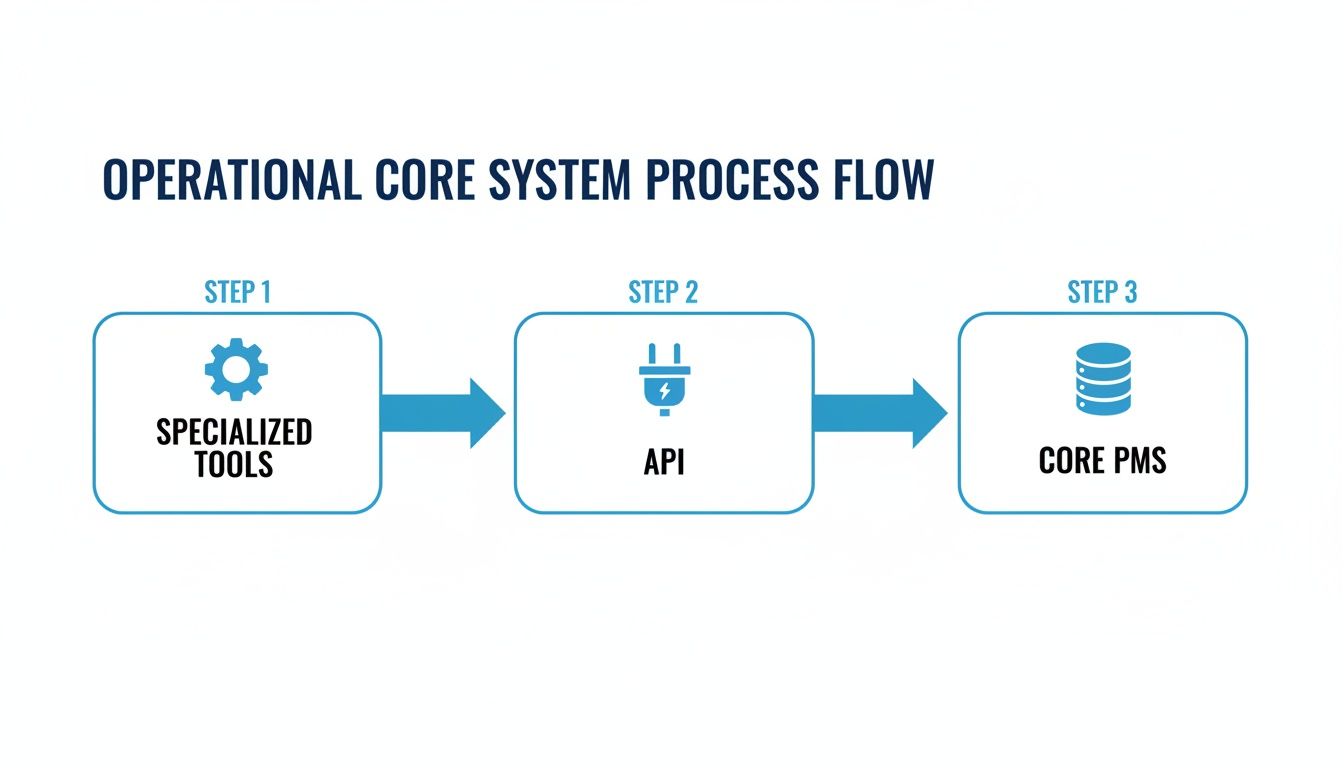
The key takeaway? An open API lets you plug best-in-class tools directly into your central system, which automates workflows and finally puts an end to mind-numbing manual data entry.
Calculating The Financial Impact Of Speed-To-Lease
Let's break down the tangible value. Offering same-day showings is an absolute game-changer for capturing those high-intent prospects who are ready to move now. Platforms like Showdigs use a network of on-demand agents to get properties shown within hours, not days. This capability directly juices your most important metrics.
Financial Impact Example:
- Average Rent: $2,200/month
- Daily Rent Loss: $73.33
- Manual Scheduling Delay: 3 days
- Lost Revenue Per Unit: $219.99
For a portfolio with 50 vacant units at any given time, that manual delay is costing you nearly $11,000 in lost revenue. An automated system that enables immediate tour scheduling recovers that income, proving that leasing automation isn't an expense—it's a powerful investment in your profitability. By implementing the right marketing automation for your leasing tech stack, you can systematically wipe out these costly delays.
Before we dive into the stages, let's look at how stark the difference is between the old, manual way of doing things and a modern, automated funnel.
Manual vs. Automated Leasing Funnel Comparison
This side-by-side comparison shows the real-world operational and financial differences between a traditional leasing process and a modern, automated one, especially when operating at scale.
As you can see, automation doesn't just make things easier—it fundamentally changes the financial equation of your leasing operations, turning costly delays into recovered revenue.
The Stages Of An Automated Leasing Funnel
A truly automated leasing funnel is just a series of optimized conversion points, all designed for speed and efficiency at scale.
- Instant Lead Response: The second a lead comes in from Zillow or Apartments.com, an AI-powered system shoots them a text or email. It engages the prospect instantly and invites them to schedule a tour.
- Self-Service Scheduling: No more phone tag. Prospects pick a time that works for them from a live calendar. The system can offer options like self-guided tours with smart locks or on-demand, agent-led showings.
- Automated Pre-Screening: Basic qualifying questions are asked right there during the scheduling process. This ensures your team only spends time on high-quality leads who actually meet your criteria.
- Post-Tour Follow-Up: Right after a tour wraps up, the system automatically sends a follow-up message with a direct link to the online application, keeping the momentum going while the property is still fresh in their mind.
This streamlined process doesn't just get units leased faster; it also helps you prepare the property for the next tenant much more efficiently. To make those turnovers even quicker, having a standardized process is key. Using a detailed move-in cleaning checklist ensures every unit is pristine and ready for immediate occupancy, which is the perfect complement to a fast-moving, automated leasing strategy.
Mitigating Risk with Modern Tenant Screening
Anyone can sign a lease. Getting the right tenant to sign is what protects your assets and keeps revenue stable across a large portfolio. When you’re overseeing hundreds or thousands of units, the screening process is your first—and most important—line of defense against vacancies, late payments, and the nightmare of eviction. It's the foundation of your entire risk management strategy.
The old way of doing things, like a basic credit check and a quick phone call, just doesn’t cut it anymore, especially when you’re managing properties all over the place. It’s inconsistent, leaves the door wide open for bias, and is impossible to standardize across different markets. This is exactly where modern tenant screening and digital onboarding tools become some of the most essential property management tools for landlords.
Standardizing Quality Control at Scale
Modern screening platforms go way beyond a simple credit score. They use smart algorithms to build a full risk profile for every applicant, making sure every decision is backed by data and follows the rules. This lets you enforce the same high standard across your entire portfolio, no matter which team member is handling the application.
These advanced systems pull together multiple data points to paint the full picture:
- Comprehensive Background Checks: Tools like Certn can pull records from over 200 countries, giving you a much deeper insight than a local-only check ever could.
- Income and Employment Verification: Forget about chasing down pay stubs that might be fake. These platforms can often link directly to an applicant's bank or payroll for instant, fraud-proof verification.
- Rental History Analysis: They dig into an applicant’s past rental behavior, flagging patterns of late payments or previous eviction filings that a simple credit report would likely miss.
This level of detail, all automated and standardized, acts like a security system for your revenue stream.
Ensuring Compliance and Reducing Liability
One of the biggest minefields in tenant screening is navigating the tangled web of Fair Housing laws. One accidental misstep can land you in an expensive lawsuit and do serious damage to your company’s name. Thankfully, automated screening platforms are built with compliance baked right in.
By using a centralized, data-driven screening tool, you take subjective opinions out of the equation. The system applies the exact same criteria to every single applicant, creating an objective, documented, and defensible process that is absolutely critical for fighting off Fair Housing complaints.
This creates a clean, auditable trail for every application, protecting your business while ensuring every prospect gets a fair shake. For any large-scale operation, this isn't just a "nice-to-have"—it's a must.
From Screening to Seamless Onboarding
Your job isn't done once an applicant is approved. The move-in process sets the tone for the entire lease term. A clunky, paper-heavy onboarding experience creates friction from day one and can sour the relationship before it even begins, which definitely won't help your renewal rates down the road.
Today’s property management tools for landlords make this transition seamless with digital lease signing and onboarding. New residents can review and sign their lease, pay their security deposit, and get all their move-in info right from their phone. It’s a professional, efficient experience that confirms they made the right choice in renting from you.
A smooth onboarding process is directly linked to happier long-term residents and better retention. By automating this final step, you cut down on your team’s busywork and start the relationship on a positive, professional note that protects your revenue for years to come.
Scaling Maintenance and Resident Communication

Once a tenant signs the lease, your focus pivots from leasing speed to keeping them happy and protecting the property. Nothing sours a tenant relationship faster than slow maintenance and spotty communication. It's a quick way to drive up turnover and let your asset’s value slide.
For property managers with units scattered across different markets, trying to juggle these tasks without a central system is a recipe for chaos. This is where dedicated maintenance and communication platforms become essential property management tools for landlords. Think of them as a central command center for everything that happens after move-in.
Centralizing Maintenance for Portfolio-Wide Visibility
A good maintenance platform takes you from putting out fires to proactively managing your properties. Forget the nightmare of tracking work orders through spreadsheets, emails, and phone calls. These systems give you a single dashboard to see every request from start to finish.
This unified approach is a game-changer for large portfolios:
- Standardized Workflows: Every single request, whether it’s a leaky faucet or a busted HVAC, follows the same digital path. No more guesswork.
- Automated Vendor Dispatch: The system can automatically assign jobs to your trusted vendors based on their trade, location, and availability. This alone cuts out hours of administrative back-and-forth.
- Real-Time Expense Tracking: Get a clear, portfolio-wide view of your maintenance spending. You can finally spot trends, keep budgets in check, and plan for big-ticket capital expenses down the road.
Getting a handle on property upkeep also means being strategic about common issues. For example, understanding approaches like Integrated Pest Management can make a real difference in your maintenance operations and resident satisfaction. This level of organization is how you protect your assets and control costs across hundreds or thousands of units.
Empowering Residents with Self-Service Communication
Just like automation makes leasing faster, resident portals make life easier after move-in. These tools give tenants self-service options, which lightens the load on your team and gives residents a much better experience. A portal brings everything together—rent payments, maintenance tickets, community announcements, and even lease renewals.
This tech is especially powerful for remote-first property managers, allowing you to deliver five-star service without being on-site. The industry is moving this way fast. In fact, cloud-based tools are expected to grab a 61.4% revenue share by 2025, with U.S. managers leading the charge.
These systems help cut operational costs by 20-30% with features like mobile apps and real-time tracking. More importantly, they’re proven to boost tenant satisfaction scores by up to 35%. Some even use AI for predictive maintenance, which can head off 15-20% of expensive repairs before they even happen. You can see more on these trends in this detailed industry analysis.
The whole point is to create a frictionless living experience. When a tenant can easily pay rent, submit a work order with photos from their phone, and get instant updates, they’re happier. That directly translates to higher renewal rates and a healthier bottom line.
Integrating Your PropTech Stack for Maximum ROI
A collection of powerful tools is just an expensive hobby if they can’t talk to each other. The real magic happens when your PropTech stack works as one cohesive, automated machine. This is what turns individual software subscriptions into a powerful engine that drives efficiency across your entire portfolio. For any large-scale operation, a disconnected tech stack isn't just inefficient—it's a major liability.
The secret to making this happen is choosing "API-first" software. Think of an API (Application Programming Interface) as a universal translator, letting different systems communicate and share data automatically. This is what finally kills off the soul-crushing manual data entry that eats up your team's time and is a breeding ground for costly human errors.
Evaluating Integration Capabilities
Before you even think about adding a new tool, the first question should be: "How well does it play with our core Property Management System (PMS)?" If a tool can't sync with your central database, it's going to create more headaches than it solves.
Here’s a practical checklist to run through when you're vetting a new tool's integration potential:
- Does it have a public API? The vendor should have clear, easy-to-understand documentation for their API. If it looks like rocket science, walk away.
- Does it offer pre-built integrations? Look for out-of-the-box connections to major PMS platforms like Appfolio or Rentvine. Top-tier platforms are proud of these connections—you can see a list of seamless, pre-built connections on their property management software integrations page.
- What data syncs automatically? Get specific. For a leasing tool, you need to know that unit availability, lead information, and application status all flow between systems without anyone lifting a finger.
- What’s the support process like? Make sure the vendor offers real, technical support to help you set up and maintain the integration. You don't want to be left on your own when things go sideways.
A Phased Rollout for Large Portfolios
Trying to implement new technology across hundreds or thousands of units all at once is a recipe for chaos. A "big bang" rollout almost never works. Instead, a strategic, phased approach is the only way to go for enterprise-scale operations.
- Pilot Program (Weeks 1-4): Start small. Pick a single market or a representative chunk of your portfolio—maybe 50-100 units—to test the new tool. This lets you measure its direct impact on key metrics like days on market and lead conversion in a controlled environment.
- Refine and Train (Weeks 5-6): Take what you learned from the pilot group and use it to tweak your workflows and training guides. Identify a few people on the team who really get it and turn them into "super-users" who can champion the new tech for everyone else.
- Market-by-Market Expansion (Weeks 7-12): Now you're ready to expand. Roll the tool out one market or region at a time. This controlled expansion allows you to provide focused support and iron out any kinks before moving on to the next area.
Calculating the True ROI of Your Stack
The final piece of the puzzle is measuring the actual return on your investment, which is about so much more than just what you’re paying in subscription fees. The true ROI of a well-integrated stack is measured by its impact on your bottom line.
Your PropTech stack's ROI is not just about cost savings; it's about revenue generation. An integrated system that reduces vacancy by 10 days on a $2,000/month unit doesn't just save you admin time—it directly adds $667 in revenue for that property.
Measure the real financial gains. Look at the money you're making from reduced vacancy days, the savings from lower operational overhead due to automation, and the long-term value of improved tenant retention. When you add it all up, it becomes crystal clear that a seamlessly integrated toolset isn't a cost center—it's the foundation for profitable growth.
Common Questions from Property Managers
What's the single best tool for cutting down Days on Market?
While good marketing gets you leads, the fastest way to slash your Days on Market (DOM) is with a showing and leasing automation platform. Why? Because the biggest bottleneck in the whole leasing process is the dead space between a prospect’s first email and the moment they actually see the property.
Systems that let renters schedule their own tours or tap into on-demand agents can get a showing booked in minutes, not days. That speed is everything. It lets you capture serious, high-intent leads before they get snapped up by another property, directly shrinking your vacancy time and putting rent money back in your pocket.
Should we go with an all-in-one system or build a specialized PropTech stack?
If you’re a small landlord with just a few properties, a simple all-in-one platform is probably fine. But once you’re managing 100+ units, a specialized “best-in-class” stack is the smarter strategic move. The reality is, all-in-one systems are often jacks of all trades but masters of none—their leasing or maintenance features rarely compare to a tool built for that one specific job.
A specialized stack means you get to pick the absolute best software for each part of your business. Think AppFolio for its powerhouse accounting and a platform like Showdigs for its unbeatable leasing automation. You connect them through an API and create a high-octane workflow that’s built around your team’s actual needs.
What's the very first step to rolling out a new tool across a large portfolio?
Before you do anything else, you need to do a process audit. Pinpoint the single biggest bottleneck in your operations—the one that’s actively costing you the most money or time. For most property managers at scale, that pain point is almost always vacancy loss from a slow, manual leasing funnel.
Once you know the problem, start small with a pilot program. Test the new software on a limited, representative slice of your portfolio, like 50-100 units in a single market. This lets you measure the real impact, train a core group of your staff, and work out the kinks before a company-wide launch. A solid pilot proves the ROI from day one and makes the full rollout a whole lot smoother.
Ready to stop losing rent to long vacancies? See how Showdigs uses a smart mix of AI and on-demand agents to get your properties leased faster. Schedule a personalized demo to see it in action!
.png)

.png)