




For large-scale property management companies managing hundreds or thousands of units, the idea of hiring a property manager part time might seem counterintuitive. But this isn't about shrinking your core team—it's about reallocating focus to maximize operational efficiency and drive down costs per door.
This framework leverages part-time field agents as a flexible, on-demand resource to handle specific, high-leverage leasing tasks, freeing your full-time portfolio managers from the logistical burden of coordinating showings across a dispersed portfolio.
Rethinking Your Workforce for Scalability
In today's competitive rental market, rigid, traditional hiring models create operational bottlenecks, especially when managing distributed portfolios. Integrating part-time property managers into your operations allows you to build a more agile, responsive, and cost-effective team, directly impacting your most critical performance metrics.
It’s about moving beyond the traditional hire-and-train cycle to solve high-volume, tactical challenges like same-day showings and routine inspections.
Strategic Integration, Not Replacement
A part-time property manager doesn't replace your full-time portfolio managers; they augment them. Their role is to execute the repetitive, time-consuming fieldwork that bogs down senior staff but doesn't require high-level strategic decision-making.
This division of labor allows your core team to concentrate on what truly drives portfolio revenue—owner relations, asset management, and strategic growth.
This blended model delivers significant operational benefits:
- Targeted Task Management: Delegate high-volume tasks like property showings, routine inspections, and condition reports to specialized part-time staff.
- Operational Agility: During peak leasing season, you can instantly scale up field operations to meet demand without the fixed overhead of a full-time hire, then scale back down just as easily.
- Cost Per Door Reduction: By shifting from a fixed salary to a variable, per-task cost model for fieldwork, you directly lower the operational cost for each unit you manage.
Impact on Core Performance Metrics
This agile approach has a direct, measurable impact on the KPIs that matter most to enterprise-level operations. By using on-demand agents for showings, you can dramatically reduce your Days on Market (DOM). A faster response to leads results in higher lead-to-tour conversion rates, which means less revenue lost to vacancy.
This operational efficiency is critical. As the property management market is expected to hit USD 27,812.8 million in 2025, and with 35% of U.S. managers overseeing 101-500 units, scalable operational models are essential for profitable growth.
By transforming your workforce into a dynamic network, you convert operational costs into direct revenue drivers. The objective is a system where your team's capacity expands precisely when and where needed, ensuring no qualified lead goes cold and no unit sits vacant a day longer than necessary.
To better understand these non-traditional staffing models, it's worth exploring how to implement flexible staffing solutions. This strategy is fundamental to building a modern, efficient property management company. You can also see how to scale your team on demand by pairing the right technology with the right processes.
Defining Clear Roles and Operational Boundaries
To successfully integrate a part-time property manager into a large-scale operation, you must establish clear operational boundaries. Without them, you risk accountability gaps and undermine the very efficiency you aim to create.
The key is to define this role not as a scaled-down portfolio manager, but as a field specialist executing specific, high-volume tasks. This frees up your core team for high-value strategic activities while the part-time crew handles the on-the-ground work that keeps the leasing funnel full and moving quickly.
Think of your full-time managers as the operational strategists and your part-time team as the tactical executors on the ground.
The Part-Time Manager's Core Responsibilities
The ideal role for a part-time property manager involves tasks that are repeatable, require an on-site presence, and directly impact your speed-to-lease. These are the high-leverage activities that, when executed quickly and consistently, can significantly slash your Days on Market (DOM).
The perfect tasks to delegate include:
- Property Showings: Acting as your on-demand "boots on the ground" to show vacant units, often within hours of a lead's inquiry. This speed is critical for converting hot leads before they lease elsewhere.
- Routine Inspections: Executing standardized move-in, move-out, and periodic inspections. This focused responsibility ensures consistency and detailed reporting across your entire portfolio.
- Condition Reports: Systematically documenting property conditions with photos and notes, which is non-negotiable for managing security deposit dispositions and identifying preventative maintenance.
- Lockbox and Key Management: Ensuring secure and consistent property access for vendors, prospects, and new tenants—a logistical challenge for scattered-site portfolios.
This diagram illustrates how a part-time manager integrates into an agile team, bridging the gap between your core staff and critical fieldwork.
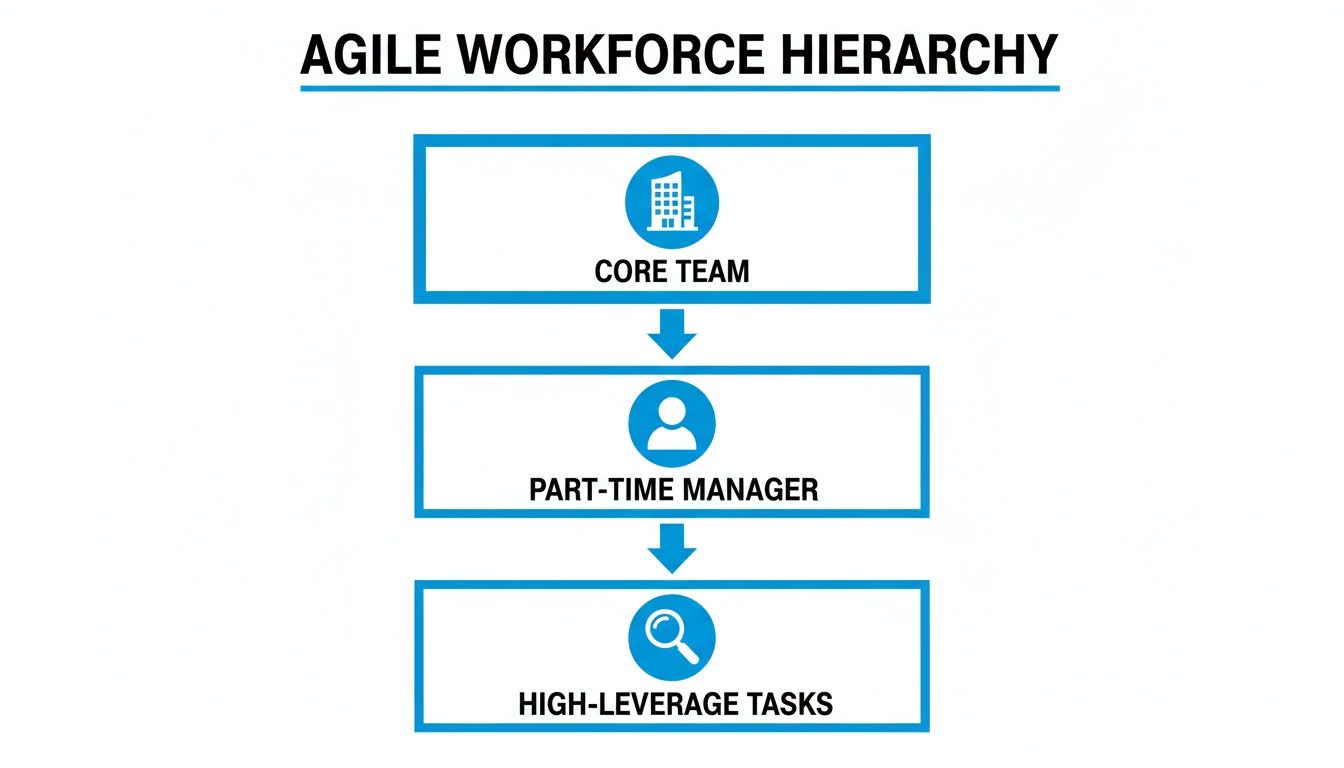
As shown, these specialists are the critical link that executes the on-site tasks necessary to achieve the core team's strategic goals.
Strategic Boundaries for Your Core Team
Conversely, certain responsibilities must remain with your full-time portfolio managers. These duties require deep institutional knowledge, strategic decision-making authority, and a focus on long-term asset performance. Delegating these to part-time staff is a recipe for operational failure.
The goal isn't just to offload work, but to reallocate focus. A part-time property manager handles the transactional fieldwork, while your full-time manager owns the relational and strategic asset management.
Keep these responsibilities firmly with your core team:
- Owner Relations and Communication: Building and maintaining trust with property owners is paramount and requires a deep understanding of portfolio strategy and financial performance.
- Complex Financial Reporting: Managing budgets, analyzing P&L statements, and making key financial decisions for the assets under management.
- Lease Negotiations and Legal Escalations: Handling complex lease clauses, managing eviction proceedings, and ensuring compliance with local landlord-tenant laws.
- Vendor Contract Negotiation: Sourcing, vetting, and negotiating contracts with key maintenance, repair, and capital improvement vendors.
This clear delineation empowers your part-time team to become experts in high-volume fieldwork while liberating your senior managers to drive portfolio growth and owner satisfaction. This structured approach is the foundation of scaling operations efficiently.
Task Allocation for Full-Time vs Part Time Property Managers
To put it all together, let’s look at a practical breakdown of who should be doing what. The right task allocation ensures that your most experienced team members are working on the highest-value activities, while repeatable, on-site jobs are handled with maximum efficiency. Here’s how that division of labor typically looks:
Operational TaskIdeal for Full-Time ManagerIdeal for Part Time ManagerIdeal for Automation (e.g., Showdigs)Owner Communication & Reporting✅Financial Strategy & Budgeting✅Lease Negotiations & Renewals✅Vendor Contract Negotiation✅Handling Legal Escalations✅Prospective Tenant Showings✅✅Move-In/Move-Out Inspections✅✅Routine Property Condition Reports✅Answering Initial Lead Inquiries✅Pre-screening Applicants✅Scheduling Tours 24/7✅
This table makes it clear how an agile workforce model operates. High-stakes, strategic work stays with the core team. High-volume, tactical fieldwork goes to part-time specialists. And the most repetitive, time-sensitive tasks—like responding to leads and scheduling tours—get handed off to smart automation. This triple-layered approach is how modern property management companies scale effectively.
Calculating the Financial Impact on Your Portfolio
For any large-scale portfolio manager, every operational decision must be justified by the numbers. Integrating a part-time property manager is a strategic financial move that must demonstrate a clear return on investment by impacting critical metrics like vacancy cost and cost per door.
When analyzing the financial impact, it's effective to frame it with proven cost optimization strategies. This helps you see exactly how a blended staffing model improves your bottom line by eliminating operational inefficiencies.

Beyond Salary Savings to Vacancy Cost Reduction
The largest financial drain on any portfolio is vacancy. Every day a unit sits empty, you lose revenue that can never be recovered. This is precisely where a part-time property manager delivers an immediate, tangible return.
Consider this: a vacant unit might cost your portfolio $75 per day in lost rent. If your full-time manager is occupied and can't conduct a showing for three days, that’s $225 in lost revenue. A flexible, on-demand agent can respond to that showing request within hours, saving hundreds of dollars on a single vacancy.
The real ROI of a part-time field agent isn't just their lower direct cost—it's the revenue they save. By shrinking the lead-to-tour timeline, they directly reduce your Days on Market (DOM) and recapture income that would otherwise be lost.
Across a portfolio of 1,000+ units, these gains compound quickly. If you can reduce the average vacancy period by just two days for 100 turnovers a year, you’ve recaptured $15,000 in revenue ($75/day x 2 days x 100 units).
Analyzing the Impact on Cost Per Door
Another critical KPI for any scaled operation is the cost per door. A blended staffing model fundamentally changes this calculation. Instead of carrying the fixed overhead of a full-time employee’s salary and benefits for fieldwork, you switch to a variable, pay-per-task model.
Here’s how it breaks down:
- Full-Time Model: A salaried manager’s time is divided among dozens of tasks. The true cost of a single showing includes their loaded hourly rate, benefits, drive time, and associated administrative overhead.
- Blended Model: You pay a predictable flat fee for a specific task, such as a showing or an inspection. This isolates the cost, making it fully transparent and easy to scale up or down with leasing velocity.
This shift allows you to handle a surge in leasing activity without permanently increasing your fixed operational costs. As your portfolio grows, your fieldwork expenses scale in direct proportion to leasing demand—not exponentially with each new full-time hire. That financial flexibility is crucial for sustainable growth.
The global property management services sector is projected to grow from $15.57 billion in 2024 to $16.79 billion in 2025, fueled by trends like remote operations and data-driven decisions—areas where nimble, cost-effective part-time specialists excel.
Ultimately, combining your core team with on-demand specialists and smart automation creates a powerful financial engine. It slashes your DOM, accelerates leasing cycles, and builds a more profitable and resilient operation poised for growth.
Plugging Part-Time Staff into Your Technology Stack
In any scaled-up property management company, technology is the central nervous system that ensures consistency and efficiency across thousands of units. When you integrate a part-time property manager, the goal is to plug them directly into your operational workflow so they function as a seamless extension of your core team.
The objective is to provide them with the right tools for efficient fieldwork while giving your central office complete visibility and control. Frictionless integration allows part-time staff to handle high-volume fieldwork without disrupting the data flow that informs portfolio-level decisions.
The Core Tools for a Blended Workforce
Managing a distributed team requires a streamlined, simple tech stack. You need tools that facilitate clear communication, unambiguous task assignment, and performance tracking against key metrics. A disjointed system creates chaos and negates the efficiency you’re trying to build.
Your essential toolkit should include:
- A Central Communication Hub: Tools like Slack or Microsoft Teams are non-negotiable for creating dedicated channels for maintenance updates, showing feedback, and general announcements, preventing important information from getting lost in emails or text threads.
- A Task Management Platform: Whether it’s a feature within your PMS or a dedicated tool like Asana, you need a single source of truth for assigning and tracking fieldwork like inspections and condition reports.
- An Automated Leasing and Showing Platform: This is the engine for a part-time field agent. A platform that automates showing schedules and dispatches them to properties drives their entire workflow.
Technology transforms your part-time staff from a group of individuals into a coordinated, on-demand network. It's the infrastructure that enables you to dispatch the nearest agent to a hot lead in minutes, not days, which has a massive impact on your tour conversion rates and Days on Market.
Putting On-Demand Fieldwork on Autopilot
Platforms like Showdigs were purpose-built for this blended team model. Instead of a leasing coordinator manually juggling schedules with multiple part-time agents, the system handles it automatically. When a prospect requests a tour, the platform offers the job to your network of approved field agents based on availability and proximity to the property.
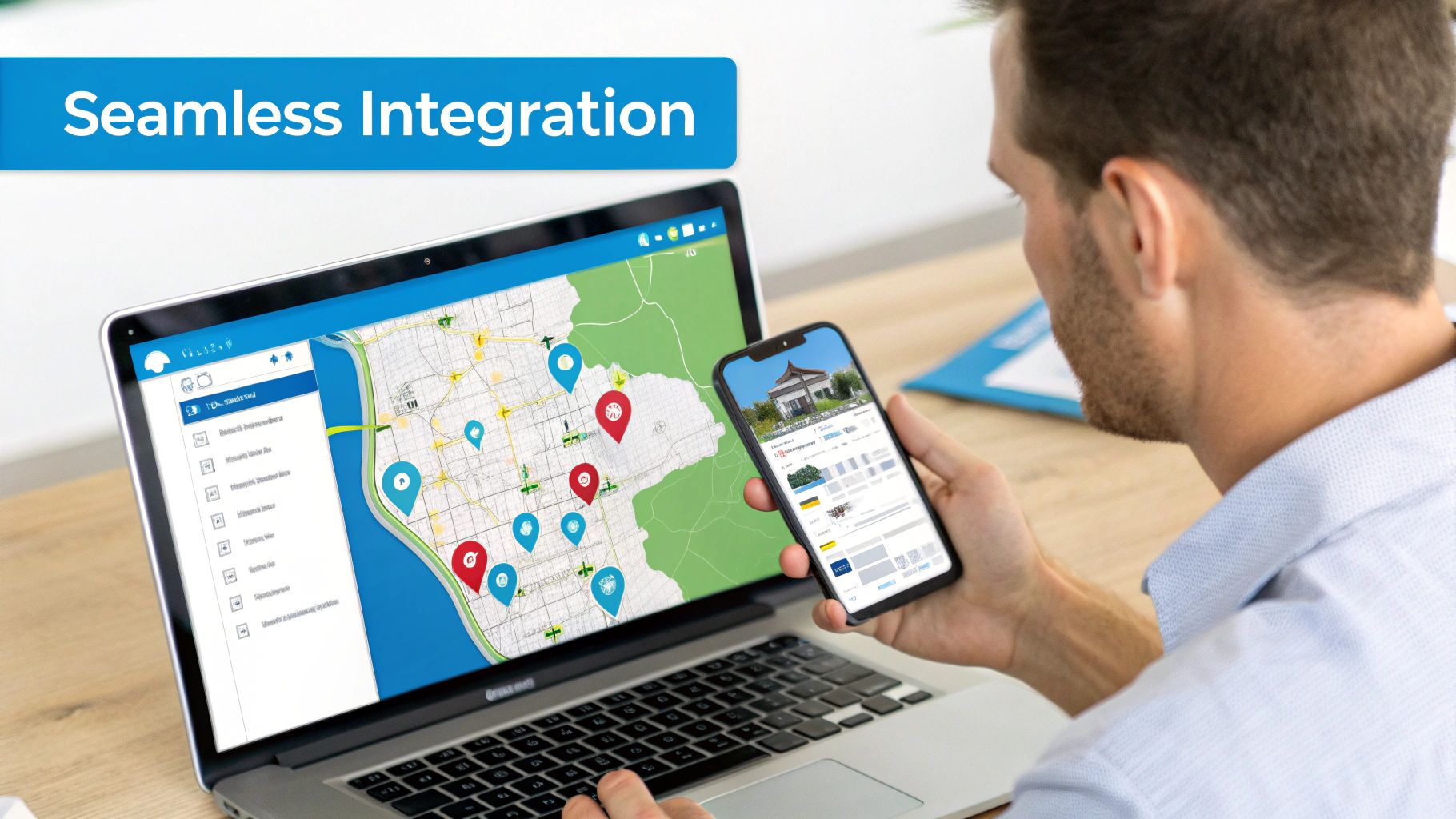
A central dashboard provides operations managers with a live, consolidated view of all leasing activity—scheduling, agent movements, and property status—without requiring constant check-ins.
This level of automation is what makes a part-time workforce truly scalable. It removes the administrative burden from your full-time staff and ensures every prospect receives a consistent, professional experience, regardless of which agent conducts the tour.
Keeping Your Data in Sync with API Integrations
The final component is ensuring all fieldwork data flows directly back into your core Property Management System (PMS). A showing platform operating in a silo creates information gaps, leading to time-consuming manual data entry and inaccurate reporting. This is where API integrations are essential.
When your leasing automation tool integrates with systems like AppFolio, RentManager, or Buildium, every action your part-time manager takes in the field is logged automatically. Tour feedback, applicant notes, and status updates sync in real time. This keeps your portfolio-level dashboards accurate, providing a clear, up-to-the-minute picture of metrics like lead-to-lease velocity and cost per acquisition. To see how this works, you can explore the benefits of these property management software integrations. By connecting your systems, you maintain a single source of truth and complete operational control.
How to Recruit and Onboard a High-Performing Team
Sourcing the right talent is only half the battle; how you onboard them is what protects your brand and ensures success, especially across a distributed portfolio. A haphazard hiring and training process for a part time property manager leads to inconsistency, increased risk, and undermines operational efficiency. At scale, a repeatable, standardized process is non-negotiable.
This is about building a reliable, on-demand network that functions as a natural extension of your core staff, ensuring every property and every prospect receives the same high-quality service.

Crafting the Ideal Job Description
Your job description is your first filter. A generic post attracts generic candidates. To attract dependable, tech-savvy professionals seeking a flexible role, you must be specific about the job's responsibilities and environment.
Your posting must include:
- A Clear Focus on Tasks: Be explicit that the primary duties are on-site activities like property showings, move-in/move-out inspections, and condition reports. This filters out candidates expecting a traditional office role.
- Technology Requirements: List the specific tools they will use daily, such as a smartphone with a quality camera and familiarity with scheduling applications. This signals you are a modern, tech-forward operation.
- Geographic Specificity: Clearly define the service areas or neighborhoods they will be required to cover. This is critical for minimizing travel time and ensuring rapid response to showing requests.
When you define the role with this clarity, you attract candidates who desire a flexible, task-based job, which leads to higher satisfaction and lower turnover. For a head start, check out this property manager job description template designed for agile, modern teams.
The Interview and Vetting Process
Once you have a qualified applicant pool, your interview process must assess the skills required for a remote, field-based position. Standard interview questions are insufficient. You need to evaluate reliability, problem-solving ability, and professionalism.
Your interview checklist should focus on:
- Situational Judgment: Present real-world scenarios. "A prospect is running 15 minutes late for a showing, but you have another appointment across town in 30 minutes. What is your course of action?" Their response reveals their time management and communication skills.
- Tech Proficiency: Ask them to describe their experience using mobile apps in a professional setting. A candidate who can confidently discuss using scheduling or reporting software will likely adapt to your systems quickly.
- Reliability and Accountability: Inquire about how they manage their schedule and professional commitments. You are looking for evidence of punctuality, clear communication, and professionalism—they will be the face of your company.
Building a Scalable Onboarding Program
A standardized onboarding process is your key to ensuring consistency. It guarantees every part-time team member, regardless of location, adheres to the same protocols and quality standards. This is how you embed compliance and quality into your operations from day one.
Your training should be digital, accessible on-demand, and cover these essentials:
- Company Policies and Brand Standards: How to interact with prospective tenants, professional attire, and the key selling points of your properties.
- Fair Housing Act (FHA) Compliance: This is mandatory. Comprehensive training on fair housing laws is crucial for minimizing legal risk.
- Software and Systems Training: Create simple, step-by-step video tutorials on using your showing platform, inspection apps, and communication tools.
- Field Procedures: Develop detailed guides on conducting a showing, completing an inspection report, and using lockboxes securely.
By systemizing your recruiting and onboarding, you create a powerful engine for talent acquisition. This allows you to quickly add resources for new markets or scale up during peak leasing season without sacrificing quality or control.
Navigating Legal and Compliance Guardrails
Integrating a property manager part time into a large-scale operation introduces a new layer of legal complexity. For enterprise property management companies, where efficiency and risk mitigation are paramount, proper legal and compliance adherence is non-negotiable. A single misstep can lead to significant fines and legal challenges, negating any cost savings.
The most common pitfall is the misclassification of part-time staff, which can trigger audits, back taxes, and penalties across your entire portfolio.
Employee vs. Independent Contractor: The Critical Distinction
The most critical legal decision is whether to classify your part-time help as an employee (W-2) or an independent contractor (1099). This decision dictates your responsibilities regarding taxes, insurance, and benefits.
The IRS typically considers three factors:
- Behavioral Control: Do you dictate how, when, and where the work is performed? If you require a specific script for showings or mandate the use of company software, they more closely resemble an employee.
- Financial Control: Do you control the business aspects of their job, such as how they are paid, whether expenses are reimbursed, and who provides the tools (e.g., lockbox key, phone)? A contractor typically uses their own equipment and is paid per task.
- Relationship of the Parties: Is there a contract defining the relationship? Are you offering employee-style benefits like insurance or paid time off? Is their work a core function of your business?
For large companies, classifying a closely supervised part-timer as a "contractor" to reduce costs is a significant risk. The more control you exert to maintain brand consistency, the more likely they will be legally considered an employee.
Airtight Contracts and a Clear Scope of Work
Regardless of classification, a robust contract is your best defense against risk. This document must be unambiguous, leaving no room for interpretation regarding their role and operational boundaries.
Your contract is more than a legal formality; it's an operational playbook that sets expectations and protects your business, ensuring your flexible team operates within a standardized, compliant framework that enhances, rather than jeopardizes, your portfolio.
Your agreement must explicitly define:
- Defined Responsibilities: List exactly what they are authorized to do (e.g., conduct property showings, handle move-in inspections) and what is strictly prohibited (e.g., signing leases, collecting rent, communicating with property owners).
- Compensation Structure: Specify the payment terms, whether an hourly rate for an employee or a flat fee per task for a contractor.
- Performance Expectations: Outline the quality standards for tasks like inspection photos or communication with prospects.
- Confidentiality and Data Security: Clarify their obligation to protect sensitive tenant and property information.
Mandatory Compliance Training
Finally, standardized compliance training is your first line of defense in maintaining professional standards and mitigating liability. Every part-time manager, regardless of their role's scope, must complete it.
This training must cover the Fair Housing Act (FHA) at a minimum, plus any local landlord-tenant laws relevant to your operating areas. Documenting that every team member has completed this training provides a powerful legal defense. It also ensures a consistent, professional experience for every prospect. By establishing these legal guardrails, you can build a flexible staffing model that is not only efficient but also compliant and resilient.
Frequently Asked Questions
How Do You Measure the ROI of a Part-Time Property Manager?
Measuring ROI extends beyond direct cost savings to include revenue recapture and improved operational capacity.
First, analyze your Days on Market (DOM). Every day a unit is vacant represents lost revenue. For a property renting at $2,500 per month, that's over $80 in lost income daily. A part-time manager focused on rapid showing response can reduce vacancy time, and every day saved translates directly to recaptured rental income.
Next, calculate the cost per showing. A salaried employee's time is a significant fixed cost, especially when including benefits and travel time. An on-demand, part-time agent converts this into a variable, pay-per-task expense. You pay only for the showing, which is almost always more cost-effective than dispatching full-time staff across a wide geographic area.
Finally, consider the increased capacity of your core team. When portfolio managers are not consumed by fieldwork, they can focus on high-value activities: nurturing owner relationships, strategizing portfolio growth, and closing complex deals. This is where long-term profitability is generated.
What Technology Is Essential for Managing a Remote Part-Time Team?
Managing a remote part-time team effectively requires a streamlined tech stack designed to create a coordinated workflow.
The essential components are:
- A Central Communication Hub: A platform like Slack or Microsoft Teams is crucial for organizing conversations and preventing critical updates from being lost in email or text chains.
- A Task Management System: You need a method for assigning and tracking non-leasing tasks like inspections. This can be a tool like Asana or a feature within your existing property management software.
- A Leasing Automation Platform: This is the operational core for your on-demand team. A system like Showdigs automates the entire lead-to-tour process by scheduling showings, dispatching the nearest available agent, and collecting field feedback in real time, all without manual intervention.
This technology combination transforms a distributed group of individuals into a cohesive, efficient machine that can respond to leasing demand in minutes.
Can a Part-Time Manager Handle Tenant Emergencies?
In short, no. A part-time property manager provides the greatest value by focusing on scheduled, repeatable tasks during business hours, such as showings, inspections, and administrative support.
Emergency response requires 24/7 availability, in-depth knowledge of property history, and the authority to make critical decisions. This responsibility should remain with your core, full-time team or a dedicated after-hours service.
A clear escalation protocol is essential for risk management and operational continuity. This ensures every emergency call is immediately routed to a full-time staff member with the training and authority to handle it, thereby protecting your tenants, properties, and brand reputation.
This clear division of labor allows your part-time team to remain focused on accelerating the leasing process, while your core team manages the high-stakes situations they are trained for.
Ready to see how an on-demand network of showing agents can slash your Days on Market and reduce operational overhead? Showdigs provides the technology and talent to turn vacancies into leases faster than ever before. Learn how to scale your leasing operations with Showdigs today.
.png)

.png)