


Your rental application is more than a form—it's the engine driving your lead-to-lease cycle. For large-scale portfolios, a clunky, inefficient application process directly inflates Days on Market (DOM), a critical metric that impacts revenue across thousands of units. It needs to collect verifiable data, ensure multi-market legal compliance, and provide a seamless mobile experience for top-tier applicants. A slow or confusing process doesn't just create friction; it actively extends vacancy periods and costs your portfolio significant revenue.
Your Application Process Is Costing You Revenue

Every day a unit sits vacant, it's a direct hit to your bottom line and a negative mark on your operational efficiency metrics. Let's calculate the real-world financial impact. For a portfolio of 1,000 units with an average rent of $1,800/month, a single day of vacancy costs the portfolio $60,000 in lost revenue. When a poorly designed application adds even a few extra days to that cycle, the financial drain becomes a major operational issue that affects cost-per-door and overall profitability.
The application stage is often the biggest bottleneck in the leasing funnel. It not only extends vacancy periods but also attracts unqualified applicants, consuming your team’s valuable time and resources. It’s time to stop treating the application as a bureaucratic hurdle and start leveraging it as a strategic tool for operational efficiency and revenue optimization.
Pillars of a High-Performing, Scalable Application Process
A modern, enterprise-grade application workflow is built on three core pillars designed for remote management at scale:
- Decisive Data Collection: Gathering verifiable, decision-ready information upfront means faster, more accurate screening and less manual follow-up for your leasing teams.
- Bulletproof Legal Compliance: For multi-market portfolios, strict, standardized adherence to Fair Housing laws and disparate local regulations is non-negotiable for mitigating risk at scale.
- A Seamless Digital Experience: Top prospects expect a fast, mobile-first digital journey. If your application isn't intuitive on a smartphone, your lead-to-tour conversion rate will suffer.
The rental market is digitizing rapidly. The global real estate rental app sector is projected to grow from USD 12.03 billion to USD 38.4 billion by 2034. This isn't just a trend; it's a fundamental operational shift. Property management companies leveraging AI-backed pre-screening and automated workflows are reducing vacancy periods by up to 20-30% and cutting manual review time by over 50%.
By optimizing the application, large-scale property managers can directly reduce Days on Market (DOM)—a critical metric for portfolio health. The objective isn't just to fill a unit; it's to accelerate the lead-to-lease cycle with a more qualified tenant. That’s how you maximize revenue and operational efficiency.
This guide will break down how to engineer a rental application process for speed, compliance, and scalability. To benchmark your current performance, get a full business health check with these leasing metrics. Let's cover the essential components that will turn your application from a cost center into a revenue accelerator.
Gathering Actionable Data for Faster Screening

A standard rental application is a checklist. An optimized one is a surgical tool designed to answer one question: "Does this applicant meet our pre-defined, non-negotiable criteria?" For managers of distributed portfolios, the speed and accuracy of that answer directly impacts revenue.
The goal isn't just data collection; it's to automate the validation of that data. Each field should feed directly into a standardized risk assessment model, enabling your team to make faster, data-driven decisions at scale.
Focus on Verifiable Financial Data
The bedrock of any defensible application is verifiable financial data. This goes beyond asking for an income figure; it's about structuring your application to demand fraud-resistant proof that integrates with your screening systems.
The common 3x rent-to-income rule is a good benchmark, but a simple "What is your monthly income?" field invites inflated numbers and creates a manual verification bottleneck for your team. Your application workflow must demand specific, verifiable proof from the start.
- Require Recent Pay Stubs: Specify the two most recent pay stubs showing year-to-date earnings. This simple requirement complicates income fabrication and provides a clear picture of consistent employment.
- Request Bank Statements: For self-employed applicants, mandate two to three months of recent bank statements to confirm consistent cash flow and average monthly deposits.
- Automate Income Verification: The most efficient route for remote operations is integrating a service that allows applicants to securely link their bank accounts for instant income verification. This eliminates manual review, reduces human error, and dramatically accelerates screening time.
This structure places the burden of proof on the applicant and provides your system with decision-ready data your team can act on immediately, reducing DOM.
Uncover the Full Residence History
An incomplete residence history is a significant red flag. Gaps in the timeline often conceal evictions, broken leases, or poor rental histories that an applicant hopes you'll miss during a high-volume screening process.
A detailed, verifiable residence history is a key predictor of future tenant behavior. Do not allow applicants to summarize their past—demand a complete, five-year history with no unexplained gaps.
Your application must require:
- Full landlord or property management company contact information for every prior residence.
- Exact move-in and move-out dates (month and year).
- The rent amount paid at each location.
- A mandatory field explaining the reason for leaving.
When an application is submitted with missing landlord details or a vague timeline, it should be automatically flagged for follow-up. In a large-scale operation, these small data points are often the first indicator of a high-risk applicant. It's also crucial to back this up with effective strategies for conducting thorough reference checks to ensure data integrity.
Collect Ancillary Details That Impact Operations
Details about pets, vehicles, and occupants are not minor points; they have direct operational and financial consequences. A smart, scalable application gathers this information upfront to prevent future operational issues and ensure compliance with property-specific rules.
An applicant "forgetting" to mention a large dog can lead to property damage, noise complaints, and HOA violations—costly problems that are entirely avoidable with a structured data collection process. Likewise, knowing the exact number and type of vehicles helps manage parking allocations and prevents unauthorized long-term "guests."
Capturing these details at the application stage is key to identifying your ideal tenants. To learn more about refining your criteria, check out our guide on prospect screening for ideal tenants.
By building an application that gathers targeted, actionable data, you empower your team to screen with speed and confidence, transforming your application from a form into a powerful tool that mitigates risk and minimizes vacancy across your portfolio.
Building a Legally Compliant Application Process
For property management companies operating across multiple markets, compliance is a core business function, not just a legal requirement. A single misstep can lead to costly lawsuits, reputational damage, and liabilities that impact the entire portfolio. A legally airtight, standardized rental application is your first and most critical line of defense.
The foundation is a deep, operational understanding of the Fair Housing Act (FHA). The FHA prohibits discrimination based on race, color, national origin, religion, sex (including gender identity and sexual orientation), familial status, and disability. Your application cannot ask for information related to these protected classes.
Navigating Fair Housing Act Essentials
To ensure compliance at scale, your application language must be neutral and, most importantly, consistent. Every applicant must receive the exact same form with the exact same questions. This standardization is what makes your screening process defensible against legal challenges.
Operationalize compliance with these rules:
- Don't ask: "How many children will live with you?" or "Where are you originally from?" These questions directly probe protected classes (familial status and national origin).
- Instead, ask: "How many people will be occupying the home?" This is a legitimate question tied to local occupancy limits that applies equally to everyone.
- Avoid open-ended fields: A "comments" box is an open invitation for applicants to volunteer protected information you cannot legally consider, creating unnecessary risk.
The rule is simple: only request information that directly verifies an applicant's ability to pay rent and adhere to the lease terms. Anything beyond that is a legal landmine.
Integrating Mandated Disclosures and Consents
A compliant application delivers required legal notices and obtains explicit consent for screening. This transparency protects both your business and the applicant.
Depending on property location and age, you must include specific disclosures. For any property built before 1978, the federal lead-based paint disclosure is mandatory. Other state or local requirements, like Megan's Law notices or environmental hazard disclosures, must also be integrated into your workflow.
Critically, you must obtain explicit, auditable consent for background and credit checks. This should be a standalone section with a mandatory checkbox where the applicant agrees to:
- A full credit history check
- A nationwide criminal background check
- A search of their eviction history
- Verification of their employment and rental history
The language must be direct, stating that this information will be used to determine their eligibility for tenancy.
The Impact of Compliant Digital Applications
As renting moves online, a legally sound, automated application process is essential for managing risk at scale. The peer-to-peer rental apps market is projected to reach USD 55.2 billion by 2035. This massive digital shift makes a bulletproof screening process more important than ever.
A robust, compliant screening process helps minimize evictions, which can affect 5-10% of tenants sourced through traditional applications. Well-designed digital applications have been shown to reduce fraudulent applications by 30% and improve tenant retention by up to 15% by selecting more qualified residents from the start. You can dive deeper into the data by checking out the full report on the P2P rental apps market.
When you build your process around FHA principles, clear disclosures, and explicit consent, you create a standardized, defensible system that protects your portfolio from legal and financial risk.
Weaving Your Application Into an Automated Leasing Workflow
An optimized rental application is a powerful tool, but its true value is unlocked when integrated into a seamless, automated leasing funnel. For large, distributed portfolios, the primary goal is reducing speed-to-lease. When the application is a disconnected step, you create friction, extend vacancy days, and lose revenue.
Modern leasing platforms are designed to connect the entire journey, from the initial lead inquiry and tour request through post-tour follow-up and, finally, to the application itself. The financial impact of this integration is direct and significant.
The moment a prospect completes a showing, the clock is ticking. An automated workflow can trigger an immediate follow-up message with a direct application link before they have left the property. This simple, automated action can convert a successful tour into a submitted application in under an hour, capturing high-intent leads while your property is top of mind and dramatically improving your lead-to-tour conversion rates.
This flow chart breaks down the critical legal steps that must be built into your automated workflow.
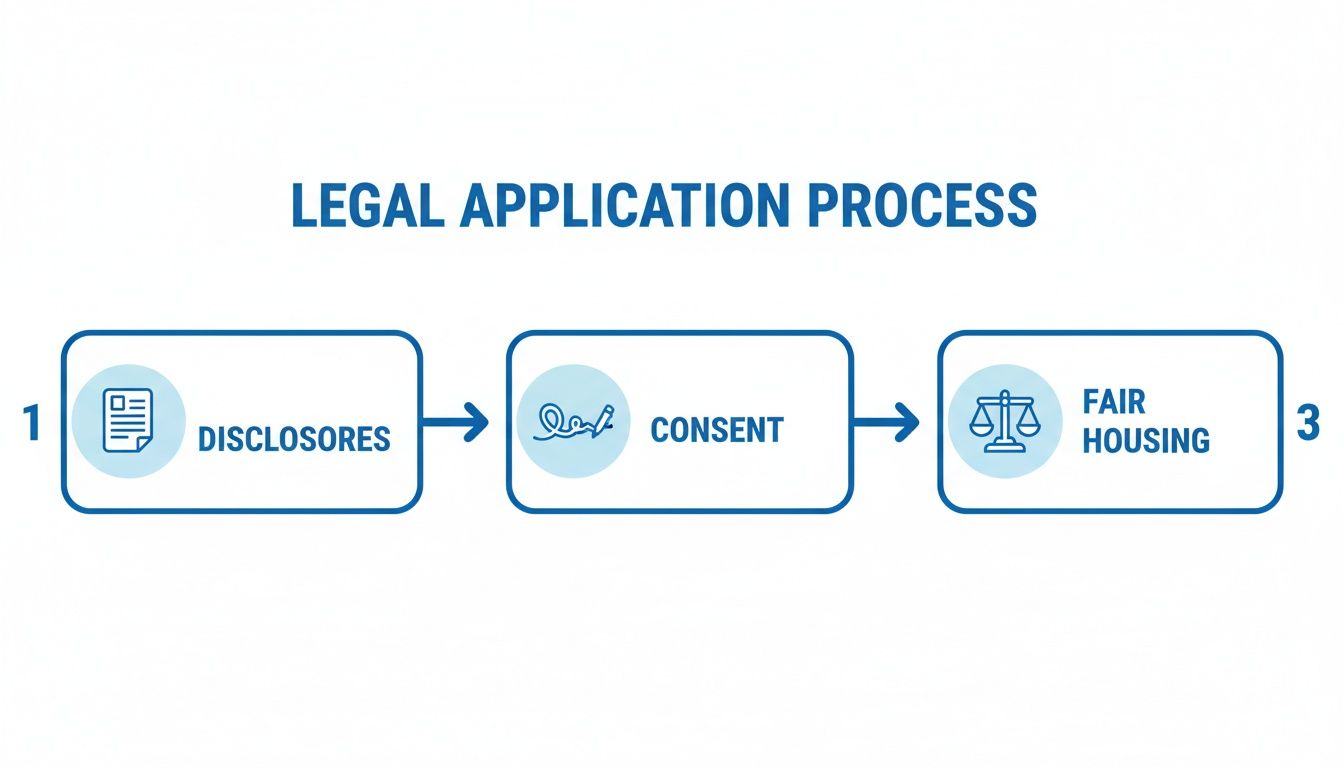
This process highlights the non-negotiable compliance points—Disclosures, Consent, and Fair Housing. Automation is essential here, ensuring these requirements are met consistently for every applicant, every time, across your entire portfolio.
Building Your Automated Funnel
An effective automated funnel does more than email an application link; it nurtures the lead from showing completion to lease signing. The key is to map critical touchpoints and use technology to execute them flawlessly at scale, removing the administrative burden from your leasing team so they can focus on high-value activities.
Here is a simple framework for connecting your application to post-tour communications:
- The Instant Follow-Up: As soon as a tour is marked "complete" in your showing system, an automated text or email is sent. Thank the prospect and provide a clear call-to-action with a direct link to your mobile-first rental application.
- The Smart Reminder: If an application isn't started within a few hours, the system sends a polite reminder, keeping your property top-of-mind and increasing completion rates.
- The "Almost There" Nudge: For applicants who start but do not complete the form, automated alerts can prompt them to finish, recovering potentially lost leads without manual intervention.
This level of automation is a competitive necessity. It ensures a qualified lead never goes cold due to a missed or delayed manual follow-up, directly impacting your DOM reduction efforts.
This strategy is crucial in today's market. With U.S. multifamily rent growth slowing and luxury vacancies climbing to 11.5%, every operational efficiency counts. Platforms that automate the entire funnel, from lead communication to AI-powered screening, have been shown to cut the time-to-lease by 25-35%. That's a significant revenue impact when even minor dips in rent medians pressure managers to fill units faster.
Manual vs Automated Application Workflow Analysis
The time savings are substantial. This table compares a traditional, manual leasing workflow against a modern, automated one, illustrating the impact on a portfolio of 100 units.
These saved hours translate directly into fewer vacancy days, reduced cost-per-door, and increased net operating income (NOI).
Plugging Into Your Core Systems
True operational scalability is achieved through API integrations that connect your entire PropTech stack. Your showing management platform, application software, and core Property Management System (PMS) should be seamlessly integrated. For instance, using an AI leasing assistant can handle initial lead responses and scheduling, feeding qualified prospects into your funnel. You can learn more about the benefits of using an AI leasing assistant in our guide.
When a prospect submits an application, the data should flow directly into your PMS, creating a guest card and flagging it for final screening. This eliminates manual data entry, reduces errors, and drastically shortens the time from application to lease signing.
Integrated payment solutions specifically for housing rentals can further streamline this process, simplifying the collection of application fees and security deposits within a single, compliant workflow.
Getting More (and Better) Applications Across the Finish Line
Getting a prospect to click "apply now" is only the first step. The real challenge for large portfolios is ensuring high completion rates among qualified applicants. A high application abandonment rate is a silent killer for your leasing pipeline, directly inflating your Days on Market (DOM) and eroding revenue.
To optimize this stage, you must treat the application as a user experience (UX) problem. It’s about creating a smooth, professional journey that attracts the best applicants and filters out those who don’t meet your criteria. A superior application experience reflects on your brand and can be the deciding factor for a top-tier tenant choosing your property.
If It’s Not Mobile-First, It’s Broken
Today’s renters operate on their phones. If your application requires pinching and zooming on a mobile screen, you are actively losing qualified leads.
"Mobile-first" means designing the experience specifically for a small screen:
- Large, tap-friendly buttons and clear form fields are essential.
- A simple, linear navigation guides the user step-by-step.
- Progress-saving functionality is critical, as applicants are often interrupted.
- Seamless document uploads via the phone's camera or file system are non-negotiable.
A clean, modern application signals that you are a professional, tech-forward management company—exactly what a high-quality tenant is looking for.
Be Radically Transparent from the Get-Go
Ambiguity is the enemy of an efficient leasing process. The single best way to improve both completion rates and applicant quality is to state all requirements upfront, before they begin the application.
On the application landing page, clearly state:
- The exact, non-refundable application fee.
- Your minimum screening criteria (e.g., credit score, 3x income-to-rent ratio).
- Critical property rules like pet policies or parking regulations.
This transparency acts as a powerful self-screening tool. Unqualified applicants will self-select out, saving your team significant time and resources processing applications that are destined for denial. This small change has a huge impact on your team's efficiency, allowing them to focus on the most viable leads.
Setting clear expectations is a hallmark of professional operations. Being upfront about costs and criteria builds trust and attracts serious applicants who are prepared to move forward.
Use Pre-Qualification Questions to Triage Leads
For property managers with large portfolios, a few pre-qualification questions are a game-changer. This is an automated "knockout" stage at the beginning of the process to flag immediate deal-breakers.
Lead with simple, binary questions:
- Is your gross monthly household income at least 3x the monthly rent?
- Do you have any prior evictions on your record?
- Can you provide proof of income and a government-issued ID?
- Do you have pets? If so, what is the breed and weight?
Based on their answers, provide immediate, automated feedback. If a prospect doesn't meet a core requirement, you can politely inform them before they invest time and money in the full application. This respectful approach streamlines your team’s workflow, ensuring they only spend time on the most viable candidates.
Common Questions on Tenant Applications
Even with a highly optimized application process, questions will arise. Having clear, standardized policies for these common issues is key to maintaining operational consistency and ensuring compliance across your portfolio.
Here are the most frequent questions from property managers and how to handle them at scale.
What Are the Most Common Red Flags on a Tenant Application?
When processing a high volume of applications, you must systematize red flag identification to manage risk effectively. Beyond obvious disqualifiers like evictions, several subtle signs should trigger a closer review.
- Gaps in Residence or Employment History: Unexplained gaps of several months or more can conceal a problematic tenancy or signal employment instability. Your process should automatically flag applications where timelines do not align.
- Incomplete or Missing Landlord Information: An applicant providing a friend's contact information or leaving the previous landlord section blank is almost always attempting to hide a poor reference.
- Use of a P.O. Box Instead of a Physical Address: While sometimes legitimate, a P.O. Box as a current residence often indicates an unstable housing situation or an attempt to obscure their actual location.
- Multiple Applications Within a Short Timeframe: A credit report revealing numerous recent rental inquiries can be a sign that other properties have already declined the applicant. This pattern warrants a deeper review of their qualifications.
Systematize your response to these red flags. Instead of treating each as a unique case, use automated triggers in your software to request specific follow-up documentation. This keeps your screening process consistent and legally defensible across your portfolio.
How Much Should We Charge for a Rental Application Fee?
Determining the application fee is a balance between covering costs and attracting a wide pool of qualified applicants. The fee should be reasonable and directly tied to your actual costs for background checks, credit reports, and administrative processing.
Nationally, fees typically range from $30 to $75 per adult applicant. However, you must adhere to local and state laws. Some jurisdictions cap application fees, while others require them to be refundable under certain conditions.
For multi-market operators, the best practice is to set a standard fee based on the strictest regulations in any of your markets. This simplifies accounting and ensures compliance. Remember, the fee must only cover your direct costs; it should never be a profit center, which can lead to legal challenges.
Can We Legally Deny an Applicant Based on Their Credit Score?
Yes, provided you do so consistently and non-discriminatorily based on a pre-defined screening policy. You cannot deny an applicant with a 620 credit score on Monday and approve another with the same score on Tuesday. This inconsistency creates significant legal risk.
Your written screening criteria, provided to every applicant, must clearly state your minimum credit score requirement. If you deny an applicant for failing to meet this minimum, the Fair Credit Reporting Act (FCRA) legally requires you to send them an "adverse action" notice.
This notice must include:
- The name and contact information of the credit reporting agency used.
- A statement that the agency did not make the denial decision.
- Notification of their right to receive a free copy of their report within 60 days and to dispute inaccuracies.
Automating adverse action notices through your property management software is essential for any large-scale operation to ensure compliance and maintain a clear, auditable trail.
How Long Should Our Company Keep Rental Applications on File?
Managing application records—for both approved and denied applicants—is a critical risk management function. The industry best practice is to retain all rental applications and associated screening documents for at least two to three years.
This retention period is primarily driven by the two-year statute of limitations for housing discrimination lawsuits under the Fair Housing Act. Maintaining these records provides the necessary evidence to defend your leasing decisions.
For an approved applicant who becomes a tenant, their application becomes part of their permanent tenant file and should be kept for the duration of their tenancy plus several years post-move-out, in accordance with state laws. For a large portfolio, secure digital storage is the only feasible solution for managing data retention policies efficiently and securely.
Optimizing every step of the leasing journey, from the first showing to the final application, is how top-performing property management companies reduce vacancy and boost revenue. Showdigs provides an AI-backed leasing platform with on-demand agent services to automate your entire funnel, slash your Days on Market, and scale your operations effortlessly.
Discover how to accelerate your lead-to-lease cycle with Showdigs.
.png)