




When you’re managing hundreds—or even thousands—of rental units, manual processes aren't just a headache. They're a direct threat to your bottom line. Modern rental management solutions are a complete game-changer, going way beyond basic software. Think of them as integrated ecosystems built to slash your Days on Market (DOM), skyrocket your lead-to-tour conversions, and ultimately, protect your portfolio's profitability.
The High Cost of Inefficiency in Large Portfolios
In the world of large-scale property management, operational drag isn't a minor annoyance—it's a massive financial leak. Every single manual step, from fumbling with showing schedules to finally getting back to a lead, creates a delay that erodes your net operating income (NOI).
When you multiply that small delay across a portfolio of 1,000+ units, the numbers get scary. A single day of vacancy at a property renting for $2,000 a month costs you over $66. Across a thousand similar units, just one day of inefficiency across your leasing process adds up to a $66,000 revenue gap.
This stark reality is why sophisticated property management companies are no longer just managing properties. They're obsessively optimizing every single step of the leasing funnel to maximize speed-to-lease.
The Shift to Scalable Infrastructure
The industry is waking up and embracing technology to fight back against these inefficiencies. In fact, the U.S. property management market is on track to hit $98.88 billion by 2029, and this tech-fueled shift is a huge reason why.
We’re already seeing 67% of companies using property management software, and leading firms are layering on automated and AI-driven tools to get a serious competitive edge. It's a move away from high-friction, manual work toward high-efficiency, automated workflows that let you grow without piling on more headcount. Frankly, it's the only sustainable way to keep your cost-per-door in check while expanding.
For enterprise portfolios, the whole game is about speed-to-lease. The gap between a qualified lead raising their hand and signing the lease is where revenue is won or lost. Closing that gap takes a purpose-built technology stack, not just more people.
The table below breaks down just how stark the difference is between the old way and the new way of doing things.
From Manual Methods to Modern Solutions
This table contrasts the friction of traditional property management with the efficiency of modern rental solutions, highlighting the direct impact on large-scale operations.
Operational AreaTraditional Method (High Friction)Modern Solution (High Efficiency)Impact on Large PortfoliosLead ResponseManual follow-up, hours or days later.Instant, automated responses and pre-screening 24/7.Captures hot leads before they move on; improves lead-to-tour conversion.Tour SchedulingBack-and-forth phone calls and emails.Self-service online booking, 24/7 availability.Reduces scheduling delays by over 90%, accelerating the leasing cycle.Property ShowingsStaff-driven, limited by agent availability.On-demand agents and secure self-showings.Triples available tour times, directly reducing Days on Market (DOM).Tenant ScreeningManual application processing.Automated background and credit checks.Standardizes approvals, reduces risk, and accelerates decision-making.
As you can see, the contrast isn’t just about convenience—it's about building a scalable, profitable leasing engine.
The Real-World Impact of Delays
Let’s walk in a prospective tenant’s shoes for a moment. They find your listing online and send an inquiry. They expect to hear back now. A delay of even a few hours can mean they've already booked a tour with your competitor down the street. It’s a harsh truth that failing to respond instantly leads to missed opportunities, a problem that highlights how AI solutions can address inefficiencies in real estate.
Without a solid rental management solution, your team is stuck in a constant game of catch-up. This leads directly to:
- Lower Lead-to-Tour Conversion: Hot leads go stone-cold while they wait for a human to reply or find a tour time that works.
- Increased DOM: Every tiny delay in the leasing process tacks another vacant day onto the calendar, directly costing you revenue.
- Inconsistent Tenant Experience: It's impossible to deliver standardized, high-quality service across a huge portfolio when everything is done by hand.
At the end of the day, clinging to outdated methods means you are actively choosing to sacrifice revenue and limit your own growth. The right solution isn't just another expense; it's the essential infrastructure you need to scale profitably in today's demanding market.
Essential Features for Driving Efficiency at Scale
When you're managing a huge, scattered portfolio, the right features aren't just a nice-to-have—they're a matter of survival. The basic tools that work for a few properties will absolutely crumble when you’re dealing with hundreds or thousands of units. Real rental management solutions built for scale are all about their power to automate high-volume tasks and actually move the needle on core metrics like Days on Market (DOM) and lead-to-tour conversion rates.
It's not enough to just look at a feature list. You have to understand the why behind each one. These tools are designed to pinpoint and eliminate the friction that costs large portfolios thousands of dollars a day in lost rent. Every single manual step in your process adds a delay, and those delays directly translate to longer vacancies and higher operating costs.
This flowchart shows exactly how those seemingly small manual tasks snowball into a major financial headache across a large portfolio.
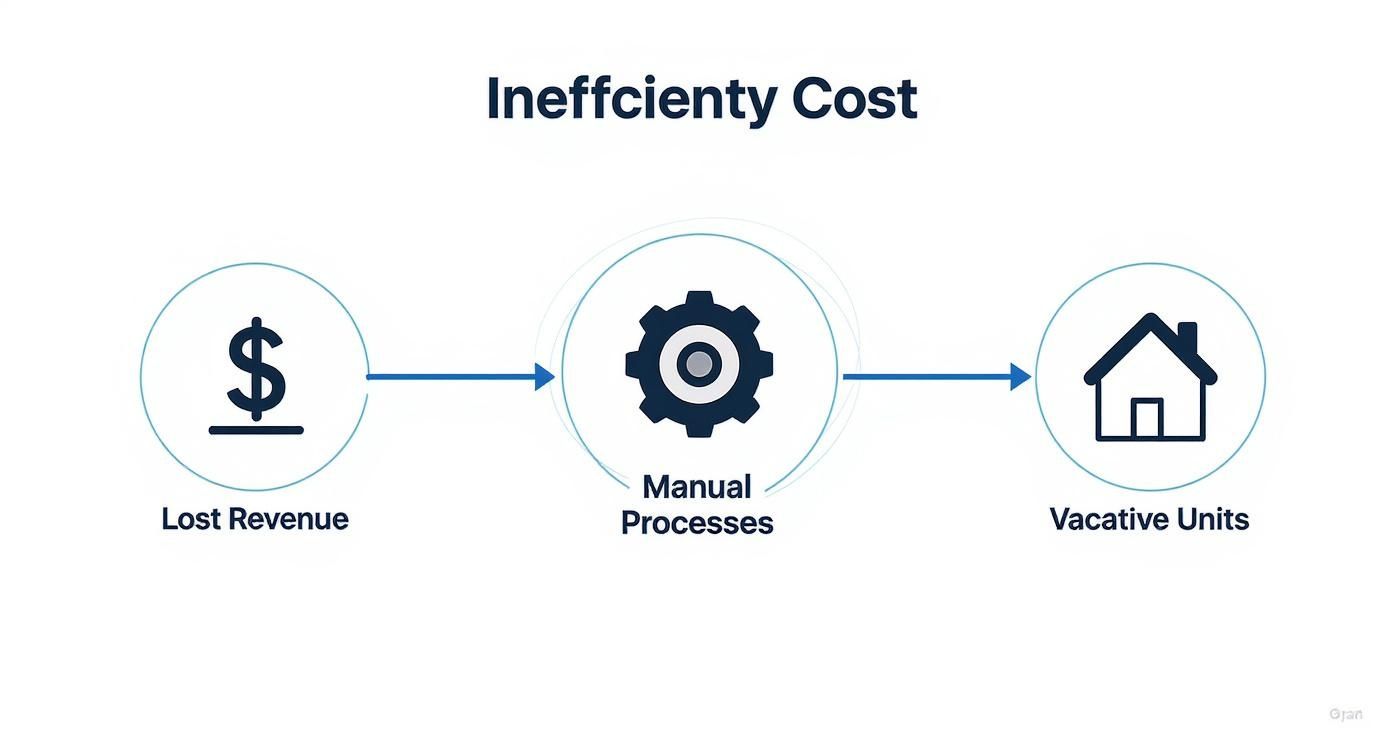
As you can see, manual work is the root of the problem. It creates a vicious cycle of longer vacancies and lost income that directly hurts your portfolio’s performance.
Automated Lead Response and Intelligent Scheduling
The moment a renter shows interest is do-or-die. If you wait even 30 minutes to respond, you’ve likely lost them. Enterprise-level solutions tackle this with instant, automated communication that works 24/7. It engages leads, answers their basic questions, and smoothly guides them to the next step: booking a tour.
This is way more than a generic "we'll get back to you" email. A truly smart system can:
- Pre-qualify leads with your own custom questions, so your team only talks to people who are serious and ready to move.
- Sync with your team’s calendars in real-time to show actual, available tour slots, cutting out all the back-and-forth emails.
- Nurture leads who aren't ready yet with automated follow-ups, keeping your properties on their radar.
By automating that first contact, you immediately boost your lead-to-tour conversion rate and give prospects a professional, responsive experience right from the start.
Flexible and On-Demand Showing Solutions
Trying to manage showings across hundreds of scattered-site properties is a logistical nightmare. Your in-house team can't be everywhere at once. Relying on them creates bottlenecks that leave your properties sitting empty for longer. This is why flexible touring technology is non-negotiable for multi-market property management.
The goal is to say "yes" to every single tour request. A modern rental management solution makes this possible by giving prospects multiple ways to see a property on their schedule, not yours.
This means offering a mix of options that you can switch on or off for each property:
- Self-Service Tours: Using smart lockboxes, prospects who pass a pre-screening can tour a vacant home whenever they want. This one feature alone can dramatically multiply your potential showings.
- On-Demand Agent Showings: For properties that need a personal touch, you can tap into a network of licensed agents to conduct tours on your behalf. This ensures you never miss a showing because your staff is tied up. You can learn more about how to scale your team on-demand to handle busy seasons without hiring more full-time employees.
- Virtual and Pre-Recorded Tours: High-quality virtual tours are perfect for out-of-state renters or anyone who wants to narrow down their options from their couch.
This hybrid approach guarantees maximum showing availability, which is the most powerful tool you have for slashing DOM. It turns your showing process from a rigid, staff-dependent headache into a flexible, scalable system that gets leases signed faster than any manual method possibly could.
Calculating the Real ROI of Reducing Vacancy
For any property management company with a sizable portfolio, "efficiency" isn't just a buzzword—it's a direct line to your bottom line. We all track metrics like Days on Market (DOM), but their real power comes alive when you translate them into the language every stakeholder understands: dollars and cents.
Calculating the true return on investment (ROI) of a modern rental management solution starts by putting a price tag on the high cost of vacancy. Every single day a unit sits empty isn’t just a missed opportunity; it’s cash leaking directly from your portfolio.
Framing vacancy in financial terms transforms DOM from an abstract operational metric into a hard number that directly hits your net operating income (NOI). This is exactly how you prove the value of investing in smart leasing automation.
A Framework for Quantifying Vacancy Costs
Figuring out the cost of vacancy is surprisingly simple, but the results are incredibly powerful. The formula looks like this:
- Find the Daily Rent: (Monthly Rent / 30 Days) = Daily Cost of Vacancy
- Calculate Portfolio Impact: (Daily Cost of Vacancy x Number of Units) x Average DOM = Total Vacancy Cost
Let's plug in some real-world numbers to see how this plays out for a large portfolio.
Portfolio Example: The Financial Drain of DOM
Picture a portfolio of 1,000 single-family rentals. The average monthly rent is $2,200, and your current average Days on Market is 21 days.
Here’s how the math breaks down:
- Daily Rent Per Unit: $2,200 / 30 = $73.33
- Cost Per Vacancy: $73.33 x 21 DOM = $1,539.93 per unit
- Total Portfolio Loss (Annual Turnover at 50%): $1,539.93 x 500 units = a staggering $769,965 in lost revenue every year.
Now, let's see what happens when a rental management solution shaves just seven days off your average DOM, bringing it down to 14.
- New Cost Per Vacancy: $73.33 x 14 DOM = $1,026.62
- New Total Portfolio Loss: $1,026.62 x 500 units = $513,310
- Annual Revenue Reclaimed: $769,965 - $513,310 = $256,655
By cutting just one week from your vacancy period, you’ve put over a quarter of a million dollars back into the business. This isn't just theory; it's the direct financial outcome of a more efficient leasing process. When you can show this kind of ROI, the investment in technology stops being an expense and becomes an obvious strategic move.
Every feature in an advanced rental management solution is designed to shave hours and days off the leasing timeline. Instant lead follow-up, 24/7 self-service tour scheduling, and on-demand showing agents are all powerful levers for reducing DOM and directly boosting revenue.
The pressure to minimize vacancy is only getting more intense. The U.S. is home to roughly 43.9 million occupied rental units, and with rents climbing, every day a property sits empty costs you more. Property owners are laser-focused on maximizing their returns, so demonstrating your ability to keep properties filled is a massive competitive advantage.
Connecting Features to Financial Recovery
The real magic of this calculation is connecting specific tech features to concrete financial gains. You’re not just buying software; you’re buying speed.
- Instant Lead Follow-Up: This alone can cut DOM by 1-2 days by grabbing a renter's attention before they find another listing. For our example portfolio, that’s a potential revenue recovery of $36,665 to $73,330.
- Same-Day Showing Availability: By offering self-tours or on-demand agents, you get rid of the scheduling back-and-forth that can easily add 3-5 days to your DOM. That translates to $109,995 to $183,325 in reclaimed income. Our guide on the link between showing availability and vacancy rates digs much deeper into this crucial connection.
When you break down the ROI this way, you can clearly show how a modern rental management solution pays for itself many times over. It changes the conversation from a cost-center discussion about software to a profit-center strategy focused on making your portfolio perform at its absolute best.
How to Choose the Right Solution for Your Portfolio
Picking the right technology partner is a huge decision, especially when you're running a large-scale operation. It's easy to get distracted by flashy features, but what really matters is finding a solution that can truly handle the demands of scale. The best rental management solutions aren't just tools; they're the very foundation your remote property management operations are built on.
For anyone managing hundreds or even thousands of properties scattered across different locations, the wrong choice can create more headaches than it solves. You could end up with siloed data, a frustrated team, and a platform that never delivers on its promises. But the right choice? That becomes a powerful engine for growth, pushing down vacancy rates and making every single property more profitable.
Start with Scalability and Integration
Before you even sit down for a demo, your evaluation has to start with two massive enterprise requirements: scalability and integration. A platform that works great for 50 doors will buckle under the pressure of 5,000 unless it was built from the ground up to handle that kind of volume.
You need to ask potential vendors some tough, direct questions about their system's architecture:
- Performance Under Load: How does your platform handle tens of thousands of lead inquiries and tour requests all at once during the busiest leasing season?
- API Capabilities: Do you offer a robust, well-documented API for a deep, two-way sync with our core Property Management System (PMS) like Yardi or AppFolio?
- Data Integrity: How do you guarantee real-time data syncs for property availability, pricing, and lead status? We can't afford double-bookings or showing outdated listings.
A flimsy integration or a system that lags during peak hours will absolutely cripple your remote operations. Your leasing platform needs to feel like a natural extension of your tech stack, not a clunky afterthought.
Focus on Remote Operations and Flexibility
This is non-negotiable for modern, large-scale property management: your chosen solution must deeply understand the challenges of managing a distributed portfolio without any onsite staff. A platform designed with an "onsite-first" mindset just won't cut it for scattered single-family rentals or multifamily buildings that don't have a leasing office.
The ultimate test of a rental management solution is its ability to make geography irrelevant. It should empower your central team to manage a portfolio across multiple markets with the same level of control and efficiency as if every property were next door.
So, how do you evaluate a platform's ability to support a remote-first model? Look at its flexibility. Can you set up different showing rules for different markets, or even for specific properties? Can it handle a hybrid model, offering secure self-showings for some units and on-demand agent tours for others? This level of customization is what lets you adapt to different kinds of properties and unique market demands.
Vet the Vendor’s Industry Expertise
Finally, look past the software and get to know the team behind it. Does the vendor actually get the nuances of multi-market property management? Do they speak your language—talking about reducing DOM, boosting lead-to-tour conversion rates, and improving operational efficiency? When you're thinking about how to choose the right rental management solution, it can be useful to see how other fields select specialized tools. For example, learning how to choose the right tool for your practice in the financial sector shows how critical it is to vet a vendor's specific expertise.
A true technology partner acts more like a consultant than a salesperson. They should be able to share best practices, offer data-backed insights from other large portfolios, and help you calculate the potential ROI for your business. This partnership approach ensures the solution doesn't just fit your current process but also grows with you as you scale. Honestly, choosing a vendor with proven enterprise experience is the best insurance policy you can get against a costly implementation failure.
Your Enterprise Rental Management Solution Checklist
When you're evaluating platforms, it's easy to lose track of what really matters for a large-scale, distributed portfolio. This checklist will help you systematically compare your options and keep your team focused on the features that drive real-world results.
Evaluation CategoryKey Questions to AskWhy It Matters for ScaleScalability & PerformanceCan the system handle peak leasing season volume across thousands of units without slowing down? What are its performance benchmarks?A system that lags during busy periods creates a poor prospect experience and leads to lost revenue. It must perform under pressure.Integration CapabilitiesDoes it offer a deep, two-way API integration with our core PMS (e.g., Yardi, AppFolio, RealPage)? How seamless is the data sync?Without a robust integration, you'll be stuck with manual data entry, creating errors and operational bottlenecks that are impossible to manage at scale.Remote Operations SupportWas the platform built for a distributed portfolio? Does it support self-showings, on-demand agent networks, and remote condition reports?Onsite-first solutions fail for scattered properties. You need a tool that makes geography irrelevant and supports a centralized leasing model.Customization & FlexibilityCan we configure leasing rules, showing types, and workflows by market, property type, or even individual unit?A one-size-fits-all approach doesn't work for a diverse portfolio. You need the flexibility to adapt your strategy to different assets and markets.Security & Fraud PreventionWhat measures are in place to verify prospect identities, secure properties during showings, and prevent rental scams?As you scale, so does your risk. Enterprise-grade security is essential to protect your assets, your team, and your reputation.Vendor Expertise & SupportDoes the vendor have a proven track record with portfolios of our size and complexity? Do they offer dedicated enterprise support and a partnership approach?You're not just buying software; you're buying a partnership. A vendor with deep industry experience will be a strategic asset, not just a help desk.
Using a structured approach like this ensures you look beyond the surface-level features and choose a true technology partner that can support your growth for years to come.
Rolling Out New Tech Across a Scattered Team
Adopting a new rental management solution is as much about people as it is about software. When your team is spread out across different cities or even states, you can't just flip a switch and hope for the best. That’s a surefire way to create chaos and frustration.
A smart rollout strategy turns a potentially painful switch into a clear win for everyone. The trick is to show your team how the new tool makes their jobs easier, not harder. When you do that, the technology stops being a chore and starts being the engine that drives the efficiency you were hoping for.
Phase 1: Run a Targeted Pilot Program
Before going all-in, the smartest first move is to test the waters with a pilot program in one, controlled market. Think of it as a real-world test drive for your new rental management solution, letting you see how it performs under your company's unique conditions.
The main goals here are pretty straightforward:
- Prove the ROI on a small scale: Keep a close eye on key numbers like Days on Market (DOM) and lead-to-tour conversion rates. Seeing a solid improvement, even in one market, builds a powerful case for rolling it out everywhere.
- Iron out the kinks: This is your chance to find and fix any friction points in the new process. You can document what works best and create a standard playbook before you hand it off to hundreds of team members.
- Get real feedback: Your pilot team is your most valuable source of information. Their hands-on experience will give you practical insights you’ll never get from a sales demo, helping you tweak the system to perfection.
This first step takes a lot of the risk out of the project. It gives you the hard data and proven methods you need to confidently invest in a company-wide change.
Phase 2: Get Your Team On Board
Let's be honest—nobody really likes change. The biggest hurdle you'll face is getting your team to embrace a new way of doing things. The best way to do that is to clearly answer the question on everyone's mind: "What's in it for me?"
People will get excited about a new tool when they see it as something that solves their biggest headaches, not just another task from management. Tie the technology directly to their daily pain points, and you’ll create genuine enthusiasm.
Focus on the direct wins for each role. For your leasing agents, show them how automation gets rid of the boring manual follow-ups and scheduling nightmares, giving them more time to actually connect with prospects and close leases. For portfolio managers, highlight how real-time data gives them a crystal-clear view of leasing performance across their portfolio.
When an agent sees for themselves how fast they can get a tour scheduled—and how that speed directly helps lower the property's DOM—they'll become the biggest advocate for the new system.
Phase 3: Go for a Full-Scale Rollout
Once you have a successful pilot under your belt and a solid process in place, you’re ready to go big. This final phase is all about smart execution, clear communication, and great training. It’s a good idea to break the deployment into stages, maybe market-by-market, so you don't overwhelm your support team.
Your rollout plan should cover these bases:
- Standardized Training: Build a solid training program using the best practices you figured out during the pilot. A mix of live webinars, on-demand videos, and simple cheat sheets works great.
- Clear Communication: Keep everyone in the loop before, during, and after the launch in each market. Make sure they know the timeline, what to expect, and where to turn for help.
- Ongoing Support: Set up a clear support channel. Whether it’s a go-to person internally or a direct line to the software provider, make sure your team knows help is always available.
By taking this phased approach, you can roll out new rental management solutions successfully, even with a large and scattered team. It ensures the tech actually delivers on its promise to make your operations smoother and your portfolio more profitable.
The Future of Rental Management Is AI and Automation
Let's be honest: basic automation isn't a "nice-to-have" anymore. Things like automated lead responses and tour scheduling are simply the price of entry. If that’s all you’re doing, you’re already behind.
The real game-changer, the next frontier for property managers looking to scale, is shifting from simply automating tasks to actively predicting outcomes. This is where artificial intelligence comes in, and it's where the sharpest operators will build their competitive edge over the next few years.
Modern rental management solutions are quickly becoming more than just workflow tools. They’re evolving into intelligent data platforms that fuel predictive analytics, giving you the power to make smarter, faster decisions across your entire portfolio. This isn’t some far-off concept; it’s happening now, with AI solving some of the most complex and high-stakes problems we face every day.

From Reactive to Predictive Operations
Imagine a system that does more than just flag an upcoming lease expiration. What if it could predict how likely that tenant is to renew? That's the power of predictive AI in action.
- Proactive Renewal Strategies: Instead of getting blindsided by a non-renewal notice, an AI model can flag at-risk tenants months ahead of time. It looks at subtle cues like maintenance request frequency or payment patterns. This gives your team a chance to step in with a targeted offer or a personal phone call, potentially saving that renewal and dodging vacancy costs entirely.
- Dynamic Pricing Recommendations: AI can crunch real-time market data, local demand signals, and your own historical performance to suggest the sweet spot for rental pricing. You’ll know you aren't leaving money on the table or pricing a unit so high that it sits empty for weeks.
- Optimized Marketing Spend: By tracking leads from the first click all the way to a signed lease, AI can tell you exactly which marketing channels are delivering the best tenants for the lowest cost. Finally, you can put your marketing budget where it will have the biggest impact.
This isn't just about efficiency; it's about survival. The rental industry is a $136.9 billion market, and with the national vacancy rate sitting around 7.0%, the competition is fierce. Property managers have to use every advantage they can get, making AI-driven insights the new key differentiator for success.
Building the Foundation for Tomorrow
The most forward-thinking rental management solutions aren't just solving today's headaches. They’re building the data foundation you'll need for tomorrow's innovations. Every single lead interaction, every tour, every application becomes another data point that makes the entire system smarter and more predictive.
The goal is to create a leasing operation that learns and adapts. The data you gather today is what will power the AI that gives you a decisive advantage next year, turning your operational processes into a strategic asset.
Platforms that are already weaving these capabilities into their fabric are leading the charge. For example, understanding the benefits of using an AI leasing assistant shows how these tools are handling complex communications and qualifying leads right now, freeing up your team for the high-value work that only humans can do.
When you're choosing a solution, look for one with a strong AI roadmap. That's how you ensure your operation stays competitive, efficient, and profitable as the industry continues to evolve.
Frequently Asked Questions
When you're looking at new rental management solutions, especially for a large portfolio, a few key questions always come up. You need to know how a new platform will impact your bottom line and fit into your current operations. Let’s tackle the most common ones property managers ask.
How Do These Solutions Integrate With Our Existing PMS?
This is usually the first—and most important—question. The best rental management solutions are designed to play nice with the major Property Management Software you already use, like Yardi or AppFolio. They use robust APIs to create a seamless, two-way data sync.
This means critical info—property availability, pricing changes, new leads—is always current across all your systems. It gets rid of the soul-crushing (and mistake-prone) task of manual data entry. When you're vetting a new platform, make sure it has a deep, proven integration with your specific PMS. Your goal is to maintain a single source of truth for your entire portfolio.
What Is the Typical ROI From an Automated Leasing Solution?
The return on your investment boils down to two things: slashing vacancy and saving on operational costs. Getting your Days on Market (DOM) down provides the biggest financial win. For a big portfolio, cutting just 5-7 days of vacancy can easily translate to tens of thousands of dollars in reclaimed revenue each year.
The smartest way to calculate ROI for any rental management solution is to start with your portfolio's cost of vacancy per day. This simple number turns efficiency gains into a hard dollar figure, making the business case crystal clear to any stakeholder.
On top of that, you get huge savings on labor costs by automating repetitive work like scheduling showings and following up with leads. This frees up your leasing team to focus on what they do best: building relationships and closing deals, which directly improves your cost-per-door metrics.
Can These Platforms Support Both Self-Showings and Agent-Led Tours?
Absolutely. Flexibility is the name of the game for any serious rental management solution. A top-tier platform will let you set up different touring options for each property or market, giving you total control over how you lease.
This means you can mix and match your approach:
- Use smart lockbox self-tours for your vacant single-family homes in one area.
- Bring in on-demand showing agents for specific multifamily buildings in another.
- Stick with traditional agent-led tours for high-end units that need that personal touch.
This kind of hybrid model lets you tailor your showing strategy to fit the asset, maximizing your tour availability and converting leads faster across your whole portfolio.
Ready to see how an AI-backed leasing automation platform can slash your Days on Market and boost your lead-to-tour conversion rates? Showdigs is purpose-built for large, distributed portfolios, combining smart software with on-demand agents to deliver unparalleled efficiency. Discover the Showdigs advantage today.
.png)
.png)