




When you're managing a large portfolio of single-family or multi-family rentals, every vacant unit is more than just an empty property—it’s a constant, daily drain on your revenue. A single day a property sits on the market might not seem like much, but multiply that across hundreds or even thousands of doors, and you're looking at a serious impact on your Net Operating Income (NOI).
The old "post and pray" method of advertising is obsolete for enterprise-scale operations. To win in today's competitive rental market, property management companies need a systematic, repeatable playbook that gets qualified renters through the leasing funnel, fast. This is about minimizing Days on Market (DOM) and maximizing lead-to-tour conversion rates.
This isn't just another list of generic tips. We're breaking down a strategic framework built specifically for operations directors and portfolio managers—the people obsessed with cost-per-door and operational efficiency. We'll get into the nuts and bolts of building a high-performance advertising machine that shrinks your speed-to-lease cycle and protects your bottom line.

More Than Just Ads—It's a High-Stakes Performance Engine
Let's be clear: promoting rental properties has become a major economic driver. The global real estate advertising market hit USD 35.42 billion in revenue and is still climbing. That number tells you everything you need to know about the importance of having a sophisticated approach to grab renter attention and turn it into leases. You can dig into more of the market data at Research and Markets.
An effective advertising strategy at this scale is really an interconnected system. Each piece has to work together toward the ultimate goal: slashing vacancy. We've found that the most successful strategies are built on a few core pillars, each with its own objective and a way to measure success.
Here's a quick breakdown of what that looks like in practice.
Key Pillars of a Scalable Rental Advertising Strategy
PillarObjective for Large PortfoliosPrimary KPIStrategic Channel SelectionAllocate budget to platforms that deliver the highest quality leads for your specific property types (SFR vs. multifamily), not just the highest volume.Cost-Per-Qualified-LeadCompelling Creative That ConvertsUse professional visuals and data-informed copy to move a prospect from initial interest to actually scheduling a tour.Lead-to-Tour Conversion RateData-Driven OptimizationTrack metrics like cost-per-lead and lead-to-lease time to find what's working and continuously refine your approach.Portfolio-Wide Days on Market (DOM)Operational EfficiencyUse technology and automation to handle inquiries, qualify leads, and schedule showings instantly, ensuring no lead ever goes cold.Speed-to-Lease
Each of these pillars supports the others. Great ads on the wrong platform won't work, and a perfect channel mix won't matter if your team can't respond to leads quickly enough.
The real challenge for property managers operating at scale isn't just filling one vacancy. It's building a predictable, efficient leasing engine that systematically reduces portfolio-wide Days on Market and maximizes rental income.
This playbook is designed to give you the tools and frameworks to build that very engine. From picking the right listing sites to completely automating your lead-to-lease funnel, every step here is geared toward making real, measurable improvements in the metrics that matter most to your operation.
Choosing Your Channels for Maximum Lead Velocity
When you're managing a scattered, multi-market portfolio, a "spray and pray" approach to advertising is a surefire way to burn through your budget. Just blasting your listings across every platform you can find creates a lot of noise but very few qualified leads. The real goal is to build a smart, strategic channel mix that delivers a steady stream of high-intent applicants without burying your leasing team.
This is about shifting from a volume mindset to a velocity mindset. It’s not about how many leads you get; it's about how fast you turn the right ones into signed leases. Every dollar you spend on a channel must be judged by its direct impact on your speed-to-lease and your portfolio's bottom line.
The Big Three ILSs and Beyond
For any large-scale operation, the major Internet Listing Services (ILSs) like Zillow, Apartments.com, and Zumper are the bedrock of your advertising strategy. They bring massive, high-intent traffic to the table, but you can’t just set it and forget it.
- Zillow Group (Zillow, Trulia, HotPads): This is the 800-pound gorilla, especially for single-family rentals (SFRs). Its audience is so huge that you pretty much have to be there, but optimizing your spend is critical. You need to be analyzing lead quality and cost-per-lease market by market to make sure you aren't just paying for low-intent clicks.
- Apartments.com Network: It might have started with a focus on multifamily, but its user base is incredibly broad now. We often see that renters from this platform are a bit further along in their search, making it a great source for higher-end SFRs or smaller multifamily buildings that don't have on-site staff.
- Zumper: Known for its slick interface and real-time alerts, Zumper pulls in a crowd that values speed and convenience. This can be a goldmine for properties in competitive, fast-moving urban and suburban areas where you need to get ahead of the competition.
But don’t stop with the giants. Hyper-local and niche platforms can deliver an incredible ROI. Never underestimate the power of Facebook Marketplace, where you can get in front of local communities and answer questions directly. And if you have visually stunning properties, a solid Instagram strategy using Reels and sharp photo carousels can build a brand that attracts tenants looking for a certain lifestyle.
For enterprise-scale portfolios, just being on these platforms isn’t enough. You have to track performance like a hawk. You should know, without a doubt, which channel gives you the best lead-to-tour conversion rate for a three-bedroom in Phoenix versus a two-bedroom in Atlanta.
Building a Balanced Channel Mix
An effective strategy doesn't just use these channels—it weaves them together. An increasingly popular tactic is creating a dedicated property website, giving you a direct-to-consumer presence you completely control. When looking for inspiration, checking out the best website builder for vacation rentals can offer some great frameworks for creating a powerful direct channel for your own long-term rentals.
Your ideal mix will always depend on your specific properties and market conditions. A good starting point is to categorize your units and map them to the channels most likely to reach your target renter. For more ideas on generating high-quality applicants, check out our guide on securing more property management leads.
To help you evaluate, here’s a quick breakdown of how these channels stack up for larger operators.
Rental Advertising Channel ROI Comparison for Large Portfolios
This table compares common advertising channels, evaluating them based on cost, lead quality, and scalability—specifically for property managers handling 500+ units.
ChannelTypical Cost Per LeadLead Quality & IntentScalability RatingBest ForMajor ILSs (Zillow, etc.)Moderate to HighHigh5/5Broad reach across SFR & multifamily, high-intent renters.Social Media (Paid Ads)Low to ModerateVariable4/5Hyper-local targeting, reaching passive seekers, brand building.Facebook MarketplaceLowLow to Moderate3/5Localized targeting, direct community engagement, budget-friendly.Direct Property Website/SEOLow (long-term)Very High4/5Building brand equity, capturing high-intent organic traffic.
Ultimately, succeeding with rental advertising at scale comes down to precision. It means you allocate your budget based on hard performance data, not just what everyone else is doing. By obsessively tracking your cost-per-lease and lead-to-tour rates from every single source, you'll build a powerful and predictable leasing engine that keeps your Days on Market low and your revenue high.
Crafting Listings That Convert Leads to Tours
Once you’ve got your advertising channels dialed in, the real work begins: making sure your listings actually perform. An ad is only as good as its ability to convince a qualified renter to take the next step and schedule a tour. When you're managing hundreds or even thousands of units, a weak listing doesn't just underperform—it actively costs you money by stretching out vacancy days across your portfolio.
The secret is to stop listing features and start selling a lifestyle. A great rental ad creates an emotional connection, making a prospect feel like they’ve already found their next home before they even see it. This takes a calculated approach to both the words you choose and the visuals you show.

Writing Headlines and Descriptions That Stop the Scroll
In an endless sea of online listings, your headline is your first and, frankly, often your only chance to grab someone's attention. Generic titles like "3 Bed, 2 Bath Home for Rent" are invisible. They get lost in the noise. Instead, lock onto a unique selling point that speaks directly to what your ideal renter is looking for.
Try thinking in these frameworks for your headlines:
- Benefit-Driven: "Your Private Oasis: Fenced-In Backyard Perfect for Pets and BBQs"
- Location-Specific: "Walk to Downtown from This Upgraded Craftsman Home"
- Unique Feature Focus: "Sun-Drenched Living Room with Soaring Ceilings and Skylights"
From there, your property description should expand on that promise. Don't just give a dry list of amenities. Paint a picture of what it’s like to live in the home. Use descriptive, evocative language that helps the reader imagine their life there.
The most effective property descriptions answer a prospect's unasked questions. They don't just state there's a patio; they describe enjoying morning coffee on a sunlit patio. This storytelling approach is what transforms a passive scroller into an active lead.
The Non-Negotiable Power of Professional Visuals
If your headline and description create the interest, your visuals seal the deal. In the world of rental property advertising, blurry smartphone photos are a direct hit to your bottom line. Let's be clear: professional-grade photography isn’t a luxury anymore. It’s a fundamental requirement for minimizing your Days on Market (DOM).
High-quality photos do more than just show the space—they build trust. They signal that you're a professional, reputable property manager. The investment pays for itself almost immediately through faster lease-ups.
To take it a step further, the sharpest property management companies are embracing immersive media. Renters now expect video and virtual tours. According to Zillow Consumer Housing Trends data, listings with a Zillow 3D Home tour get, on average, 40% more saves and 30% more shares. These tools are no longer a novelty; they are an industry standard for driving higher lead-to-tour conversion.
Mini Case Study: Upgrading Visuals to Cut DOM
A multi-market PM company managing over 1,500 single-family homes was stuck with an average DOM of 28 days—a massive drain on revenue. Their listings used standard, agent-taken photos, and their lead-to-tour conversion rate was hovering around a dismal 15%.
They decided to completely overhaul their visual strategy. The new rule: every new vacancy got professional photography and a 360° virtual tour. No exceptions.
The Results:
- Lead-to-Tour Conversion Rate: It shot up from 15% to 40% within the first quarter. Prospects who took a virtual tour were far more qualified and ready to see the property in person.
- Days on Market (DOM): The portfolio-wide average DOM plummeted from 28 days to just 16 days. That's a 43% reduction.
- Revenue Impact: The 12-day reduction in vacancy per unit translated to hundreds of thousands of dollars in recovered revenue across their portfolio every year.
This is proof that high-quality visuals aren't a cost center; they are one of the most powerful levers you can pull to improve your KPIs. By letting prospects truly experience a property online, you attract more serious inquiries, streamline your showing process, and ultimately, you sign leases faster.
Building a Budget That Actually Works
For large-scale property managers, advertising isn't just an expense—it's a direct investment in your portfolio's health. A smart budget strategy isn't about just "paying for ads." It's about creating a feedback loop where performance data tells you exactly where to put your money for the best results. Every dollar you spend has to be accountable to your most important metrics: Days on Market (DOM) and cost-per-lease.
When you're managing a big, distributed portfolio, a one-size-fits-all budget just won't cut it. What works for a three-bedroom house in a hot suburban market is completely different from what you need for a two-bedroom unit in a slower part of the city. The real goal is to build a dynamic budgeting framework that can both predict and react to what's happening on the ground, in real time.
This whole process kicks off when you stop guessing and nail down a clear, acceptable cost-per-lease (CPL).
Calculating Your Target Cost-Per-Lease
Think of your target CPL as the North Star for your entire advertising budget. It’s the absolute maximum you're willing to spend to land a new tenant for a specific property. Without this number, you're essentially flying blind and have no way of knowing if your ad spend is actually making you money.
To figure it out, you have to start with what you stand to lose from a vacancy.
Here's a quick example:
- Monthly Rent: $2,500
- Average Vacancy Cost (1 month): $2,500 in lost rent, plus let's say $500 in turnover costs. That's $3,000 down the drain.
- Acceptable CPL (a common benchmark is 20% of one month's rent): $2,500 * 0.20 = $500
In this situation, spending up to $500 on ads to fill this unit is a no-brainer. It prevents the much bigger financial hit of the property sitting empty. You’ll want to run this calculation for different property types and markets across your portfolio to set specific, localized targets.
How to Allocate Funds Across a Diverse Portfolio
Once you have your target CPLs, you can start putting your budget to work strategically. Instead of just assigning a flat rate to every door, I recommend a tiered approach based on how a property is performing and what its market demands.
- Tier 1: High-Priority Units. These are your problem children—properties in super-competitive markets or units that have been vacant way too long. They get the biggest slice of the budget for premium ILS placements and aggressive paid social campaigns.
- Tier 2: Standard Units. These are your steady performers in stable markets. They get a standard, baseline budget that’s just enough to keep a healthy stream of qualified leads coming in.
- Tier 3: Low-Priority Units. These are the easy ones. They're in high-demand areas and usually lease up fast with minimal ad spend, mostly relying on organic search and traffic to your own website.
This tiered system focuses your resources where they’ll make the biggest dent in your portfolio-wide vacancy loss.
Advanced Targeting and Actually Tracking What Works
Okay, so you've allocated a budget. That’s just the start. You have to track its effectiveness like a hawk. And I don't mean just looking at surface-level stuff like clicks and impressions. Your property management software and leasing platforms need to give you granular data on where your leads are coming from.
You absolutely need to know which channel—Zillow, Facebook Ads, your own website—is delivering the most cost-effective leads that actually turn into tours and signed leases.
A critical metric for any data-driven budget strategy is assessing the direct revenue generated for every dollar spent on advertising. Gain a complete guide to understanding Return on Ad Spend (ROAS) to master this essential KPI.
Paid social media platforms are your best friend here. You can get incredibly specific with your targeting, building custom audiences based on demographics, income, and even life events like "likely to move." Geotargeting is especially powerful for large portfolios. You can run campaigns aimed squarely at people within a few miles of your vacant properties, which maximizes relevance and cuts down on wasted ad spend.
By creating this powerful feedback loop—calculate CPL, allocate funds by tier, and track performance obsessively—you stop just spending money and start building an advertising machine that actively makes you money by keeping your properties filled.
Automating Your Lead-to-Lease Funnel
Getting a steady stream of leads is a great start, but in today's rental market, that's really only half the battle. For property managers with larger portfolios, the real money is made—or lost—in the time it takes to turn an interested renter into a signed lease.
Every single hour of delay is another chance for a qualified applicant to find and sign for a different property. This is where your operational workflows, especially when supercharged by automation, become your most powerful advantage.
The modern renter expects everything to be instant. When they inquire about one of your properties, they aren't willing to wait hours for a response. An automated system makes sure every single inquiry gets an immediate, professional reply, 24/7. This first touchpoint can even pre-qualify the lead by asking a few key questions, so your leasing agents only spend their valuable time on prospects who are a good fit.
The Power of On-Demand Showings
Let's be honest, the single biggest bottleneck in the traditional leasing process is just scheduling the tour. The back-and-forth emails and phone calls are slow, clunky, and create just enough friction to make even the most excited leads go cold. This gets even tougher when you're managing a scattered portfolio without staff at every single location.
This is where on-demand showing platforms completely change the game.
When you let prospects schedule their own tours instantly—whether it's in-person, virtual, or a self-guided tour—you slash the friction and collapse the timeline. This isn't just a "nice to have" anymore. The competition for qualified tenants is fierce, and speed is your primary weapon.
The ability to offer a same-day or even next-hour tour is no longer a luxury; it's a core operational requirement. When a highly qualified renter is ready to see a property, the property manager who can get them through the door first almost always wins the lease.
The process flow below shows how a data-driven mindset can smooth out the entire path from lead to lease, starting with calculated decisions.
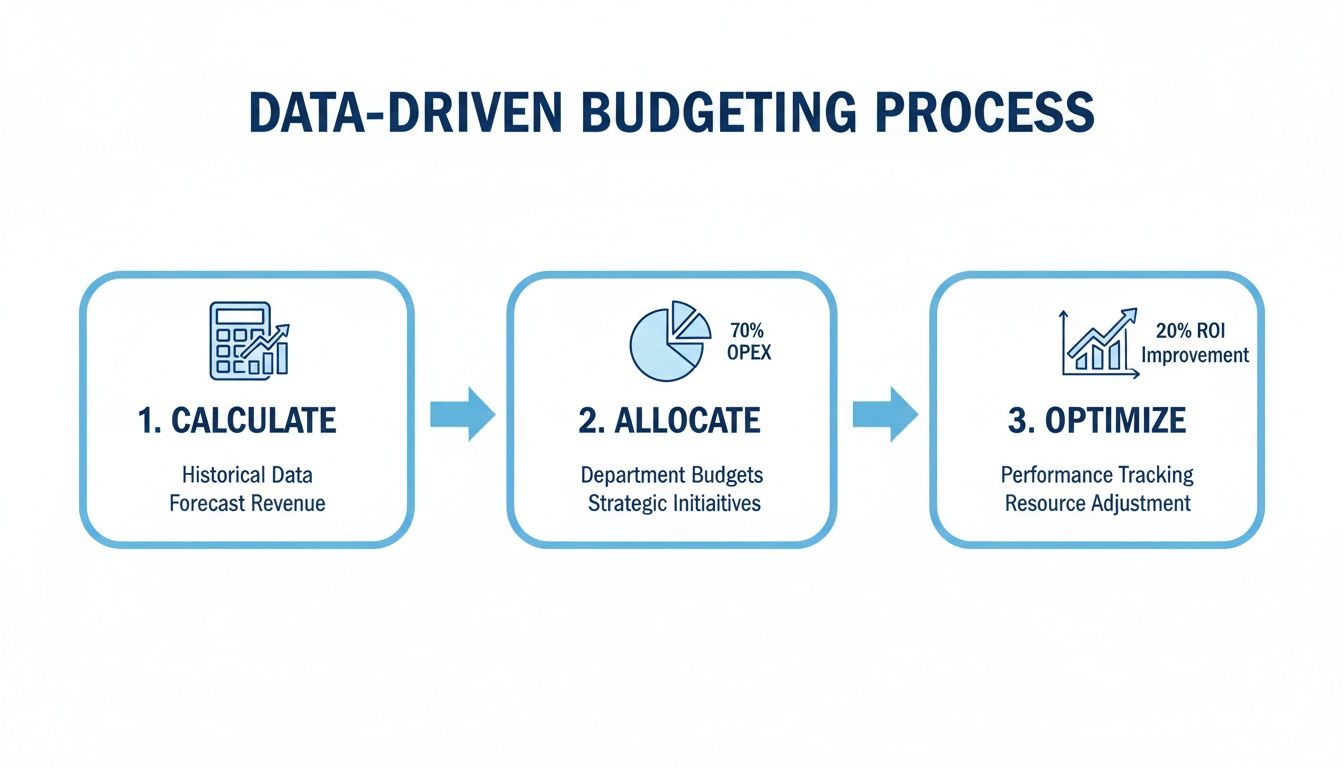
This visual really nails a crucial feedback loop: calculating your metrics, allocating your resources, and constantly optimizing performance are all interconnected steps that drive serious efficiency.
Creating a Seamless Data Ecosystem
True operational excellence at scale requires more than just a collection of standalone tools. It demands a fully integrated system. When your automated showing platform syncs directly with your Property Management Software (PMS) and your CRM, you create a seamless, uninterrupted flow of data.
This integration gives you complete, real-time visibility into your entire leasing funnel.
- Lead Source Tracking: Know exactly which ad channels are bringing in the leads that actually convert to tours and signed leases.
- Conversion Rate Monitoring: Easily track your lead-to-tour and tour-to-application rates for every single property and agent.
- Performance Benchmarking: Analyze data across your whole portfolio to spot your star properties and identify which ones need a little more help.
By connecting these systems, you give your team the data they need to make smarter decisions, get more out of your advertising spend, and ultimately, shorten that all-important speed-to-lease cycle. This is how you transform rental property advertising from a bunch of disconnected tasks into a smooth, automated engine that slashes vacancy loss and pushes revenue up. An integrated approach ensures that from the moment a lead comes in, the entire process is optimized for one thing: getting a quality tenant into your property as fast as humanly—and technologically—possible.
Your Top Rental Advertising Questions, Answered
When you're managing a large portfolio, rental advertising isn't just about posting on Zillow and hoping for the best. It's about building a predictable, scalable leasing engine. Here are some of the most common questions we hear from operations directors and portfolio managers, along with some straight answers.
How Do I Set a Realistic Advertising Budget Per Unit?
Forget picking a random number. Your advertising budget should be directly tied to the cost of letting a unit sit empty. The best way to think about this is by calculating your Maximum Allowable Cost-Per-Lease (CPL).
First, figure out what a 30-day vacancy really costs you. It's not just the lost rent. You've also got turnover expenses like cleaning, minor repairs, and the administrative time spent dealing with it all. For a property renting at $2,200/month, a 30-day vacancy can easily be a $2,500+ hit to your revenue.
A good rule of thumb is to set your CPL at 15-25% of one month's rent. On that same $2,200 unit, you’re looking at a budget of $330 to $550 to get a qualified tenant in the door. Spending that money isn't an expense; it's a strategic move to prevent a much bigger financial loss. This data-driven approach gives you the ammo to justify your ad spend and focus your efforts where they're needed most.
Which Technologies are Essential for Managing Listings at Scale?
Trying to manage listings for hundreds—or thousands—of doors manually is a recipe for disaster. You need a solid tech stack that's built for efficiency and remote work.
Here’s what your core system should include:
- A Centralized Listing Syndication Tool: This is non-negotiable. You need a platform that talks to your Property Management Software (PMS) and automatically pushes updated pricing, photos, and descriptions to all the major ILSs like Zillow, Zumper, and Apartments.com. It ensures everything is consistent and accurate without you lifting a finger.
- An Automated Showing and Scheduling Platform: Leads go cold fast. A tool that lets prospects self-schedule their own tours—whether they're in-person, virtual, or self-guided—is a game-changer. It cuts out the endless back-and-forth and has a direct, positive impact on your lead-to-tour conversion rate.
- A CRM with Real Analytics: You absolutely must have a system that can track a lead from the moment it comes in to the moment a lease is signed. That data tells you which channels are actually worth your money, helping you optimize your ad spend across different markets and property types.
The goal is to build an ecosystem where your PMS, listing syndicator, and showing platform all work together seamlessly. This creates a powerful feedback loop that automates your workflows and gives you the data you need to keep improving.
How Can We Effectively Measure Advertising ROI?
Measuring your return on investment is about much more than just clicks and impressions. For a serious operator, ROI has to be tied to what really matters: cutting vacancy loss and making your team more efficient.
These are the KPIs you should be obsessed with:
- Cost-Per-Lease by Source: You need to know exactly what it costs to land a tenant from each channel. If Zillow costs you $450 per lease but a targeted Facebook Ad campaign costs $250, you know exactly where to shift your budget for a better return.
- Lead-to-Lease Velocity: How long does it take for a lead from a specific channel to sign a lease? A channel that delivers tenants faster is more valuable because it directly slashes your Days on Market (DOM).
- Portfolio-Wide Vacancy Rate: This is the ultimate report card. A successful advertising strategy should lead to a clear, steady drop in your overall vacancy rate. That's how you prove its direct impact on the bottom line.
When you focus on these metrics, you stop just "spending on ads" and start making calculated investments that generate predictable, measurable results.
Ready to slash your Days on Market and convert more leads into leases? Showdigs provides the AI-backed leasing automation platform that combines intelligent software with on-demand field agents to accelerate your entire leasing funnel. Discover how Showdigs can optimize your operations at scale.
.png)

.png)