




Your tenant rental application isn't just administrative paperwork—it's the most critical conversion point in your leasing funnel. For property management companies managing hundreds or thousands of units, a clunky application process is a direct hit to revenue, driving up Days on Market (DOM) and causing qualified leads to abandon the process.
A confusing or outdated application is more than an annoyance. It directly translates into lost revenue from prolonged vacancies. For large-scale portfolios, this isn't a minor leak; it's a massive operational bottleneck draining your NOI.
How Your Rental Application Is Hurting Your Portfolio's NOI
When you're managing a large, distributed portfolio, the tenant application for rental properties is a direct reflection of your company's operational efficiency. Every second a qualified applicant spends wrestling with a poorly designed form is a second they could be applying to a competitor's property.
This friction doesn't just create a poor prospect experience. It inflicts tangible financial damage that compounds quickly across a large portfolio, directly impacting your speed-to-lease.

The High Cost of Application Friction at Scale
Let's calculate the real-world financial impact. Imagine you manage a portfolio of 1,000 units, with an average rent of $2,000 per month. That's approximately $66.67 in lost revenue per unit, per vacant day.
If your inefficient application process adds just three extra days of vacancy to each turnover, the cost scales rapidly.
- Cost per unit turnover: 3 days x $66.67/day = $200.01 in lost revenue
- Annual portfolio impact: Assuming a 40% annual turnover rate (400 units), the total loss is a staggering 400 units x $200.01 = $80,004 per year.
This calculation doesn't even account for wasted marketing spend on lost leads or the operational drag on your team chasing incomplete information. Every additional day on market is a direct reduction in your Net Operating Income (NOI). Reducing DOM by even a single day can add tens of thousands of dollars back to your bottom line.
Meeting the Demands of the Modern Renter
Today’s competitive rental market amplifies this problem. Prospective tenants are digitally savvy, have high expectations for user experience, and have little patience for friction. They are quick to move on when they encounter a roadblock.
A seamless, mobile-friendly application isn't a "nice-to-have"; it's a critical component for achieving high lead-to-tour conversion rates. For property managers managing a high volume of inquiries across a distributed portfolio, an inefficient system is a surefire way to prolong vacancies and bleed revenue.
For enterprise-level portfolios, the tenant application for rental properties is no longer a simple form. It's a strategic tool that can either accelerate your speed-to-lease and boost revenue or become a major operational bottleneck that quietly drains your profits.
Optimizing this single touchpoint is one of the highest-leverage actions a large-scale property manager can take. It directly impacts your most critical KPIs: slashing DOM, boosting lead-to-lease conversion rates, and maximizing revenue across your entire portfolio. The rest of this guide provides an actionable framework to transform your application from a liability into a high-performance asset.
Designing A Digital Application That Converts
A clunky, confusing application is a direct threat to your leasing velocity. For every qualified applicant who abandons your form out of frustration, your Days on Market increase, and you lose potential revenue. The solution isn't just putting a form online; it's engineering a digital experience that feels effortless, intuitive, and accelerates the applicant toward a decision.

Mobile-First Is Non-Negotiable
A significant portion of your applicants will complete your form on their smartphones. If your tenant application for rental units isn't optimized for a mobile experience, you're erecting a significant barrier at the most critical stage of the leasing funnel.
This means more than a responsive design that shrinks to fit a screen. A true mobile-first design features large, easy-to-tap fields, logical workflows, and dropdowns that function seamlessly without pinching and zooming. A poor mobile experience is one of the fastest ways to lose a top-tier applicant to a competitor with a more modern tech stack.
Combating Form Fatigue to Maximize Completion Rates
Long, intimidating forms lead to high abandonment rates. The key is to manage the applicant's perception of effort and build momentum throughout the process.
Here are a few simple features that make a massive difference in conversion:
- Progress Bars: A visual indicator showing "You're on step 2 of 4" is incredibly motivating. It communicates progress and shows the applicant they are close to the finish line.
- Auto-Save Functionality: Applicants may get interrupted or need to locate a document. Allowing them to save their progress and return later shows respect for their time and dramatically improves completion rates.
- Logical Field Grouping: Breaking the form into digestible sections like "Personal Info," "Rental History," and "Employment" makes the process feel like a guided conversation rather than an interrogation.
The goal is to create a digital handshake—a process so smooth and professional that it sets a positive tone for your entire management company. Every click should pull the applicant forward, not push them away.
Smart Design That Boosts Data Quality
Once the fundamentals are in place, advanced features can further enhance the experience and improve the quality of submitted applications.
Conditional logic is a game-changer for scalability. This feature dynamically shows or hides questions based on previous answers. For example, if an applicant indicates they do not have a pet, all subsequent questions about breed, weight, and vet records disappear. This personalizes and shortens the form, removing irrelevant steps and reducing friction.
The psychology behind creating a high-converting intake form applies directly to tenant applications. The core principle is the same: eliminate every point of friction.
For property managers focused on scaling operations, a frictionless application is the first step to optimize your leasing funnel and reduce costly vacancies. The design choices you make directly impact your bottom line, from lead conversion rates to portfolio-wide profitability.
Navigating The Legal Maze Of Rental Applications
For property managers with units across multiple states, compliance isn't just a best practice—it's the foundation of a scalable and defensible business. A single non-compliant question on your rental application creates a risk that is multiplied across your entire portfolio. A standardized, legally vetted application process is essential.
This isn't about finding a one-size-fits-all template. It's about creating a robust framework that adheres to federal, state, and local laws without creating operational chaos. The goal is consistency and fairness, ensuring every applicant is evaluated against the same objective, legally sound criteria.
Fair Housing Act Essentials
Your starting point is always the federal Fair Housing Act (FHA). This law prohibits discrimination based on seven protected classes: race, color, religion, national origin, sex (including gender identity and sexual orientation), disability, and familial status. Every question on your application must be filtered through this lens.
Seemingly innocuous questions can create legal exposure. For instance, instead of asking about marital status, which can imply familial status discrimination, you should ask for the total number of occupants. The golden rule is that every question must be directly related to the applicant's ability to meet the terms of the lease.
A legally defensible tenant application is your first line of defense against costly discrimination claims. Its purpose is to gather the necessary information to assess risk, not to collect personal details that could lead to a biased decision.
State And Local Regulations
While the FHA sets the national standard, the primary challenge for multi-market operators is the complex web of state and local laws. These regulations can be highly specific and are subject to change, requiring ongoing diligence.
Common variations to address in your operational framework include:
- Application Fee Caps: Some states impose strict limits on application fees. New York caps fees at $20, while Virginia allows up to $50. Other states, like Colorado and Washington, stipulate that the fee cannot exceed actual screening costs. Your property management system must be configured to adjust fees based on property location to avoid illegal overcharges.
- "Ban the Box" Laws: An increasing number of jurisdictions restrict when and how you can inquire about criminal history. These laws often require a conditional rental offer to be made before a criminal background check is run, altering the traditional screening workflow.
- Source of Income Protection: Many local ordinances protect an applicant's lawful source of income. This means income from housing vouchers, disability benefits, or alimony must be considered the same as employment wages. Your application and screening criteria must reflect these protections.
Creating A Defensible Application Template
Managing compliance at scale requires a standardized yet flexible template. Your core application should be consistent across all markets, collecting essential information like identity verification, rental history, employment, and income.
The solution is to build in state-specific addendums or conditional fields that only appear based on the property's address. This ensures you are asking for—and not asking for—the correct information in every market you serve.
Actionable Compliance Checklist for Large Portfolios:
- Audit Your Current Application: Review every question and ask, "Why do I need this information, and could it be perceived as related to a protected class?" If it doesn't directly pertain to their ability to pay rent and abide by lease terms, remove it.
- Develop a Multi-State Compliance Matrix: Create a centralized document that tracks key regulations (fee caps, "ban the box" rules, source of income laws) for every market. This should be a living document updated at least annually.
- Standardize Screening Criteria: Document your screening criteria and provide it to every applicant. This document should clearly outline minimums for credit, income, and rental history, serving as proof of objective and consistent decision-making.
- Train Your Leasing Team: Your leasing agents are on the front lines and require regular training on fair housing and how to handle applicant questions without creating legal risk, such as responding appropriately to a request for a reasonable accommodation.
A legally sound application process not only mitigates risk but also builds a professional reputation and an operational framework that supports confident growth into new markets.
Building Repeatable Tenant Screening Criteria
A high-converting rental application is only half the battle. Without an objective, consistent, and well-documented screening process, you invite inconsistency and legal risk—two factors that are fatal to scalable operations.
For any large portfolio manager, documenting your screening criteria before reviewing an application isn't just a best practice; it's a non-negotiable operational control.
This simple step transforms screening from a subjective judgment into a repeatable, defensible system. It ensures every team member, regardless of their location, uses the exact same yardstick to evaluate applicants. This is your strongest defense against fair housing complaints and the foundation of a scalable leasing operation.
Defining Your Core Financial Thresholds
First, establish clear, quantifiable financial standards. These rules must be directly tied to an applicant's ability to pay rent and fulfill lease obligations. Vague policies are indefensible; you need specific, documented minimums.
Two key financial metrics are industry standards for good reason:
- Income-to-Rent Ratio: The 3x monthly rent rule is a widely accepted benchmark. It requires an applicant's verifiable gross monthly income to be at least three times the rent. For a diverse portfolio, this ratio ensures consistent evaluation across different price points.
- Credit Score Minimums: Establish a defensible minimum credit score. While there is no universal number, many property managers set a threshold between 600 and 650. The critical element is applying that standard consistently to every applicant for a given property type.
When you're operating at scale, your screening criteria are more than just guidelines—they're an operational asset. A well-documented policy allows any team member, anywhere, to make a confident and compliant leasing decision. This crushes approval bottlenecks and helps get your Days on Market down.
Navigating Criminal and Eviction Histories
Handling criminal and eviction histories requires a nuanced and careful approach, especially for multi-market portfolios. Blanket bans ("we do not rent to anyone with a criminal record") are a significant legal liability and should be avoided.
Instead, implement a policy that uses an individualized assessment based on clear look-back periods. For example, your criteria might state that you do not consider applicants with specific felony convictions from the last seven years. The policy should focus on offenses that present a demonstrable risk to the property or the safety of other residents.
The same logic applies to eviction histories. A common and defensible policy is to automatically decline applicants with an eviction filing within the past three to five years. By documenting these rules, you remove subjectivity and ensure every applicant is evaluated fairly under the same criteria.
Sample Screening Criteria Checklist for Large Operators
To make this process foolproof, create a simple checklist that your team can use across the entire portfolio. This not only drives consistency but also gives you a clear audit trail for every application you process.
This systematic approach removes guesswork, empowers your teams, and creates a scalable framework that protects your business as it grows. It's the operational backbone you need to build a fast, efficient, and legally compliant leasing machine.
Automating The Process From First Contact To Lease
A perfectly designed and legally compliant application unlocks its true potential when integrated into an automated leasing funnel. For property managers handling hundreds or thousands of doors, manual processes are not just inefficient—they are a direct impediment to growth.
Automation transforms a high volume of leads into signed leases at maximum velocity. It creates a seamless, low-touch journey that moves a qualified applicant from initial inquiry to a signed lease with minimal human intervention. This is where modern property management technology provides a decisive competitive advantage, slashing your cost-per-door and reducing DOM.
Pre-Qualifying Leads Before The Tour
One of the greatest operational drains on a leasing team is conducting tours for prospects who will not qualify. Automation allows you to place this qualification process on autopilot, ensuring your team engages only with viable applicants.
Here’s how to implement it:
- Automated Pre-Screening Questions: Before a prospect can book a showing, an automated system can ask key qualifying questions. Simple queries like, "Is your gross monthly income at least 3x the rent?" or "Do you meet the minimum credit score requirement?" instantly filter out unqualified leads.
- AI-Powered Leasing Assistants: An AI leasing assistant works 24/7 to answer common questions, gather basic information, and pre-qualify leads. This ensures no lead goes cold and that initial qualification occurs automatically, even outside business hours.
This initial filtering is a game-changer for operational efficiency. It means your showing agents—whether in-house or on-demand—are only meeting prospects with a high probability of converting to a lease.
Seamless PMS Integration for Accelerated Decisions
After a prospect completes a tour and submits an application, the next step is critical. Connecting application data directly to your Property Management System (PMS) is the core of an automated leasing operation.
When your application platform integrates with a PMS like AppFolio, Rent Manager, or Yardi, you create a seamless data pipeline. Manual data entry, a process prone to errors and delays, is eliminated. With an integrated system, applicant data flows directly into your screening workflow.
This is where true velocity is achieved.
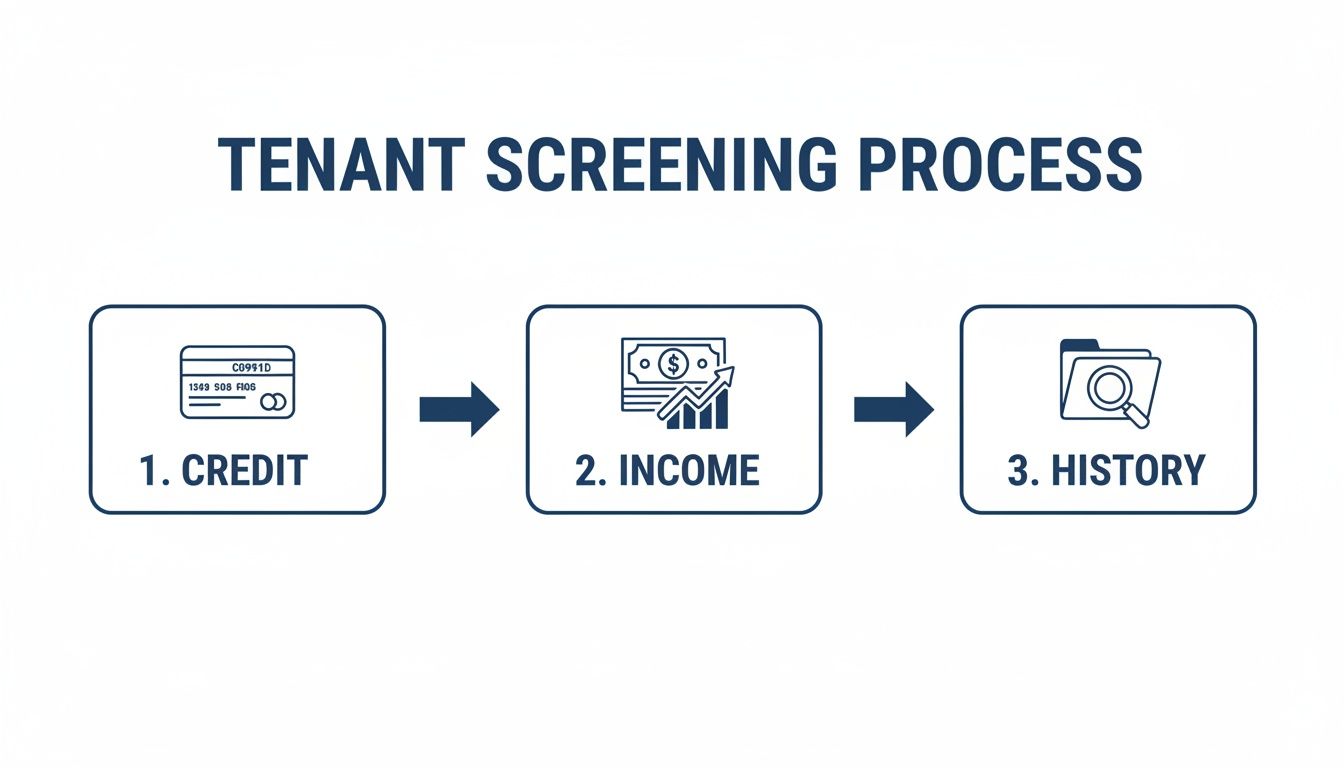
The entire screening process—credit, income, rental history—becomes nearly instantaneous, enabling you to make a leasing decision in hours, not days.
By automating the flow of information from the rental application directly into your PMS, you can shrink the decision timeline from days to just a few hours. In a competitive rental market, that speed is everything. It lets you lock down the best tenants before anyone else gets a chance.
The demand for this efficiency is driving significant investment in the industry. According to a 2024 report by PropTech experts, automation in leasing can reduce DOM by up to 50% for large portfolios by eliminating manual bottlenecks.
The Impact on Key Portfolio Metrics
Implementing an automated leasing funnel has a direct, measurable impact on your portfolio's financial performance. When you connect lead generation, pre-qualification, showings, and applications into a single, automated workflow, you will see significant improvements in key metrics. For a closer look, you can learn more about how marketing automation streamlines your leasing process.
Ultimately, this technology stack frees your team from low-value administrative tasks, allowing them to focus on high-value activities like resident relations and business development. This directly improves your speed-to-lease, cuts vacancy loss, and lowers your cost-per-door—providing the scalable foundation needed to grow your portfolio profitably.
Frequently Asked Questions
Even with a well-oiled machine, property managers running large, multi-market portfolios get hit with the same questions over and over. Getting these answers right isn't just about efficiency; it's about staying compliant and keeping your operations smooth at scale.
Let's break down some of the most common questions that pop up during the application and screening grind.
How Much Can I Legally Charge For A Rental Application Fee?
This is a major compliance trap for multi-market operators because there is no single federal standard. The limits vary significantly by state and even city.
Many jurisdictions cap the fee at your actual screening costs, which typically falls between $35 and $75. However, states like New York impose a hard $20 cap, while Virginia limits it to $50. For a large portfolio, maintaining a detailed compliance matrix for every location is non-negotiable to avoid legal penalties.
Your best defense is a standardized process. Always provide an itemized receipt for the fee and, if required by local law, a copy of the screening reports purchased. Overcharging, even accidentally, can result in significant fines.
What Should I Do If An Applicant Provides False Information?
Your first line of defense is a well-drafted application form. The tenant application for rental properties you use absolutely must include a certification statement at the end. This is where the applicant signs to confirm that all provided information is true and accurate.
This clause should also state that any falsified information is grounds for immediate denial of the application.
If you discover false information during screening, you have a clear, documented, and objective reason to deny the application, which ties directly back to your written criteria. This makes the rejection defensible. If the falsehood is discovered after a lease is signed, your lease agreement should contain a clause allowing for termination based on application fraud. The key is to enforce this policy uniformly across the entire portfolio to avoid discrimination claims.
Can I Deny An Applicant Based On Their Criminal Record?
Yes, but this must be handled with extreme care to comply with Fair Housing laws. The Department of Housing and Urban Development (HUD) has issued guidance stating that blanket policies denying any applicant with any criminal record are legally risky, as they can have a disparate impact on protected classes.
The best practice is to conduct an individualized assessment. This means considering the nature and severity of the crime, how long ago the offense occurred, and any mitigating evidence the applicant provides.
Your written screening criteria must be specific. Define which types of convictions may result in a denial and establish a "look-back" period (e.g., no violent felonies within the last seven years). Because this is a legally complex area, consulting with legal counsel to develop a defensible, portfolio-wide policy is a critical investment. It provides your team with the framework needed to make consistent, low-risk decisions while evaluating each applicant fairly.
Ready to eliminate application bottlenecks and slash your Days on Market? Showdigs provides an AI-backed leasing automation platform that connects pre-qualified leads to on-demand showings, creating the fastest path from first contact to signed lease. See how our system can integrate with your PMS to accelerate your entire leasing funnel. Learn more at Showdigs.


.png)