
For large-scale property management companies, tenant application screening is more than a background check—it’s the central control valve for portfolio health and revenue velocity. A slow, inconsistent, or manual screening process directly inflates vacancy costs, creates operational drag, and acts as a bottleneck that limits speed-to-lease. It’s a direct impediment to scalable growth and exposes your entire portfolio to unnecessary risk.
Why Scalable Tenant Screening is a Non-Negotiable KPI Driver
For property managers balancing portfolios of 100 to 10,000+ units, the tenant screening process is a critical point of leverage for financial performance.
Every day an approved applicant is left waiting—or worse, a weak application is approved due to process gaps—translates into a measurable revenue loss. This isn’t just about finding qualified tenants; it’s about engineering a predictable, scalable leasing engine that accelerates revenue capture and supports sustainable growth.
An inefficient system has a direct and costly impact on your most critical metric: Days on Market (DOM). A clunky screening workflow can easily add 3-5 days to your leasing timeline, delaying lease signing and move-in. For a portfolio of 1,000 units with an average daily rent of $60, a three-day delay per vacancy represents over $180,000 in lost revenue annually.
The Pillars of an Enterprise-Grade Screening System
To combat this revenue leakage, enterprise-level property managers are moving beyond manual checklists toward a tech-driven framework built on three core pillars:
- Consistent Criteria: Establish objective, non-negotiable standards for income, credit, and rental history, applied uniformly across every asset and market. This removes subjective guesswork, improves decision quality, and is the first line of defense against Fair Housing violations at scale.
- Intelligent Automation: Integrate screening software directly with your PMS and leasing platforms to create a frictionless workflow. This eliminates manual data entry, accelerates decision-making, and can shrink the application-to-lease cycle from days to hours, a key factor in improving lead-to-tour conversion rates.
- Ironclad Compliance: Modern systems automate and document every step of the process. From applicant consent to adverse action notices, a clear audit trail ensures your operations are legally defensible across a multi-market portfolio.
A robust, scalable screening process is your primary tool for accelerating lease-up velocity. It transforms a reactive, administrative task into a proactive strategy for risk mitigation and revenue optimization, ensuring every unit is filled faster with a qualified resident.
This shift toward systemization is a major industry trend. The global tenant screening market was valued at over $3.2 billion in 2023 and is projected to nearly double by 2032, driven by the enterprise-level need for efficiency and risk management in large portfolios.
As you scale your operations, the sophistication of your partners is critical. Understanding their approach to tenant screening is vital when selecting a property management company. A partner’s screening technology is a direct indicator of their ability to protect your assets and drive portfolio performance. By standardizing your approach, you build a resilient operation capable of handling high volume without sacrificing quality or compliance.
Developing a Defensible Screening Policy at Scale
Your screening policy is the operational rulebook for your entire leasing function. It minimizes portfolio risk, ensures fairness, and creates a repeatable process that can scale from 100 to 10,000 units. A well-defined, documented policy eliminates the subjective guesswork that leads to Fair Housing claims and operational inconsistency.
A strong policy ensures a leasing agent in one market applies the exact same logic as an agent in another. This isn’t about creating barriers; it’s about building a consistent, legally defensible process that measures every applicant with the same objective yardstick. That consistency is your best defense against discrimination claims and the foundation of an efficient leasing engine.
Establishing Objective Criteria
The backbone of a scalable policy is a set of clear, non-negotiable standards. Vague guidelines create inconsistency and risk. Instead, define specific, measurable thresholds for the core components of your tenant application screening.
- Income-to-Rent Ratio: The industry standard is typically 3x the monthly rent in verifiable gross income. Specify acceptable documentation (e.g., pay stubs, bank statements verified via API, offer letters) and your verification process.
- Minimum Credit Score: Define a specific score, such as 650, but more importantly, detail how your policy handles collections, bankruptcies, or a pattern of late payments.
- Rental History Verification: Document your exact process for contacting previous landlords. What questions are asked? How do you handle applicants without a formal rental history? This protects you from accusations of inconsistent treatment.
- Criminal Background Checks: This is a major Fair Housing hotspot. Your policy must be specific, assessing only relevant convictions that pose a direct threat to the property or residents, while strictly adhering to all local and state “ban the box” laws.
This decision tree visualizes how an inconsistent or biased screening process directly impacts financial outcomes, while a structured, objective policy protects your assets.
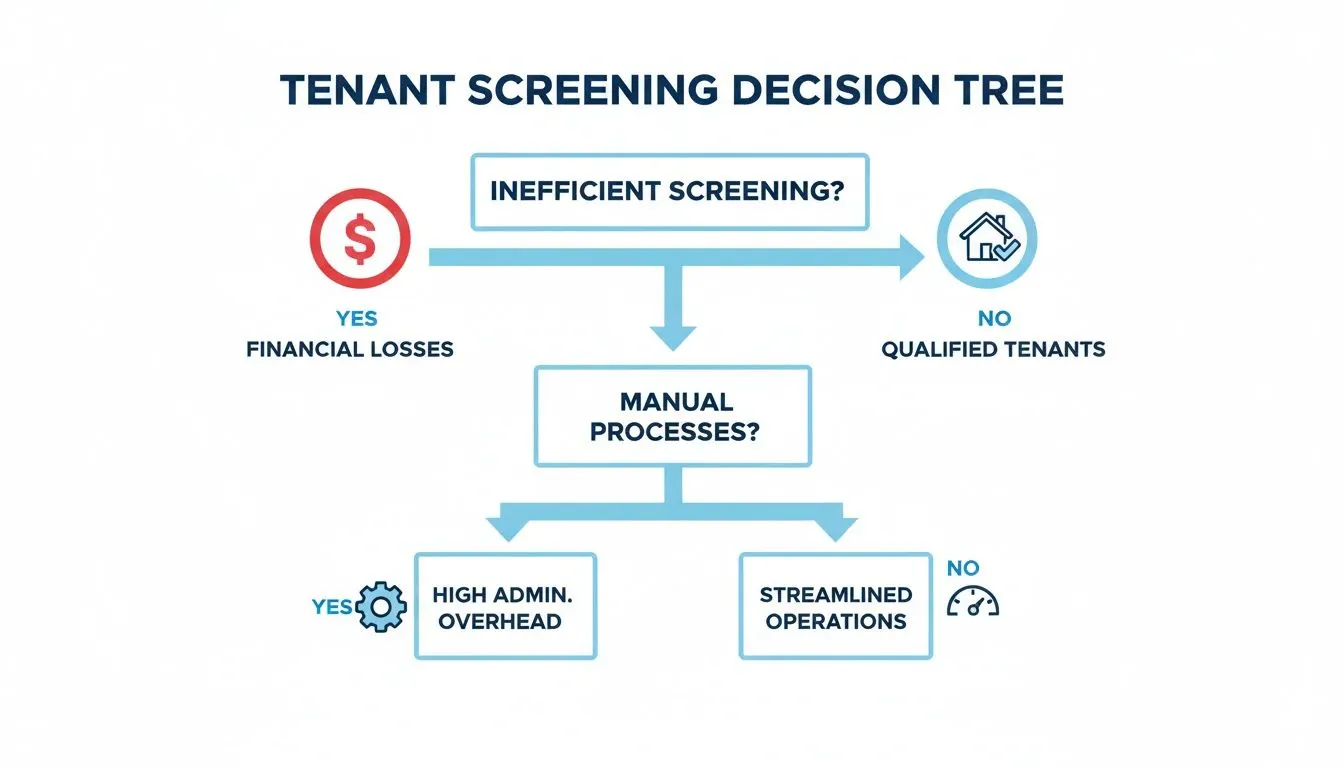
A well-defined policy isn’t just a compliance task—it’s a direct driver of operational and financial health for your portfolio.
Building a Tiered Scoring Matrix
For any property manager with a distributed portfolio, a simple pass/fail system is too rigid. A tiered scoring matrix provides necessary nuance while maintaining objectivity. This model enables conditional approvals, which can reduce vacancy by creating a path forward for qualified applicants who may have a minor blemish on their record.
A three-outcome structure works best for scalability:
- Automatic Approval: The applicant exceeds all thresholds (e.g., credit score > 700, income > 3x rent, flawless rental history).
- Conditional Approval: They meet most criteria but fall short in one area (e.g., credit score is 600-649). This can trigger a requirement for a higher security deposit or a qualified co-signer, where permitted by law.
- Automatic Denial: The applicant fails a non-negotiable criterion (e.g., income < 2.5x rent, recent eviction, or relevant criminal conviction per policy).
This sample matrix provides a model for setting objective, multi-tiered criteria that can be applied consistently across a large portfolio.
Example Tenant Screening Criteria Matrix
Screening ComponentAutomatic ApprovalConditional ApprovalAutomatic DenialGross Monthly Income****≥ 3x monthly rent2.5x - 2.99x monthly rent**< 2.5x** monthly rentCredit Score****≥ 680****600 - 679 (May require co-signer or increased deposit)< 600 or active bankruptcyRental History****2+ years of positive, verifiable history; no late payments in the last yearNo prior rental history (e.g., student, first-time renter) Any eviction filing in the last 5 years or money owed to a prior landlordCriminal BackgroundNo relevant convictionsCase-by-case review based on nature and time of non-violent/non-drug manufacturing offensesAny relevant felony convictions within the last 7 years per policy
This type of matrix institutionalizes decision-making and empowers your team to make rapid, compliant choices at scale.
A scoring matrix ensures that whether you’re processing five applications or five hundred, the outcome is determined by consistent, pre-defined business rules, not individual judgment. This system is the cornerstone of a defensible and efficient screening operation.
This systematic approach is fundamental to acquiring qualified tenants at scale. For more ideas on how to sharpen your criteria, check out these expert tips for screening tenants effectively.
Leveraging Technology for Automated and Secure Screening
In high-volume leasing operations, manual screening destroys scalability and profitability. It introduces human error, creates bottlenecks that inflate Days on Market (DOM), and leaves your portfolio vulnerable to sophisticated application fraud. For large-scale managers, technology-driven automation isn’t a choice; it’s a strategic necessity for making faster, more secure decisions.
Modern screening platforms do more than pull a credit score. Today’s best-in-class tools are designed to combat fraud by verifying information with a level of precision that is impossible to achieve manually. This has become a core operational requirement for risk mitigation.
Leveraging AI for Fraud Detection and Verification
Application fraud has evolved. AI-generated pay stubs and digitally altered bank statements are nearly indistinguishable from authentic documents. AI-powered verification provides a crucial layer of defense for your tenant application screening process.
Top-tier screening solutions now offer:
- Instant Income Verification: By connecting directly to an applicant’s bank or payroll provider via API (with their consent), these tools confirm income at the source, eliminating reliance on easily forged documents.
- Bank Statement Analysis: AI algorithms can scan bank statements for red flags, such as suspiciously large, one-time deposits designed to inflate an applicant’s perceived financial stability.
- Document Tampering Detection: Advanced systems can identify metadata inconsistencies or pixel-level alterations in uploaded PDFs that are invisible to the human eye.
The industry is adopting these tools out of necessity. An Experian analysis found that a staggering 93.3% of property managers encountered application fraud in the past year, with 84.3% citing falsified pay stubs and employment references as the top culprits.
With a 2025 forecast showing that 65% of property management companies have already implemented AI-powered screening, not adopting this technology makes your portfolio an easier target for fraudsters. You can explore more data in this analysis of today’s rental market.
Creating a Seamless Application-to-Lease Workflow
The greatest operational gains are realized when screening technology is integrated into your core leasing ecosystem. A siloed screening tool creates more manual work. The goal is a seamless data flow that connects the entire prospect journey, from initial inquiry to lease execution.
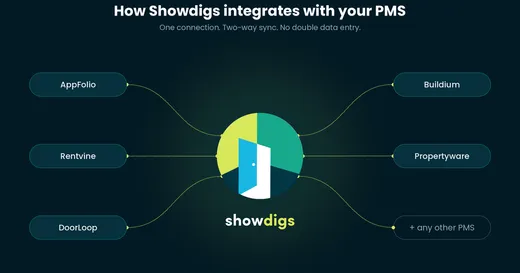
When you integrate your screening provider with your Property Management System (PMS) and a leasing automation platform, you create a powerful, high-velocity leasing funnel. A prospect can complete a tour, apply on the spot via mobile, and have their data flow directly into the screening engine. The results are returned to your PMS, allowing your team to make a decision and issue a lease in minutes, not days.
This integrated approach transforms your leasing cycle. It can shrink the application-to-lease timeline from 3-5 days to under 24 hours, capturing high-intent applicants before they tour another property. Speed is a direct and measurable strategy to reduce DOM.
This level of automation also dramatically improves team efficiency, directly lowering your cost-per-lease. By eliminating manual data entry and follow-up, you free up leasing staff to manage a higher volume of applications, focusing their time on lead nurturing and closing deals.
For a deeper dive into how AI empowers leasing teams, review the benefits of using an AI leasing assistant. By adopting an automated and secure screening system, you are not just managing risk—you are building a more profitable and scalable leasing operation.
Maintaining Fair Housing Compliance Across a Multi-Market Portfolio
For any property management company operating at scale, compliance is not a checkbox—it is a core business function. A single Fair Housing violation can create a ripple effect of financial and reputational damage across an entire portfolio. The only way to operate safely is to embed compliance into the DNA of your tenant application screening process.
This requires more than a basic understanding of the law. It demands an operational framework that ensures consistency. The objective is to protect your assets and brand by treating every applicant identically, every time, with the documentation to prove it.
Understanding Disparate Impact
While intentional discrimination is well understood, the more significant risk for large portfolios is disparate impact. This occurs when a seemingly neutral policy unintentionally disadvantages a protected class.
For example, a blanket policy of rejecting any applicant with any criminal record could disproportionately affect certain racial or ethnic groups, creating grounds for a Fair Housing complaint even if no discriminatory intent existed.
The key is to ensure every screening criterion is directly linked to a legitimate business necessity, such as an applicant’s ability to pay rent and care for the property.
When you manage thousands of units, your screening policy is judged by its outcome, not its intent. A policy that creates a statistically negative result for a protected group can be as legally damaging as overt discrimination.
Handling Criminal Histories and Accommodations
Screening for criminal history requires a nuanced, individualized approach. The Department of Housing and Urban Development (HUD) has provided clear guidance that landlords should consider the nature, severity, and date of a conviction. A “one-size-fits-all” ban is a major compliance risk.
- Individualized Assessment: Your policy must include a process for evaluating convictions on a case-by-case basis, considering the crime, its recency, and any mitigating circumstances.
- Relevance is Key: The assessment should focus only on convictions that pose a demonstrable threat to the property or the safety of other residents.
- Reasonable Accommodations: Your entire team must be trained to recognize and properly handle requests for reasonable accommodations or modifications for individuals with disabilities. An inconsistent or delayed response can itself be a Fair Housing violation.
The Adverse Action Notice Process
This process is non-negotiable. If you deny an applicant based on information from a consumer report (e.g., credit check, background screening), the Fair Credit Reporting Act (FCRA) legally requires you to send an adverse action notice.
This notice must be sent to the applicant and must clearly state:
- That the decision was based, in whole or in part, on information from a consumer reporting agency.
- The name, address, and phone number of the agency that provided the report.
- A statement that the agency did not make the decision and cannot explain the reason for denial.
- That the applicant has a right to obtain a free copy of their report from that agency within 60 days.
- That they also have the right to dispute any inaccurate information in the report.
Automating this process through your property management software is the only scalable and compliant solution. It ensures every denial is handled correctly and consistently, creating a defensible audit trail that protects your portfolio from costly legal challenges.
Tracking the KPIs That Define Screening Success
You cannot optimize what you do not measure. For large-scale property managers, a high-performance screening process is a direct contributor to the bottom line. To connect screening operations to portfolio performance, you must track the right key performance indicators (KPIs).

This is about more than data collection; it’s about generating actionable insights that identify process bottlenecks, quantify efficiency gains, and justify technology investments. When you can demonstrate to leadership precisely how a faster screening process reduces vacancy loss, the conversation shifts from operational cost to strategic investment.
Essential Screening Metrics for Large Portfolios
While every company’s dashboard differs, several core KPIs provide a clear view of your screening effectiveness. These metrics move beyond a simple pass/fail to measure the speed, quality, and financial impact of your decisions.
Essential data points for enterprise-level tracking include:
- Application Processing Time: The duration from completed application submission to final decision delivery. A lengthy processing time is the fastest way to lose qualified applicants to competitors. The goal is to reduce this from days to hours.
- Approval-to-Lease-Signed Time: This measures the gap between applicant approval and executed lease. An increasing number here indicates friction in your lease generation or signing workflow—a critical drop-off point for approved tenants.
- First-Year Eviction Rate: This is the ultimate report card on your screening quality. Tracking the percentage of tenants evicted within their first 12 months provides definitive feedback on whether your criteria are identifying stable, long-term residents.
- Cost Per Application Processed: Calculate the total cost of screening software, associated labor, and overhead, divided by the number of applications processed. This defines the unit economics of your leasing operation and helps calculate the ROI of automation tools.
Calculating the ROI of Screening Technology
To secure investment in superior screening technology, you must tie its impact directly to revenue. The ROI framework is simple when you focus on how speed affects your most important financial metric: Days on Market (DOM).
Every day you eliminate from the application-to-lease timeline is a day of rent captured. Across a portfolio of thousands of units, these days compound into significant annual revenue, directly improving your Net Operating Income (NOI).
Consider the financial impact. Property management firms in major metro areas have achieved a 20% reduction in vacancy rates simply by implementing an integrated online screening and leasing workflow. With vacancy costing hundreds or thousands per unit per month, even a marginal drop in DOM can translate to six-figure revenue gains for portfolios of 100+ units.
You can run this calculation for your own portfolio. Determine your average daily rent. Then, multiply that by the number of days you can cut from your screening timeline. For a 1,000-unit portfolio, shortening a 4-day screening process to just 2 days could recapture thousands of dollars in vacancy loss every single month.
This data-driven approach transforms screening from a cost center into a documented value-driver. To diagnose your own operational health, use a framework to assess your business health with key leasing metrics. It provides the concrete data needed to drive improvements and prove the value of every operational change.
Tenant Screening FAQs
Even with a robust screening policy, complex real-world questions arise, especially when managing a multi-market portfolio. Clear, consistent answers are essential for maintaining efficiency and compliance. Here’s how to handle common challenges faced by large-scale property managers.
How Do We Standardize Screening Criteria Across Different States?
This is a primary challenge for multi-market operators. The solution is to build your policy on a federal foundation—the Fair Housing Act—and then layer on local regulations.
Your core criteria, such as income-to-rent ratios, credit score thresholds, and rental history standards, should remain consistent across all markets to create a uniform baseline.
Then, leverage technology to manage local variations. Modern property management software allows you to create rule sets for specific states or municipalities. This enables you to systematically account for “ban the box” laws in one city, source of income protections in another, or varying security deposit limits. This “federal baseline, local addendum” model ensures consistency where it counts and compliance where it matters.
What Is the Best Way to Handle Applicants Offering to Pay Rent Upfront?
An offer to pay six or twelve months’ rent upfront can seem appealing, especially for a unit experiencing high DOM. However, accepting such offers creates significant Fair Housing risk.
The core issue is consistency.
If you make an exception for one applicant because they offer a large upfront payment, you must offer the same option to every similarly situated applicant. Failure to do so can lead to a discrimination claim. The operational complexity and legal risk are not worth it.
The most defensible and scalable approach is to adhere strictly to your written policy. If an applicant does not meet your income requirements, the proper procedure is to require a qualified co-signer or guarantor. This maintains your financial standards and provides a legally sound method for securing the lease without introducing inconsistency.
How Does Integrating Screening with a Leasing Platform Help?
Connecting your screening software with a leasing automation platform like Showdigs is not just about convenience; it’s about speed and conversion. The moment between a property tour and an application is where you win or lose a high-intent lead.
A prospect has just completed a tour and their interest is at its peak. A direct integration allows them to apply immediately, capturing that momentum before they can view another property.
The synergy between touring and application systems is a direct driver of DOM reduction. It systematically removes the small delays and administrative hurdles that give qualified, high-intent leads time to find and apply for another property.
For your team, this integration is a massive efficiency gain. Manual data entry is eliminated, everything is centralized, and the entire leasing pipeline accelerates. It is a simple technological change that converts more qualified leads into signed leases, directly impacting revenue.
What Are the Most Common Red Flags to Look For?
While a screening report provides objective data, your team must also be trained to identify subtle red flags that may indicate fraud or future tenancy issues.
- Inconsistent Information: Discrepancies between the application and the background report (e.g., employment duration, previous addresses) are major red flags.
- Unexplained Gaps in Rental History: Long, unaccounted-for periods between tenancies could conceal an eviction or an undesirable rental history.
- Suspicious Landlord References: Be wary if a “previous landlord” is a friend or family member providing vague answers. A quick property records search can verify ownership.
- Extreme Urgency: Applicants who aggressively push to expedite the process or ask you to skip steps may be attempting to conceal information.
A critical modern red flag is the reliance on PDF pay stubs or bank statements. Document forgery tools are highly sophisticated, making fake documents nearly impossible to detect visually. Automated, source-linked income verification is no longer a luxury—it is your most effective defense against fraud.
Ready to shrink your application-to-lease timeline and reduce vacancy across your portfolio? Showdigs combines AI-powered automation with an on-demand agent network to create the fastest, most efficient path from lead to lease. Learn how our integrated leasing platform can help you cut Days on Market and improve your operational efficiency.