




For large-scale property management companies, a tenant rental application isn't just paperwork—it's a critical control point in the leasing funnel. It’s the primary data-gathering tool that protects against costly vacancies and standardizes risk assessment across a distributed portfolio. A poorly designed application process is a direct drag on your Net Operating Income (NOI).
From Application Bottleneck to Revenue Velocity
When managing hundreds or thousands of scattered-site units, a clunky or manual application process is a major operational bottleneck. It doesn't just frustrate applicants; it directly inflates your Days on Market (DOM) and erodes profitability. Every day a unit sits vacant due to a sluggish application workflow is lost revenue, a loss that compounds exponentially across a large portfolio.
Conversely, a streamlined and automated tenant rental application process becomes a powerful engine for leasing velocity. It transforms a slow administrative task into a strategic asset that accelerates the lead-to-lease cycle. This optimization is non-negotiable for hitting key performance indicators (KPIs) tied to operational efficiency and cost per door.

The True Portfolio Cost of a Slow Application Process
The financial impact of a deficient application system extends far beyond lost rent. It creates significant operational drag that cripples scalability.
- Increased Administrative Overhead: Manual data entry, chasing missing documents, and disorganized follow-ups consume valuable staff hours. These are hours your team should be spending on high-value, revenue-generating activities like lead nurturing or tour coordination.
- Lost Opportunity Cost: The best applicants are also the fastest to act. A high-friction process gives them ample time to find and sign a lease with a more efficient competitor. This leaves you with a smaller, potentially less-qualified applicant pool. According to a 2022 survey from the National Multifamily Housing Council, 84% of apartment renters applied to only one or two properties, underscoring the urgency to capture qualified leads immediately.
- Compromised Data Integrity: Inconsistent, manual applications lead to fragmented data. This makes it impossible to run accurate portfolio-wide reports, identify leasing trends, or ensure fair housing compliance across different markets.
At an enterprise scale, every point of friction is magnified. A one-day processing delay, multiplied across a 1,000-unit portfolio with an average rent of $1,500, translates to a potential $50,000 in lost monthly revenue.
By reframing the tenant application as a core component of your revenue operations, you can identify and eliminate the bottlenecks hindering portfolio performance. A faster, standardized process leads directly to lower DOM, improved lead-to-tour conversion rates, and a healthier bottom line.
Anatomy Of An Ironclad Rental Application

For property managers overseeing hundreds or thousands of doors, using a generic rental application template is a massive operational liability. A robust application is a standardized risk mitigation tool meticulously designed for a multi-market portfolio.
It serves as the central nervous system for your entire screening process, ensuring that an applicant in one state is evaluated against the same core criteria as an applicant in another. This consistency is non-negotiable for mitigating fair housing violations and protecting your operational integrity at scale.
Foundational Data And Authorization
Every application begins with personal details, residency history, and employment information. However, for an enterprise operation, the most critical element of this section is securing explicit authorization to conduct necessary background checks.
- Explicit Consent: The application must contain unambiguous language granting your company and its screening partners permission to pull credit reports, criminal histories, and eviction records.
- FCRA Acknowledgment: Applicants must acknowledge their rights under the Fair Credit Reporting Act (FCRA). Integrating this acknowledgment into the digital application flow creates a defensible, time-stamped record for every applicant.
This authorization is the legal gateway to your entire screening workflow. Without it, the process halts, Days on Market (DOM) increase, and you risk losing qualified applicants to competitors with more efficient systems.
Standardizing Financial Verification
Income verification is a frequent point of failure in the leasing process—a major source of fraud and a significant time-sink when handled manually. At scale, leasing agents cannot be expected to individually interpret pay stubs or bank statements. A system is required.
An intelligent application is structured to collect financial data in a format that feeds directly into automated verification platforms. This involves requesting specific document uploads and data points that screening software can instantly validate.
The objective is to establish a clear, non-discriminatory income standard—such as requiring income to be three times the monthly rent—and apply it uniformly across the entire portfolio. A systemized tenant rental application removes subjectivity, ensuring every financial evaluation is objective and compliant.
This approach accelerates decision-making and creates a consistent, defensible screening process that holds up under scrutiny. For a company processing thousands of applications annually, this operational discipline is essential for preventing vacancy loss and mitigating legal risk.
Core Components of an Enterprise-Grade Rental Application
Component CategoryEssential InformationScalability ConsiderationApplicant IdentifiersFull Name, DOB, SSN/ITIN, Phone, EmailFields must map directly to screening provider APIs for instant data transfer.Residency History3-5 Years of Addresses, Landlord ContactStandardized fields prevent data entry errors and allow for automated reference checks.Employment & IncomeEmployer Info, Job Title, Gross Monthly IncomeData points must be compatible with automated income verification services (e.g., The Work Number, Plaid).Authorizations & ConsentsExplicit Consent for Screening, FCRA NoticeDigital signatures and time-stamped acknowledgments create a clear, auditable compliance trail for every applicant.Additional OccupantsNames and Relationship for All Adults (18+)Ensures all adults undergo the same screening process, maintaining consistency and mitigating risk.Disclosures & PoliciesPet Policy, Smoking Policy, Application FeeRequired fields with acknowledgments confirm applicants have read and understood key property rules upfront.
By architecting your application around these core pillars, you create a scalable, compliant, and efficient leasing engine capable of handling high volume without sacrificing quality or increasing risk.
How To Accelerate Your Application Workflow
For property managers of large portfolios, speed-to-lease is a critical, non-negotiable KPI. A sluggish application workflow directly impacts the bottom line, inflating vacancy costs daily. Across a large portfolio, these delays compound into significant financial losses.
Accelerating the process isn't about making hasty decisions; it's about eliminating friction. The goal is a seamless journey from application submission to final decision. This requires moving beyond manual data entry and disjointed communication—operational drags that kill efficiency and send top applicants to competitors.
Automate Data Inflow and Screening
The biggest bottleneck in any application workflow is manual intervention. Your leasing team's time is better spent on revenue-generating activities than deciphering blurry pay stubs or re-typing information from a PDF into your Property Management System (PMS). True acceleration comes from an integrated tech stack.
Through API integrations connecting your leasing platform, PMS, and screening providers, the workflow becomes an automated chain reaction:
- An applicant submits their tenant rental application.
- The data instantly creates and populates a guest card or record in your PMS, eliminating data entry errors.
- The system automatically triggers credit, criminal, and eviction background checks through your screening partner.
This level of automation can reduce a multi-day manual process to one that is nearly instantaneous. Your team is freed to focus only on applications requiring human review.
Systemize Applicant Communication
While the system processes checks in the background, automated communication is your key to keeping qualified applicants engaged. A silent application process is a reliable way to lose top-tier candidates to more responsive properties.
At scale, automated communication is not impersonal—it is essential for operational excellence. It ensures every applicant receives timely, consistent updates, reinforcing a professional brand experience while saving staff hundreds of hours.
Simple automated workflows can send notifications at key milestones:
- Application Received: An instant confirmation email assures the applicant their submission was successful.
- Screening in Progress: A brief update manages expectations regarding the timeline.
- Decision Rendered: Automated approval or adverse action emails are sent based on your pre-set, non-discriminatory screening criteria.
This automation drastically reduces the administrative hours spent per application. By systemizing both back-end processing and front-end communication, you empower your team to handle significantly more volume without increasing headcount.
For more insights on this topic, you can learn more about new tools for leasing automation in our guide. This efficiency directly reduces your Days on Market (DOM) and converts interested leads into signed leases faster, maximizing your portfolio's revenue potential.
Maintaining Legal Compliance Across Your Portfolio
When managing properties across multiple jurisdictions, legal compliance is a high-stakes endeavor. The complex web of federal, state, and local housing laws presents a significant risk. A single misstep on a tenant rental application can trigger costly litigation that damages both your bottom line and your brand reputation.
The only scalable solution is a defensible, repeatable compliance framework. This begins with a thorough understanding of two cornerstone laws: the Fair Housing Act and the Fair Credit Reporting Act (FCRA). These federal mandates govern everything from marketing and application questions to the handling of an applicant's private information.
This process flow illustrates the journey of a compliant application, from submission to final decision.
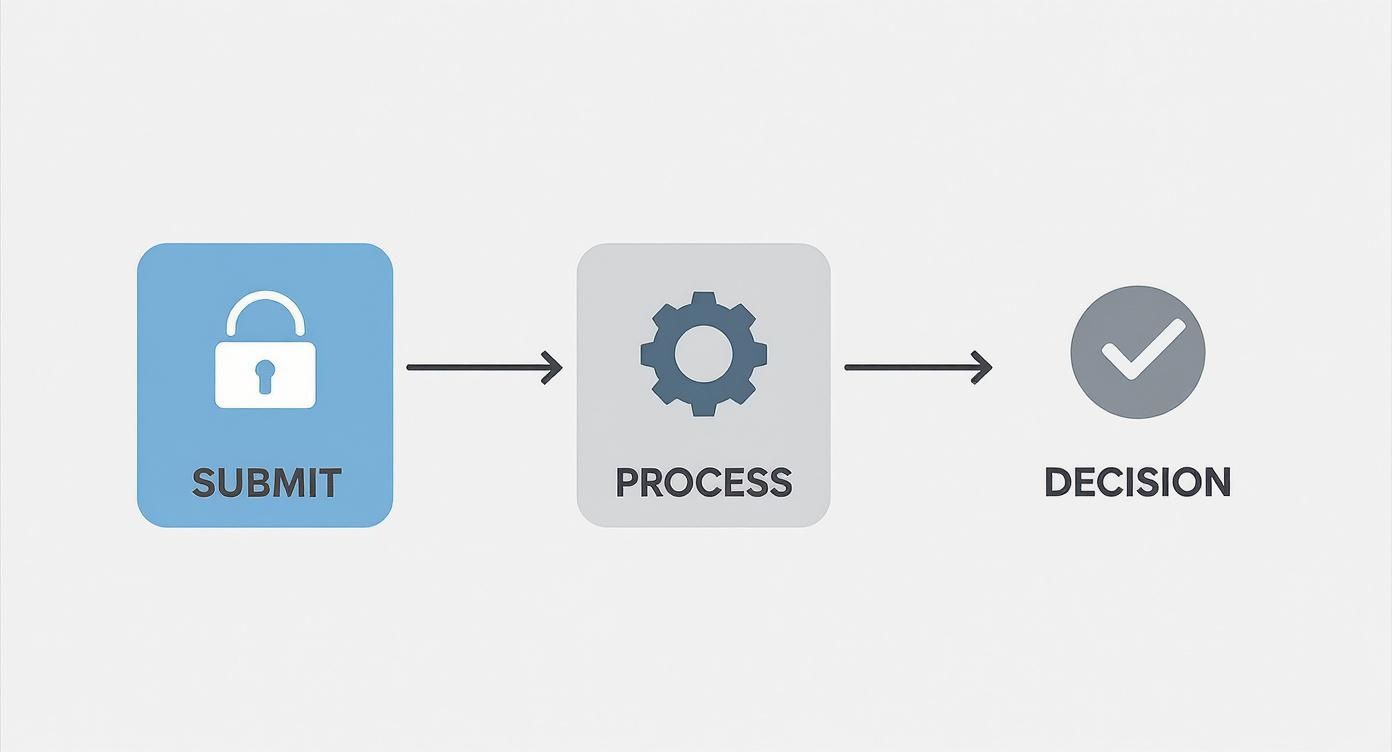
A structured process is paramount. When every application is handled identically, you eliminate subjective, and potentially biased, decision-making. This uniformity is the bedrock of fair housing compliance at scale.
Standardizing Your Screening Criteria
The most effective defense against discrimination claims is a documented set of standardized screening criteria. These rules must be applied consistently to every applicant, regardless of property, market, or leasing agent, creating an objective and defensible process.
Your criteria should be concrete, measurable, and unambiguous. Focus on key areas:
- Income Requirements: A clear income-to-rent ratio, such as requiring gross monthly income to be 3x the rent, applied universally.
- Credit History: A minimum credit score threshold, along with specific policies for handling bankruptcies or major delinquencies.
- Rental History: Clear guidelines for addressing prior evictions or outstanding debts to former landlords.
- Criminal Background: A well-defined policy that aligns with HUD guidance on the use of criminal records in housing decisions.
Once documented, these standards should be configured within your property management software. This ensures every team member—from corporate headquarters to agents in the field—adheres to the same rulebook, providing a robust shield against legal challenges.
Managing Adverse Action and Data Security
When denying an applicant, your obligations under the FCRA are clear. If the decision was based on any information from a consumer report (e.g., a credit or background check), you must send an adverse action notice.
At an enterprise scale, manually sending adverse action notices is an operational and compliance nightmare. A single missed notice can lead to a lawsuit. Automating this process through your PMS is the only viable solution.
A robust automated system will generate a compliant notice that identifies the credit reporting agency used and clearly outlines the applicant’s rights. Equally critical is data security. Secure data storage protocols for every tenant rental application are non-negotiable to protect against breaches and safeguard applicant privacy.
By fostering a compliance-first culture powered by technology, you are not just mitigating legal risk; you are building a foundation for sustainable, responsible portfolio growth.
Using Technology To Automate Application Processing
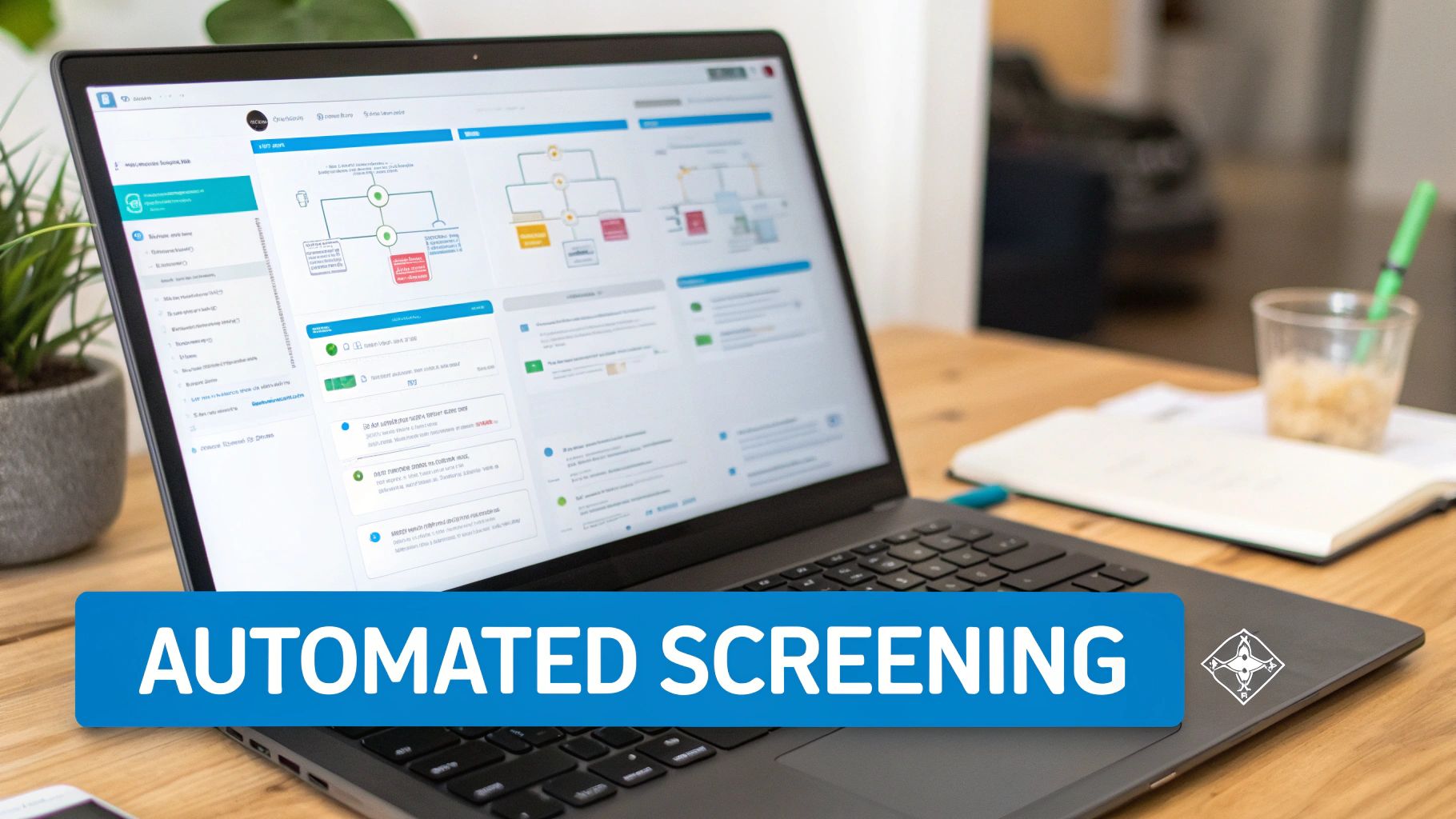
For large-scale property management, manual application processing is an operational dead end. It creates bottlenecks that drive up Days on Market (DOM) and consume valuable team resources. The only scalable path forward is a modern PropTech stack that automates the entire application workflow.
The global property management software market is projected to grow from $3.25 billion in 2023 to $6.31 billion by 2030, according to Fortune Business Insights. This growth is fueled by technology that streamlines leasing operations. For large portfolios, adopting this technology is essential for maintaining a competitive edge.
Building An Integrated Leasing Ecosystem
The key to a truly modern application process is seamless integration. Your showing platform, Property Management System (PMS), and screening services must communicate flawlessly. When these systems are connected via API, the workflow transforms into a smooth, automated chain of events.
An applicant completes their form, and the data instantly populates your PMS, triggering background and credit checks without manual intervention. This not only accelerates the process but also mitigates the risk of human error that can lead to costly compliance violations.
For an operations director, this integrated ecosystem provides a single source of truth. You gain a portfolio-wide view of application trends, approval rates, and processing times, enabling data-driven decisions that boost revenue and reduce vacancy loss.
The Role Of AI In Tenant Screening
Artificial intelligence is elevating this automation to the next level. AI-powered tools can analyze thousands of data points to assess an applicant's reliability with a speed and accuracy that manual reviews cannot match. These systems can instantly flag potential red flags like fraudulent pay stubs or fake references, allowing your team to focus only on applications requiring human oversight.
- Predictive Analytics: AI models evaluate an applicant's complete financial profile, not just a credit score, providing a more nuanced risk assessment.
- Fraud Detection: Advanced algorithms can identify inconsistencies indicative of fraud, protecting your assets from professional tenants.
- Efficiency Gains: By automating the initial review, AI significantly reduces the time-to-decision—a crucial advantage when competing for qualified tenants.
This intelligent automation transforms your application process from a reactive, manual task into a proactive, data-driven engine. You can see more on how this works by exploring the benefits of using an AI leasing assistant. By embracing this technology, large-scale operators can enhance efficiency and make smarter, more profitable leasing decisions across their entire portfolio.
Turning Application Data Into Reduced Vacancy Costs
Your tenant rental application process generates a wealth of operational intelligence. For portfolio managers overseeing thousands of doors, this data is the key to identifying weaknesses in the leasing funnel and systematically reducing vacancy costs.
By treating application analytics as a core business metric, you can shift from a reactive to a proactive operational posture.
Key Metrics To Track
Every number tells a story about your portfolio's operational health and market position. These are the KPIs that matter most for enterprise-scale operations:
- Application Completion Rates: A high drop-off rate indicates friction in your process. This is a clear signal that you are losing qualified leads before you can even screen them.
- Average Time-to-Decision: This is a direct measure of your leasing velocity. A slow decision process directly increases your Days on Market (DOM) and allows top applicants to sign elsewhere.
- Lead Source Effectiveness: Track which marketing channels generate the highest volume of approved applications to optimize ad spend and maximize ROI.
- Common Denial Reasons: Consistent denial reasons (e.g., income, credit) may indicate a misalignment between your marketing and your screening criteria, signaling a need for strategic adjustments.
By analyzing this data, property managers can pinpoint bottlenecks, refine marketing strategies, and reduce the carrying cost of vacant units. These insights enable data-driven decisions that enhance portfolio-wide performance.
It’s also crucial to connect application data with showing activity. A long delay between a tour request and the actual showing can lead to fewer, lower-quality applications. Optimizing tour availability is a critical first step in a healthy leasing funnel.
Once a lease is signed, rapid turnover is essential to minimize vacancy. Utilizing professional move-in/move-out cleaning services can significantly shorten the time a unit is off the market. By leveraging application analytics, you can fine-tune the entire leasing operation for maximum efficiency and profitability.
Frequently Asked Questions
How Can We Standardize Our Rental Application Across Multiple States With Different Laws?
The best practice for multi-market portfolios is to create a "master" tenant rental application that covers all federal requirements. This serves as your universal template.
Then, develop state-specific addendums to address local regulations. Modern property management software allows you to create rules that automatically attach the correct addendum based on the property's location, ensuring compliance without manual oversight.
What Is The Most Effective Way To Reduce Application Processing Time?
Eliminate manual bottlenecks through automation. The single most impactful step is integrating your screening provider directly with your property management system via an API.
When an applicant submits their information, it should instantly trigger credit, criminal, and eviction checks. By setting pre-defined, non-discriminatory criteria, you can even auto-approve qualified applicants, reducing your decision time from days to minutes and freeing your team to focus on exceptions.
How Do We Handle Adverse Action Notices Consistently Across Thousands Of Units?
Do not leave this critical compliance step to manual processes. Leading property management platforms can automatically generate and send a fully compliant adverse action notice the moment an application is denied based on screening results.
The system should automatically populate the required information—such as the credit reporting agency's name and the applicant's rights statement—ensuring every notice is accurate, timely, and compliant with the FCRA, regardless of portfolio size.
And once a tenant is approved, providing helpful resources can enhance the resident experience from day one. A simple guide on how to change your address when moving is a valuable and appreciated touch.
Ready to slash your Days on Market and accelerate your entire leasing funnel? Showdigs combines on-demand showings with powerful automation to get your properties leased faster. Learn how Showdigs can transform your leasing operations today.
.png)

.png)