


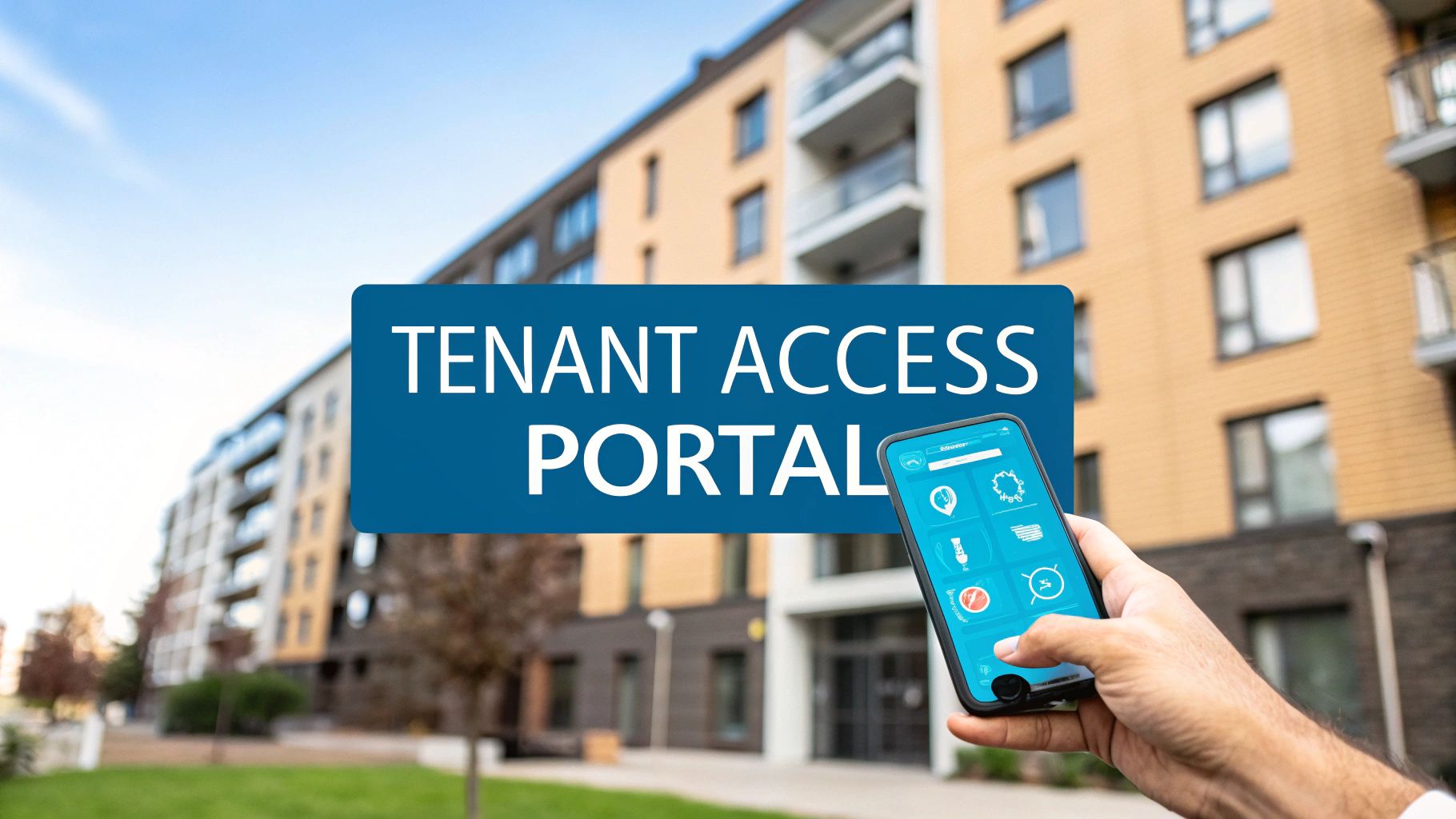
For large-scale property management companies, a tenant web access app is more than a digital platform—it's the central nervous system of your resident experience. Commonly known as a tenant portal, it allows residents to manage their entire rental lifecycle from any device. It's the command center for rent payments, maintenance requests, and communication. The strategic objective is to eliminate the operational drag of phone calls and emails, replacing it with a streamlined, scalable self-service system that boosts efficiency and reduces cost per door.
Your Digital Command Center for Scalable Operations

When you're managing a distributed portfolio of hundreds or thousands of rental units, the daily deluge of tenant communications creates significant operational friction. A tenant web access app imposes order on this chaos, creating a structured, automated workflow that standardizes processes across your entire portfolio.
Think of it not as just another piece of software, but as a digital extension of your operations team. All those scattered processes—collecting rent, coordinating repairs, sending out lease renewals—get pulled into one efficient hub. This isn't just about convenience; it's a strategic imperative to meet modern renter expectations and drive operational leverage.
Meeting Modern Tenant Demands
Renters today expect a seamless digital experience for every service, and housing is no exception. In fact, a recent Zillow study found that 72% of tenants now prefer apps or online portals for all their rental needs. Failing to provide this isn't just a competitive disadvantage; it directly impacts your ability to attract qualified residents and, more importantly, retain them, which is critical for maintaining low vacancy rates.
This table breaks down the core functions that separate a basic portal from a tool built for a modern, scalable property management business.
Core Functions of a Modern Tenant Web Access App
Ultimately, a well-designed tenant portal gives your residents the control and responsiveness they demand while providing your operations team the efficiency required to manage a large-scale portfolio.
Connecting Features to Your KPIs
Every feature within an enterprise-grade tenant web access app is engineered to impact your most critical KPIs. From improving rent collection rates to documenting every maintenance interaction for liability purposes, the platform delivers the data and efficiency to lower your cost-per-door and protect your bottom line.
Of course, as your portfolio grows, you need assurance the app can handle the load. That’s why it’s critical to use robust strategies for boosting application performance through load testing—you need to know it won't crash when thousands of tenants try to pay rent on the first of the month.
By automating routine tasks, the app frees up your team to focus on high-value activities that grow the business, like lead conversion and owner relations. For a deeper look, check out our guide on how the right mobile apps for property managers can revolutionize your operational framework.
Key Features That Drive Operational Efficiency and ROI

A robust tenant web access app is not a discretionary expense; it’s an operational asset that directly impacts your portfolio's profitability. Its power lies not in superficial features, but in how each function saves time, slashes operational costs, and stabilizes revenue streams across hundreds or thousands of doors.
For property managers overseeing large portfolios, these marginal efficiencies compound rapidly. A feature saving five minutes per unit translates into hundreds of reclaimed hours when scaled across your entire operation. This is the critical distinction between a basic tenant portal and a tool architected for enterprise growth.
Automated Financial Workflows
The most immediate and quantifiable ROI comes from automating financial workflows. This extends far beyond simple online payment collection.
- One-Click Online Payments & Auto-Pay: This is foundational for reducing the friction of chasing late payments and manually processing paper checks. When rent payment is frictionless, cash flow becomes more predictable and reliable.
- Automated Rent Reminders: A simple push notification or email a few days before rent is due significantly reduces delinquencies. This eliminates countless hours your team spends on manual follow-up calls each month.
Let's run a quick calculation. For a 1,000-unit portfolio with an average rent of $1,800, if automated reminders prevent just 5% of tenants from being late, that's 50 manual follow-up calls eliminated and $90,000 in revenue secured on time. This frees up your team to focus on revenue-generating activities like leasing and renewals.
Streamlined Maintenance Coordination
Maintenance is a critical touchpoint where both budget and tenant satisfaction are at risk. An integrated maintenance system transforms the chaotic mix of phone calls, voicemails, and emails into a transparent, trackable workflow.
Imagine a tenant discovers a leak. Instead of playing phone tag, they open the app, upload a photo, and submit a maintenance request in under 60 seconds. Your team receives an instant ticket with visual evidence, enabling them to diagnose urgency and dispatch the correct vendor on the first visit, a crucial efficiency for remote management.
The tenant can track the request's status directly in the app, eliminating follow-up calls. This creates a documented, transparent trail that enhances the resident experience and reduces your operational liability.
Digital Lease and Renewal Management
Every day a unit sits vacant is a direct revenue loss. A modern tenant web access app mitigates this by digitizing the entire leasing and renewal cycle, which is a critical lever for reducing Days on Market (DOM).
When a lease nears expiration, the system can automatically deliver a renewal offer. Your tenant can review the terms and e-sign the new lease from their phone. This simple workflow secures another year of occupancy without administrative lag, minimizing vacancy loss and maximizing portfolio revenue.
Boosting Tenant Retention and Satisfaction Across Your Portfolio
High tenant turnover is the silent killer of profitability for any large-scale portfolio. Every time a unit goes vacant, you're not just losing rent—you're racking up costs for marketing, showings, and make-ready repairs. A modern tenant web access app flips this script, turning the resident experience from a cost center into your most powerful retention tool.
The psychology is simple: renters value empowerment and transparency. When residents can pay rent at midnight, log a maintenance issue with a photo from their phone, or check a request's status 24/7, they feel in control. This self-service model smooths out the small, everyday frictions that quietly build into dissatisfaction and, eventually, a non-renewal notice.
From Transactional to Relational
Building a sense of community across a scattered portfolio of single-family homes or multifamily units without onsite staff is a significant challenge. The tenant app becomes the central hub for your relationship with the tenant, transforming a transactional exchange into a more stable, loyal partnership. It's not just about convenience; it's about demonstrating responsiveness and reliability at scale.
This is where specific features drive engagement and open crucial feedback loops:
- Post-Maintenance Surveys: Once a work order is marked complete, the app can automatically trigger a short survey. This simple step shows you value their experience and provides priceless performance data on your vendors across different markets.
- Automated Renewal Offers: Ditch the generic form letter. The app can deliver a personalized renewal offer that a tenant can review and e-sign in a few clicks. By removing friction, you make staying the path of least resistance.
- Community Announcements: Need to inform residents about upcoming property maintenance or policy reminders? A broadcast announcement keeps everyone informed and reinforces a sense of a well-managed property.
The Impact of a Superior Digital Experience
A seamless, user-friendly tenant portal directly correlates to higher resident satisfaction and retention. Tenant web access apps are fundamentally changing resident expectations, a fact supported by AppFolio's top 94% Tenant Portal score in a recent G2 Grid Report. That score, the highest among leaders, significantly outpaces competitors. The data is clear: high portal satisfaction drives long-term engagement through automated renewals and digital feedback mechanisms. For a deeper dive into how digital tools are shaping property marketing, you can check out these marketing software insights for property managers.
By providing a transparent, responsive, and empowering digital experience, you aren't just managing a property; you're managing a long-term asset. Every positive interaction inside that app reinforces a tenant's decision to stay, cutting your turnover costs and stabilizing revenue across the entire portfolio.
To gain a competitive edge, systematically collect and act on resident feedback. Frameworks like Voice of the Customer programs can help you transform raw feedback from your tenant app into actionable business intelligence for improving service delivery at scale.
Integrating Your Tenant App into a Larger PropTech Ecosystem
A powerful tenant web access app doesn't operate in a silo. Its true enterprise value is unlocked when integrated into your broader property technology stack. For managers of large, distributed portfolios, seamless connectivity between systems is what transforms a collection of tools into a unified, high-performance operational machine. Disconnected platforms create data entry errors, wasted time, and an incomplete view of portfolio health.
This is why robust, two-way API integrations with your core Property Management Software (PMS) are non-negotiable. When your tenant app and PMS are in constant communication, every rent payment, maintenance request, and lease renewal syncs automatically. This ensures data integrity across all platforms, eliminating manual reconciliation and establishing a single source of truth for your operations.
Understanding the Tenant Lifecycle Handoff
It's critical to understand how different platforms play specialized roles across the tenant journey. The goal isn't to find one monolithic tool that does everything; it's about building a "best-of-breed" tech stack where each component excels at its specific function.
- Top of Funnel (Lead-to-Lease): This stage is about speed-to-lease and lead conversion. Specialized leasing automation platforms are designed to capture leads, pre-qualify prospects, and schedule tours instantly to keep your Days on Market (DOM) at an absolute minimum.
- Bottom of Funnel (Resident Experience): Once the lease is signed, the tenant app takes over. The focus shifts from converting a lead to retaining a resident. This is where you manage the day-to-day experience—collecting rent, handling maintenance, and fostering communication.
This seamless handoff is where a well-integrated app proves its worth, directly contributing to resident satisfaction and loyalty.
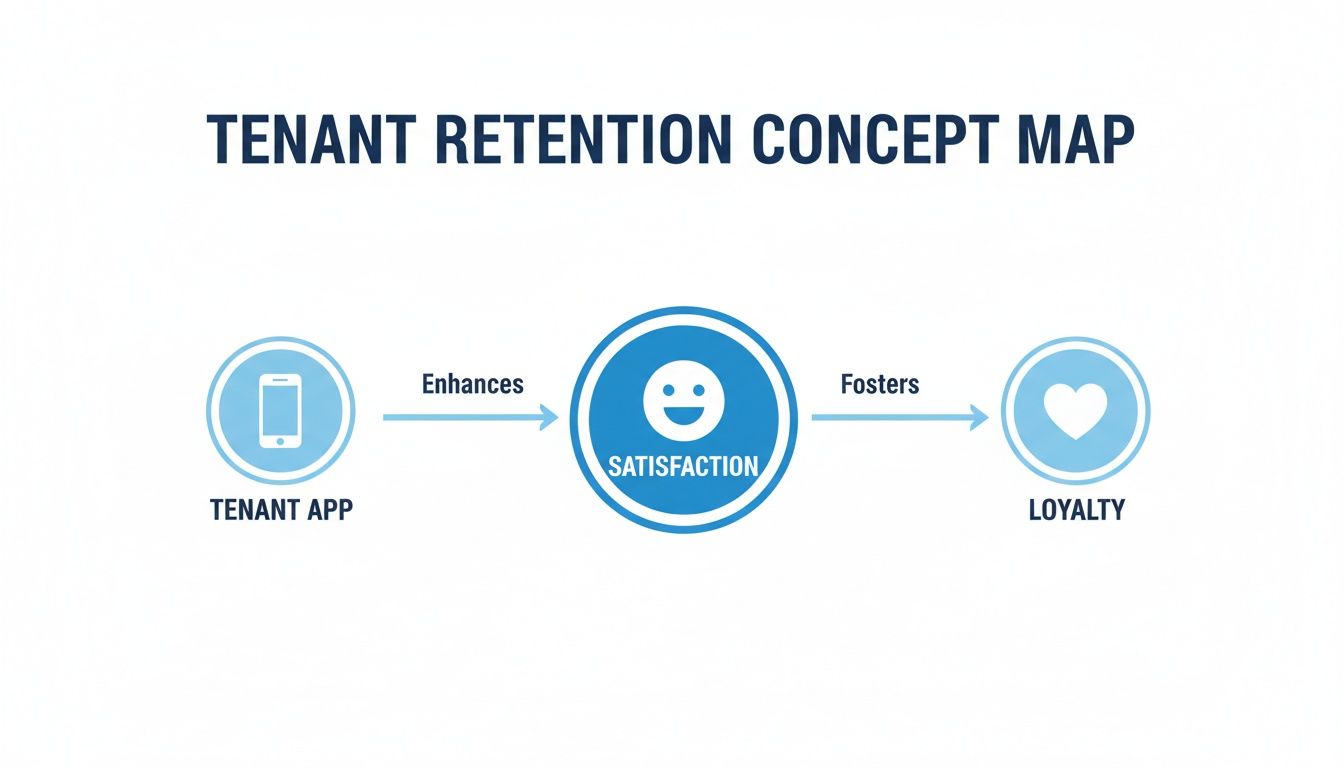
The path is clear: a user-friendly app leads to higher tenant satisfaction, and satisfied tenants are far more likely to renew. This is the formula for reducing costly turnover and stabilizing your revenue.
Synergy in Action Reducing Vacancy
Optimizing this synergy is key to building an efficient, end-to-end management system. For example, a platform like Showdigs is purpose-built to dominate the top of the funnel, converting interested leads into scheduled tours before they go cold. Once that prospect signs a lease and becomes a resident, their information flows frictionlessly into your PMS and tenant app.
For a closer look at how these connections work in practice, you can explore the details of Showdigs integrations with leading PMS platforms.
The rise of AI will only make these integrations more critical. The broader AI automation market for property management is projected to reach USD 1.8 billion by 2030. Furthermore, a 2024 industry report shows 75% of property managers plan portfolio growth in the next 12 months. This level of expansion is simply impossible without an integrated tech stack where every component works in concert to drive efficiency and scale.
Choosing the Right Tenant Web Access App for Your Portfolio
Selecting the right tenant web access app is a strategic decision that will either accelerate portfolio growth or create significant operational drag. When managing thousands of units, you cannot afford to base decisions on marketing claims—you need a platform that has been battle-tested at scale.
The evaluation must go deeper than a feature-for-feature comparison. A slick user interface is worthless if the backend crashes when 5,000 tenants attempt to pay rent on the first of the month. Your evaluation framework must prioritize the platform's technical architecture.
A Framework for Enterprise Evaluation
When vetting technology partners, you must focus on the core attributes that enable scale and ensure data security. A brittle API or weak security protocols are ticking time bombs that create massive operational and reputational risks. A truly enterprise-grade tenant web access app must deliver on several non-negotiables.
Here's a checklist to guide your evaluation process:
Robust API and PMS Integration: Does the platform offer a seamless, two-way API that syncs with your existing Property Management Software? Data integrity is paramount. Confirm the sync frequency and depth of the integration to avoid creating disconnected data silos.
Proven Scalability and Performance: Request performance benchmarks and case studies from portfolios larger than your own. Any credible vendor should provide evidence of their platform's ability to handle high transaction volumes without performance degradation.
Data Security and Compliance: How is tenant data encrypted at rest and in transit? In an era of constant data breaches, ensuring the platform meets all local and federal compliance standards (like SOC 2) isn’t just best practice—it’s essential for risk management.
A single leaked credential can expose your entire tenant database. Prioritizing platforms with a documented history of robust security isn't just a technical requirement; it's a fundamental business imperative to protect your residents and your reputation.
Now, let's formalize this into a scoring system. For large-scale operations, a structured vendor comparison is crucial. It removes subjectivity and ensures all stakeholders evaluate options against the same mission-critical criteria.
Enterprise Tenant App Evaluation Checklist
Use this table to objectively score and compare potential tenant app solutions. It helps move the conversation from "what looks best" to "what works best" for an enterprise-level portfolio.
Once you've vetted the technical foundation, you can focus on the user experience for both your team and your tenants—because that's what ultimately drives adoption.
For a deeper dive into what makes a platform truly stand out, check out our guide on the best property management mobile app features. Choosing a partner that delivers on both rock-solid technical performance and a fantastic user experience is the key to making sure your investment pays off for years to come.
A Framework for a Smooth Portfolio-Wide App Rollout
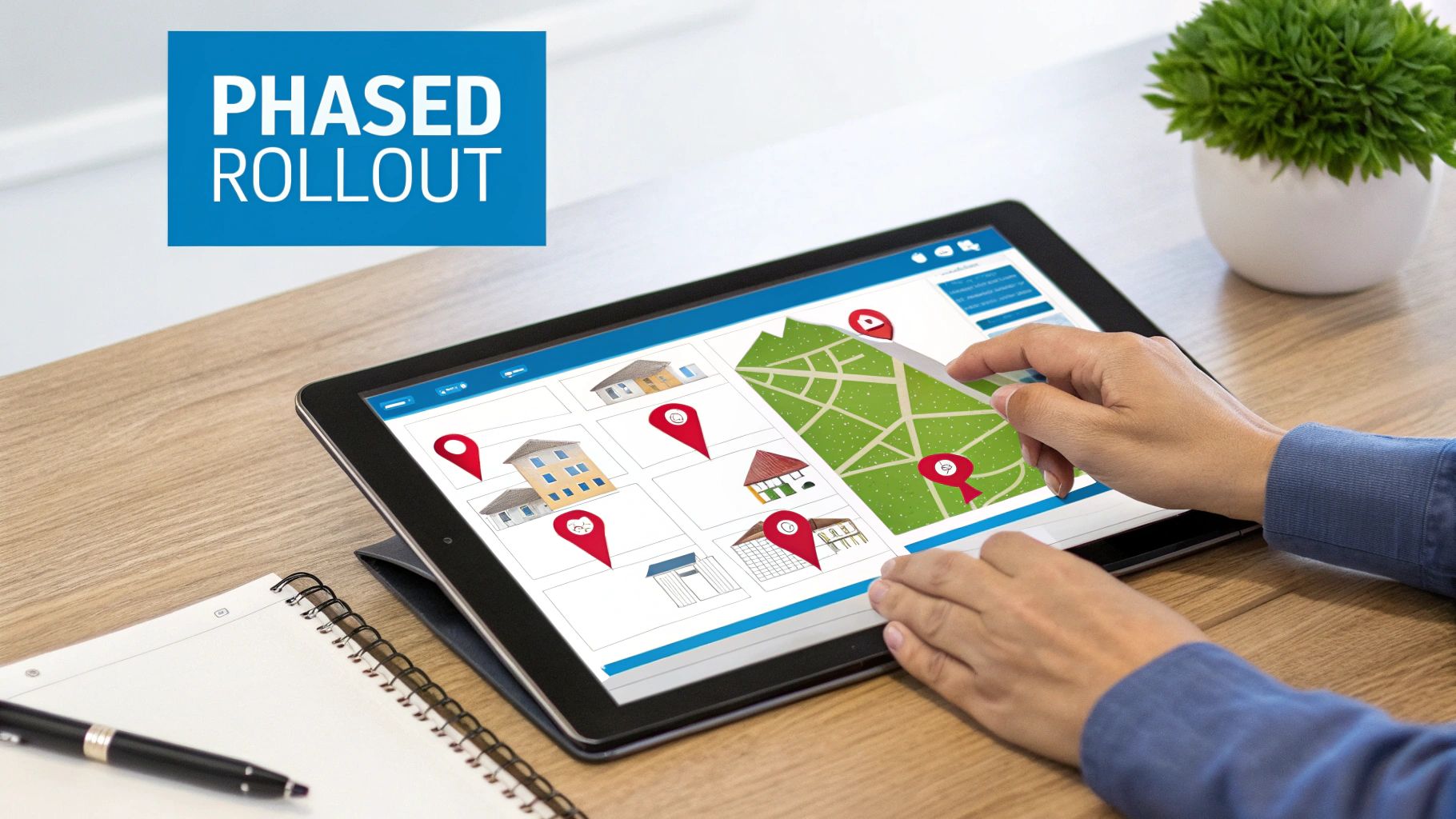
Rolling out new technology across a portfolio of thousands of units requires a meticulous, structured plan. A successful launch of a tenant web access app hinges on methodical execution. Without it, you risk confused tenants, frustrated staff, and a poor return on your technology investment.
The first step, before any rollout begins, is data hygiene. Conduct a full audit of tenant information within your Property Management Software (PMS). Ensure every email, phone number, and lease detail is accurate. Correcting this data upfront will prevent a cascade of support tickets later.
The Phased Rollout Strategy
Avoid a "big bang" launch, which is a recipe for operational chaos. A phased approach minimizes risk and allows you to refine your processes iteratively.
- Pilot Program: Select a small, representative group of properties—perhaps 50-100 units—as your test cohort. This provides a controlled environment to identify bugs, perfect onboarding materials, and gather initial feedback without disrupting your entire portfolio.
- Gather Feedback: Actively solicit feedback from both tenants and staff in the pilot group. What features are most valuable? What parts of the process are confusing? Use this real-world input to build a practical FAQ document and refine your communication strategy.
- Iterate and Expand: With validated processes and materials, begin rolling out the app in logical batches—by region, property manager, or portfolio segment. This staggered approach ensures your support team can effectively manage onboarding inquiries without being overwhelmed.
Driving Staff and Tenant Adoption
Superior technology is useless without adoption. Securing buy-in from both your internal team and your residents is mission-critical.
For staff, frame the app as a tool that eliminates their most tedious tasks. It's not another system to learn; it's the solution that ends the repetitive phone calls about rent payments and routine maintenance, freeing them up for higher-value work.
For tenants, communication must be clear, consistent, and benefit-oriented. Map out a multi-touch onboarding campaign:
- Pre-Launch Teaser: Two weeks before launch, send an email hyping the benefits—emphasize online payments, real-time maintenance tracking, and 24/7 access.
- Launch Day Announcement: On launch day, send a concise email and text message with a direct download link and simple login instructions.
- Post-Launch Follow-Up: A week later, send a follow-up encouraging users to set up auto-pay or explore other key features.
By combining meticulous data preparation with a phased rollout and a strategic communication plan, your new tenant app will quickly become an indispensable tool for scaling your property management operations.
Answering Your Top Questions
When considering the implementation of a tenant web access app, several key questions consistently arise for large-scale operators. Addressing concerns around cost, adoption, and compliance is crucial before making a commitment. After all, this platform will become a core component of your operational infrastructure.
How Much Does a Tenant Web Access App Cost for a Large Portfolio?
For property managers with large portfolios, pricing is almost always structured on a per-unit, per-month basis. Costs typically range from $1 to $3 per unit. Crucially, significant volume discounts are standard for portfolios exceeding 1,000 or 5,000 units.
Some Property Management Systems (PMS) include a basic tenant portal, while others offer it as a premium add-on. The key is to look beyond the line-item cost and calculate the total value. When you factor in the operational savings from reduced administrative tasks, accelerated rent collection, and improved tenant retention, the ROI becomes compelling.
How Do We Get Tenants to Actually Use the New App?
Driving high tenant adoption hinges on a well-executed communication plan. Announce the app in advance via email and text, highlighting the specific benefits that matter most to residents: convenience, speed, and control.
On launch day, provide direct, frictionless sign-up links. More importantly, designate the app as the primary channel for key interactions like rent payments and maintenance requests. To accelerate initial uptake, consider a simple launch promotion, such as a gift card raffle for all residents who enable auto-pay within the first 30 days. This small incentive can significantly boost early adoption rates.
Can a Tenant Portal Really Help with Compliance and Paperwork?
Absolutely. This is one of the most significant yet often overlooked benefits for enterprise-level management. A robust portal creates a secure, timestamped digital record of every interaction—every payment, maintenance ticket, and communication. This centralized, auditable log is invaluable in the event of a dispute.
Furthermore, features like digital lease execution and document storage centralize all critical legal paperwork. This system is easy to audit, compliant with e-signature laws, and eliminates the risk and inefficiency associated with managing physical files across a distributed portfolio.
Ready to slash your Days on Market and convert more leads into leases? Showdigs combines on-demand showings with powerful automation to fill your vacancies faster. Learn how we can streamline your entire leasing funnel by visiting https://showdigs.com.
.png)