




A solid business plan for a property management company is more than just a document—it's your strategic roadmap for scaling to thousands of units. It must lay out a crystal-clear vision for how you'll leverage technology and streamlined processes to crush key metrics like Days on Market (DOM), optimize lead-to-tour conversion rates, and prove to any institutional investor that you’re a smart bet. It’s what turns an ambitious goal, like managing a 5,000-unit distributed portfolio, into a data-driven, scalable strategy.
Defining Your Vision and Executive Summary

The executive summary is the most critical part of your entire business plan. This is your one-page pitch to a busy operations director or portfolio manager. It has to immediately grab their attention and show them your company isn't just another service provider, but a strategic partner built for the modern, tech-forward world of large-scale property management.
Think of it less as an introduction and more as a high-impact snapshot of your entire operation. It has to distill your company's core purpose and unique value into a story that sticks. Most importantly, it must answer one question: What specific, high-value operational or financial problem are you solving for owners of large, distributed portfolios?
Articulating Your Unique Value Proposition
Your value proposition is what makes you different. It's your "why us." Are you the expert in managing geographically dispersed single-family rental (SFR) portfolios, using a tech-first approach to slash vacancy days and their associated revenue loss? Or maybe your sweet spot is multifamily assets without costly onsite staff, where you can bring unmatched operational efficiency and cost-per-door savings.
Get specific and back up your claims with real, measurable outcomes. Don't just say you "improve efficiency." Instead, say you "reduce Days on Market by an average of 30% by deploying on-demand showing agents and automated tour scheduling, directly increasing annual revenue." See the difference?
To nail your value proposition, you need to include:
- Target Market: Define your ideal client with precision (e.g., institutional investors with 1,000+ scattered-site SFR units across multiple markets).
- Core Problem Solved: Pinpoint their biggest headache, like high operational costs per door, painfully slow lead-to-tour conversion rates that burn marketing spend, or the inability to offer same-day showings across a large portfolio.
- Your Unique Solution: Explain exactly how your model—powered by an integrated PropTech stack and standardized remote processes—delivers a superior financial result.
Setting Clear and Ambitious Goals
Your executive summary also needs to map out goals that are both ambitious and achievable, all grounded in the KPIs that matter to enterprise-level operators. This shows you understand what actually drives profitability and scale in this business.
Your vision has to be both inspirational and quantifiable. It’s not enough to say you want to grow; you have to define what growth looks like in terms of units, revenue, and key performance indicators that impact the bottom line.
For example, your plan could outline a clear path to hitting milestones like these:
- Portfolio Growth: Scale from 500 to 5,000 units under management in three years by targeting multi-market operators.
- Operational Efficiency: Achieve a target cost-per-showing of under $25 by year two through automation and an on-demand agent network.
- Leasing Performance: Maintain a lead-to-tour conversion rate above 40% portfolio-wide, maximizing the ROI on lead generation efforts.
- Revenue Impact: Reduce portfolio-wide Days on Market (DOM) by 7 days, translating to an additional $X in annual revenue for a 1,000-unit portfolio.
When you frame your vision with hard numbers, you create a powerful story that highlights your strategic foresight. This turns your executive summary from a simple overview into a compelling argument for why your property management company is a sound—and scalable—investment.
Sizing Up the Battlefield: Your Market and Competitive Analysis
A solid business plan isn’t built on hopes; it’s built on a cold, hard understanding of your market. Before you can dominate, you have to know the size of the prize, who you’re up against, and exactly what operational pain points your ideal clients are desperate to solve. This is a strategic deep-dive to find the gaps where your tech-enabled model can win.
The U.S. property management industry is a giant, with over 335,000 businesses pulling in nearly $137 billion a year. Here’s a critical stat: about 35% of those managers are handling portfolios of 101-500 units. That’s a huge segment on the verge of scaling, making them a prime target for anyone offering tech-driven efficiency. This isn’t just a big market; it’s a market hungry for scalable solutions. For more on this, check out DoorLoop's comprehensive report on property management statistics.
Nailing Down Your Ideal Client Profile
When you're playing in the enterprise space, your "Ideal Client Profile" (ICP) isn't just any landlord. You're targeting a sophisticated operator—an investor or institution that lives and breathes metrics like cost-per-door, DOM, and ROI.
Their biggest headaches aren't leaky faucets. They're losing sleep over inefficient leasing funnels that cause revenue leakage, sky-high vacancy losses, and the chaos of trying to standardize processes across dozens of markets. You need to get laser-focused on this profile.
Ask yourself:
- Portfolio Size: Are you after the 500-2,000 unit operators or the institutional players with 5,000+ doors?
- Geographic Spread: Are they concentrated in one metro or scattered across states? This is a critical factor for designing remote property management operations.
- Tech Stack: Are they still wrestling with spreadsheets, or are they already using a PMS like AppFolio and hunting for slick API integrations to automate leasing?
- KPIs: Do they obsess over shaving down Days on Market (DOM) to minimize vacancy loss, or is improving a low lead-to-tour conversion their holy grail?
Getting this right means your entire pitch—from your service offerings to your marketing—speaks directly to their pain. You stop being a vendor and start becoming a strategic partner they can’t afford to lose.
Scoping Out the Competition (It's Not Who You Think)
For large-scale operators, your direct competition isn't just the PMC down the street. It’s the tech platforms they’re already using—or considering—to manage their leasing funnel. Your business plan must show you know this landscape inside and out.
Take a hard look at the established leasing automation tools like Tenant Turner and ShowMojo. A proper competitive analysis in your business plan for a property management company needs to break down:
- Their Tech: How good is their automated scheduling? What about lead qualification and agent dispatching for scattered-site portfolios?
- Their Pricing: Do they charge per unit, per showing, or a flat fee? More importantly, how does that model scale for a 5,000-unit portfolio?
- Their Footprint: Who owns the market in your target cities or property types (SFR vs. multifamily)?
- Their Weaknesses: Where do they drop the ball? Maybe they don’t have a licensed, on-demand agent network for showings, making same-day tours impossible at scale. Or perhaps their API integrations are clunky and limited.
This isn't about listing features. It's about finding your opening. You're hunting for the service gaps—like the desperate need for same-day showings to convert hot leads or better lead conversion data—that your unique operational model can fill better than anyone else.
When you approach it this way, your business plan transforms from a stuffy document into a tactical playbook. It proves you’ve done your homework and carved out a defensible spot in the market, ready to attract large portfolios by solving their most expensive problems.
Structuring Your Services and Operations for Scale
A brilliant strategy is just a piece of paper without the operational muscle to bring it to life, whether you're managing 500 units or 5,000. This part of your business plan for a property management company is the engine room. It’s where you lay out exactly how you'll deliver consistent, high-quality service across different properties and even different cities, all while keeping your cost per door as lean as possible.
The entire model must be built for remote management. Think centralized teams, a smart PropTech stack, and minimal need for expensive onsite staff. This is how you achieve profitable growth without operational chaos.
Designing Service Packages for the Modern Investor
Your services are your product. For the large-scale investors you're targeting, a generic list of "management duties" is just noise. They want solutions that directly boost their bottom line. The trick is to package your offerings into clear, value-driven tiers that solve their biggest financial pain points.
Forget one-size-fits-all. Think in terms of tiered solutions that match different investor appetites.
- Leasing Engine Package: This is your vacancy-killer, focused on one thing: getting quality tenants in fast to minimize revenue loss. It includes AI-powered lead qualification, automated scheduling, and on-demand showings powered by a platform like Showdigs. Frame this around hard numbers: "Reduce your average Days on Market (DOM) by 10 days."
- Full-Service Operations Package: This tier adds the day-to-day operational grind, managed efficiently from a central hub. Showcase how technology enables this: automated rent collection, a centralized maintenance dispatch system, and standardized owner reports delivered through a portal. Emphasize the cost-per-door savings achieved through remote management.
- Portfolio Optimization Package: This is your top-shelf offering for institutional clients. It bundles the other two packages with high-level strategy: advanced analytics on leasing performance, market benchmarking, and proactive advice on rent adjustments and capital improvements to maximize portfolio ROI.
When you package services this way, you change the conversation from "How much does it cost?" to "How much more revenue will my portfolio generate?" You’re showing them exactly how your operational model creates superior returns.
Property Management Pricing Model Comparison
Choosing the right pricing is critical. You need a model that aligns with the value you provide and scales effectively for large portfolios. Here’s a quick breakdown to help you decide.
Pricing ModelHow It WorksBest ForPotential DrawbackPercentage of RentA percentage (typically 8-12%) of the monthly collected rent.Standard residential properties where rent is consistent. It's the industry-standard model.Revenue fluctuates with vacancies; can create misalignment if not paired with a leasing fee.Flat-Fee ManagementA fixed dollar amount per unit per month, regardless of rent price.Large portfolios with uniform unit types or in markets with a narrow rent range. Offers predictability.May not be profitable for high-maintenance, low-rent properties. Can be a tough sell for high-end units.Tiered or PackagedOffers different service levels (e.g., Leasing Only, Full-Service) at different price points.Companies targeting diverse investors with varying needs, from hands-off to highly involved.Can become complex to manage and market if you offer too many options.Leasing Fee OnlyA one-time fee, often equal to one month's rent, for finding and placing a tenant.DIY landlords or investors who want to handle day-to-day management themselves.No recurring revenue stream, making it hard to build a predictable business model.
Ultimately, many successful property managers use a hybrid approach—like a monthly flat-fee per door plus a separate leasing fee—to ensure cash flow is stable and incentives are aligned to fill vacancies quickly.
Building Repeatable, Tech-Enabled Workflows
Scalability isn't magic; it's the direct result of standardized operating procedures (SOPs). You need a documented, tech-driven workflow for every critical function. This is how any team member can execute flawlessly, every single time. For multi-market property management, this is completely non-negotiable.
Your business plan needs to show you've engineered these processes for scale:
- The Lead-to-Lease Funnel: Map it all out, from the second a lead hits your system to the moment a lease is signed. Define how tech automates each step, from the first AI-driven response to scheduling a tour with an on-demand agent. A well-oiled workflow can dramatically boost your lead to tour conversion rate, turning more leads into leases.
- Centralized Maintenance Coordination: Outline a system where tenants submit requests online, which automatically creates a work order, dispatches it to a pre-vetted vendor, and gives the owner real-time updates through a portal. It's efficient, transparent, and cuts down on overhead.
- Owner Onboarding & Reporting: Ditch the paperwork. Create a slick, digital onboarding for new clients. Then, define a standard monthly reporting package that your property management software (PMS) generates automatically, highlighting the KPIs institutional owners care about.
Building these workflows isn't just about being efficient; it's about de-risking your own growth. When your processes are standardized and automated, you can bolt on hundreds of doors to your portfolio without breaking your operational back.
This obsessive focus on systems proves to investors that you’re not just another property manager—you're building a scalable asset designed for the future of the industry.
Building Your Enterprise PropTech Stack
For a modern, large-scale property management company, technology isn't just a tool; it's the central nervous system of your entire operation. Your business plan for a property management company must detail an enterprise-grade PropTech stack that functions as a single, cohesive unit—not a clunky collection of separate programs.
This architecture is your key to unlocking true scalability, allowing you to manage thousands of units across multiple markets with precision and efficiency.
The conversation starts with your Property Management Software (PMS), but it doesn't end there. While foundational systems like AppFolio or RentManager are a must, the real operational magic happens when you integrate specialized, best-in-class tools that automate your most critical, revenue-impacting functions. The goal is a seamless flow of data, from lead capture to owner report, with minimal manual input.
Architecting a Scalable Tech Ecosystem
The power of a modern PropTech stack lies in its APIs (Application Programming Interfaces). A solid API lets different software platforms talk to each other, creating a single source of truth for your data and eliminating soul-crushing double entry. Your business plan should be built around this principle of seamless integration.
Here are the core pieces of a tech stack designed for remote property management operations at scale:
- Core PMS: Your central hub for all property, tenant, and owner accounting and data.
- Automated Leasing & Showing Platform: This is non-negotiable if you want to crush your Days on Market (DOM). These tools handle AI-powered lead qualification, automated tour scheduling, and coordination of on-demand showing agents—the engine of a high-speed leasing funnel.
- Centralized Maintenance Coordination: Software that lets tenants submit digital work orders that are automatically dispatched, tracked, and billed, providing total transparency for owners.
- Smart Home & Access Control: For remote portfolios, smart lock systems that sync with your leasing software solve the logistical nightmare of managing property access for showings, vendors, and move-ins securely and efficiently.
The flowchart below shows how these components come together to build a scalable operational framework.
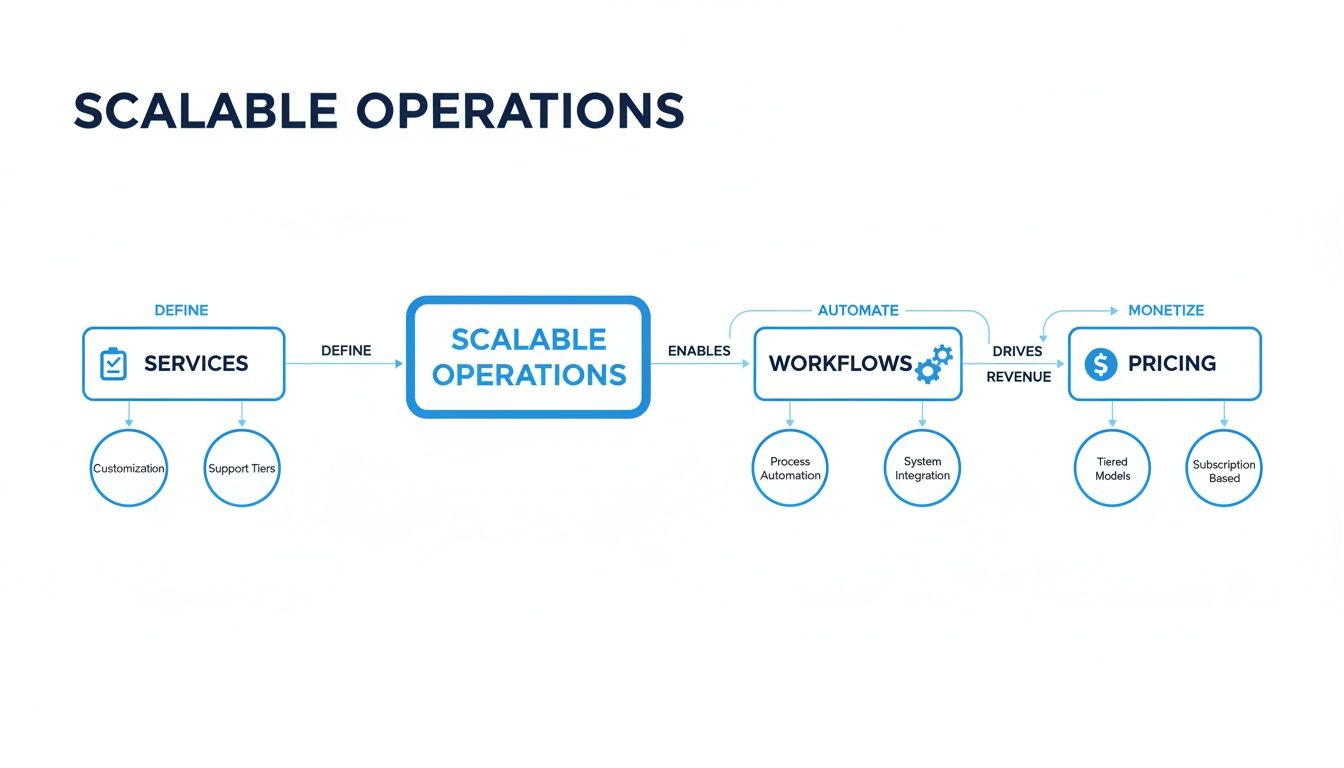
As you can see, scalable operations start with well-defined services, are powered by automated workflows, and are supported by a clear pricing structure.
From Tech Stack to Tangible ROI
An integrated tech stack isn't just about efficiency; it's a direct driver of revenue and profit. The global property management software market is expected to explode to $42.78 billion by 2030. This proves a sophisticated tech stack is no longer a "nice-to-have"—it's a competitive necessity for any company aiming for significant scale.
By automating the top of your leasing funnel—from the first lead inquiry to the property tour—you directly impact the two most critical metrics for any portfolio manager: Days on Market and lead-to-tour conversion rate. Every single day you shave off a vacancy is pure profit straight to the bottom line.
Consider the revenue impact. For a 1,000-unit portfolio with an average rent of $2,000, each vacant day costs the portfolio over $66,000. If your tech stack can cut the average DOM by just five days, you're adding over $330,000 in annual revenue. This is the kind of powerful, metric-driven ROI calculation that must be in your business plan.
When you invest in platforms specializing in leasing automation, you are buying speed-to-lease. For a deeper look, check our guide on the best AI-powered property management tools. This focus on technology is what separates a company that struggles to grow past 500 doors from one that can seamlessly scale to 5,000 and beyond.
Developing a High-Growth Marketing and Sales Engine
You can have the most dialed-in operational model on the planet, but it's just a high-performance engine with no fuel if you can't acquire new clients. A truly scalable business plan for a property management company depends on a marketing and sales engine built to attract and close the right kind of clients—large portfolio owners, institutional investors, and real estate developers.
This isn't about casting a wide net. It's about precision-targeting the decision-makers who obsess over the same KPIs you do, like vacancy loss, cost-per-door, and net operating income. Your strategy must translate your operational strengths into undeniable financial wins for them.
Crafting a Narrative That Sells ROI
Large-scale property owners don't buy "property management"; they invest in predictable returns and operational efficiency. Your sales narrative must shift from listing services to showcasing financial outcomes. Every conversation, every email, and every proposal should hammer home how your tech-forward model directly pads their bottom line.
Instead of saying, "We offer leasing services," try this: "Our automated leasing platform slashes Days on Market by an average of 35%, adding an estimated $1,200 in annual revenue per door back to a portfolio of your size." You’ve just shifted the conversation from a cost center to a profit driver.
Your core messaging needs to revolve around key financial drivers:
- Vacancy Loss Reduction: Position your leasing speed as a direct weapon against lost revenue. Calculate the dollar impact of every vacant day and show exactly how your system crushes that number.
- Operational Efficiency: Show them how your streamlined, remote-first operations cut down on overhead. This translates to a lower cost per door and a higher net operating income for their assets.
- Data-Driven Insights: Provide real performance data, not just boring monthly statements. Highlight how you track metrics like lead-to-tour conversion rates and showing-to-application ratios—numbers that sophisticated investors actually care about.
Building a Repeatable Sales and Marketing Funnel
To consistently add high-value units to your portfolio, you need a repeatable process that attracts, nurtures, and converts your ideal clients. This means a multi-channel approach focused on establishing your company as an authority on scalable property management.
A high-growth funnel for enterprise clients includes:
- Content Marketing as Authority Building: Create insightful content—think whitepapers on "DOM Reduction at Scale" or case studies on "Optimizing Lead-to-Tour Conversion for SFR Portfolios"—that tackles the specific headaches of managing large, scattered portfolios. This is how you become known as an expert in multi-market property management.
- Targeted Digital Advertising: Use platforms like LinkedIn to get in front of people with titles like "Asset Manager" or "Director of Operations" at real estate investment firms in your target markets.
- Strategic Networking: Connect with institutional investors, real estate developers, and brokers who work with large portfolio owners. Attend industry conferences and position yourself as the expert on scalable remote operations.
The goal is to build a system where high-quality leads are consistently coming to you. A well-oiled strategy ensures your sales team spends their time closing deals with warm, qualified prospects, not chasing down cold leads.
This focus on generating inbound interest is the secret to sustainable growth. For a deeper dive, our guide on securing high-quality property management leads is packed with actionable insights. When you build an engine that speaks directly to the financial goals of sophisticated investors, you create a powerful and predictable path to scaling your portfolio.
Forecasting Your Financials and Securing Funding

This is where your operational strategy gets translated into a compelling financial story. A rock-solid forecast isn’t just about listing costs; it’s about proving to potential investors that you’ve designed a profitable, scalable machine.
You're building a data-backed narrative that shows you understand the unit economics of property management at scale and have a realistic grasp of your market's potential. Every dollar invested in your PropTech stack and operations must show a clear path to a powerful return.
Building Your Financial Projections
Your financial model has to be detailed, defensible, and grounded in the reality of enterprise-level operations. Start by mapping out your startup costs—the strategic investments that will fuel your growth from day one.
A smart startup cost analysis for a scalable firm includes:
- Technology & Software: Licensing fees for your core PMS, leasing automation software like Showdigs, and maintenance coordination tools. This is your largest capital expense outside of payroll.
- Legal & Licensing: Business registration, brokerage licensing, and crucial insurance policies.
- Initial Marketing Spend: The budget for your website, content creation (e.g., case studies), and targeted ad campaigns designed to land those first large portfolio clients.
- Operational Runway: You absolutely need at least six months of operating capital to cover salaries and other recurring costs before you're cash-flow positive.
Before you project future revenue, you need to know exactly what it costs to land a new client. A good customer acquisition cost calculator guide is invaluable here. It shows investors you're thinking strategically about growth and managing your marketing spend wisely.
Pro Tip: The most convincing financial plans are built on solid unit economics. Investors want to see that you know your cost-per-door for both acquisition and management—and that you have a clear strategy for lowering it as you scale through automation.
Once startup costs are defined, build out three-to-five-year projections for your profit and loss (P&L) statement, balance sheet, and cash flow statement. Use industry benchmarks for key metrics like revenue-per-unit and typical operating margins for tech-forward firms to keep your numbers credible.
Sample Startup Cost Breakdown
Here’s a look at what your initial expenses might include. These figures vary by market and scale, but provide a solid framework.
Expense CategoryEstimated Cost RangeNotesBusiness Registration & Legal Fees$1,500 - $4,000Includes LLC formation, attorney review of contracts, and local business permits.Real Estate Broker License$500 - $2,000Varies significantly by state requirements and exam fees.Insurance (E&O, General Liability)$2,000 - $5,000Annual premium. Errors & Omissions is non-negotiable for property managers.Software Subscriptions (Annual)$3,000 - $10,000PMS, leasing automation (e.g., Showdigs), accounting software, and maintenance platforms.Website & Initial Marketing$4,000 - $12,000Professional website design, branding, digital ad spend for the first 3-6 months.Office Setup & Equipment$2,500 - $8,000Even for a remote-first setup, this includes laptops, phones, and essential office supplies.Operational Runway (6 Months)$30,000 - $75,000+Covers salaries, rent, utilities, and software fees before revenue ramps up. This is critical.
This table illustrates the foundational investments needed. Having these numbers buttoned up shows you’ve done your homework and are serious about building a sustainable business.
Structuring a Compelling Funding Request
If you're seeking outside capital, your funding request needs to be incredibly clear. Don't just ask for a lump sum; break down precisely how every single dollar will be used to accelerate growth and generate a return on investment (ROI).
- Technology Investment: A major chunk of your funds should be dedicated to your PropTech stack. This is how you'll drive efficiency, slash Days on Market, and provide superior data to clients.
- Key Hires: Detail the critical roles you need to fill—like a Director of Operations or a seasoned sales leader—and explain how they’ll drive portfolio growth.
- Market Expansion: If you have ambitions to enter new geographic markets, outline the specific costs tied to that expansion, from marketing to local compliance.
Remember, investors are looking for opportunities in growing markets. With the global property management market projected to hit nearly $28 billion by 2028, the potential for a well-run, tech-enabled company is massive. This isn't a small-time play; it's a justifiable investment in a booming industry.
When you clearly connect the use of funds to revenue-generating activities, you signal that you're a disciplined operator focused on creating value. Highlighting how funding fuels tech adoption, as demonstrated by Showdigs' recent successful funding round, is a powerful way to reinforce your modern, tech-centric growth story.
Answering the Tough Questions: What Investors Want to Know
When you're building a business plan to scale a property management company, a few questions are guaranteed to come up from potential investors or partners. Having sharp, insightful answers shows you've done your homework and understand the modern PM landscape.
How Much Capital Do I Need to Start?
It depends entirely on your model. A traditional brick-and-mortar setup is the most expensive route. A remote-first, tech-forward company can launch far more leanly.
Your initial tech stack is a big piece of the puzzle. Expect to invest anywhere from $5,000 to $15,000 for your core property management software and essential leasing automation tools.
Beyond software, you'll need to budget for:
- Licensing and Insurance: Plan for $1,500 - $3,000 to cover your brokerage licensing and crucial Errors & Omissions (E&O) insurance.
- Initial Marketing & Website: A professional website and targeted campaigns to land your first clients will likely run between $2,000 - $7,000.
- Operating Runway: This is critical. You need at least 3-6 months of operating capital tucked away before you launch.
A lean, tech-powered launch can realistically get started for around $15,000. If your plan is built for immediate, aggressive growth, you’ll likely need upwards of $50,000 to fuel that engine.
What KPIs Should My Business Plan Focus On?
Move beyond the basics. Investors and large portfolio owners want to see metrics that prove you understand the levers of a modern, scalable business. They're looking for proof of operational efficiency and a clear path to profitability.
For an enterprise-level property management company, your KPIs must tell a story about speed, efficiency, and the financial performance of every single unit. It’s about more than just occupancy.
Operationally, you need to track and set targets for:
- Days on Market (DOM)
- Lead-to-Tour Conversion Rate
- Cost Per Showing
- Tenant Turnover Percentage
On the financial side, your projections should highlight:
- Average Revenue Per Unit (ARPU)
- Cost Per Door (for both acquisition and ongoing management)
- Gross Operating Margin
- Client Lifetime Value (CLV)
How Can I Project Revenue With No History?
When you're starting out, a bottom-up forecast is the only credible approach. Start by defining a realistic target for how many new units you can acquire each month based on your sales and marketing engine.
From there, multiply that number by your projected average management fee per unit—whether that's a flat fee or a percentage of collected rent. Anchor your assumptions in reality by using the actual average rents in your specific target markets. To show you've thought it through, develop three scenarios: conservative, target, and aggressive. This demonstrates that you've considered multiple outcomes and have a plan for each.
Ready to build an operational model that crushes your Days on Market and scales effortlessly? Showdigs provides the AI-backed leasing automation and on-demand agent network you need to turn vacancies into revenue, faster. Learn how Showdigs can supercharge your leasing funnel.
.png)
.png)